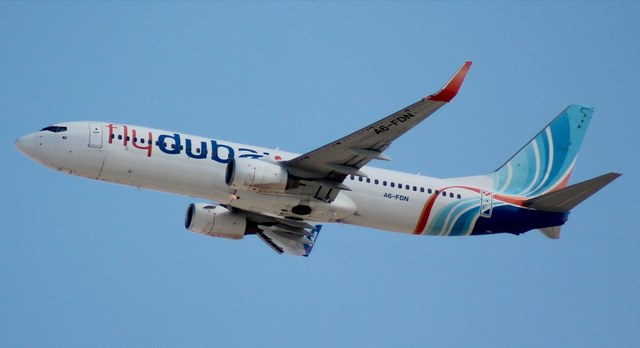
A second go-around at Rostov-on-Don developed into a loss of control after maximum thrust, configuration changes and prolonged nose-down trim. All 62 occupants died.
Resized copies supplied for different screen widths. Colour and framing unchanged.
Geographic context
Runway 22 impact site
Rostov-on-Don destination aerodrome reference point
Flight 981 flew from Dubai to Rostov-on-Don. The impact was on Runway 22, about 120 metres beyond the threshold. Coordinates identify the impact site and the destination aerodrome reference point. Basemap: Natural Earth, public domain.Read supporting evidence
Flight 981 waited for almost two hours after a windshear warning interrupted its first approach. During the second approach, a sharp airspeed increase prompted another go-around. The crew retracted the landing gear and flaps while using maximum thrust. The captain struggled to control pitch, then applied prolonged nose-down stabilizer trim while holding the control column forward. The aircraft entered a steep descent and struck the runway.
Read the full incident Follow what happened, from the flight to the investigation findings.
What investigators concluded
MAK concluded that incorrect configuration and piloting during the second go-around, followed by the captain's loss of situational awareness at night in instrument conditions, caused loss of control. Probable contributing factors included gusty wind and turbulence, uncoordinated go-around actions, insufficient stabilizer trim skills, psychological incapacitation and gaps in procedures and training.
1,588 words / about 8 minutes to read. Based on the investigation records cited below.
A night flight to Rostov-on-Don
flydubai Flight 981 left Dubai at 18:37 UTC on 18 March 2016 for Rostov-on-Don in southern Russia. The Boeing 737-8KN, registered A6-FDN, carried 55 passengers, two pilots and five cabin crew. Dubai Aviation Corporation operated the international scheduled passenger flight under the flydubai name. The aircraft climbed to flight level 360, and the crew began preparing for a night arrival in gusty weather.
Neither pilot had previously flown to Rostov-on-Don, and they had not flown together before. The airline required the captain to conduct the approach, landing and takeoff there. Its airport guidance highlighted the unusual glideslope angle, pressure-setting procedures, and the possibility of turbulence and windshear on final approach. MAK found that the crew held valid licences and medical certificates, had completed the required training and had received sufficient preflight rest.
The aircraft carried sufficient fuel for the route and selected alternates. Its departure weight and centre of gravity were within limits. The investigation found no technical failure that could have affected the flight outcome. The descent began at 22:17, after the crew obtained information about Rostov weather and the active runway.
The first approach was to Runway 22. The captain disengaged the autopilot and autothrottle and flew manually using the head-up display, while the first officer monitored conventional instruments. The runway came into view about seven kilometres ahead. At 22:42:02, around 335 metres above runway level, the predictive windshear system issued its go-around warning. The crew responded almost immediately, and the aircraft began climbing away at 22:42:05.
The captain selected a windshear escape maneuver. He applied maximum available thrust and initially kept the landing gear and flaps in their landing configuration. Engine N1 reached approximately 101 to 102 percent. The target missed-approach altitude was only a short climb above the aircraft, and altitude-acquisition guidance activated early. The captain pushed forward to control pitch and later used nose-down trim.
Airspeed increased enough to activate flap load relief, which automatically moved the flaps from 30 to 25 degrees. The captain reduced thrust after reaching the selected altitude, and the crew obtained clearance to climb higher. At 22:43:14 the autopilot and autothrottle were engaged; gear and flap retraction followed. MAK assessed the crew's response as generally safe, while identifying a need for more detailed guidance on low-weight go-arounds with high thrust and a low level-off altitude.
After the first go-around, the pilots sought a holding area clear of adverse weather. They climbed initially to flight level 80 and later to flight level 150 to leave icing conditions. Controllers relayed reports of repeated windshear go-arounds by another aircraft, which eventually diverted to Krasnodar. Flight 981 had about nine tonnes of fuel when the crew decided to wait, enough for more than two hours of holding.
The captain planned a further approach when conditions improved, with an immediate diversion if that attempt failed. The crew examined Volgograd and Mineralnye Vody as alternates. In a satellite telephone discussion, the airline supported Mineralnye Vody and sent a diversion flight plan. It also recommended holding as long as fuel allowed and attempting to land at Rostov if the weather improved. MAK considered the holding and diversion preparations logical and reasoned.
The pilots calculated a diversion fuel threshold, entered the alternate route into the flight management system and reviewed the approach charts. They also discussed the effect of the delay on the return flight and their remaining duty time. During the briefing for another approach, the captain specified that a windshear warning would require a go-around with the flap and gear configuration unchanged.
At 00:20 on 19 March, the tower reported visibility of five kilometres, a ceiling of 630 metres, gusty surface wind, light shower rain, mist, severe turbulence on final and moderate windshear. A later transmission said that the meteorological office had no report of windshear on the runway. MAK found that this partly contradicted the earlier warning. The airport had no automated windshear detection, and a forecast of moderate windshear remained displayed to controllers.
The crew requested another descent at 00:23 and began it at 00:23:35. For the aircraft's approximately 54-tonne landing weight, they calculated a reference speed of 133 knots and added 20 knots for wind, producing an approach target of 153 knots. They also coordinated a climb to flight level 80 if another go-around became necessary.
The captain disengaged the autopilot at 00:38:55, about 575 metres above the airport, and continued flying with the head-up display. The autothrottle was disengaged at 00:39:17. With the landing gear down and flaps at 30 degrees, the aircraft approached the selected speed. Corrective control inputs, an increase in engine thrust and a gust then combined to raise airspeed from 153 to 168 knots within a second, and to 176 knots over the following two seconds.
The first officer called attention to the speed. The captain immediately called for a go-around, and the takeoff/go-around mode activated at 00:40:50 as he advanced the thrust levers fully. This time there was no windshear warning. MAK could not determine whether the captain interpreted the airspeed surge as windshear or as an unstable approach. He gave no explicit callout identifying the type of maneuver.
The first officer suggested flaps 15, and the captain agreed. The crew subsequently retracted the landing gear after a positive climb was reported. Their configuration changes followed the standard go-around procedure, while engine thrust remained at the maximum associated with a windshear escape. At the aircraft's low weight, that combination produced a strong nose-up pitching moment. Countering it required forward control-column forces reaching about 50 pounds, or 23 kilograms, for more than 40 seconds.
The captain struggled to establish and maintain the required climb attitude. The first officer repeatedly prompted him to keep the nose at 15 degrees. Pitch varied substantially, and airspeed continued rising. At 00:41:10 it reached the 200-knot flap limit for the selected configuration. Flap load relief moved the flaps from 15 to 10 degrees. The engines continued delivering maximum thrust, while both pilots concentrated increasingly on pitch control.
At 00:41:30.5, with the aircraft about 935 metres above runway level, airspeed around 210 knots and pitch about 10 degrees nose up, the captain pressed the stabilizer trim switches in the nose-down direction. MAK considered that he was probably trying to relieve the sustained forward control force. He continued holding the control column forward as the trim switches remained pressed for about 12 seconds.
Moving the stabilizer changes the aircraft's pitch balance. The report explained that relieving column forces requires the pilot to return the column toward neutral as the stabilizer moves. On Flight 981, the continued forward column position and prolonged trim movement increased the nose-down effect together. The aircraft transitioned rapidly from climbing to descending. Near-zero and negative G followed, with the recorded minimum reaching minus 1.07 G.
Recorded trim commands matched the direction and duration of stabilizer movement. MAK found no sign of stabilizer failure or uncommanded movement. A brief aft movement of the column interrupted trimming in accordance with the control-system logic. The investigation identified insufficient knowledge and skill in stabilizer trimming, followed by the captain's spatial disorientation and psychological incapacitation, as elements of the loss-of-control sequence.
The first officer recognized the deteriorating attitude and urged corrective action. At about 00:41:42 to 00:41:43 the column briefly moved aft, then returned forward. Engineering calculations indicated that sustained full aft input at that point could still have recovered the aircraft with a height margin. A simulator exercise also achieved recovery with appropriate control inputs and reduced thrust. Those calculations examined the aircraft's aerodynamic capability; the pilots' condition was excluded from the engineering model.
From 00:41:44 the first officer attempted to pull the column. Force signals showed opposing actions, with the captain commanding nose down and the first officer nose up. The aircraft also developed a substantial left bank. By the time the ground-proximity pull-up warning activated, MAK considered that recovery was probably already impossible. The dive reached a descent rate far beyond the warning system's specified design range.
At 00:41:49 the aircraft struck the runway surface near its left edge, about 120 metres beyond the Runway 22 threshold. Impact speed was approximately 340 knots, pitch about 50 degrees nose down and bank about 60 degrees left. The aircraft disintegrated. All 55 passengers and seven crew died. Airport firefighters began their response at 00:44, and the fire was isolated at 00:50.
MAK closed the investigation on 25 November 2019. Its final report attributed the accident to incorrect configuration and piloting during the second go-around, followed by loss of the captain's situational awareness at night in instrument conditions. It identified probable contributing factors involving weather, the captain's readiness for another go-around, crew coordination, trim skills and psychological incapacitation. The first officer generally assessed the attitude correctly and prompted appropriate actions, but his intervention failed to arrest the sequence.
Recommendations to flydubai included stabilizer trim training, explicit identification of the intended go-around maneuver, monitoring of trim duration and position, and guidance for psychological incapacitation. MAK also recommended practical familiarization with upset conditions, including zero and negative G. The report recorded that flydubai had implemented the recommendation concerning explicit maneuver callouts.
MAK recommended that Boeing clarify when maximum thrust should be reduced during low-weight go-arounds and expand guidance on stabilizer operation and force trimming. It also proposed design changes to reduce the risk of an out-of-trim setting. Boeing opposed that design recommendation, citing the need for full control authority in abnormal situations and existing ways for the monitoring pilot to stop trimming. MAK maintained the recommendation, pointing to the difficulty of recognizing prolonged trim movement promptly.
The crew reduced drag through configuration changes while applying maximum thrust. A substantial nose-up moment required sustained forward control force.
Pitch varied, airspeed increased through the flap limit, and flap load relief retracted the flaps to 10 degrees. Crew attention narrowed around pitch control.
The captain applied nose-down stabilizer trim for about 12 seconds while holding the control column forward. The combined inputs created a major pitch imbalance and negative G.
The captain became spatially disoriented. The first officer prompted corrective inputs and attempted to pull the column, but the aircraft continued into a steep descending impact.
A simplified reading of the investigation findings. The sequence does not replace the full report or imply that every contributing factor is shown.
Sequence of events
Times are UTC. Rostov-on-Don local time was UTC plus three hours. The recorded impact time was 00:41:49 on 19 March 2016. Expand an event to see its evidence.
18 March, 18:37Departure from Dubai
A6-FDN took off on the scheduled passenger service to Rostov-on-Don with 55 passengers and seven crew.
A predictive windshear warning prompted the crew to climb away from the first approach. They initially kept the landing configuration and applied maximum thrust.
The crew obtained clearance to climb to flight level 150 to leave icing conditions. They planned one further approach, followed by diversion if it was unsuccessful.
The captain disengaged the autopilot, continued using the head-up display, and subsequently disengaged the autothrottle. The flaps reached the landing setting of 30 degrees.
The aircraft struck near the left edge of Runway 22, about 120 metres beyond its threshold, at about 340 knots and 50 degrees nose down. All 62 occupants died.
What weather information preceded the second approach?
Controllers reported severe turbulence and moderate windshear, then relayed that the meteorological office had no windshear report on the runway. The aerodrome had no automated windshear detection. A moderate windshear forecast remained displayed, and no recent aircraft report had confirmed that conditions had improved.
At 00:41:30.5 the captain began a nose-down stabilizer trim input that lasted about 12 seconds while continuing to hold the control column forward. The aircraft became substantially out of trim, entered a steep descent and experienced negative G. MAK found that the stabilizer movement followed the recorded commands.
MAK recommended explicit callouts distinguishing a standard go-around from a windshear escape maneuver, monitoring trim duration and stabilizer position, training for upset conditions including zero and negative G, and guidance for recognizing psychological incapacitation. It also recommended clearer criteria for reducing maximum thrust during low-weight go-arounds.
The head-up display's influence remained unresolved
MAK could not determine the HUD's possible effect on the outcome. Investigators lacked a reconstruction of the exact image visible from the captain's changing head position, and flight tests had not covered the entire operating G range. The team considered that display characteristics in the upset could have affected his situational awareness.
The State of the Operator considered that a somatogravic pitch-up illusion affected the captain within two or three seconds of starting the go-around. MAK rejected that early onset as highly unlikely while outside references remained available. It considered that the illusion might have prolonged the later nose-down trim input after near-zero and negative G developed.
Actions and recommendations are described at the dates of the cited records. A recommendation is not proof of implementation.
Go-around callouts
MAK recommended specifying the maneuver type in the pilot flying's callout, including whether a windshear escape was intended. The final report recorded flydubai's implementation of this recommendation.
Recommendations addressed manual stabilizer trim skills, monitoring trim duration and position, practical upset training including zero and negative G, and criteria for psychological incapacitation.
MAK recommended clearer maximum-thrust reduction criteria and fuller explanations of stabilizer control and force trimming. Boeing opposed the proposed design restriction on out-of-trim settings; MAK maintained its recommendation.
MAK recommended additional HUD flight tests across operating conditions and G loads, improved information presentation, and equipment capable of reconstructing displayed information from recorded flight data.
Turbulence and gusty wind, assessed as moderate-to-strong windshear, led to two go-arounds. A predictive windshear warning activated during the first approach.
The crew combined standard go-around configuration changes with maximum thrust associated with the windshear escape procedure. The captain did not specify which maneuver he intended.
These comparisons connect specific research topics. Shared circumstances do not establish identical causes. Evidence from both investigations is provided below.
Both investigations examined loss of control following go-around mode activation and difficulty interpreting aircraft attitude. Flight 981 involved an intentional second go-around, configuration changes and prolonged stabilizer trim. On Atlas Air 3591, the NTSB found that inadvertent go-around mode activation led to the first officer's spatial disorientation and nose-down inputs during descent toward Houston.
Explore the records below for additional context. They open on the publisher's site and are not all included in our report search. Source reuse terms apply.
Kevin Murphy writes the incident accounts on AirlineIncidents.com, out of a long interest in aviation safety and the lessons each investigation leaves behind.
Prepared by
AirlineIncidents editorial desk
Report citation check
Independent expert review
Not completed
Citation checks compare supporting text with the indexed report pages. They do not constitute independent expert review. How these pages are prepared.
Revision history
: Final report findings include the second go-around sequence, stabilizer trim evidence, crew performance and safety recommendations.