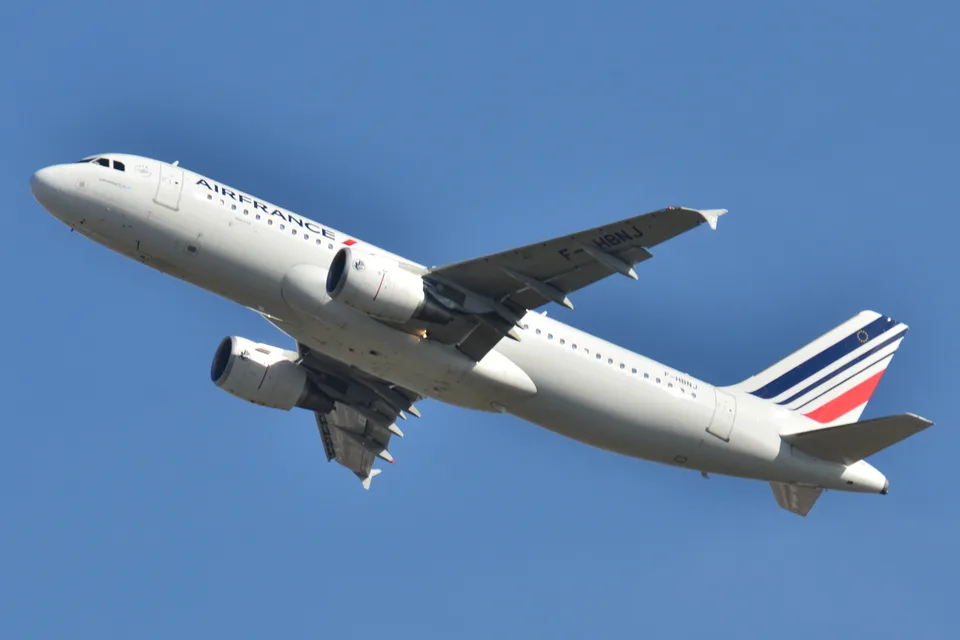
Five people were seriously injured when the A320 entered a developing convective cell. Late weather detection and incomplete injury communication shaped the consequences.
Original source photograph retained without cropping. Responsive WebP copies resized without cropping.
Geographic context
Paris Orly departure
Ajaccio destination
Schematic approximate airport markers, not a recorded flight track or navigation chart. Route names are documented in the report. Basemap: Natural Earth, public domain.Read supporting evidence
Five people were seriously injured when the A320 entered a developing convective cell. Late weather detection and incomplete injury communication shaped the consequences.
Read the full incident Follow what happened, from the flight to the investigation findings.
What investigators concluded
The BEA established late detection of a rapidly developing convective cell and an ineffective avoidance attempt. It could not explain exactly why detection was late. Possible contributing factors and shortcomings in cabin and medical-response communication are separately identified.
1,617 words / about 8 minutes to read. Based on the investigation records cited below.
A flight planned around stormy weather
Air France's Airbus A320-214, registered F-HBNJ, was flying from Paris Orly to Ajaccio on 20 August 2025. There were 143 passengers, two pilots and four cabin crew aboard. The pilots had already flown a rotation between Orly and Bastia and knew that thunderstorms were a feature of the day's operations. For the Ajaccio flight, they chose a route west of the Rhone valley to avoid areas of storm activity. The aircraft reached flight level 370, approximately 37,000 feet on the standard pressure setting, and initially encountered only slight turbulence over the continent.
A new cabin crew had joined the pilots for this second rotation. Before departure, the captain briefed them about the stormy conditions encountered earlier. He explained that providing food and drink was secondary to safety and that cabin crew could secure themselves if turbulence made that necessary, even without a specific instruction from the cockpit. After departure, they remained seated while the aircraft passed the storm cells south of Paris. Once that area was behind them, the service went ahead in comparatively smooth conditions and the galleys were tidied.
As the aircraft moved out over the Mediterranean, the captain believed the more difficult weather was behind them. The pilots were still flying in a cloud layer, so a clear route on their instruments did not mean they could see everything ahead. An arrival briefing began, interspersed with instructions and frequency changes from air traffic control. At about 12:10 UTC, around 125 nautical miles from Ajaccio, they started descending. The weather threat had been recognised before departure, but the specific convective cell that would injure people aboard had not yet become a clear, actionable threat to the crew.
The descent brought several tasks together in a short period. The pilots completed their approach briefing, dealt with heading and frequency changes, obtained weather information for possible alternate airports and made passenger announcements. They also discussed a passenger lying in the forward galley to relieve pain, whom they could see on the cockpit access security camera. The BEA later identified this combined workload as one possible contributor to the late recognition of the weather ahead. It did not establish a single proven explanation for why the cell was detected so late.
At 12:15:50, descending through flight level 288, the aircraft was about eight nautical miles from the centre of the convective cell. The crew discussed green echoes on their navigation displays. The co-pilot proposed illuminating the fasten-seatbelt sign, and the captain agreed. At 12:16:07, he selected a heading change to the right. Over the following seconds a red echo appeared near the flight path. Both pilots changed display ranges as they tried to understand the developing picture, while the selected lateral guidance changed between heading and navigation modes.
The captain's and co-pilot's recollections help explain the uncertainty rather than remove it. The captain described changing the radar tilt, then seeing stronger echoes. The co-pilot remembered trying to identify a way around the weather and looking outside at a darker area embedded in the clouds. The resulting guidance changes made little difference to the recorded track. By the time the threat was unmistakable, the crew had too little time to analyse it and establish an effective avoidance strategy. The aircraft continued almost straight into the cell.
The cabin response to the seatbelt sign did not take the form of an immediate warning that severe turbulence was about to occur. A cabin crew member asked the purser whether to make the turbulence announcement or the final announcement before landing. Because the aircraft was descending and the air was still smooth, they chose the landing announcement. Two cabin crew members then started the cabin checks from opposite ends. The purser asked the passenger and family in the forward galley to return to their seats.
At 12:16:39, near flight level 262, the A320 entered turbulence that lasted thirty-one seconds. The first four seconds were severe, and the aircraft encountered hail for twelve seconds. There had been no preceding period of light turbulence to give an additional warning. The recorded loads changed abruptly, reaching between minus 0.2 and plus 3.2 g at the aircraft's centre of gravity. Calculations for the rear of the aircraft indicated an even wider range. The autopilot remained engaged, and the turbulence did not generate cockpit warnings or cautions.
For people who were standing or otherwise insufficiently restrained, the sudden loads had immediate consequences. Cabin crew and passengers were thrown upwards and then onto the floor or surrounding fittings. Three cabin crew members and two passengers sustained injuries classified as serious. The report describes vertebral fractures and other injuries, including major damage to one crew member's foot and knee. One passenger reported that her belt was fastened and adjusted but loosened during the encounter. The investigation did not count every minor injury, so five serious injuries must not be presented as the total number of people hurt.
After leaving the turbulent area, the pilots continued towards Ajaccio. The purser reminded passengers to keep their seatbelts fastened. Injured cabin crew tried to secure themselves, and some could no longer perform their normal duties. One remained in a passenger seat until arrival. Another made it back to a galley despite a serious injury. This created a difficult assessment problem: a person who was still moving and working could appear less badly hurt than they actually were. The crew later described shock and difficulty making the seriousness of the injuries explicit.
The captain contacted the cabin after the encounter. Subsequent exchanges established that several people were hurt, including a passenger bleeding from the head. However, a concrete assessment of the injuries was postponed until the aircraft was on the ground. The captain later explained that he prioritised the imminent approach and landing and chose not to inform air traffic control or request medical assistance while airborne. The BEA recorded that reasoning as his account, while identifying the operational consequences of the missing information.
The A320 landed at 12:31 UTC and reached the apron about five minutes later. Only then did the request for medical assistance progress through the operator's local unit and the tower. Airport responders reached the aircraft at 12:42 and requested further help. Additional medical vehicles arrived over the next half-hour. For about fifteen minutes all the airport rescue and firefighting personnel were engaged, although their vehicles' water and foam resources remained unused. The investigation explains that earlier information about the number and condition of the injured would have helped organise a more suitable response and park the aircraft without interfering with other traffic.
The BEA used flight recorder information, crew statements and meteorological analysis to examine the encounter. It established that the airborne weather radar was functional. The aircraft carried a manually adjusted radar, so the crew had to manage its tilt while performing other descent tasks. Weather radar detects liquid water more readily than ice crystals or dry snow. Its indications require interpretation, and the choice of beam angle affects the part of a cloud being sampled. These limitations do not prove that the radar failed, or that one particular setting caused this accident.
The investigation found that the convective cell had developed about forty-five minutes before the aircraft entered it. Until roughly 12:10, its centre remained below flight level 230. In the following minutes it grew rapidly upwards, helping explain the severity of the encounter around flight level 260. This was a developing weather system during a descent, rather than a fixed obstacle represented identically on every screen. The report discusses both cockpit and ground-based weather tools as possible ways to improve awareness.
Crucially, the radar settings and the weather picture actually displayed to the pilots were not recorded. Investigators could not precisely reconstruct the displays from recollections. They also could not determine what information was available on the crew's supplementary weather application before the encounter, or whether the controllers had consulted the secondary weather display available to them. Those gaps limit any claim that a specific person knowingly ignored an obvious warning. The supported finding is that detection was late and the resulting avoidance attempt ineffective, while the exact reason for that late detection remains unresolved.
The BEA listed several factors that may have contributed to the late detection: workload during the descent, a possible reduction in vigilance over the sea, the demands of manually adjusting the radar, and the absence of information from air traffic control about the developing cell. The report retains the word 'may'. These are qualified explanatory factors, not a definitive ranking of causes or proof that every factor operated to the same extent. The final report also distinguishes the weather encounter from the cabin and emergency-response consequences.
Cabin checks started as the risk was increasing, leaving people exposed when severe turbulence arrived without a milder lead-in. The landing announcement did not alert passengers to impending turbulence. Nevertheless, the BEA considered that the choice of announcement most likely did not influence the passengers' injuries. After the encounter, information exchanged between the cabin and cockpit did not establish a sufficiently concrete picture of the injuries. The lack of an airborne notification then made the ground response harder to organise.
At publication, Air France was considering changes to cabin-securement policies and the communication model between pilots and cabin crew. It also envisaged clearer guidance on cabin crew incapacitation and planned to use the event in crew resource management training. These were report-era proposals and plans, not evidence that every measure had already been implemented. The wider safety messages concern combining weather information, communicating unusual conditions to controllers, and clearly transmitting injury information to emergency services. The A320 remained controllable and landed safely, but those outcomes did not prevent a serious accident inside its cabin.
These comparisons connect specific research topics. Shared circumstances do not establish identical causes. Evidence from both investigations is provided below.
Both reports discuss convective weather and operational decisions. F-HBNJ remained controllable and landed after a cabin-injury turbulence accident; American 1420 involved a runway overrun during a thunderstorm landing. These are different mechanisms and outcomes.
Explore the records below for additional context. They open on the publisher's site and are not all included in our report search. Source reuse terms apply.
Prepared 7 October 2026 from the cited final investigation. Unpublished; editorial approval and independent expert review have not been completed.
Source limitations
Five serious injuries are counted; minor injuries were not counted. Radar settings and displayed weather were not recorded, so the precise reason for late detection remains unresolved. Contributing factors are qualified as possible.
Accident to the Airbus A320 registered F-HBNJ operated by Air France le 20/08/2025 near Ajaccio AD Flight through an area of severe convective turbulence, during descent
BEA Official final report; cached original bytes and complete extraction checked 7 October 2026; English courtesy translation, French original remains authoritative
US federal investigation report, attributed to the NTSB. Limited excerpts for commentary; third-party material and illustrations excluded. No NTSB endorsement. Source terms / provenance.
Kevin Murphy writes the incident accounts on AirlineIncidents.com, out of a long interest in aviation safety and the lessons each investigation leaves behind.
Prepared by
AirlineIncidents editorial desk
Report citation check
Independent expert review
Not completed
Citation checks compare supporting text with the indexed report pages. They do not constitute independent expert review. How these pages are prepared.
Revision history
: Published sourced incident account, timeline, photographs and investigation findings.
.jpg)