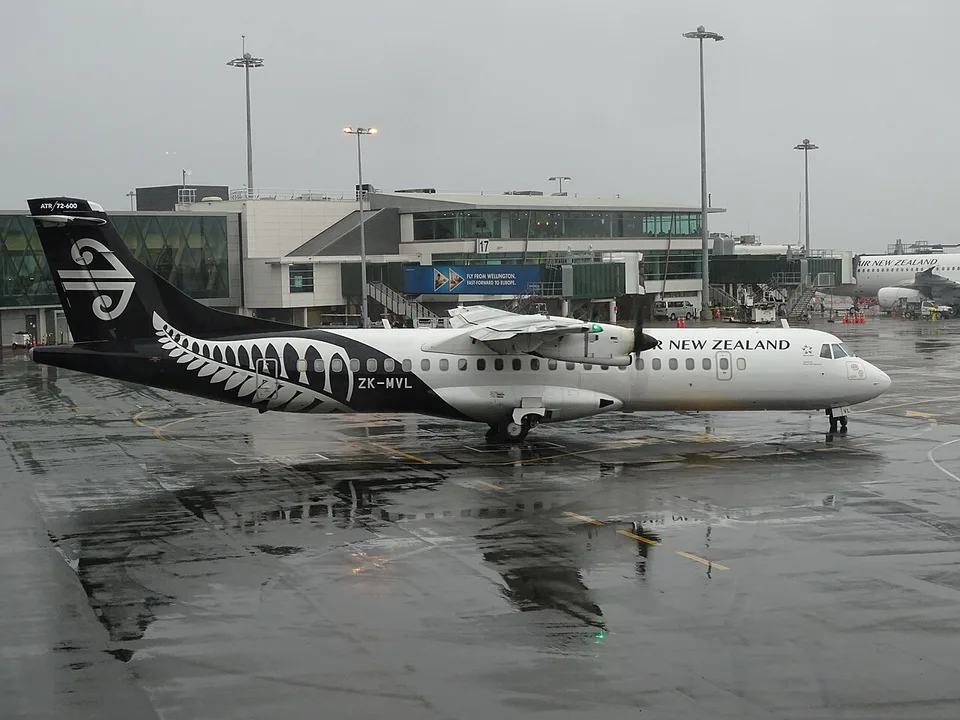
Commons-supplied 1280-pixel JPEG retained without cropping. Responsive WebP copies resized without cropping.
Geographic context
Christchurch departure
Wellington landing
Schematic approximate airport markers, not a recorded flight track or navigation chart. Route names are documented in the report. Basemap: Natural Earth, public domain.Read supporting evidence
A turbine blade fatigue failure caused an engine fire on low approach. The aircraft landed safely, but the evacuation exposed further hazards.
Read the full incident Follow what happened, from the flight to the investigation findings.
What investigators concluded
TAIC found a fatigue failure of a low-pressure turbine blade initiated the engine fire. It considered pre-existing fatigue at overhaul likely, without determining its exact origin, and identified separate evacuation and passenger-management safety issues.
An engine fire on final approach, then a difficult evacuation
1,559 words / about 8 minutes to read. Based on the investigation records cited below.
An uneventful flight until the runway was close
On 1 September 2024, Air New Zealand's ATR72-600 registered ZK-MVL left Christchurch for Wellington at 15:16. Four crew and seventy passengers were aboard. The passenger total included an infant on a parent's lap and an adult occupying the flight deck jump seat. The aircraft's cabin had sixty-eight passenger seats. These distinctions explain the occupancy figures without implying that every passenger occupied a separate cabin seat. The captain was flying, and the first officer was monitoring. It was their third sector that day in the same aircraft, after a return trip to Rotorua.
The journey and descent were uneventful. Visibility at Wellington was unrestricted, and the tower reported wind nearly aligned with runway 34. After changing to the tower frequency, the crew were told they were following another aircraft. That aircraft landed, and ZK-MVL received landing clearance. At 16:03:49, about 380 feet above mean sea level, left-engine oil pressure fell and triggered a caution. The first officer announced it, and the captain decided to continue the approach. The caution cleared and returned three more times in roughly fifteen seconds.
As the aircraft passed about 100 feet, an engine fire warning sounded. The first officer transmitted a Mayday, but the tower controller was transmitting a conditional line-up clearance at the same time and did not hear it. The absence of an immediate reply did not mean emergency services remained unaware. Watching the arriving aircraft through binoculars, the controller saw smoke from an engine and activated the airport emergency alarm. Rescue fire vehicles were dispatched towards the landing aircraft. The Commission separates this visual intervention from the crossed radio calls.
ZK-MVL touched down at 16:04:30 and stopped about halfway along the runway. While it slowed, the first officer repeated the Mayday. This time the controller acknowledged it, confirmed fire vehicles were coming, instructed the next arriving aircraft to overshoot and stopped other ground movements. Cabin crew reported fire outside and smoke or haze inside. Some passengers began standing, but an announcement from the forward flight attendant brought them back to their seats. The aircraft had landed safely, yet its engine warning and cabin observations required further action.
The pilots completed the engine-fire memory actions. Both engines were shut down, the left fire handle was pulled and the first suppressant bottle was discharged into the nacelle. After the required thirty-second wait, the warning remained illuminated, so they discharged the second bottle. The captain alerted cabin crew to their stations. Both pilots removed their headsets to communicate more easily with each other, without selecting the flight deck speaker. That choice subsequently prevented them hearing information from the tower and the rescue fire service.
The continuing warning led the captain to order the evacuation checklist. Its air traffic notification item was read, but no radio call announcing the evacuation was made. At 16:06:30, responders reported only a very small amount of smoke from the left engine. The tower asked the aircraft whether it had anything to add, without receiving a response. At 16:07:11, the captain gave the evacuation announcement. Investigators considered it virtually certain that the fire had already been extinguished shortly after the second suppressant discharge. Residual heat kept the sensing system active; a continuing warning is therefore not evidence of flames continuing throughout the evacuation.
Three of the four cabin exits were used: the rear-left door with its built-in stairs, and the two smaller forward emergency exits. The rear-right service door remained closed, although it was available. Cabin crew checked for heat and hazards before directing passengers out. The rear stairs carried most of the cabin passengers. The forward openings required passengers to step up and then jump roughly six feet to the runway. Some found the hatch weight, opening size and drop more difficult than they had expected; one had expected a slide.
The report's findings identify twelve passengers leaving through the forward-left exit, fifteen through the forward-right and forty-two through the rear stairs. Its detailed table reverses the two forward counts. The same source presents evacuation duration in different ways: its safety issue cites two minutes fifty-one seconds, while the table places the last rear-stair passenger three minutes seven seconds after the announcement. Those inconsistencies prevent a single definitive exit-by-exit stopwatch reconstruction here. Both presentations establish an evacuation substantially longer than the ninety-second certification benchmark. That benchmark describes a controlled demonstration, rather than a guarantee for every real emergency.
Many passengers took baggage despite the briefing and cabin crew instructions. Video showed nineteen of the twenty-seven people using the forward exits carrying bags; the rear-door estimate was less precise. Retrieving baggage slowed the aisle, and handling it at the forward openings further interrupted the flow. The Commission also recognised that passengers no longer saw an obvious fire threat. It did not attribute every individual's behaviour to one motive. Several people then walked near the previously burning left engine and propeller while joining another group. Responders shifted from firefighting to helping people at the exits and managing movement outside.
The replacement left engine had been installed the day before, following overhaul at the manufacturer's Singapore facility. That overhaul included replacing the low-pressure turbine disc and inspecting its forty-seven blades. A satisfactory ground run preceded the aircraft's return to service. The engine had flown only four hours since overhaul when the occurrence happened. Investigators found no recorded operating exceedance or abnormality during those hours. The short interval is significant to the investigation, but by itself it does not prove precisely when a crack began or who should have detected it.
Examination identified a low-pressure turbine blade that had fractured near its root and separated. The resulting imbalance damaged internal seals and associated components, allowing oil into the engine and producing smoke, flames and the falling oil pressure. Canadian laboratory work confirmed fatigue. Later examination found a second cracked blade six positions away from the failed one, with similar fatigue features. The blades had different serial numbers and were not from the same manufacturing batch. The second blade's condition made the quality-assurance question broader than a single isolated fracture.
The laboratories differed over timing. The Transportation Safety Board of Canada considered the fatigue likely present at overhaul. Pratt & Whitney Canada interpreted oxidation, progression marks and the absence of penetrant residue as indicating cracking after the inspection. The Commission reviewed both examinations and requested clarification. Its adopted finding was that the blade failed through fatigue and that fatigue on both blades was likely already present during overhaul, while the exact origin remained undetermined. The draft retains that distinction between a firm failure mechanism and a qualified timing conclusion. It does not turn the manufacturer's interpretation into the Commission's finding or claim a proven manufacturing defect.
The Commission credited the flight and cabin crews with achieving a safe landing and evacuation. It also identified opportunities to improve the response. Engine-fire memory actions should have been verbalised so the other pilot could verify them. An acknowledged engine-fire Mayday did not replace notification that passengers were about to evacuate. Keeping a means of hearing the radio would have preserved communication with responders. Those observations concern how information and checking work during an emergency; they are not evidence that the wrong engine was shut down on this flight.
Cabin training facilities could not realistically reproduce both flight-attendant positions and all four exits simultaneously. Passengers' difficulties at the forward hatches, the unused rear service door, baggage retrieval and movement near the engine all informed the recommendations. Personal headphones prevented at least one passenger hearing the initial command, but the Commission said this did not materially affect the overall duration. The account therefore distinguishes an observed communication concern from a demonstrated major delay. It also avoids attributing all evacuation time to baggage alone.
The report describes minor injuries, mainly strains associated with jumping from the forward exits, in its analysis and summary. Its data table lists no injuries, and the airline's appended response also describes evacuation without injury. This account follows the investigation's substantive narrative while disclosing the conflict. No death or serious injury is established. The compelling scope basis is the actual engine fire on very low approach, followed by an evacuation whose delays and external hazards the official investigation examined. It is not a claim that the aircraft remained on fire while people escaped.
On 26 August 2026, the Commission recommended that Pratt & Whitney Canada ensure overhaul quality-assurance procedures identify pre-existing fatigue. In its September response, the manufacturer said its inspection methodology and assessment processes already met the recommendation's intent and that it would continue monitoring reliability. The final report records that response alongside the recommendation. It does not establish an independently verified new inspection programme. The safety issue and disagreement must remain visible rather than being resolved by editorial assumption.
Air New Zealand accepted the evacuation recommendation and described a mixture of implemented and progressing measures. These included reinforced procedures, aligned commands, stronger rear-service-door training and more realistic flight crew scenarios. Passenger briefing and safety-card changes were being taken through approval, with implementation targeted for December 2026. A dedicated ATR evacuation trainer remained a proposal subject to business-case and funding approval. The report also records improved emergency transport arrangements at Wellington. These are dated findings and organisational responses. Acceptance, a target date and a proposed trainer each mean something different from completed implementation, and none is presented here as a later audit of actual airline practice.
A simplified reading of the investigation findings. The sequence does not replace the full report or imply that every contributing factor is shown.
Sequence of events
Report narrative times are local New Zealand time. Some report evacuation timing and injury entries conflict; those differences are disclosed. Expand an event to see its evidence.
The summary and analysis describe minor injuries; the data summary and appended airline response say nil. This conflict is preserved, and no serious injury is claimed.
The safety issue gives 2:51, while Table 1 gives 3:07 to the last rear-stair passenger. Both exceed the benchmark; neither is silently substituted for the other.
Air New Zealand accepted 027/26. Its September response describes implemented and progressing measures, with safety-card implementation targeted for December 2026 and a trainer still subject to funding approval.
These comparisons connect specific research topics. Shared circumstances do not establish identical causes. Evidence from both investigations is provided below.
Both investigations examine flight and cabin crew management of an engine emergency. Wellington involved an ATR turbine-blade fatigue failure and evacuation; Qantas 32 involved a different uncontained rotor failure and extensive system damage. Their failure mechanisms and exit decisions are not identical.
Explore the records below for additional context. They open on the publisher's site and are not all included in our report search. Source reuse terms apply.
Prepared 7 October 2026 from the cited final investigation. Unpublished; editorial approval and independent expert review have not been completed.
Source limitations
The report gives inconsistent injury summaries, forward-exit counts and evacuation timings. Fatigue failure is established, but its exact origin is not. Report-era action responses are not a later implementation audit.
ATR72-600, ZK-MVL Engine fire and evacuation Wellington 1 September 2024
TAIC Official final report; cached original bytes and complete extraction checked 7 October 2026
Source: Australian Transport Safety Bureau. Commonwealth content licensed CC BY 3.0 Australia; Coat of Arms, ATSB logo and third-party photos/graphics excluded. Only limited text excerpts used. Source terms / provenance.
Kevin Murphy writes the incident accounts on AirlineIncidents.com, out of a long interest in aviation safety and the lessons each investigation leaves behind.
Prepared by
AirlineIncidents editorial desk
Report citation check
Independent expert review
Not completed
Citation checks compare supporting text with the indexed report pages. They do not constitute independent expert review. How these pages are prepared.
Revision history
: Published sourced incident account, timeline, photographs and investigation findings.