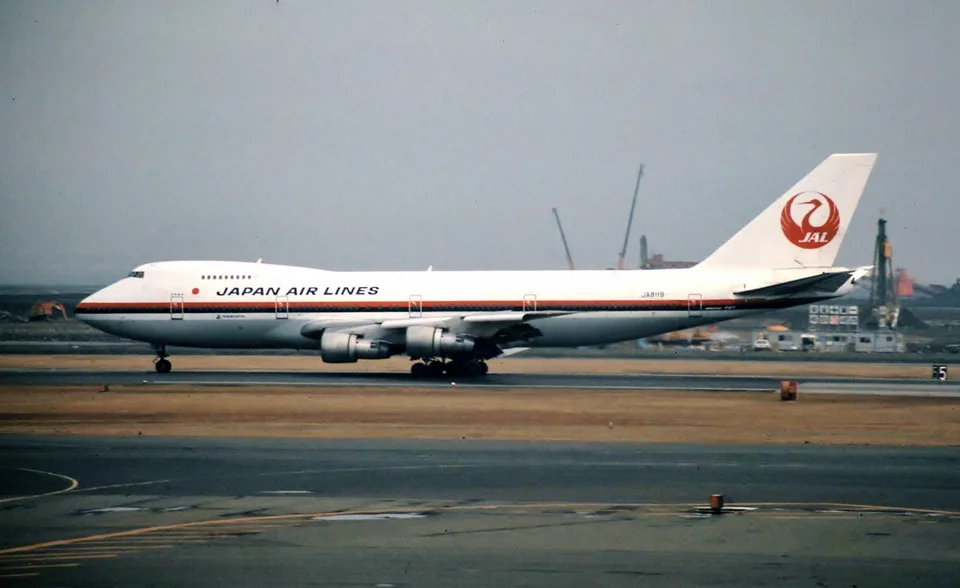
An improperly repaired pressure bulkhead failed in flight, damaging the tail and all four hydraulic systems. The crew struggled with severe oscillations before the aircraft struck mountainous terrain.
The copies shown here were resized without cropping or retouching.
Geographic context
Tokyo Haneda, departure
Osaka, intended destination
Gunma mountain region, approximate accident area
Approximate geographic context only; markers do not reconstruct the recorded flight path. Basemap: Natural Earth, public domain.Read supporting evidence
Fatigue cracks at an improper repair weakened the aft pressure bulkhead. Its rupture allowed cabin pressure into the tail, causing structural and hydraulic damage that removed primary control functions.
Read the full incident Follow what happened, from the flight to the investigation findings.
What investigators concluded
AAIC attributed the accident to lost control and degraded flying qualities following bulkhead rupture. Improper repairs in 1978 caused fatigue cracking; later failure to detect the cracks contributed.
A repaired bulkhead, a lost tail and a prolonged struggle
1,544 words / about 8 minutes to read. Based on the investigation records cited below.
An ordinary domestic departure
Japan Air Lines flight 123 left Tokyo Haneda for Osaka on 12 August 1985. The aircraft was Boeing 747SR-100 JA8119, carrying 509 passengers and fifteen crew members. Its earlier flights that day had produced no reports of abnormality relevant to the accident. The crew were qualified and the investigation found the weather unrelated to the initiating emergency. The weakness in the aft pressure bulkhead had remained undetected.
The aircraft took off at 18:12 Japan standard time. The captain occupied the right seat and the copilot the left under a training arrangement described in the report. During the climb, at 18:24:35, a loud sound marked a sudden abnormal event. The crew requested a return to Haneda at 18:25:21. They could recognise that something serious had happened, but they did not immediately know the extent of the damage behind them or the consequences for the control systems.
The aircraft remained in the air while its motion became difficult to manage. The flight crew attempted to stabilise it and sought assistance from controllers.
By 18:28:35 the captain reported that the aircraft was uncontrollable. Controllers offered headings and possible landing options, and the crew continued to seek a return to Haneda. The report considered the decision to attempt that return appropriate. Maintaining attitude, heading, climb or descent had become extremely difficult.
AAIC described severe phugoid and Dutch roll motion. In plain terms, the aircraft repeatedly changed its pitch and speed and also experienced coupled rolling and yawing. These were consequences of lost primary control functions and severely degraded lateral and directional stability. The commission concluded that stable flight, flight as intended by the captain, and a safe landing on land or water were next to impossible.
The crew coordinated control attempts, communications and system operations under severe motion and depressurisation. The report discusses changes in engine power and the lowering of the landing gear as part of the subsequent behaviour. AAIC considered the situation beyond the education, training, knowledge and experience ordinarily available to them.
The chronology also depends on aligning different records. AAIC matched cockpit communications with the air traffic control recording carrying Japan standard time, then adjusted flight-recorder timing against the same reference. It noted equipment-related limits on timing precision.
After the crew lowered the landing gear, the aircraft descended and the phugoid motion subsided. As the aircraft approached the mountains, the crew increased engine power. AAIC considered that this brought the aircraft back into unstable flight with both phugoid and Dutch roll motion. Changes in power could alter its motion, but the missing control functions and loss of stability continued to constrain the crew's attempts to manage it. They were coping with severe movement and depressurisation while trying to understand the emergency from the indications still available in the cockpit.
The investigation traced the initiating failure back to repair work following earlier damage at Osaka in 1978. Boeing performed structural repair work for JAL. AAIC considered the repair plan generally proper, including the intended solution to an edge-margin problem at the joint between bulkhead webs.
During the work, a narrower splice plate and a filler were installed in place of the intended single splice plate. The resulting arrangement left part of the connection functioning through a single row of rivets where the design intended two rows. AAIC estimated that this reduced the strength of the affected part and made it susceptible to fatigue cracking. Inspections during and after the repair did not discover the improper work. The management and inspection of the working process were judged partly insufficient.
As the aircraft continued in service, fatigue cracks propagated mainly at those affected connections. Later visual inspections did not detect them. Inspection assumptions were suited to a normally manufactured and correctly repaired bulkhead; the incorrect repair had created a different weakness. The accident thus linked workmanship and later surveillance. A repair could appear complete, the aircraft could operate without an obvious discrepancy, and the damage could still grow until the remaining structure no longer withstood an ordinary pressurisation load.
AAIC examined the inspections made after the Osaka repair as well as the repair itself. Visual checks during scheduled maintenance had repeatedly passed the bulkhead while cracks were growing at the altered splice. The commission considered that such checks could have been suitable for a bulkhead built and repaired as intended. They were partly inadequate for the actual structure because they failed to find the fatigue damage produced by the improper work. The service record contained no related flight discrepancies to direct attention to the splice. The defective connection therefore remained in use through repeated cabin loading, with its condition concealed from both routine operation and the subsequent inspection process.
AAIC reconstructed the bulkhead rupture while the aircraft was climbing at about 24,000 feet. Fatigue had reduced its remaining strength until it could no longer endure the cabin-pressure differential. The fracture spread through the bulkhead and opened a route for pressurised cabin air into the aft structure. Escaping cabin air subjected the tail structure to a sudden pressure increase.
The report estimated that pressure increased in the empennage, damaging the auxiliary power unit firewall and aft structure. Air also entered the vertical fin, with internal failure and separation of major portions following. The rudder separated and lines associated with all four hydraulic systems fractured. Parts of this sequence occurred within a few seconds.
The destruction immediately removed some primary control functions and subsequently removed others as hydraulic capability was lost. The simultaneous loss of structural stability and control authority explains the severe oscillations. Having several hydraulic systems was insufficient when they were all exposed to the same damaging event in the tail.
The reconstructed rupture spread upward through the central bulkhead and along its reinforcing structure. Part of the upper web was forced aft, creating the opening through which cabin air entered the tail. AAIC estimated that the pressure broke the firewall behind the auxiliary power unit and destroyed structure aft of it. A separate route through the lower part of the fin's aft torque box allowed air into the vertical fin. Failure of internal attachments was followed by destruction of internal structure and separation of skin and major fin sections. The pressure boundary, the surrounding tail structure and the hydraulic lines were thus involved in a rapidly spreading failure.
The aircraft struck mountainous terrain in Ueno, Gunma, at about 18:56. AAIC's detailed reconstruction estimated an initial encounter with terrain features before the principal impact, with major components separating and wreckage dispersing. The extreme crash forces destroyed the forward and central portions. Of the 524 occupants, 520 died. Four passengers survived with serious injuries. The official injury analysis associates their survival with their location in the aft fuselage and the particular impact circumstances around their seats.
It discusses possible differences in posture, restraint, seat damage and nearby material that may have buffered the impact for the survivors.
Search and rescue were conducted in remote mountainous terrain at night. AAIC judged the time needed to identify and confirm the crash location justifiable under those conditions and acknowledged the extreme difficulties faced by participating organisations. It also considered ATC information and responses broadly adequate.
AAIC distinguished the breakup of the forward and central fuselage from the movement of the aft section at impact. It estimated that the aft fuselage separated, passed over a ridge and fell into a branch of the valley. The cabin floor, seats and galley were broken and scattered. The injury analysis considered both the initial shock and injuries from collision with or compression by these fragments. For the survivors, it considered that posture, belt fastening, seat damage and surrounding material might have buffered the impact, together with less exposure to flying cabin debris. The report presents these as possible explanations for the survival of those particular passengers in the aft seating area.
The cause statement and the recorded safety response
The final cause statement joined the physical sequence to its origin. AAIC estimated that rupture of the aft pressure bulkhead, followed by damage to the tail, vertical fin and hydraulic control systems, caused degraded flying qualities and loss of primary control. It attributed fatigue initiation and propagation to the improper repair in 1978. The failure to find those cracks during later maintenance contributed to their growth.
The report records recommendations and countermeasures concerning pressure protection of the tail, preservation of hydraulic systems, evaluation of bulkhead fail-safe validity, repair procedures and inspection. In particular, the recorded inspection proposals went beyond ordinary visual checks to consider multiple-site fatigue cracking. The measures addressed the possibility that a locally weakened pressure boundary could trigger widespread damage.
Some cockpit questions remained unresolved. The commission could not clarify why the pilots did not use oxygen masks and discussed possible physiological effects as possibilities.
The safety programme recorded in the report included separate evaluations of bulkhead design and repair practice. Proposed tests would check whether the domed bulkhead still had its fail-safe capability, while review of repair procedures would check that a repair did not compromise that capability. The inspection proposal sought a method capable of detecting the extent of multiple-site fatigue cracking. Pressure protection of the empennage and preservation of hydraulic integrity addressed the damage after rupture. Together these proposals followed the physical sequence from the weakened splice to a pressure event that disabled systems beyond the original damaged structure.
The report could not clarify why the pilots did not use their oxygen masks. It considered possible physiological effects but could not establish their extent.
Matching dossiers for Severe oscillatory motion: No other dossier in this collection.
Read alongside
These comparisons connect specific research topics. Shared circumstances do not establish identical causes. Evidence from both investigations is provided below.
JAL 123 involved physical destruction of primary controls and loss of stability. AF447 involved unreliable airspeed indications, crew difficulty identifying the stall and a prolonged loss of control.
Explore the records below for additional context. They open on the publisher's site and are not all included in our report search. Source reuse terms apply.
Official English tentative translation, dated 19 June 1987, hosted by JTSB. Japanese original is the reference language version.
Sources and transparency
Checked against the official final investigation report. No independent expert review.
Source limitations
The report reconstructs parts of the structural sequence by calculation and wreckage analysis.
AAIC final report: Japan Air Lines Boeing 747SR-100 JA8119
Aircraft Accident Investigation Commission, Japan Official English tentative translation, dated 19 June 1987, hosted by JTSB. Japanese original is the reference language version.
Limited quotations for source-based commentary. Full report and illustrations are not republished. Wider reuse requires checking BEA terms. Source terms.
Kevin Murphy writes the incident accounts on AirlineIncidents.com, out of a long interest in aviation safety and the lessons each investigation leaves behind.
Prepared by
AirlineIncidents editorial desk
Report citation check
Independent expert review
Not completed
Citation checks compare supporting text with the indexed report pages. They do not constitute independent expert review. How these pages are prepared.
Revision history
: Published a sourced account, timeline, photographs and final investigation findings.