LEVEL 3 Final report

Based on the investigation authority's final report.

Date
Show source
NTSB AAR-89/03: Aloha Airlines flight 243, N73711Official investigation report | Printed page v | PDF page 6Find this passage in evidence search
Occurrence
Fuselage fatigue failure and explosive decompression
Location
Near Maui; landing at Kahului Airport
Show source
NTSB AAR-89/03: Aloha Airlines flight 243, N73711Official investigation report | Printed page v | PDF page 6Find this passage in evidence search
Operator
Aloha Airlines, flight 243
Show source
NTSB AAR-89/03: Aloha Airlines flight 243, N73711Official investigation report | Printed page v | PDF page 6Find this passage in evidence search
Flight
243
Show source
NTSB AAR-89/03: Aloha Airlines flight 243, N73711Official investigation report | Printed page v | PDF page 6Find this passage in evidence search
Aircraft
Boeing 737-297, in the 737-200 series
Show source
NTSB AAR-89/03: Aloha Airlines flight 243, N73711Official investigation report | Printed page 12 | PDF page 18Find this passage in evidence search
Registration
N73711
Show source
NTSB AAR-89/03: Aloha Airlines flight 243, N73711Official investigation report | Printed page 12 | PDF page 18Find this passage in evidence search
Route
Hilo to Honolulu; diverted to Kahului, Maui
Show source
NTSB AAR-89/03: Aloha Airlines flight 243, N73711Official investigation report | Printed page v | PDF page 6Find this passage in evidence search
People aboard
89 passengers, five operating crew and one cockpit observer, total 95
Show source
NTSB AAR-89/03: Aloha Airlines flight 243, N73711Official investigation report | Printed page 2 | PDF page 8Find this passage in evidence search
Fatalities
One flight attendant lost in flight and presumed dead
Show source
NTSB AAR-89/03: Aloha Airlines flight 243, N73711Official investigation report | Printed page 5 | PDF page 11Find this passage in evidence search
Serious injuries
Eight: seven passengers and one flight attendant
Show source
NTSB AAR-89/03: Aloha Airlines flight 243, N73711Official investigation report | Printed page 5 | PDF page 11Find this passage in evidence search
Survivors
94 occupants
Show source
NTSB AAR-89/03: Aloha Airlines flight 243, N73711Official investigation report | Printed page 5 | PDF page 11Find this passage in evidence search
Investigating authority
National Transportation Safety Board
Show source
NTSB AAR-89/03: Aloha Airlines flight 243, N73711Official investigation report | Printed page Report front matter | PDF page 2Find this passage in evidence search
Topics
Inspection and quality control, Structural failure, Management and FAA oversight, Cold-bond durability

This photograph is cropped for the banner. See the full photograph, credit, licence and what it shows.

Photographs and geographic context

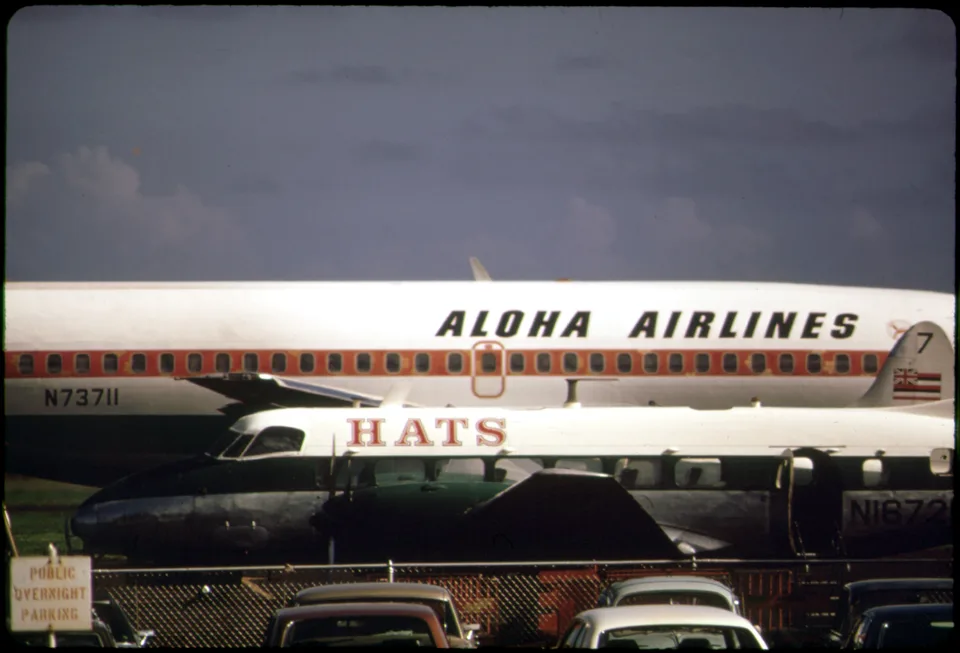
Aloha Airlines Boeing 737 N73711 behind another aircraft.

N73711 in October 1973.

Photo: Charles O'Rear, Public domain

Image info

N73711 is the accident aircraft. Taken in October 1973, before the accident. This is not the accident flight and shows the aircraft before it was damaged.

Image source

The source scan was retouched, according to Commons. The copies shown here were resized without cropping or further retouching.

Geographic context

Geographical orientation for Aloha Airlines 243Hilo, departure; Honolulu, planned destination; Kahului, diversion landing. Approximate airport markers; route is geographic context and does not plot the actual emergency track.123NORTH UP / SCHEMATIC / NOT A RECORDED FLIGHT TRACK
  1. Hilo, departure
  2. Honolulu, planned destination
  3. Kahului, diversion landing
Approximate airport markers; route is geographic context and does not plot the actual emergency track. Basemap: Natural Earth, public domain.
Read supporting evidence
NTSB AAR-89/03: Aloha Airlines flight 243, N73711Official investigation report | Printed page 2 | PDF page 8Find this passage in evidence search
NTSB AAR-89/03: Aloha Airlines flight 243, N73711Official investigation report | Printed page 5 | PDF page 11Find this passage in evidence search

What happened

Disbonding and multiple-site fatigue cracking defeated the intended controlled-decompression behaviour of the fuselage lap joint, allowing a large upper section to separate.

Read the full incident Follow what happened, from the flight to the investigation findings.

What investigators concluded

NTSB found that the maintenance programme failed to detect significant disbonding and fatigue damage. Airline management, FAA oversight and inspection scope, and lack of a complete terminating action contributed.

Evidence behind this explanation
NTSB AAR-89/03: Aloha Airlines flight 243, N73711Official investigation report | Printed page 73 | PDF page 79Find this passage in evidence search
NTSB AAR-89/03: Aloha Airlines flight 243, N73711Official investigation report | Printed page 74 | PDF page 80Find this passage in evidence search

The fuselage that opened over Hawaii

1,615 words / about 8 minutes to read. Based on the investigation records cited below.

A routine interisland flight

Aloha Airlines flight 243 departed Hilo for Honolulu at 13:25 Hawaiian standard time on 28 April 1988. Boeing 737 N73711 had already flown interisland sectors that day without a reported system or structural abnormality. The departure and climb were uneventful, and the weather was not a factor in the accident. The flight carried 89 passengers, two pilots and three flight attendants, with an FAA air traffic controller occupying the cockpit observer seat. That observer explains why the executive summary groups six people with the crew while the injury table separates one as an other occupant.

As the aircraft levelled at 24,000 feet, the pilots heard a loud sound followed by wind noise. Debris entered the cockpit, the cockpit door was missing, and the captain could see open sky where the forward cabin ceiling had been. At 13:46 a large portion of upper fuselage skin and structure separated, producing explosive decompression. About eighteen feet of cabin structure behind the entrance door was lost. Cabin air expanded and escaped through the opening.

One flight attendant was swept from the cabin and was presumed fatally injured after an unsuccessful sea search. Another was struck by debris and seriously hurt. Passengers remained seated with the seat-belt sign illuminated at the initiating event. The surviving cabin crew continued to assist and reassure them despite injuries and the exposed cabin. The crew had to fly and land an aircraft whose structure, systems and cabin environment had been severely altered.

Sources for this section
NTSB AAR-89/03: Aloha Airlines flight 243, N73711Official investigation report | Printed page 1 | PDF page 7Find this passage in evidence search
NTSB AAR-89/03: Aloha Airlines flight 243, N73711Official investigation report | Printed page 2 | PDF page 8Find this passage in evidence search
NTSB AAR-89/03: Aloha Airlines flight 243, N73711Official investigation report | Printed page v | PDF page 6Find this passage in evidence search
NTSB AAR-89/03: Aloha Airlines flight 243, N73711Official investigation report | Printed page 5 | PDF page 11Find this passage in evidence search
NTSB AAR-89/03: Aloha Airlines flight 243, N73711Official investigation report | Printed page 2 | PDF page 8Find this passage in evidence search

Descending and landing with several emergencies

The captain took over the controls and began an emergency descent. Both pilots and the observer donned oxygen masks. Wind noise initially prevented normal conversation, so the pilots used hand signals. The first officer selected the emergency transponder code and tried to alert air traffic control before establishing contact with Maui Tower. Kahului on Maui was the diversion landing airport. The communication difficulties were a direct operational consequence of the missing cabin structure, adding to the task of controlling the damaged aircraft and assessing what remained functional.

During the approach the captain found the aircraft less controllable when flaps were extended beyond five, and returned them to that setting. He also chose an approach speed of 170 knots because control deteriorated below it. The main landing gear indicated down, but the nose-gear down indication did not illuminate even after manual-extension attempts. A direct visual check was not made because of the occupied centre jumpseat and the urgency of landing. The left engine also failed, and an attempted restart did not restore it.

Flight 243 landed on Kahului's runway 02 at 13:58:45. The captain reported a normal touchdown and rollout, using the remaining engine's reverser and the brakes. An emergency evacuation followed on the runway. Eight people had serious injuries, including seven passengers and one flight attendant. The aircraft was damaged beyond repair.

The first officer tried to reach the flight attendants through both the public-address system and the interphone, without a response. She told the tower that the crew could not communicate with them and would need help for the passengers after landing. That call did not result in an ambulance request. She supplied the passenger count, but did not give the fuel load. The controller did not repeat the request for fuel information even after the emergency-response chief asked about it. These gaps affected preparation on the ground while the pilots concentrated on controlling the aircraft and arranging an immediate landing.

Sources for this section
NTSB AAR-89/03: Aloha Airlines flight 243, N73711Official investigation report | Printed page 2 | PDF page 8Find this passage in evidence search
NTSB AAR-89/03: Aloha Airlines flight 243, N73711Official investigation report | Printed page 3 | PDF page 9Find this passage in evidence search
NTSB AAR-89/03: Aloha Airlines flight 243, N73711Official investigation report | Printed page 4 | PDF page 10Find this passage in evidence search
NTSB AAR-89/03: Aloha Airlines flight 243, N73711Official investigation report | Printed page 5 | PDF page 11Find this passage in evidence search
NTSB AAR-89/03: Aloha Airlines flight 243, N73711Official investigation report | Printed page 4 | PDF page 10Find this passage in evidence search

Reconstructing a missing piece of fuselage

The initial failure origin was not recovered. NTSB therefore examined the structure still attached to the aircraft and its service history to reconstruct where separation began. Deformation, broken frames and floor damage pointed to the left side of the upper fuselage. The Board concluded that failure initiated at the lap joint along S-10L. The final findings describe multiple-site fatigue cracking near rivet holes, together with tear-strap disbonding, as the mechanism that defeated the intended fail-safe behaviour.

The early fuselage lap joints depended partly on bonded surfaces to transfer loads. Manufacturing difficulties in surface preparation or bond processing reduced environmental durability or left portions insufficiently bonded. When bonding deteriorated, loads transferred through the rivets and concentrated at the knife edges associated with countersunk holes. Fatigue cracks could then develop at many sites. Numerous small cracks could link into a larger opening, while disbonded tear straps no longer reliably contained the damage.

The intended structural response was a limited opening and controlled decompression, with the surrounding structure retaining adequate integrity. NTSB found that sufficient cracking and disbonding existed to negate that response. After the accident, a passenger reported seeing a longitudinal crack while boarding at Hilo but had not told airline staff or the pilots.

Sources for this section
NTSB AAR-89/03: Aloha Airlines flight 243, N73711Official investigation report | Printed page 47 | PDF page 53Find this passage in evidence search
NTSB AAR-89/03: Aloha Airlines flight 243, N73711Official investigation report | Printed page 71 | PDF page 77Find this passage in evidence search
NTSB AAR-89/03: Aloha Airlines flight 243, N73711Official investigation report | Printed page 50 | PDF page 56Find this passage in evidence search
NTSB AAR-89/03: Aloha Airlines flight 243, N73711Official investigation report | Printed page 5 | PDF page 11Find this passage in evidence search

A programme that did not match the aircraft use

N73711 had accumulated 89,680 flight cycles and 35,496 flight hours. Short interisland services generated many cycles in relatively little flying time. Some short flights reached only partial pressure differential and imposed partial loads on the fuselage. Even after allowing for those flights, cycle accumulation exceeded the maintenance-planning assumptions. Inspection intervals built primarily around flight hours could allow substantially more cyclic exposure than the original maintenance-planning assumptions anticipated.

NTSB identified high cycle accumulation between structural inspections, long elapsed intervals for related deterioration and a heavily segmented inspection programme. Inspecting small portions over an extended period limited the ability to assess the aircraft's overall structural condition and carry out full repairs. Overnight scheduling and the need to return aircraft to service constrained time and manpower. The scheduling constraints limited both inspection and repair work.

The Board found that Aloha had sufficient information about lap-joint problems to implement an effective detection and repair programme. That information included known bonding and corrosion issues and prior damage in the fleet. It also found uncertainty about a required eddy-current inspection: the investigation could not determine whether it had not been performed or had been ineffective.

Investigators compared fatigue striations in surviving cracks with the service accumulated since the previous inspection. This allowed them to estimate the size of cracks at the time that inspection was due. Postaccident eddy-current checks by Aloha inspectors reliably detected cracks above the demonstrated threshold. Some cracks were estimated to have exceeded that detectable size at the earlier inspection. The NTSB therefore concluded that the required process had either been omitted or had failed to find damage that the method should have detected. The surviving structure supplied evidence for that conclusion even though the initial failure origin had been lost.

Sources for this section
NTSB AAR-89/03: Aloha Airlines flight 243, N73711Official investigation report | Printed page 12 | PDF page 18Find this passage in evidence search
NTSB AAR-89/03: Aloha Airlines flight 243, N73711Official investigation report | Printed page 51 | PDF page 57Find this passage in evidence search
NTSB AAR-89/03: Aloha Airlines flight 243, N73711Official investigation report | Printed page 52 | PDF page 58Find this passage in evidence search
NTSB AAR-89/03: Aloha Airlines flight 243, N73711Official investigation report | Printed page 72 | PDF page 78Find this passage in evidence search
NTSB AAR-89/03: Aloha Airlines flight 243, N73711Official investigation report | Printed page 54 | PDF page 60Find this passage in evidence search

Inspection, oversight and design assumptions

Human performance was a substantial part of the inspection problem. NTSB examined the demands of repetitive visual and nondestructive tasks, the working environment and the effects of maintenance scheduling. Repetitive rivet inspections imposed demands on attention, access and time, with fatigue affecting the reliability of the work. The Board criticised management's failure to recognise these factors and focus inspectors on the critical nature of crack detection, corrosion control and lap-joint inspection. These are organisational conditions that affect the reliability of the technical method.

FAA oversight also failed to establish the actual condition of the operating fleet. The report describes a surveillance approach focused too heavily on manuals and records, and an assigned inspector burdened with other responsibilities and insufficiently informed about the fleet and its operations. Required lap-joint inspection had also been limited more narrowly than Boeing's proposed scope. The Board included FAA programme evaluation and inspection requirements among the contributing factors.

The design and certification analysis considered why the deterioration escaped the original controlled-decompression assumptions. Fatigue tests had not reproduced the long-term effects of bonding degradation, corrosion and multiple-site cracks found in service. Supplemental inspection classifications that treated fuselage skin damage as readily obvious were also questioned. NTSB's final cause attributed the accident to the maintenance programme's failure to detect significant disbonding and fatigue, with management, FAA oversight and the absence of complete corrective action for early cold-bond problems contributing.

The Board examined the physical demands of the rivet inspections. Inspectors had to work from scaffolding, move along the upper fuselage and carry a bright light. Eddy-current inspection required a probe and meter as well. Work on top of the fuselage sometimes required ropes attached to the hangar rafters to prevent a fall. Repeating close inspections over long rows of rivets created demands on attention and expectation. The analysis identified boredom, task length, isolation and the surrounding environment as influences on reliable performance. Night work added concerns about sleep loss, irregular rest schedules and circadian effects on mechanics and inspectors.

Sources for this section
NTSB AAR-89/03: Aloha Airlines flight 243, N73711Official investigation report | Printed page 54 | PDF page 60Find this passage in evidence search
NTSB AAR-89/03: Aloha Airlines flight 243, N73711Official investigation report | Printed page 72 | PDF page 78Find this passage in evidence search
NTSB AAR-89/03: Aloha Airlines flight 243, N73711Official investigation report | Printed page 73 | PDF page 79Find this passage in evidence search
NTSB AAR-89/03: Aloha Airlines flight 243, N73711Official investigation report | Printed page 68 | PDF page 74Find this passage in evidence search
NTSB AAR-89/03: Aloha Airlines flight 243, N73711Official investigation report | Printed page 74 | PDF page 80Find this passage in evidence search
NTSB AAR-89/03: Aloha Airlines flight 243, N73711Official investigation report | Printed page 54 | PDF page 60Find this passage in evidence search

Safety action and crew performance

Recommendations addressed the maintenance programme itself, inspector competence and the evaluation of real aircraft condition. NTSB sought engineering support for approval of segmented inspections, programme limits suited to cycle and time exposure, modern maintenance curricula and recurrent training for nondestructive inspection personnel. It also called for corrosion control programs and evaluation of maintenance effectiveness using engineering resources. The Board sought programmes capable of finding and correcting progressive structural deterioration.

The Board commended the flight and cabin crews for managing an unprecedented emergency and bringing the aircraft to a safe landing. Its analysis also identified a concern with the emergency descent: using high speed and speed brakes without first adequately accounting for structural integrity could impose additional loads on the damaged aircraft and expose passengers to further harm.

The training recommendation included apprenticeship and periodic demonstration of skills for inspectors performing nondestructive work. The Board also wanted modern industry technology included in mechanic-school curricula and licensing tests. Programme approval required engineering support where airlines proposed dividing major inspections into smaller segments. Another recommendation asked the FAA to identify operators whose relationship between flight cycles and flight time differed substantially from maintenance-planning assumptions. Their programmes would then need to provide timely detection of both cycle-related and time-related deterioration. These proposals addressed the frequent short sectors flown by Aloha and the practical reliability of the inspections intended to support continued service.

Sources for this section
NTSB AAR-89/03: Aloha Airlines flight 243, N73711Official investigation report | Printed page 74 | PDF page 80Find this passage in evidence search
NTSB AAR-89/03: Aloha Airlines flight 243, N73711Official investigation report | Printed page 75 | PDF page 81Find this passage in evidence search
NTSB AAR-89/03: Aloha Airlines flight 243, N73711Official investigation report | Printed page 69 | PDF page 75Find this passage in evidence search
NTSB AAR-89/03: Aloha Airlines flight 243, N73711Official investigation report | Printed page 70 | PDF page 76Find this passage in evidence search
NTSB AAR-89/03: Aloha Airlines flight 243, N73711Official investigation report | Printed page 73 | PDF page 79Find this passage in evidence search
NTSB AAR-89/03: Aloha Airlines flight 243, N73711Official investigation report | Printed page 74 | PDF page 80Find this passage in evidence search

Return to the short summary / Source status and limitations

How the sequence developed

Follow the main stages, then open the evidence beneath each step.

  1. Bond deterioration

    Cold-bond manufacturing problems reduced environmental durability and permitted disbonding.

    Read supporting evidence
    NTSB AAR-89/03: Aloha Airlines flight 243, N73711Official investigation report | Printed page 71 | PDF page 77Find this passage in evidence search
  2. Fatigue growth

    Stress concentrated at countersunk rivet holes after load transferred through the rivets.

    Read supporting evidence
    NTSB AAR-89/03: Aloha Airlines flight 243, N73711Official investigation report | Printed page 71 | PDF page 77Find this passage in evidence search
  3. Failed damage containment

    Multiple cracks and tear-strap disbonding defeated controlled decompression.

    Read supporting evidence
    NTSB AAR-89/03: Aloha Airlines flight 243, N73711Official investigation report | Printed page 50 | PDF page 56Find this passage in evidence search
  4. Upper lobe separation

    The upper fuselage section left the aircraft, exposing the cabin.

    Read supporting evidence
    NTSB AAR-89/03: Aloha Airlines flight 243, N73711Official investigation report | Printed page 5 | PDF page 11Find this passage in evidence search

A simplified reading of the investigation findings. The sequence does not replace the full report or imply that every contributing factor is shown.

Sequence of events

Hawaiian standard time, 24-hour clock. Expand an event to see its evidence.

  1. 13:25 HSTDeparture

    The aircraft departed Hilo for Honolulu.

    NTSB AAR-89/03: Aloha Airlines flight 243, N73711Official investigation report | Printed page 2 | PDF page 8Find this passage in evidence search
  2. 13:46 HSTStructural failure

    Decompression and upper fuselage separation occurred at 24,000 feet.

    NTSB AAR-89/03: Aloha Airlines flight 243, N73711Official investigation report | Printed page v | PDF page 6Find this passage in evidence search
  3. Emergency descentDiversion

    The captain took control and descended toward Maui.

    NTSB AAR-89/03: Aloha Airlines flight 243, N73711Official investigation report | Printed page 2 | PDF page 8Find this passage in evidence search
  4. ApproachAdditional difficulties

    The left engine failed and nose-gear indication remained uncertain.

    NTSB AAR-89/03: Aloha Airlines flight 243, N73711Official investigation report | Printed page 4 | PDF page 10Find this passage in evidence search
  5. 13:58:45 HSTLanding

    The aircraft landed on runway 02 at Kahului and was evacuated.

    NTSB AAR-89/03: Aloha Airlines flight 243, N73711Official investigation report | Printed page 5 | PDF page 11Find this passage in evidence search
  6. After landingEvacuation

    Passengers evacuated on the runway after the aircraft stopped at Kahului.

    NTSB AAR-89/03: Aloha Airlines flight 243, N73711Official investigation report | Printed page 5 | PDF page 11Find this passage in evidence search

Search the report evidence

Search extracted report prose, with original page references. Short results link to the full document.

Questions readers ask

Was explosive decompression a bomb?

No. Cabin air escaped violently when the fuselage structure failed.

NTSB AAR-89/03: Aloha Airlines flight 243, N73711Official investigation report | Printed page 5 | PDF page 11Find this passage in evidence search
Was the aircraft simply too old to fly?

NTSB found that the maintenance programme failed to detect disbonding and fatigue damage. Frequent flight cycles, corrosion and deficiencies in inspection and repair allowed the structure to deteriorate.

NTSB AAR-89/03: Aloha Airlines flight 243, N73711Official investigation report | Printed page 73 | PDF page 79Find this passage in evidence search
NTSB AAR-89/03: Aloha Airlines flight 243, N73711Official investigation report | Printed page 12 | PDF page 18Find this passage in evidence search
How many crew were aboard?

There were two pilots and three flight attendants, plus an FAA air traffic controller in the cockpit observer seat. The injury table lists that observer separately as an other occupant.

NTSB AAR-89/03: Aloha Airlines flight 243, N73711Official investigation report | Printed page 2 | PDF page 8Find this passage in evidence search
NTSB AAR-89/03: Aloha Airlines flight 243, N73711Official investigation report | Printed page 5 | PDF page 11Find this passage in evidence search

What the evidence can and cannot establish

Safety follow-up

Actions and recommendations are described at the dates of the cited records. A recommendation is not proof of implementation.

Classifications, with reasons

These labels organise the evidence. They are not a ranking of causes. A shared label means a shared research topic, not an identical mechanism.

Failure mechanismStructural failure

Cracks and disbonding negated the fuselage fail-safe characteristics.

NTSB AAR-89/03: Aloha Airlines flight 243, N73711Official investigation report | Printed page 71 | PDF page 77Find this passage in evidence search
Probable causeInspection and quality control

The programme failed to find significant damage.

NTSB AAR-89/03: Aloha Airlines flight 243, N73711Official investigation report | Printed page 73 | PDF page 79Find this passage in evidence search
ContributionManagement and FAA oversight

Supervision and evaluation of the maintenance programme were deficient.

NTSB AAR-89/03: Aloha Airlines flight 243, N73711Official investigation report | Printed page 74 | PDF page 80Find this passage in evidence search
ContributionCold-bond durability

Early production problems led to disbonding, corrosion and premature fatigue.

NTSB AAR-89/03: Aloha Airlines flight 243, N73711Official investigation report | Printed page 74 | PDF page 80Find this passage in evidence search

Read alongside

These comparisons connect specific research topics. Shared circumstances do not establish identical causes. Evidence from both investigations is provided below.

Air France Flight 447

Aloha 243 involved structural loss, disrupted communication and an emergency landing with several systems impaired. AF447 involved unreliable airspeed indications and a stall that the crew did not identify. Both investigations examined the information available to pilots during an unexpected emergency.

Read supporting evidence
NTSB AAR-89/03: Aloha Airlines flight 243, N73711Official investigation report | Printed page 69 | PDF page 75Find this passage in evidence search
BEA final reportBEA final-report causes | Printed page 201 | PDF page 203Find this passage in evidence search
BEA final reportOfficial investigation report | Printed page 200 | PDF page 202Find this passage in evidence search

Further investigation records

Explore the records below for additional context. They open on the publisher's site and are not all included in our report search. Source reuse terms apply.

Sources and transparency

Checked against the official final investigation report. No independent expert review.

Source limitations

The initial failure origin was not recovered. NTSB reconstructed it from remaining structure, metallurgical evidence and the aircraft service history.

NTSB AAR-89/03: Aloha Airlines flight 243, N73711

National Transportation Safety Board
Final report adopted 14 June 1989.

Official report PDF, hosted by ntsb.gov

Open source document

264 PDF pages.

Short attributed excerpts support this account. Full reports and third-party illustrations are not republished. Source terms.

Final Report: Accident on 1st June 2009 to the Airbus A330-203 registered F-GZCP operated by Air France flight AF 447

Bureau d'Enquetes et d'Analyses (BEA)
English final report, 5 July 2012

Official report PDF, hosted by bea.aero

Open source document

223 PDF pages.

Limited quotations for source-based commentary. Full report and illustrations are not republished. Wider reuse requires checking BEA terms. Source terms.

Read the extraction, classification and review methodology.

Suggest a correction to this dossier

Editorial record

Kevin Murphy writes the incident accounts on AirlineIncidents.com, out of a long interest in aviation safety and the lessons each investigation leaves behind.

Prepared by
AirlineIncidents editorial desk
Report citation check
Independent expert review
Not completed

Citation checks compare supporting text with the indexed report pages. They do not constitute independent expert review. How these pages are prepared.

Revision history

: Published a sourced account, timeline, photographs and final investigation findings.
Source-based corrections are reviewed before changes appear here. Suggest a correction to this dossier.