A cargo door that appeared secured opened during climb. Rapid depressurisation collapsed the cabin floor and disabled controls routed beneath it, leaving the crew unable to recover.
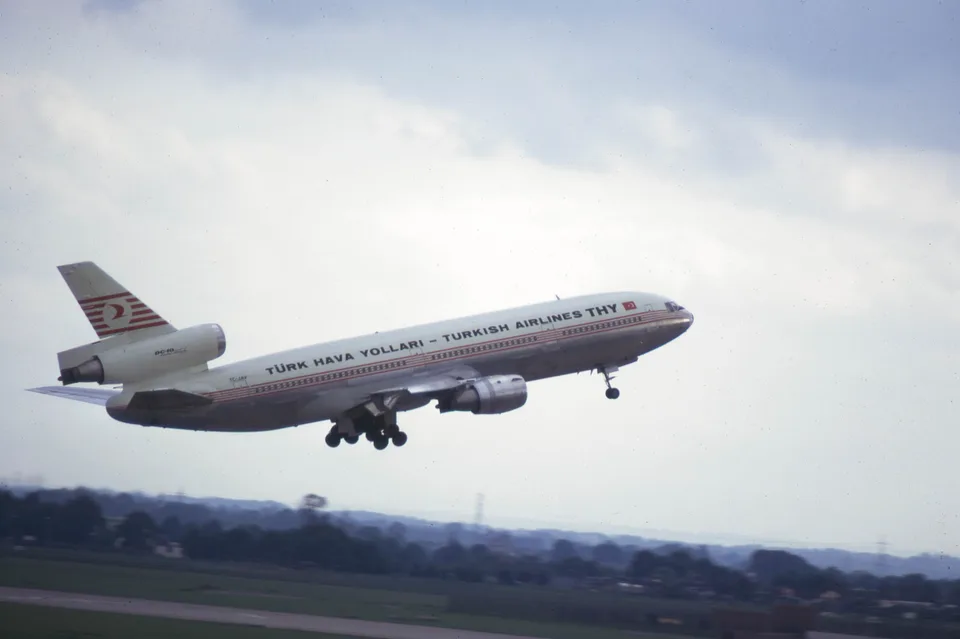
The copies shown here were resized without cropping or retouching.
Geographic context
Istanbul, origin city
Paris Orly, stop and accident-leg departure
London, intended destination city
Approximate city and airport context for the service. Not a reconstruction of the recorded flight path. Basemap: Natural Earth, public domain.Read supporting evidence
Incomplete latch engagement and ineffective locking indications allowed takeoff with an unsecured aft cargo door. Its loss caused a pressure differential across the floor, structural disruption and serious impairment of flight controls.
Read the full incident Follow what happened, from the flight to the investigation findings.
What investigators concluded
The Commission attributed the accident to door ejection and resulting floor/control damage, rooted in defective locking, incomplete modifications, incorrect adjustments and absence of a visual lock-pin check.
The door that looked locked and the controls beneath the floor
1,612 words / about 8 minutes to read. Based on the investigation records cited below.
A passenger service through Orly
Turkish Airlines flight TK 981 was operating from Istanbul through Paris Orly to London on 3 March 1974. The aircraft was McDonnell Douglas DC-10-10 TC-JAV. After its Orly stop it departed with 334 passengers and twelve crew members, a total of 346 people. The Commission of Inquiry found the crew qualified and the aircraft's loading and centre of gravity within the appropriate limits. The weather was good. The cargo-door defect was not apparent during the departure.
The aircraft took off at approximately 11:30:30 GMT, according to the detailed history in the English translation. The report uses GMT, one hour behind French local time. It followed departure clearances and climbed after turning toward the next point on its route. Flight-data analysis indicated that the climb was probably conducted in automatic flight-control mode. Neither the departure nor the early climb supplied the crew with an effective indication of the cargo-door condition.
About 11:40, at approximately 12,000 feet, the left aft cargo door opened and detached. Decompression noise was recorded in the cockpit, followed by pressure and overspeed warnings during a confused transmission. The aircraft turned and pitched down, and the centre engine's recorded speed fell sharply. Investigators correlated the flight recorder, voice recorder and ground communications to reconstruct the brief final sequence. The pressure event disrupted structure carrying the aircraft's flight-control systems.
Ground communications and the radar record captured the sudden change during the climb. The controller heard a confused transmission containing background noise, Turkish speech and the pressurisation and overspeed warnings. The flight identification disappeared from the secondary radar display. On primary radar, the echo split into a part that remained stationary and a part that continued on a curving path to the left. The Commission considered that the stationary return might correspond to material ejected from the aircraft. Later brief transmissions were received, but repeated calls from the controller eventually went unanswered. The recordings were compared to establish the interval from decompression to impact.
The recordings showed about 77 seconds between decompression and impact. The aircraft's speed increased as its nose-down attitude developed, despite reduction of power on the remaining wing engines. It struck the Ermenonville forest at high speed and disintegrated. There was no fire, and none of the occupants survived. Six passengers had already been ejected with seats and parts of the structure during the floor disruption, away from the main crash site. Their deaths are included in the injury table and the total of 346.
The Commission concluded that damage to the floor seriously impaired the centre-engine controls and the flight controls whose cables ran beneath it. The precise damage to every control path could not be established in full detail, but the combined evidence supported the finding that the crew had no means of regaining sufficient control.
The recovered cargo door and its operating mechanism allowed investigators to determine that the latches had been near their closed position but had not reached the necessary over-centre geometry. The locking pins were not engaged. In that condition pressure loads could act back through the operating linkage instead of being carried by the intended stops. As cabin pressure increased during climb, the mechanism's attachment bolts bore loads that should not have reached them in a correctly secured door. Their failure allowed the latches to open.
The door had nevertheless appeared to close normally at Orly. Its locking handle could be pulled down and its vent door closed without abnormal force despite the incomplete engagement. The cockpit warning light could also go out before the door was securely locked. The Commission identified the mechanism's design, missing support protection and incorrect adjustments as reasons this misleading state was possible. Visible handle position and a normal cockpit indication therefore did not establish the mechanical security that the system was meant to guarantee.
A view port was provided for checking the lock pins, but no such visual inspection was made. The Commission also noted that the view port's small diameter made the check difficult. The absent check operated alongside a closure mechanism that could appear normal while unsecured, ineffective modification and adjustment controls, and structural consequences that converted one door failure into loss of several flight functions.
The actuator's resistance to being driven backward affected how the door failed. With the latch links short of their over-centre position, pressure forces travelled back toward the actuator. Its shaft did not move under that compression, so the force passed to the bolts holding its fixed part to the door. The relationship between the linkage arms determined the load on those bolts: it increased as the arms moved away from dead centre. The door stayed closed while the attachments could withstand the growing pressure force. When they failed, the latches opened, the door moved suddenly and its upper actuator shaft broke. Air loads then broke the door into pieces and separated it from the fuselage.
When the door left the aircraft, the cargo compartment depressurised almost instantaneously. The pressure relief vents between that compartment and the passenger cabin could not accommodate the discharge rapidly enough. The resulting differential across the cabin floor exceeded its capacity, disrupting floor structure and ejecting seats, passengers and wreckage. The floor was thus a structural link in the causal chain.
The flight-control cables were concentrated beneath the damaged floor. Although the control systems appeared redundant in ordinary operation, that routing left them vulnerable to the same structural disruption. The Commission highlighted the danger of judging independence solely by the number of control paths when their physical location exposed them together. It also warned that damage in one circuit must not inhibit the use of surviving circuits. These observations explain why the investigation's recommendations extended beyond improving the cargo-door lock.
Investigators could not determine exactly why the actuator stopped short during closure. Possibilities included too brief a switch operation, torque-limiter or thermal-protection action, and accidental interruption of electrical power. The electric motor was not recovered, preventing a conclusive choice among them. The door had needed manual drive on earlier occasions, consistent with erratic operation, but that history did not prove one specific malfunction on the accident turnaround.
The Commission found that Service Bulletin 52-37, specifying a support plate intended to prevent a misleadingly closed handle and vent door, had not been fully applied before delivery. That omission was not detected during delivery checks. Another modification, associated with Service Bulletin 52-38 and manual access to the drive, had not been implemented in accordance with the bulletin. Lock-pin and warning-switch adjustments were incorrect, and an additional unauthorised shim was present.
The earlier cargo-door accident near Windsor, Ontario, on 12 June 1972 had already shown the serious risk from sudden cargo depressurisation, inadequate floor-pressure relief and vulnerable control cables. The French Commission judged that effective corrective action had not followed despite the prior warning. In TC-JAV, incomplete modifications and incorrect adjustments still allowed takeoff in a condition that normal handle and warning appearances did not reveal.
Incorrect door engagement was the underlying factor; door ejection caused decompression, floor disruption, loss of passengers and serious impairment of the centre engine and tail-surface controls. Defective closing resulted from incomplete bulletin application, incorrect modifications and adjustments, and the circumstances of closure without a visual pin check.
Examination of the recovered mechanism showed that work on the support-plate modification had begun at the lock tube, where chamfering had been roughly performed. The required support plate itself was absent. Investigators also found an extra shim above manufacturer-supplied shims at the unlock-limit switch striker. It lacked a reference and was not of aeronautical quality. These physical findings accompanied the incorrect lock-pin and warning-switch adjustments. The mechanism could therefore produce the outward signs of normal closure while the pins remained disengaged. At Orly, the handle had been pulled down and the vent door closed without a visual check through the port.
The Commission called for new procedures and modifications to be mandatory and implemented as soon as possible across the aircraft type. It recommended attention to cargo-door closing, locking and checking systems, floor behaviour during sudden cargo depressurisation and physical protection of redundant controls. Detailed training for personnel operating and checking the doors was also proposed. These measures address both prevention of the opening and limiting its consequences, recognising that a secure indication and a damage-tolerant arrangement must function as real protections.
It also criticised the method used to communicate necessary changes after the earlier accident: the airworthiness-directive procedure had not been used, leaving recommended measures nonmandatory. The Commission recommended mandatory directives whenever safety could be seriously at risk, regardless of financial consequences. The report additionally called for study of the recovery and identification capacity required by disasters involving large aircraft.
The Commission compared the action after Windsor with the condition found in TC-JAV. Earlier recommendations had called for a lock arrangement that prevented normal handle and vent-door positioning until the pins were fully engaged, together with measures to minimise floor damage during cargo depressurisation. The modifications proved inadequate, were incomplete on TC-JAV and had not been accompanied by the proposed floor protection. The Commission called for attention to door closing and checking systems across aircraft, and to the location of redundant control circuits. It wanted damage in a circuit to leave surviving circuits usable. Its training proposal required a detailed programme agreed between the manufacturer and airline and approved by the authorities.
The scale of the disaster also strained recovery and identification facilities. The Commission found that the Paris forensic institute and hospitals did not have capacity matched to the problems of a large-aircraft accident. It recommended study of the recovery, preservation and identification measures required as aircraft capacity increased. This recommendation accompanied the technical changes and mandatory-directive proposals in the final report.
A simplified reading of the investigation findings. The sequence does not replace the full report or imply that every contributing factor is shown.
Sequence of events
GMT, as used in the English report; add one hour for French local time. Event occurred about 11:40 GMT; impact followed about 77 seconds later. Expand an event to see its evidence.
Orly turnaroundDoor closure
The left aft cargo door appeared normally closed, but lock pins were not engaged.
No. The investigation established incomplete latching and non-engaged pins, despite a handle, vent door and warning indication that could appear normal.
These comparisons connect specific research topics. Shared circumstances do not establish identical causes. Evidence from both investigations is provided below.
Turkish 981 suffered physical disruption of controls beneath a collapsed floor, making recovery impossible. AF447 involved unreliable airspeed indications and a stall that the crew did not identify.
Explore the records below for additional context. They open on the publisher's site and are not all included in our report search. Source reuse terms apply.
BEA-hosted French final report, the reference language version for the official English translation.
Sources and transparency
Checked against the official final investigation report. No independent expert review.
Source limitations
The exact reason for the incomplete actuator stroke and precise detail of all control damage were not established. English translation is read alongside the French reference; appendices are unavailable in this edition.
French Commission of Inquiry final report: Turkish Airlines DC-10 TC-JAV, official UK-hosted English translation
French Commission of Inquiry Official English translation of the final report, February 1976. This edition has no appendices. The French original is the reference version.
Official report PDF, hosted by assets.publishing.service.gov.uk
Short attributed excerpts support this account. Full reports and third-party illustrations are not republished. Source terms.
French Commission of Inquiry final report, reference version
French Commission of Inquiry French final report, reference language version. Search may miss French wording and accents; consult the original document.
Limited quotations for source-based commentary. Full report and illustrations are not republished. Wider reuse requires checking BEA terms. Source terms.
Kevin Murphy writes the incident accounts on AirlineIncidents.com, out of a long interest in aviation safety and the lessons each investigation leaves behind.
Prepared by
AirlineIncidents editorial desk
Report citation check
Independent expert review
Not completed
Citation checks compare supporting text with the indexed report pages. They do not constitute independent expert review. How these pages are prepared.
Revision history
: Published a sourced account, timeline, photographs and final investigation findings.
.jpg)