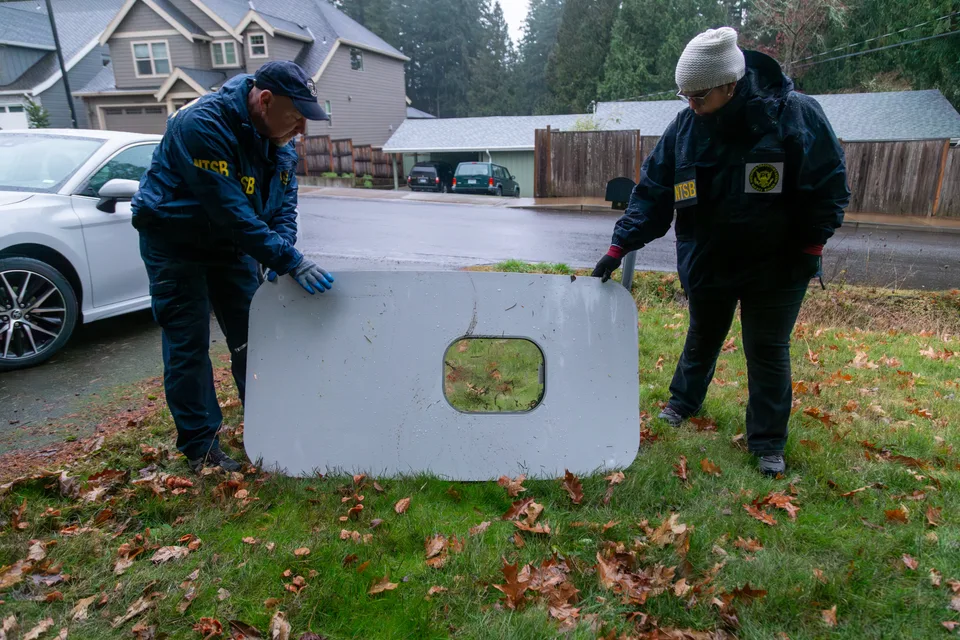
The four bolts that prevent upward movement were missing before delivery. The plug moved progressively upward until its stops disengaged.
Read the full incident Follow what happened, from the flight to the investigation findings.
What investigators concluded
The NTSB attributed the accident to Boeing training, guidance and oversight failures in its parts removal process, with ineffective FAA surveillance and audit planning contributing.
Alaska 1282: the missing bolts behind a sudden opening in the cabin
1,721 words / about 8 minutes to read. Based on the investigation records cited below.
A short flight interrupted during the climb
Alaska Airlines flight 1282 left Portland International Airport on 5 January 2024 for Ontario, California. The Boeing 737-9, registration N704AL, was operating a scheduled domestic passenger service. The captain was flying and the first officer was supporting him. Before departure, an external inspection found nothing unusual about the fuselage. Ice on the wing prompted an ice check and deicing. The departure briefing included the option of returning to Portland if a problem developed. Taxi, takeoff and the early climb gave the crews no indication of the structural emergency to come.
The airplane departed at about 17:07 Pacific standard time. At 17:12:33, with the aircraft climbing through approximately 14,830 ft, its cabin pressure dropped. The cabin altitude warning activated and the master caution followed a second later. The left mid exit door plug had separated from the fuselage. This was a structural panel occupying an opening that could be used for an additional emergency exit in other seating configurations. Its departure left an open hole alongside row 26 and abruptly changed conditions throughout the cabin and flight deck.
Both pilots described an abrupt physical disturbance. Their headsets were displaced and the flight deck door opened forcefully. They immediately put on their emergency oxygen masks and established communications, the memory steps in the airline's rapid depressurization procedure. Passenger and flight attendant oxygen masks also dropped. The warning, airflow and disturbance demanded several tasks at once, but the aircraft remained controllable. The developing emergency required a descent and a return to a nearby runway rather than continuation to the planned destination.
The first officer declared an emergency and requested a lower altitude. Both pilots found the noise made it difficult to hear one another and air traffic control. The captain disconnected the autopilot and autothrottles and began the descent. Recorded data show a maximum altitude of 16,320 ft at 17:13:41 before the aircraft descended. The selected altitude changed to 10,000 ft shortly afterward. The first officer could not find the quick reference checklist in its normal holder; the captain obtained the quick reference handbook instead, and she read the relevant procedure while continuing radio communication.
The cabin crew faced a different view of the same event. A flight attendant was bruised by the opening flight deck door. Others moved through the cabin using supplemental oxygen to assist passengers and unaccompanied minors. Empty seats near the opening initially led attendants to fear people had been lost. The investigation established that the two seats nearest the opening in row 26 had been unoccupied, while three passengers in row 25 moved after the separation. A young passenger's shirt had been pulled away, and belongings left the airplane through the hole. No occupant was lost.
The airplane descended below 10,000 ft at 17:17. The pilots prepared the runway 28L approach at Portland, using arrangements they had discussed before takeoff. An attempt to return from oxygen-mask microphones to headsets produced loud audio because the mask microphones remained active. They resumed using the masks and overhead speaker. The aircraft landed at 17:26:46, about fourteen minutes after the plug separated. The rollout and taxi were uneventful, and paramedics assessed the occupants at the gate. Seven passengers and one flight attendant had minor injuries; there were no deaths or serious injuries.
At the gate, a flight attendant told passengers to remain seated. Communication with the pilots was restored, and the crew confirmed that an evacuation was unnecessary. Aircraft rescue and firefighting personnel were waiting when the airplane arrived. No one was transported to a hospital. Reported passenger injuries included bruises and neck or ear pain. The injured flight attendant had bruises on her right arm and knee after the flight deck door struck her.
The investigation distinguished the panel's normal pressure-retaining structure from the hardware that keeps it in its correct vertical position. Stop fittings on the plug meet corresponding fittings on the fuselage frame and resist outward movement. Four bolts prevent the plug moving upward. For maintenance access, those bolts can be removed, allowing the plug to be lifted until its fittings clear the stops and its upper guides clear their rollers. The ability to open the panel is therefore deliberate, but it depends on reinstalling the securing hardware when the work is finished.
The NTSB found that the four bolts were already missing before the newly manufactured aircraft reached Alaska Airlines. Without them, the plug gradually moved upward during earlier flights. On flight 1282 it rose far enough for the retaining stops to lose engagement, then moved outward and aft and separated. Examination found no bolt contact damage around the relevant holes, supporting the finding that the bolts were missing before the plug moved off its stop pads. The aircraft damage and recovered plug supplied physical evidence independent of the crews' descriptions of the pressure loss.
A routine preflight walkaround was not a realistic means of detecting the earlier incremental movement. The board also found no evidence that Alaska Airlines had opened the left plug after delivery. Earlier AUTO FAIL indications in the pressurization system received separate investigation. The final report says that system operated as designed and that those indications were not associated with the plug's upward displacement.
The seat unit at row 26 remained firmly attached to the floor, but the seatback nearest the hole was deformed forward and outboard. Its armrest bent outward, and the tray table supports fractured. The tray table, seatback cushion and headrest were missing. Three oxygen masks above that seat unit were missing, and the reservoir bag of the remaining mask was shredded. Interior sidewall panels and trim also buckled or moved in areas extending from the forward cabin to row 27. Investigators recovered the plug and several cabin pieces on the ground along the flight path.
The plug had been opened during manufacture to give access for rivet rework on the adjacent edge frame. This disturbed an installation that had already been accepted. Boeing's parts removal process required a record identifying the removed parts, the work needed to restore the installation and the quality assurance signoffs. The record was more than an administrative trail: it was intended to make an unfinished installation visible and ensure that the securing hardware was restored before acceptance. No such removal record was generated for this opening.
When the plug was closed, the bolts and associated hardware were not reinstalled. The absence of a removal record also meant that no quality assurance inspection of the closure took place. The board could not identify the person who opened the plug. Personnel on duty lacked experience with that nonroutine task, and qualified door team personnel were not on duty when the plug was closed.
The report also examined a separate process for recording deferred or travelled work. Correct application of that process might have offered another chance to notice the missing hardware, but it did not replace the required removal record. Boeing's instruction for parts removals lacked the clarity and usability necessary for consistent decisions. On-the-job training was unstructured, undocumented and concentrated on routine build tasks. A manufacturing team could therefore be familiar with ordinary work while poorly prepared to recognise the safeguards required when an accepted assembly was disturbed.
The probable cause adopted by the NTSB connects the physical separation to Boeing's failure to provide adequate training, guidance and oversight for its parts removal process. The board identified ineffective FAA compliance surveillance and audit planning as a contributing factor. Parts-removal compliance issues had persisted for at least ten years before the accident, and corrective actions accepted by the regulator had not resolved them. The FAA failed to identify repetitive and systemic nonconformance and ensure that Boeing addressed it.
Other conclusions concern handling the emergency and preserving evidence. The NTSB found the pilots' oxygen use, decision to descend and return, and allocation of work appropriate. Cabin communication difficulties did not prevent attendants assisting passengers. Yet the oxygen training had not realistically prepared the pilots for the communications problems they encountered, and portable oxygen equipment was difficult for attendants to use quickly. The NTSB identified oxygen training and portable oxygen equipment as safety issues.
The cockpit voice recorder contained no audio from the accident flight because the recording had been overwritten. Investigators correlated flight data with flight and cabin crew interviews to reconstruct the sequence. The board also could not complete a broad assessment of Boeing's safety culture: the interview sample was small and a prolonged work stoppage prevented a wider survey.
Boeing had not conducted a change management assessment of the risks associated with a less experienced workforce, including employees with little or no manufacturing experience. The board found that this missed an opportunity to introduce measures protecting quality standards. Its quality escape guidance also inadequately addressed controls for human error. The voluntary safety management system was immature, lacked formal FAA oversight and had failed to identify the risk of this manufacturing escape.
The recommendations address both preventing another manufacturing escape and managing an emergency if one occurs. Boeing was asked to improve parts-removal guidance, recurrent training and structured on-the-job qualification, and to identify human-error risks in its safety and quality systems. The FAA was asked to improve surveillance, audit planning and access to historical records so repeated discrepancies could be tracked and resolved. Recommendations for a door plug design enhancement included certification, installation on new aircraft and retrofit of aircraft already in service.
The report also called for hands-on, aircraft-specific oxygen training and better procedures for preserving cockpit recordings. It reiterated the need for longer recording duration and measures to increase use of child restraints. The three lap-held children were uninjured, but the board identified the potential for severe injury or death in such circumstances. Structural separation damaged seats beside the open fuselage hole. Everyone returned alive, while the investigation traced that narrow escape back to safeguards that should have kept the panel securely installed.
The board recommended that FAA managers and inspectors receive recurrent training in identifying, recording and tracking repeated discrepancies and assessing whether corrective actions worked. It also called for access to compliance surveillance and audit records older than five years. For Boeing, the recommendations included a structured training program defining the tasks required for qualification, a grading system for trainers and trainees, and archived training results. For operators, the recommended cockpit recorder guidance covered flight crews and other personnel, emergency protocols and postincident checklists.
Seats 26A and 26B were unoccupied. The passenger in seat 26C remained there after the separation. The occupants of seats 25A, 25B and 25C moved before flight attendants reached the row.
Matching dossiers for Rapid depressurization: No other dossier in this collection.
Read alongside
These comparisons connect specific research topics. Shared circumstances do not establish identical causes. Evidence from both investigations is provided below.
Both this report and the BEA AF447 report discuss crew preparation for unusual emergencies. The mechanisms differ: Alaska 1282 involved structural separation and a successful return; AF447 involved loss of control after unreliable speed indications.
Explore the records below for additional context. They open on the publisher's site and are not all included in our report search. Source reuse terms apply.
Limited quotations for source-based commentary. Full report and illustrations are not republished. Wider reuse requires checking BEA terms. Source terms.
Kevin Murphy writes the incident accounts on AirlineIncidents.com, out of a long interest in aviation safety and the lessons each investigation leaves behind.
Prepared by
AirlineIncidents editorial desk
Report citation check
Independent expert review
Not completed
Citation checks compare supporting text with the indexed report pages. They do not constitute independent expert review. How these pages are prepared.
Revision history
: Published a sourced account, timeline, photographs and final investigation findings.