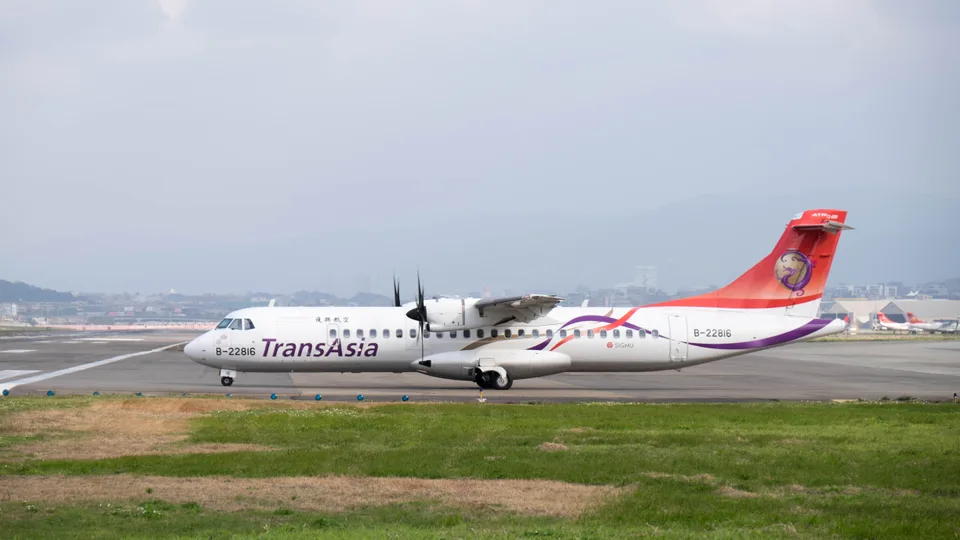
Original photograph unchanged. Responsive WebP copies resized without cropping.
Geographic context
Taipei Songshan Airport, departure
Keelung River, wreckage position
Approximate departure marker and the report's main wreckage coordinates. Kinmen was the intended destination. Basemap: Natural Earth, public domain.Read supporting evidence
During initial climb, engine 2's propeller autofeathered without a crew command. The crew failed to complete the malfunction identification procedure. The pilot flying reduced engine 1 power as speed fell and repeated stall warnings sounded. Engine 1 was then shut down. A late restart attempt could not recover the aircraft, which struck a taxi and the Huan-Dong overpass before entering the Keelung River inverted. Forty-three aircraft occupants died and fifteen survived.
Read the full incident Follow what happened, from the flight to the investigation findings.
What investigators concluded
The ASC found that intermittent torque-signal discontinuity may have triggered engine 2 autofeathering and was probably caused by compromised solder joints in its autofeather unit. The crew's failure to identify and manage the malfunction led to shutdown of the operative engine. Loss of thrust, inappropriate flight control inputs and ineffective response to stall warnings culminated in a stall and loss of control. The investigation also identified weaknesses in the airline's procedures, training, safety management and regulatory oversight.
1,716 words / about 8 minutes to read. Based on the investigation records cited below.
A third sector from Songshan
On 4 February 2015, TransAsia Airways flight GE235 was preparing to depart Taipei's Songshan Airport for Kinmen. The aircraft was B-22816, an ATR72-212A marketed as the ATR72-600. It carried 53 passengers, two cabin crew and three pilots. Two captains occupied the operating seats, with a first officer on the cockpit jump seat as an observer. The left-seat captain was pilot-in-command and pilot flying. The right-seat captain was pilot monitoring.
The crew had already completed a return journey between Songshan and Kinmen that morning. The first sector departed at 07:44 and arrived at 08:50. The return departed Kinmen at 09:17 and reached Songshan at 10:12. Both sectors were uneventful. GE235 was their third sector and was scheduled to leave at 10:45. The aircraft's maintenance records showed no reported defects or inoperative equipment when it was dispatched. Its weight and balance were within the specified limits.
Visual meteorological conditions prevailed. The airport information service reported visibility exceeding ten kilometres, wind from 100 degrees at eight knots, and a wet runway. The report found no adverse weather conditions affecting the flight. The departure used runway 10 and the MUCHA 2 Quebec instrument departure. High terrain, buildings and other obstacles surrounded Songshan and lay along the departure environment.
The takeoff roll began at 10:51:39. Four seconds later, the pilot monitoring called attention to the automatic takeoff power control system, or ATPCS, being unarmed. The pilot flying decided to continue and the pilot monitoring agreed. The crew subsequently announced that the system had armed. The aircraft became airborne at 10:52:01, retracted its landing gear and continued climbing. The crew selected 5,000 feet and a target speed of 115 knots, and engaged the autopilot.
ATPCS was designed to respond to a loss of engine torque by increasing power on the operating engine and automatically feathering the affected propeller. Feathering rotates the blades towards alignment with the airflow to reduce drag. The system received torque information through an autofeather unit on each engine. Its arming conditions included both engines producing sufficient torque and both power levers being advanced above the required position.
TransAsia's ATR72-600 crews were trained to reject a takeoff if ATPCS did not arm. Investigators found that the airline had no clear documented policy communicating this requirement. Its checklist also contained a weight check associated with the older ATR72-500 procedure, which permitted continuation under specified conditions. The ASC concluded that the absence of an enforced, documented policy created an opportunity for misunderstanding. The crew continued despite the initial arming discrepancy.
At 10:52:38, the aircraft was turning right and climbing through about 1,200 feet. The ATPCS sequence increased power on engine 1, the left engine, and began feathering the propeller on engine 2, the right engine. A master warning sounded and the engine warning display presented the engine 2 flameout-at-takeoff procedure. Engine 2's parameters had been normal before the sequence began. Its autofeather was uncommanded.
The pilot flying took manual control and the autopilot disconnected shortly after the warning. The ASC concluded that he had disconnected it. He then began reducing engine 1 power. The pilot monitoring asked for a crosscheck, but the left power lever had already moved back. Engine 1 was the operative engine, and this movement cancelled much of the extra power supplied by ATPCS.
The required procedure began with identification and confirmation of the malfunction while stabilising the flight path. The crew did not complete that process before acting. At 10:53:00, the pilot monitoring began the engine flameout check and confirmed uptrim and autofeather. As airspeed fell, he called attention to speed. The pilot flying reduced engine 1 power again. The pilot monitoring then confirmed engine 2 flameout, but the left power lever remained retarded.
At 10:53:09, the aircraft reached its highest recorded radio altitude, about 1,630 feet. Its speed was about 102 knots. The flight guidance changed from indicated-airspeed mode to pitch hold, and a stall warning sounded. Further warnings and stick shaker activation followed. These warnings indicated that the aircraft was approaching an aerodynamic stall. The pilot monitoring urged a reduction in pitch and tried to stop the continuing throttle reduction.
Engine 2's power lever was advanced while engine 1's lever was brought towards idle. The pilot flying called for engine 1 to be feathered and shut down. The documented shutdown procedure required pointing to the affected lever, naming it, obtaining the other pilot's confirmation and then moving it. The crew used nonstandard callouts and processes amid frequent stall warnings. The crosschecks did not prevent shutdown of the operative engine.
At 10:53:24, engine 1's condition lever reached fuel shutoff. Its propeller subsequently feathered. With thrust lost from both sides, the aircraft descended. Stick shaker and stick pusher activations had occurred repeatedly. The stick pusher was designed to lower angle of attack automatically as stall protection. The ASC found that the loss of power and inappropriate flight control inputs generated the warnings, and that the crew's response was too late and ineffective.
The pilot monitoring transmitted a Mayday at 10:53:35. During the descent, the crew made two attempts to use the autopilot, but it did not remain engaged. At 10:54:05, the pilot monitoring recognised the loss of power on both sides. Four seconds later, the pilot flying called for an engine restart. The aircraft was then about 545 feet above the surface, with a recorded speed of 105 knots.
At 10:54:20, engine 1's condition lever moved out of fuel shutoff. Its high-pressure spool speed reached 30 percent at 10:54:25, when the aircraft was about 400 feet high. The pilot flying recognised that he had reduced the wrong throttle at 10:54:27. The aircraft entered a stall and continued descending. A ground proximity pull-up warning sounded at 10:54:34.
The left bank steepened rapidly, reaching about 80 degrees. The left wing struck a taxi on the Huan-Dong overpass, then the overpass barrier and a light pole. The aircraft continued rolling and entered the Keelung River inverted. It broke up on impact. The main wreckage came to rest near the middle of the river, with much of it submerged. The taxi driver suffered serious injuries and the taxi passenger minor injuries.
Forty-three aircraft occupants died: the three pilots, one cabin crew member and 39 passengers. Fourteen passengers and one cabin crew member survived. Thirteen surviving passengers and the cabin crew member sustained serious injuries; one passenger had minor injuries. All fifteen survivors had been seated behind row 10. Survivors described an inverted, dark cabin, water entering the fuselage, and seats, baggage and debris obstructing escape.
Ten survivors left through a break in the right side of the fuselage around rows 14 and 15 and stood on a wing section awaiting rescue. Five others remained near the rear service door. Firefighters arrived from about 11:05 to 11:15. Strong river currents prevented two of three firefighters who attempted to swim to the wreckage from reaching it. Two powered rubber boats reached the aircraft at about 11:30. Rescuers recovered the group on the wing and opened the rear service door to reach the other five survivors at about 11:35.
Investigators examined the engines, torque sensors, wiring and autofeather units. Engine examinations found no pre-existing anomalies affecting normal operation. Wiring continuity checks were normal. The torque sensor connected to engine 2's autofeather unit had a broken coil wire, which examination attributed to impact. Testing of the autofeather unit itself found intermittent electrical continuity failures at connections between its flex circuit and header pins.
Microscopic examination found enlargement, coarsening and cracking of solder near the pin interfaces. The ASC found that compromised solder joints probably caused intermittent disruption of the torque signal and that this disruption may have caused the unstable ATPCS arming and uncommanded autofeather. A further unit examined during the investigation showed a similar fault. The affected units had accumulated 1,624 and 1,206 flight hours, well below the manufacturer's previously recommended 12,000-hour inspection point. The ASC found the earlier measures insufficiently effective.
Simulator testing showed that the aircraft could continue climbing on one engine when the appropriate procedures were followed. Manufacturer pilots maintained about 600 feet per minute at 115 knots with ATPCS active. Restart testing required about 25 to 30 seconds and consumed 400 to 900 feet of altitude. The ASC concluded that the remaining height and time during GE235's late restart were insufficient for recovery.
The pilot flying's training records contained repeated concerns about handling engine failures and performance under stress. He had passed subsequent checks, but TransAsia lacked a mechanism for identifying recurring patterns of critical performance deficiencies. The ASC found that his accident performance was consistent with weaknesses seen in training and that the airline had failed to address the associated safety risk. It also identified deficiencies in crew resource management training, command upgrade procedures, differences training and training record management.
The ASC's probable-cause findings included failure identification, shutdown of the wrong engine, ineffective response to stall warnings and ineffective crew coordination. Its risk findings addressed the airline's management processes and the Civil Aeronautics Administration's oversight. Previously identified systemic noncompliance with procedures remained unresolved when GE235 occurred.
In comments appended to the final report, the CAA disputed the conclusion that the crew had disconnected the autopilot. It said its simulator reproduction produced automatic disconnection and called for greater examination of the indications available to the pilots during uncommanded autofeather. The regulator also questioned how well the simulator represented that malfunction and proposed further human performance testing. The ASC's final analysis concluded that the pilot flying had disconnected the autopilot, using recorder data and disengagement logic analysis.
The final report issued sixteen safety recommendations. TransAsia was asked to document the ATPCS takeoff rejection policy, improve training and internal oversight, introduce a formal pilot performance review programme and assess its safety culture. The CAA was asked to strengthen oversight and ensure effective corrective action. Recommendations to component, engine and aircraft manufacturers addressed uncommanded autofeather risk and rejected takeoff procedures. EASA was asked to review flight director guidance during automatic stall protection and minimum differences training requirements.
The report recorded an improved autofeather control for new engines and a service bulletin for retrofit. ATR reported issuing operational guidance on uncommanded autofeather and revising its differences training course in March 2015. TransAsia and the CAA supplied lists of safety actions in May 2016. The ASC had not verified the actions supplied by those organisations.
Engine 2, on the right, lost thrust when its propeller autofeathered. Engine 1 was still operative when the pilot flying reduced its power and shut it down.
Why did the engine restart fail to prevent impact?
The attempt came with about 550 feet and 25 seconds remaining. Simulator restart tests required 25 to 30 seconds and lost up to 900 feet. The ASC found the remaining height and time insufficient.
Engine 2's autofeather unit had intermittent continuity failures at solder joints between the flex circuit and header pins, with solder cracking and coarsening.
The ASC judged compromised solder joints the probable source of intermittent torque-signal discontinuity. Its probable-cause finding says that discontinuity may have triggered ATPCS.
Simulator testing showed nose-up flight director guidance during automatic nose-down stall protection. The ASC could not demonstrate its influence on the accident flight.
Actions and recommendations are described at the dates of the cited records. A recommendation is not proof of implementation.
Airline procedures and pilot performance
The ASC recommended a documented ATPCS rejection policy, stronger training and internal oversight, formal performance review and evaluation of the airline's safety culture.
The report records an improved control for new production engines and service bulletin SB21880, issued in October 2015, for replacement on existing engines.
ATR reported March 2015 guidance on uncommanded autofeather and an overhaul of the ATR500-to-600 differences course. TransAsia and the CAA supplied action lists in May 2016. The ASC had not verified these submitted actions.
These comparisons connect specific research topics. Shared circumstances do not establish identical causes. Evidence from both investigations is provided below.
In both accidents, the crew shut down the operating engine after a malfunction in the other engine. At Kegworth, a fan blade fractured in engine 1 and the crew shut down the normally running engine 2. On TransAsia 235, engine 2 autofeathered without a crew command and the crew reduced power on and shut down the operative engine 1. Both investigations found that the crew acted before completing the identification of the malfunction.
Explore the records below for additional context. They open on the publisher's site and are not all included in our report search. Source reuse terms apply.
Taiwan Transportation Safety Board case record with the English final report.
Sources and transparency
ASC English final report, published 30 June 2016.
Source limitations
Functional testing of engine 2's autofeather unit stopped after a short circuit during a gain test. Investigators then examined the solder joints using imaging and destructive testing.
ASC-AOR-16-06-001: TransAsia Airways Flight GE235
Aviation Safety Council English final report, published 30 June 2016; first printing July 2016
Kevin Murphy writes the incident accounts on AirlineIncidents.com, out of a long interest in aviation safety and the lessons each investigation leaves behind.
Prepared by
AirlineIncidents editorial desk
Report citation check
Independent expert review
Not completed
Citation checks compare supporting text with the indexed report pages. They do not constitute independent expert review. How these pages are prepared.