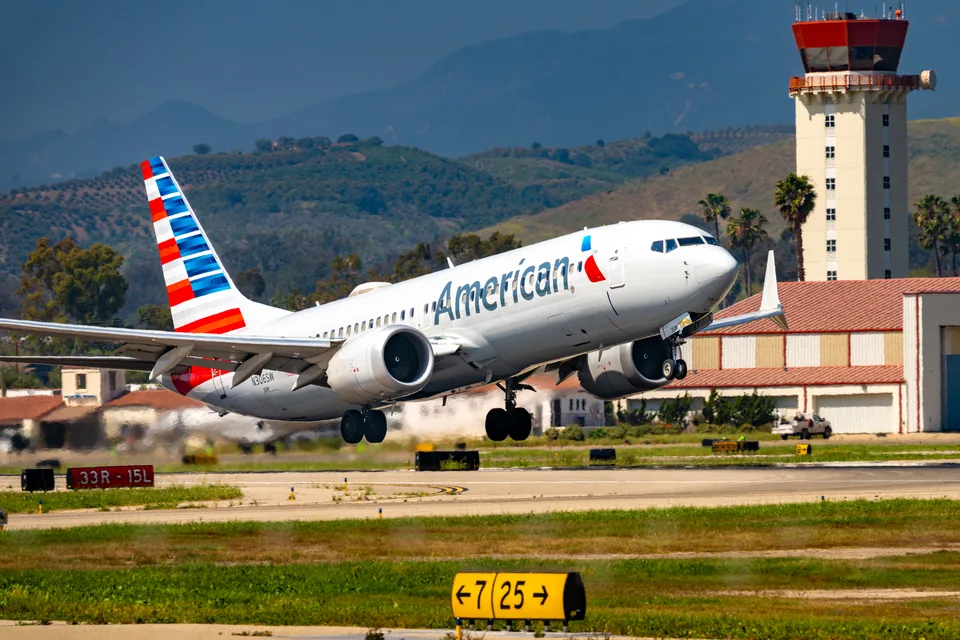
Unmodified source image. Display copies resized without cropping. Responsive WebP copies resized without cropping.
Geographic context
Denver International, accident airport
Miami International, intended destination
Schematic geography only. Airport markers are approximate; these points do not show a recorded flight track. Basemap: Natural Earth, public domain.Read supporting evidence
American Airlines Flight 3023 rejected its takeoff from Denver after the left main landing gear tires and wheels failed at about 90-100 kt. The aircraft tilted left, and both pilots perceived a significant loss of controllability. The captain stopped near the runway centreline. Reported fire beneath the left wing and smoke entering the cockpit led to an emergency evacuation. All 175 occupants were recorded as uninjured.
Read the full incident Follow what happened, from the flight to the investigation findings.
What investigators concluded
The NTSB attributed the tire and wheel failures to thermal relief plugs melting and releasing tire pressure. The resulting abnormal handling led the crew to reject the takeoff at high speed.
A changing-wind departure ends with a high-speed stop and evacuation
1,572 words / about 8 minutes to read. Based on the investigation records cited below.
A departure repeatedly reshaped by the wind
American Airlines Flight 3023 was scheduled to leave Denver for Miami on 26 July 2025. The Boeing 737-8, registered N306SW, had already brought the crew from Miami to Denver earlier in the duty day. The return departure carried 169 passengers and six crew. Before the aircraft accelerated along runway 34L, the pilots had considered and rejected other runway options as wind conditions changed across the airport.
The crew's departure planning already recognised a demanding combination of high ambient temperature, aircraft weight near performance limits and fuel close to the required minimum. They planned a bleeds-off takeoff, meaning engine air would not be used for cabin air conditioning during that phase, to obtain maximum takeoff thrust. Both engines were started early in anticipation of a short taxi and a prompt departure.
The initial airport information favoured runway 08. After the aircraft taxied there and received clearance to enter, the tower gave updated winds with a tailwind component the pilots could not accept. They advised air traffic control and left the runway. Denver was changing its runway configuration amid rapidly shifting winds, with windshear reports and another aircraft going around. The crew's first departure plan had therefore changed before any takeoff attempt.
Flight 3023 next taxied toward runway 17L, but newer wind information again contained an unacceptable tailwind component. The crew declined that departure as well and coordinated with controllers for a north-flow runway. They did not have performance data available for runway 35R. Previously calculated data did support runway 34L, so the pilots accepted that runway and continued across the airfield.
At runway 34L, an extended delay lasted approximately 25 minutes. During the wait, the crew saw a dust devil west of the airport and received further information about variable winds. They notified American Airlines dispatch that duty-time limits and minimum fuel thresholds were approaching. These details explain the operating context described in the report. They do not, by themselves, establish that a limit was actually breached or that the crew knowingly departed in prohibited conditions.
The takeoff clearance eventually came with calm winds reported. The first officer was the pilot flying. He advanced the thrust levers initially to about 40 percent N1, the engine speed parameter described in the report. Acceleration appeared normal for the high airport elevation, warm conditions and heavy aircraft. The standard 80-knot callout was made and acknowledged. The sudden failure occurred after that milestone, while the aircraft was still on the runway.
Between approximately 90 and 100 knots indicated airspeed, the captain heard a loud pop and felt a bump. Almost immediately, the aircraft tilted abruptly to the left. Both pilots perceived a significant loss of controllability. Their impression was consistent with a landing gear problem or multiple tire failures. The first officer called for an abort, and the captain took control to perform a rejected takeoff.
The captain used differential braking and rudder to preserve directional control. He did not deploy thrust reversers because of concern about controllability. The report records that choice and the successful stopping position; it does not prescribe that response as general guidance for other aircraft or failures. Flight 3023 stopped near the runway centreline despite the pronounced tilt and damaged left main gear.
This was an operational takeoff emergency, rather than a stationary ground collision. The failure had occurred at substantial speed, and the aircraft was supported unevenly as it decelerated. At that moment the crew's immediate problem was keeping the aircraft controlled and stopping it. Only after it had stopped could the subsequent fire reports and cockpit smoke determine whether passengers should remain aboard or evacuate.
Tower personnel reported smoke and fire beneath the left wing. The aircraft remained significantly tilted, and smoke began entering the cockpit. The pilots initially told passengers to stay seated. Approximately 30 to 45 seconds later, the reports of fire and the smoke led them to order an emergency evacuation. The changing instructions reflected a developing situation, not a single unchanging set of conditions.
The pilots completed the evacuation checklist twice to verify the actions. When they opened the cockpit door, the report says the passengers had already exited. The captain swept the cabin to ensure nobody remained before leaving. Airport rescue and fire fighting vehicles responded, and buses later took the passengers back to the terminal. The investigation records no passenger or crew injuries.
That outcome does not mean the evacuation was effortless. A tilted aircraft, smoke, uncertainty about the outside conditions and a crowd of people all had to be managed in a short period. The report preserves the cabin crew's accounts because they explain how the evacuation actually unfolded. It does not supply a measured overall evacuation time, and this account does not compare the real evacuation with a certification-test time.
The lead flight attendant at the forward entry door heard a rough noise during the takeoff roll, then smelled smoke and heard passengers saying that the aircraft was on fire. After stopping, some passengers stood and tried to open overhead bins despite instructions to remain seated. The attendant checked outside through the door window and moved forward to look for fire, but initially saw none.
As smoke and a burning smell persisted, passengers asked for the doors to be opened. The lead attendant attempted an emergency interphone call to the flight deck without an immediate response. After the captain ordered evacuation, she opened the left forward door. Wind resistance made the door difficult to open, but its slide deployed. She instructed people to leave their belongings, yet several took carry-on bags, slowing movement out of the aircraft.
The aft cabin account described similarly rapid events: severe bumping, a pop and a burning-rubber smell, followed by passengers standing, opening bins and moving toward the galleys. After the evacuation command, aft slides were deployed. Passengers crowded the exits and many retained belongings. Firefighters assisted outside. These are attributed observations from the crew interviews. The report records the obstruction to orderly movement, while also recording that nobody was reported injured.
The physical examination found damage to the left main gear strut, wheels, brakes and tires, as well as several flap, fairing, engine-cowl and wing components. Most of those individual items were excluded from the substantial-damage classification. The left wing lower skin was different: it was a primary structural component whose damage adversely affected wing strength and required replacement.
Investigators found dents, gouges and paint damage consistent with impacts from fractured wheel debris. The largest recorded dent was approximately three inches across and at least a quarter inch deep, with an internal fracture. Some gouges exceeded the structural repair manual's permitted limits. According to the airline, replacement of the one-piece lower skin extended from wing root to wingtip. That explained the report's substantial-damage finding despite the absence of human injuries.
The wheel evidence showed a progressive breakdown after pressure loss. One wheel remained largely intact before seizing and abrading down toward the axle. The other broke into pieces as its rims rolled along the runway. As the wheels and lower strut wore away, parts of the left engine's cowl and reverser doors contacted the runway. The detailed examination therefore connected the initial tire failure with the tilt, continuing abrasion and debris damage.
Each main wheel had four thermal relief plugs designed to melt at high temperature and release tire pressure. Their purpose was protection against excessive tire pressure. Examination found missing relief plugs on the left wheels, and a plug recovered from the runway had lost its meltable centre. The investigation concluded that melting plugs had released tire pressure during the takeoff roll.
That finding is more specific than simply saying a tire burst. It identifies a pressure-release mechanism and the resulting loss of normal wheel support. The final report does not fully reconstruct every wheel and brake temperature during the preceding taxi and delays. Although the hot-day operating context matters, this account does not assign an unsupported percentage of the heating to a particular taxi segment or pilot action.
The NTSB determined that the left main tires and wheels failed because the thermal relief plugs melted and released pressure. The abnormal handling that followed led the crew to reject the takeoff at high speed. Its findings concern wheel and tire failure. The report does not identify a 737 MAX automated flight-control failure or an engine failure as the initiating mechanism.
A successful escape, with lessons bounded by the record
All 175 occupants were recorded as uninjured. The aircraft was substantially damaged, and the investigation documented an on-ground fire. Those facts belong together: an emergency can carry substantial risk and damage while ending without deaths or serious injuries. The passenger outcome should not be used to recast the occurrence as a routine tire change.
The report also offers a concrete account of evacuation behaviour. Cabin crew repeatedly described baggage retrieval, crowding and difficulty obtaining compliance. It is reasonable to identify those observations as relevant to emergency movement. It is not reasonable to invent an injury count, a precise delay for each bag, or a hypothetical number of casualties had the fire developed differently.
The final report was published on 26 August 2026. It records the investigation's cause and supporting accounts, rather than demonstrating the current completion of a new corrective programme. This draft therefore separates the documented event, the NTSB's causal finding and the limits of the follow-up record. The narrative ends with the supported outcome: the aircraft stopped, its occupants evacuated, and the later examination traced the failure to the wheel thermal relief system.
A simplified reading of the investigation findings. The sequence does not replace the full report or imply that every contributing factor is shown.
Sequence of events
Times are Denver local. The principal sequence uses the report's relative timings; 14:16 is the overview event time, not a time derived from a flight-recorder chronology. Expand an event to see its evidence.
Before departureSeveral runways considered
The crew declined runway 08 and then 17L because updated winds included unacceptable tailwind components.
The investigation found that thermal relief plugs had melted and released pressure. These plugs protect against excessive pressure at high temperatures.
The final report records 169 passengers and 6 crew uninjured. Cabin crew described a passenger with a preexisting knee condition needing assistance; the report does not classify that as a new injury.
The final report identifies melted thermal relief plugs, but does not reconstruct every preceding wheel temperature or assign a quantified heat contribution to each taxi segment.
The report records tower observations of smoke and fire beneath the wing and smoke entering the cockpit. These do not establish that the entire wing or passenger cabin was burning.
The report documents passengers retrieving baggage and crowding exits despite commands. This was observed evacuation behaviour, not a separately quantified causal finding.
The final report was published on 26 August 2026. It states the probable cause but does not document a subsequently implemented fleet-wide corrective programme.
These comparisons connect specific research topics. Shared circumstances do not establish identical causes. Evidence from both investigations is provided below.
Both reports concern an aircraft's stopping capability and crew decisions on a runway. Flight 3023 stopped after a tire and wheel failure on takeoff; Flight 1420 overran during landing, with different spoiler and braking findings. These are related research topics, not identical causes.
Explore the records below for additional context. They open on the publisher's site and are not all included in our report search. Source reuse terms apply.
Supporting investigation records. Availability and third-party reuse rights differ between documents.
Sources and transparency
5 October 2026, report text and citation locations checked. Independent expert review not completed.
Source limitations
The report establishes melted thermal relief plugs and tire pressure loss, but does not fully quantify the prior wheel and brake temperature history or assign a separate procedural cause for the heating. Cabin accounts describe passenger behaviour without a measured total evacuation time.
American Airlines Flight 3023: rejected takeoff and evacuation at Denver - NTSB DCA25LA275
National Transportation Safety Board Official final report, released 26 August 2026
US federal investigation report, attributed to the NTSB. Third-party photographs and illustrations are excluded from reuse. No NTSB endorsement. Source terms / provenance.
Runway Overrun During Landing: American Airlines Flight 1420, McDonnell Douglas MD-82, N215AA, Little Rock, Arkansas, June 1, 1999
National Transportation Safety Board NTSB/AAR-01/02, adopted 23 October 2001
US federal investigation report, attributed to the NTSB. Limited excerpts for commentary; third-party material and illustrations excluded. No NTSB endorsement. Source terms / provenance.
Kevin Murphy writes the incident accounts on AirlineIncidents.com, out of a long interest in aviation safety and the lessons each investigation leaves behind.
Prepared by
AirlineIncidents editorial desk
Report citation check
Independent expert review
Not completed
Citation checks compare supporting text with the indexed report pages. They do not constitute independent expert review. How these pages are prepared.
Revision history
: Published sourced incident account, timeline, photographs and investigation findings.