An engine failure punctured a fuel tank during takeoff. Wind drove the resulting fire around the stopped aircraft as smoke and exit restrictions overwhelmed the evacuation.
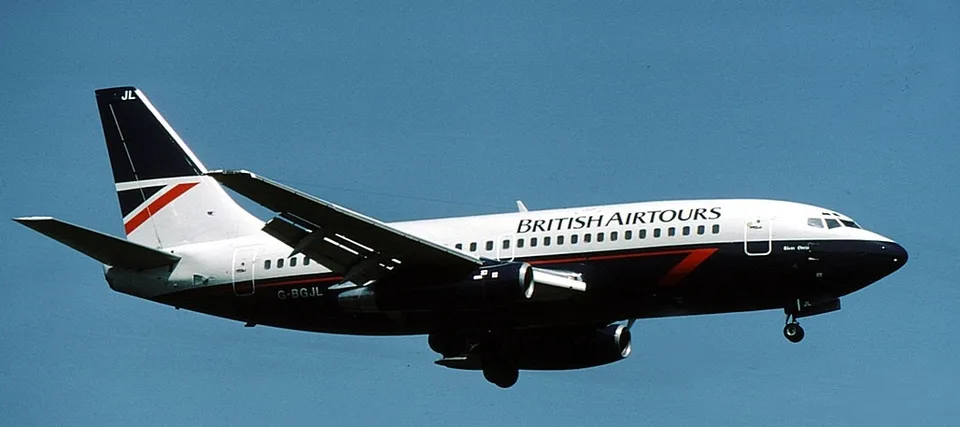
Previously cropped on Wikimedia Commons. Local image has no further crop or colour changes. Responsive WebP copies resized without cropping.
Geographic context
Manchester International Airport, departure and accident
Corfu, planned destination
The charter was scheduled from Manchester to Corfu. The aircraft stopped on the ground at Manchester during the rejected takeoff. Markers locate Manchester and Corfu approximately. Basemap: Natural Earth, public domain.Read supporting evidence
The left engine suffered an uncontained failure during the takeoff run. Ejected combustor material punctured a wing fuel-tank access panel and the leaking fuel ignited. The crew rejected the takeoff and turned right towards link Delta. A light wind drove the fire against and beneath the rear fuselage. Smoke rapidly entered the cabin, while a jammed forward door and restricted access to exits delayed evacuation. Fifty-five people died and 82 survived.
Read the full incident Follow what happened, from the flight to the investigation findings.
What investigators concluded
AAIB found that failure of the repaired No 9 combustor can initiated the uncontained engine failure. The fire became catastrophic primarily because of the stopped aircraft's orientation to the wind. The report identified weak fuel-tank access panels, hull vulnerability, inadequate provision for fighting major cabin fires and toxic emissions from burning furnishings as major contributing factors. Rapid smoke incapacitation caused most fatalities, aggravated by the door malfunction and exit restrictions.
2,000 words / about 10 minutes to read. Based on the investigation records cited below.
A charter departure from Manchester
British Airtours Flight KT28M was preparing to leave Manchester for Corfu on 22 August 1985. G-BGJL, a Boeing 737-236 series 1, carried 131 passengers and six crew. The passenger total included two infants. The crew comprised two pilots and four cabin attendants, with the purser and a stewardess stationed at the front and two stewardesses at the rear. The scheduled departure was 06:00 UTC. The crew had reported an hour earlier and carried out their normal preparations.
The pilots discussed a technical-log entry from the previous day concerning slow acceleration of the left engine. The first officer had flown the aircraft when that defect was reported. Remedial work had been followed by two flights with no reported problem, and the captain accepted the aircraft. Engine starting was normal. The pilots agreed that the first officer would fly this sector and briefed their responsibilities for a takeoff emergency before and after the decision speed of 146 knots.
The captain requested taxi clearance at 06:08 and brought the aircraft to Runway 24. The cabin crew demonstrated the safety equipment, then reported the passenger count. After lining up, the captain handed control to the first officer. Takeoff clearance came at 06:12, with wind from 250 degrees at seven knots. Both engines reached the required takeoff power, and the left engine's acceleration appeared satisfactory.
About 36 seconds into the takeoff run, as airspeed passed 125 knots, the crew heard a thud. The captain immediately ordered the takeoff abandoned, closed the throttles and selected reverse thrust. The aircraft reached a maximum indicated airspeed of 126 knots. The first officer applied maximum wheel braking, then moderated it at the captain's direction. With substantial runway remaining and a possible tyre failure in mind, the captain wanted to avoid additional wheel damage.
The left engine had suffered an explosive rupture of its combustion chamber outer case. The forward dome of the No 9 combustor can was ejected from the engine and struck a fuel-tank access panel under the wing. The panel was punctured, releasing fuel beside the damaged engine. Fuel meeting the escaping combustion gases ignited. A large flame plume streamed behind the left engine while the aircraft decelerated.
The left engine fire warning sounded nine seconds after the thud. The detection system was serviceable, but the fire was burning outside the nacelle. The captain was beginning a radio transmission about the rejected takeoff when the warning appeared. The tower confirmed the visible fire and that emergency vehicles were responding. When the captain asked about evacuation, the controller advised using the right side.
The aircraft continued towards the right turnoff into link Delta. Fourteen seconds before it stopped, the captain broadcast an instruction for evacuation on the right side. The purser came to the flight deck for confirmation, and the captain repeated the instruction. The Boeing came to rest at the entrance to the link. The captain directed the first officer to carry out the left engine fire drill and shut down the right engine to make evacuation on that side possible.
While the aircraft was moving quickly, fuel burned in the turbulent wake behind the extended reverser buckets. As its speed fell, that wake weakened and the fire developed over the fuel pooling behind it. Turning right placed the burning fuel upwind of the rear fuselage. The light wind carried fire against and beneath the hull and surrounded the right rear door with smoke. That door had been opened before the aircraft came to a complete stop; nobody escaped through it.
AAIB judged the pilots' initial assessment and actions reasonable given the cues available to them. The captain had first heard a noise consistent with a tyre burst or bird strike, and the fire warning arrived during an intense sequence of handling and communication tasks. The investigation found the turn understandable in those circumstances. Its physical effect was severe: the parked cabin was exposed directly to the wind-driven fuel fire.
The purser went to the right forward door as the aircraft stopped. It unlocked, but the escape-slide container lid caught on the doorframe while the door moved through its opening. He tried briefly to free it, then crossed to the left forward door. After checking that fire had not spread far enough forward to block escape, he opened that door and deployed its slide. Evacuation through it began about 25 seconds after the aircraft stopped, as the first fire vehicle began discharging foam.
Passengers became wedged in the narrow passage between the forward galley bulkheads. The stewardess had to pull people clear to start the flow onto the slide. The purser returned to the right door, lifted the slide pack, closed its container lid and freed the obstruction. He opened the door fully about one minute and ten seconds after the stop. The two forward cabin attendants supervised their respective exits as smoke reached the galley and became increasingly dense.
The pilots began the passenger evacuation checklist but saw fuel and fire advancing along the aircraft's left side. They escaped through the right sliding flight-deck window using a fabric strap. AAIB later found the checklist inappropriate for the emergency and recorded that it had been modified. Passenger evacuation had already begun independently of its completion.
Passengers opened the right overwing exit with difficulty. The woman beside it initially pulled the armrest mounted on the hatch. Her companion reached across and operated the release handle. The 48-pound hatch fell inward and trapped the woman in her seat. With help from another passenger, it was lifted clear and placed on a vacant seat. Escape through the opening began about 45 seconds after the aircraft stopped.
Smoke rapidly enveloped the centre cabin and the queue for the overwing opening. Restricted access, the seat arrangement and pressure from people trying to escape slowed movement. The seat back beside the exit folded forward after its hinge stop failed under passenger pressure, creating another obstruction. Some passengers climbed over seat backs because people had collapsed in the aisle. Others temporarily lost consciousness, then recovered enough to continue towards an exit.
The two forward doors and the right overwing opening were the successful passenger escape routes. Seventeen surviving passengers left through the left forward door, 34 through the right forward door and 27 through the overwing exit. The two forward cabin attendants stayed aboard until smoke threatened to overcome them. The two attendants at the rear died. AAIB credited the direct actions of the forward crew with saving passengers' lives.
The wind drove the pool fire against the lower left side of the rear fuselage. AAIB found that the lower skin near the aft cargo hold was penetrated within 20 seconds of the aircraft stopping. Fire then passed through the insulation into cavities around the hold and entered the cabin through floor-level air-conditioning grilles. The investigators estimated that the cabin sidewalls near seats 17A to 19A were penetrated within a minute, giving the fire direct access to the passenger compartment.
Openings in the fuselage and exits allowed the wind-induced pressure differences around the aircraft to draw combustion products through the cabin. Interior materials ignited, and burning ceiling panels and overhead lockers collapsed onto seats as the fire spread forward. AAIB found brief ignitions of accumulated gases but no fully developed cabin flashover. Heat and smoke were strongly layered, with comparatively cooler conditions close to the floor in areas away from active burning.
The principal cause of death was rapid incapacitation in dense toxic and irritant smoke. Of the 54 people who died aboard the aircraft, 48 had absorbed carbon monoxide, hydrogen cyanide or both at levels sufficient to incapacitate them. Waiting at blocked or restricted exits prolonged exposure. As passengers weakened or collapsed, movement slowed further, increasing the exposure of those behind them. AAIB identified this reinforcing relationship between delay and debilitation as a central survival problem.
Manchester's airport fire service responded rapidly and began firefighting about 25 seconds after the stop. Vehicles were positioned to protect escape routes and attack the external fire. Most of that fire was brought under control quickly, although running fuel beneath the wing puncture remained difficult to extinguish. The fire already inside the cabin presented a further problem for which the airport service lacked effective equipment.
A foam tender retrieved from the paint shop reached the aircraft during the rescue. Its driver saw a hand moving above a man trapped in the right overwing opening, climbed onto the wing and pulled a boy clear. The boy was rescued about five and a half minutes after the stop and was the last evacuee to survive. Firefighters subsequently entered through the right forward door. An explosion threw one firefighter out, and further entry was suspended while a reliable water supply was sought.
Water carried by the airport vehicles was effectively exhausted after about seven to eight minutes. Initial replenishment attempts failed because the ring main feeding nearby hydrants had been isolated. Outside fire crews also encountered an escort delay following changes to emergency arrangements that had not been communicated to the airport police. A passenger found unconscious in the forward aisle about 33 minutes after the stop died six days later from lung damage and pneumonia. The final toll was 55 deaths, comprising 53 passengers and two cabin crew. Eighty-two occupants survived, and 15 passengers suffered serious injuries.
The No 9 combustor can had undergone direct fusion weld repair in November 1983 after circumferential cracks with a combined length of 180 millimetres were found. It then operated for another 4,611 hours and 2,036 cycles before failing. Thermal fatigue developed into a separation around the can, allowing hot gases to overheat and weaken the outer combustion casing until it ruptured. The repair had failed to provide enough residual life to reach the next scheduled inspection.
Direct fusion welding addressed visible cracks while leaving embryonic fatigue damage elsewhere in the metal. The manufacturer's warnings about reduced fatigue life after weld repair had not quantified that reduction, and British Airways had interpreted them as applying to parts with greater service exposure. AAIB found inadequate information exchange between manufacturer and operator. It also found that routine trend analysis of G-BGJL's recorded engine data would not have warned of the impending failure.
The punctured access panel had about a quarter of the impact strength of the surrounding lower wing skin. AAIB's cause statement identified the engine failure and the adverse orientation of the parked aircraft to the wind. Major contributing factors included panel vulnerability, the hull's vulnerability to external fire, inadequate provision for fighting a major cabin fire and toxic emissions from burning interior materials. The fatalities were aggravated by the forward door malfunction and restricted access to exits.
After the accident, the CAA and FAA required recurring JT8D inspections aimed at finding circumferential combustor cracking before complete separation. AAIB recommended ending direct fusion weld repair of these cracks unless a safe life had been demonstrated for the intended inspection or overhaul interval. It also sought stronger fuel-tank access panels, protection against debris impacts and greater attention to the hull's resistance to external fire.
Operational recommendations called for crews to stop on the runway after a rejected takeoff or emergency landing, assess the situation and consider wind direction when positioning an aircraft with a ground fire. Cabin recommendations addressed the forward galley restriction and overwing access, including removal of all row 10 seats in G-BGJL's configuration. The investigators also sought evacuation testing with exits concentrated towards one end of a cabin and a simulated dense smoke atmosphere.
The report recommended stricter limits on smoke and toxic emissions from cabin materials, passenger smoke protection and development of onboard water-mist systems. Its survival research had found that smokehoods could keep evacuees conscious and mobile in aircraft fire environments. The regulatory evacuation test had previously cleared 130 passengers and five crew from a Boeing 737-200 in 75 seconds, but AAIB found that it had not examined the restrictions created when the exits at one end were unavailable or the effects of dense smoke on those trying to escape.
A simplified reading of the investigation findings. The sequence does not replace the full report or imply that every contributing factor is shown.
Sequence of events
UTC. Takeoff began at about 06:12; the report gives the accident time as 06:13. Evacuation timings are approximate intervals after the aircraft stopped. Expand an event to see its evidence.
05:00 UTCCrew reports for duty
The two pilots and four cabin attendants prepare for the Manchester to Corfu charter.
Passengers escaped through the two forward doors and the right overwing opening. The left forward door became available at about 25 seconds, the overwing opening at about 45 seconds and the right forward door at about 70 seconds after stopping.
Why could passengers become trapped in a stationary aircraft?
The cabin filled with toxic and irritant smoke. Door and access restrictions delayed escape; weakened passengers then collapsed in the escape routes, further slowing evacuation.
How did the investigation assess the pilots' actions?
AAIB found their initial assessment and subsequent actions reasonable given the available cues, knowledge, training and operating practices. Turning right placed the fire upwind of the fuselage.
What did the investigation recommend for evacuation testing?
AAIB recommended tests with half the exits concentrated towards the end imposing the greatest restriction on escape, together with simulated dense smoke throughout the evacuation.
Actions and recommendations are described at the dates of the cited records. A recommendation is not proof of implementation.
Mandatory engine inspections
After the accident, the CAA and FAA required JT8D inspections at intervals intended to detect circumferential combustor cracking before complete separation.
Recommendation 4.8 called for removal of direct fusion weld repair for circumferential combustor cracks unless a safe service life had been demonstrated.
These comparisons connect specific research topics. Shared circumstances do not establish identical causes. Evidence from both investigations is provided below.
Further investigation records
Explore the records below for additional context. They open on the publisher's site and are not all included in our report search. Source reuse terms apply.
Kevin Murphy writes the incident accounts on AirlineIncidents.com, out of a long interest in aviation safety and the lessons each investigation leaves behind.
Prepared by
AirlineIncidents editorial desk
Report citation check
Independent expert review
Not completed
Citation checks compare supporting text with the indexed report pages. They do not constitute independent expert review. How these pages are prepared.
Revision history
: AAIB final report 8/88 and its supporting appendices.
.jpg)