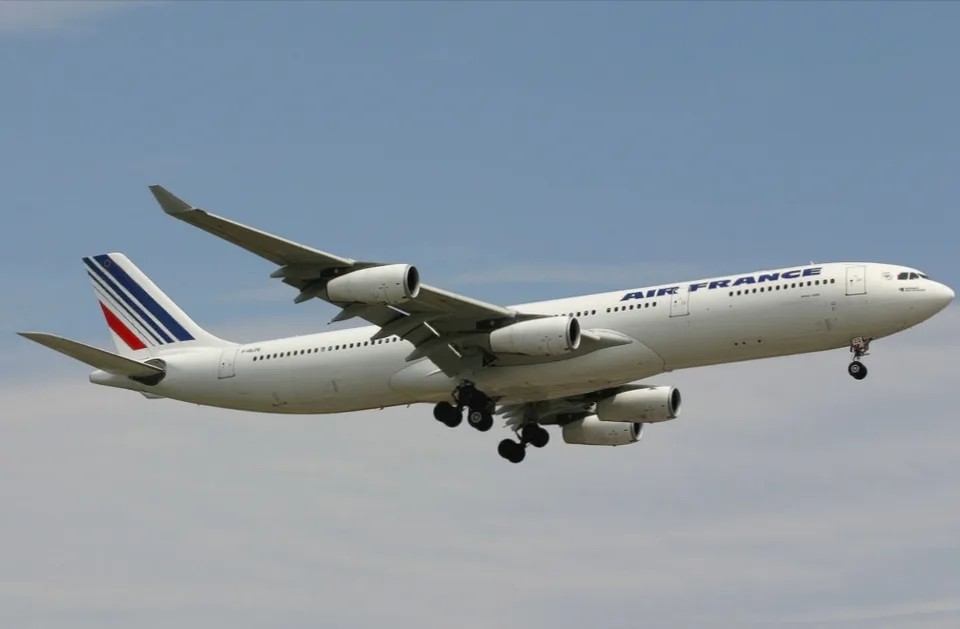
A tailwind, increased thrust and loss of forward visibility extended the flare. The aircraft touched down about 3800 feet along Runway 24L, then left its far end at about 80 knots after delayed reverse-thrust selection.
Read the full incident Follow what happened, from the flight to the investigation findings.
What investigators concluded
The TSB found that the severe, rapidly changing thunderstorm, excess aircraft energy, long touchdown, delayed reverse thrust and inadequate landing-distance assessment contributed to the overrun. Terrain beyond the runway increased the damage and injuries.
1,552 words / about 8 minutes to read. Based on the investigation records cited below.
Extra fuel for a difficult arrival
Air France Flight 358 left Paris Charles de Gaulle at 1153 UTC on 2 August 2005 for Toronto Pearson. The Airbus A340-313, F-GLZQ, carried 297 passengers and 12 crew members. The arrival forecast included thunderstorms, so the captain ordered an additional 3000 kg of fuel. That allowance was intended to provide another 23 minutes of holding at Toronto. The captain flew the takeoff and the first part of the journey. At 1617 UTC, the pilots exchanged flying duties, leaving the first officer to fly the approach and landing.
The aircraft crossed the Atlantic on a track north of its original flight plan and at a lower altitude than planned. The crew received a revised operational flight plan through the aircraft's data link. They also requested weather for Toronto and potential diversion airports. Several forecast requests returned a TAF NIL message because the crew selected the short forecast format, while those airports supplied long forecasts. Updated weather observations continued to arrive. The TSB found that the missing updated forecasts did not affect the outcome because the Toronto forecast had changed little from the preflight information.
By 1849 UTC, the pilots were considering Ottawa as a diversion destination. They calculated that 7300 kg would be needed to divert there, including final reserve fuel. As delays developed near Toronto, they repeatedly sought weather and traffic updates and obtained vectors around storms. At 1933 UTC they selected Ottawa as the alternate, with six minutes of holding fuel available at Toronto. The aircraft ultimately landed with 7630 kg aboard, enough for a missed approach and the planned diversion.
The pilots briefed a windshear escape at 1919 UTC and later prepared for the instrument landing system approach to Runway 24L. Their approach briefing omitted runway length, the missed approach procedure and landing-distance calculations for a wet or contaminated runway. They correctly discussed the runway's 2743 m length two minutes before landing. The operational flight plan supplied a maximum landing weight based on the aircraft's structural limit, but contained no contaminated-runway landing distances for Toronto.
Storm-related equipment outages narrowed the available landing options. The localizer for Runway 24R became unserviceable, followed by the glideslope for Runway 23. Runway 24L remained available with an instrument approach aligned into the wind. It was 9000 feet long. Aircraft ahead of Flight 358 landed successfully, although two regional jets reported poor braking. One reported that braking improved below 60 knots. The tower passed those reports to the Air France crew.
At 1958 UTC, the tower's wind instruments were unavailable after a thunderstorm-related failure. Controllers passed wind reports from landing aircraft. Flight 358's pilots increased the autobrake setting from low to medium and reviewed go-around calls. In the cockpit, the normal challenge and response pre-landing checklist was delayed because the landing memo had not appeared on the electronic display. Its individual items had nevertheless been completed through the cockpit flow. The runway looked shiny with water, and the aircraft's radar showed heavy precipitation moving toward it from the northwest.
While the autopilot and autothrust were engaged, the A340 followed the localizer and glideslope at its target approach speed of 140 knots. At 2001:18 UTC, passing 323 feet above ground, the first officer disconnected the autopilot. Two seconds later he disconnected autothrust. He sensed falling airspeed and a sink, and increased engine thrust from about 42 percent to about 82 percent N1. The recorder showed a small airspeed decrease. The added power then increased the aircraft's energy, and it began moving above the glide path.
At roughly the same stage, the wind shifted toward a tailwind. The TSB's cause findings describe a change from a headwind component to a 10-knot tailwind component, which increased groundspeed and altered the flight path. The aircraft crossed the runway threshold about 40 feet above the normal crossing height. It then entered an intense downpour. Forward visibility deteriorated sharply, and lightning was visible around the runway and beyond its far end.
The pilots increasingly relied on the side windows to judge the aircraft's position. The TSB found that the severe weather overwhelmed them and reduced their airspeed scanning. Near the threshold, they became committed to landing and believed a go-around was no longer available. The captain was concerned about thunderstorms and lightning in the missed approach path. During the flare, excess speed and the difficulty of seeing the runway prolonged the float. Significant pitch and roll inputs showed the first officer's workload as he tried to control the aircraft.
The main landing gear touched down at 2001:53 UTC, about 3800 feet beyond the threshold. The A340 was slightly left of the centreline and crabbed about six degrees to the right. Its recorded airspeed was about 143 knots. The spoilers deployed automatically, and the pilots applied manual braking while working to align the aircraft with the runway. The recorder showed maximum braking demand by about five seconds after touchdown. Water contamination reduced the braking action available, while the crosswind exceeded the aircraft's contaminated-runway landing limit.
Idle reverse was selected 12.8 seconds after touchdown and full reverse at 16.4 seconds. The captain omitted the standard spoiler and reverser calls. The TSB attributed the delayed reverse selection to task overload during touchdown, with the first officer occupied by directional control in the crosswind and poor visibility. The delay increased the distance needed to stop. The aircraft left the runway at 2002:19 UTC at approximately 80 knots, crossed the roads beyond the runway and descended into the Etobicoke Creek ravine.
The investigators found that the remaining runway was insufficient for the touchdown conditions. Airbus calculations gave a stopping distance after touchdown of 6674 feet using the recorded speed, tailwind and reverse-thrust timing. Selecting full reverse according to the flight manual reduced that calculated distance to 5938 feet. Using both the recommended touchdown speed and normal reverse timing reduced it to 5574 feet. Each calculation exceeded the approximately 5100 feet remaining in the TSB's findings. Systems examination and brake testing found the braking system serviceable, and the TSB found no mechanical malfunction contributing to the accident.
The aircraft bounced through several impacts before stopping. Baggage fell from overhead compartments, fittings detached and the L2 door opened while the aircraft was still moving. Fuel-system damage developed after the aircraft crossed Convair Drive. Fire intensified when the aircraft stopped in the ravine. Smoke entered the cabin, and the cabin crew began an evacuation within seconds. Three public-address announcements were made before that system failed, while the evacuation alert system also failed to operate. Both systems depended on emergency power in the vulnerable avionics bay.
Fire made the left-side L3 and L4 exits unusable. The L2 slide failed to deploy, and the R3 slide deflated after contacting wreckage. At least 16 passengers left through L2, where two suffered serious injuries after jumping or being pushed from the exit. Cabin attendants initially judged R1 and R2 unsafe because of the creek outside. As smoke increased, they reassessed the danger and opened those routes. Two crew members were needed to open R4. About two-thirds of the passengers escaped through that exit.
The evacuation took a little more than two minutes. The first officer and two cabin crew members searched the cabin and lavatories, returning along the opposite aisle to confirm that everyone had left. The first officer was the final person to exit, jumping through L1 because its slide was only partially deployed. All 309 occupants survived. Twelve sustained serious injuries, nine during the impacts and three during evacuation. Thirty-three people went to hospital by ambulance; 21 were treated for minor injuries and released. The TSB credited the training and actions of the whole cabin crew with the successful escape before fire engulfed the fuselage.
Despite fire damage to the recorders, investigators recovered the cockpit voice recording and the full 45 hours of flight data. The flight data recorder's external connectors and interface cards had suffered heat damage, but its memory board remained in pristine condition. A TSB team travelled to France for the repair and download with BEA assistance. Investigators used the recovered data to calculate the touchdown position, reconstruct aircraft performance and prepare an animation for interviews with the pilots. Those interviews helped locate the points where the weather and visibility had deteriorated.
Firefighters at the south fire hall saw the landing and responded before the tower sounded its crash alarm. The first vehicle reached the scene within one minute of that alarm. Heavy rain diluted the firefighting foam and reduced its effectiveness against the fuel-fed fire, which destroyed most of the aircraft. The TSB found that the terrain beyond the runway's compliant overrun area contributed to aircraft damage and occupant injuries. It also found that the pilots had not calculated the required landing distance and were unaware that the tailwind eliminated their available margin.
Air France subsequently changed its policy so either pilot could call for a missed approach. It added rain-repellent information and procedures in September 2005 and revised its thunderstorm guidance. Airbus replaced the approach call 'landing' with 'continue'. The TSB issued seven recommendations: limits on approaches and landings in convective weather, better pilot decision training in deteriorating weather, calculation of landing-distance margins, a 300 m runway end safety area or equivalent stopping protection, and clear passenger directions to leave carry-on baggage behind. Nearly half the passengers had retrieved baggage during the evacuation, impeding escape.
The TSB found that excess speed caused a float while intense rain and lightning made the runway difficult to see. A tailwind and high threshold crossing increased the distance used.
Would earlier reverse thrust have stopped the aircraft?
Airbus calculated 5938 feet after touchdown with normal full-reverse timing at the actual speed, and 5574 feet with normal timing and recommended speed. The TSB found about 5100 feet remained.
Cabin crew began evacuating within seconds, reassessed exits as smoke increased and directed passengers to available routes. The TSB credited their training and actions with the successful evacuation.
The training simulator provided qualitative handling results. It could not fully reproduce the evolving weather and visibility, and the TSB drew no conclusion from those trials about the pilots' go-around judgment.
Actions and recommendations are described at the dates of the cited records. A recommendation is not proof of implementation.
Air France changes in 2005
Air France amended its captain-only missed approach policy to permit either pilot to call for a go-around. It added rain-repellent guidance on 1 September 2005 and revised thunderstorm procedures on 29 September 2005.
Recommendations A07-01 and A07-02 called for limits on approaches and landings in convective weather. A07-03 and A07-04 called for pilot training to improve landing decisions in deteriorating weather.
Recommendation A07-05 called for crews to establish the margin between landing distance available and required before approaching into deteriorating weather.
These comparisons connect specific research topics. Shared circumstances do not establish identical causes. Evidence from both investigations is provided below.
Further investigation records
Explore the records below for additional context. They open on the publisher's site and are not all included in our report search. Source reuse terms apply.
Crown copyright, Minister of Public Works and Government Services Canada, 2007. Report text and photographs remain subject to Crown copyright and third-party rights.
Kevin Murphy writes the incident accounts on AirlineIncidents.com, out of a long interest in aviation safety and the lessons each investigation leaves behind.
Prepared by
AirlineIncidents editorial desk
Report citation check
Independent expert review
Not completed
Citation checks compare supporting text with the indexed report pages. They do not constitute independent expert review. How these pages are prepared.