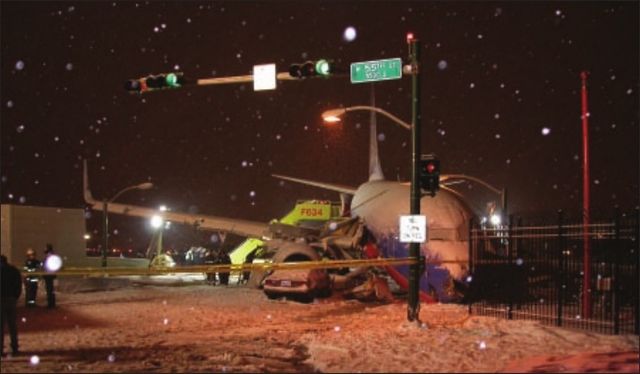
Flight 1248 landed on snow-contaminated runway 31C with a tailwind. Full reverse thrust was delayed until about 18 seconds after touchdown. The aircraft overran the runway and struck an automobile on an adjacent road.
Read the full incident Follow what happened, from the flight to the investigation findings.
What investigators concluded
The NTSB found that delayed use of available reverse thrust caused the overrun. Unfamiliar autobrake use distracted the pilots. Company guidance, performance-computer assumptions, landing safety margins and the decision to continue contributed; the missing arresting bed increased the severity.
1,524 words / about 7 minutes to read. Based on the investigation records cited below.
Snow, a delay and a holding pattern
Southwest Airlines flight 1248 left Baltimore/Washington for Chicago Midway on 8 December 2005 with 98 passengers and five crew members. The Boeing 737-7H4, registered N471WN, departed about two hours late as weather deteriorated around Chicago. The captain flew the aircraft and the first officer handled monitoring duties. The flight was operating under Part 121 on an instrument flight rules flight plan. Its departure at about 17:58 eastern standard time put the aircraft into an evening arrival during continuing snowfall at Midway.
The pilots reviewed weather and dispatch information before departure. A further release document changed the expected landing wind, braking action and runway, but it did not reach them before they left Baltimore. They subsequently received updated weather and runway reports in flight. The NTSB found that they had adequate initial and updated meteorological information throughout the flight. Weather, stopping-distance calculations, landing criteria and possible alternate airports occupied much of their recorded discussion.
Midway's snow removal operation began when snow started falling at about 13:47. Airport personnel cleared runway 13C/31C five times during the five and a half hours before the accident, most recently at about 18:45. A field report updated around 18:50 described wet snow over 90 percent of runway 31C. The approach to that runway was the only approach available to commercial arrivals that evening because of visibility requirements. Its usable landing distance was 5,826 feet.
At 18:33, controllers instructed flight 1248 to hold while snowplows worked on the runway. The crew entered the hold at about 18:44 at 10,000 feet. While waiting, the first officer entered updated conditions into Southwest's on board performance computer. Wind from 090 degrees at 11 knots produced a calculated tailwind component of eight knots. The crew also discussed the airline's new autobrake procedures. Neither pilot had previously used autobrakes during an aircraft or simulator landing.
The computer accepted a single braking-action category, so the first officer made separate calculations for fair and poor conditions. The fair calculation indicated a stopping margin of about 560 feet before the runway end. The poor calculation indicated about 40 feet. The pilots remembered a figure of about 30 feet for the poorer condition and were concerned by the small margin. Southwest permitted a landing with any positive stopping margin at the time. The crew believed reverse thrust would add several hundred feet to the distance displayed.
Two assumptions inside the calculation made the displayed result more favorable. For poor braking action, the program substituted the company's five-knot tailwind limit in its stopping-distance calculation while displaying the eight-knot component derived from the entered wind. Using the entered eight-knot tailwind would have produced a stopping margin of minus 260 feet. The display showed the wind-limit warning but did not identify the substituted wind in the distance calculation.
The 737-700 calculation also already included reverse thrust. The accident pilots believed that it did not. Southwest's instructions had contained inconsistent statements about this credit, and other company pilots interviewed by investigators also misunderstood the assumption. The NTSB found that clearer presentation of the wind and reverse-thrust assumptions might have led the crew to divert. It also found that Boeing's recommended performance data would have produced negative margins for both fair and poor conditions.
Southwest limited landings with poor braking action to a tailwind component of five knots. Its guidance required the most critical term in a mixed braking report to govern the assessment. Flight 1248's crew planned to divert if braking action was poor along the entire runway or if the tailwind exceeded ten knots. The reports they received included poor braking on part of the runway. The NTSB found that applying the poor category together with the five-knot limit would have required a diversion under company policy.
The aircraft left the holding pattern at about 18:54 and received vectors for the instrument landing system approach. At 19:03, controllers cleared the crew to intercept the localizer and then cleared the approach. A braking report described fair action except near the runway end, where it was poor. At about 19:09:54, the tower transmitted another mixed report, describing good braking over the first half and poor braking over the second half. Landing clearance followed at about 19:12:28.
The aircraft touched down on the centerline at approximately 124 knots indicated airspeed and 131 knots groundspeed. The main gear contacted the runway about 1,250 feet beyond the approach threshold, inside Boeing's recommended touchdown zone. Both pilots described a firm touchdown. The speed brakes deployed and brake pressure increased within about a second. The pilots had selected maximum autobraking for this landing because they expected it to provide the shortest stopping distance.
The captain told investigators he tried to move the reverse-thrust levers immediately after touchdown but had difficulty. He felt the antiskid system cycle, then thought the cycling stopped and the aircraft seemed to accelerate. His attention shifted to braking. He applied the wheel brakes manually and made no further attempt to deploy the reversers. He later said that his attention to the unfamiliar autobrake system had distracted him from another attempt at reverse thrust.
The first officer also became concerned about deceleration and applied manual braking. Recorder data showed a transition from autobraking to maximum manual wheel braking about 12 seconds after touchdown. The first officer then saw that the reverse-thrust levers remained stowed. He moved the captain's hand aside and initiated maximum reverse thrust about 15 seconds after touchdown. Full reverser deployment followed at about 18 seconds. The pilots maintained maximum reverse thrust until the aircraft stopped beyond the runway.
The available runway ran out before the aircraft stopped. It crossed the runway safety area, a blast fence and a navigational antenna, continued across an airport road and broke through the perimeter fence. On the adjacent public roadway it struck a northbound automobile. It stopped near the intersection at the airport's northwest corner. A child in the automobile died, another occupant suffered serious injuries and three others suffered minor injuries. All 103 people aboard the aircraft survived; 17 passengers and one flight attendant had minor injuries.
The aircraft sustained substantial but repairable damage. Fence-post contact damaged the wing leading edges and engine nacelles, while investigators observed no damage inside the cockpit or cabin. There was no in-flight or postcrash fire. The first officer performed the emergency evacuation checklist and the captain went into the cabin. The collapsed nosewheel left the forward fuselage low, and the captain directed an evacuation through the left front door.
Airport rescue and firefighting units arrived about two minutes after the accident. The first officer helped passengers at the bottom of the forward slide. Around half the passengers left through that door. Firefighters positioned mobile stairs at the right rear door about 14 minutes after the accident; the remaining passengers, the captain and the three flight attendants used those stairs. Flight attendants described an orderly evacuation. The other cabin and overwing exits remained closed.
Investigators compared recorder data, physical examinations and simulated stopping performance. The thrust reversers operated normally when the first officer selected them, and examination of the throttle quadrant and reverse-thrust system found no mechanical irregularity. Crews on the aircraft's previous ten flights reported no deployment difficulties. The NTSB concluded that mechanical or physical difficulties did not explain the delay. It found that first use of the autobrakes during a demanding landing diverted the pilots' attention from deploying reverse thrust promptly.
The performance study estimated braking ability about five times worse than on a bare, dry runway. Stopping distance was especially sensitive to braking effectiveness, wind and the delay before reverse thrust. A simulation using maximum reverse thrust two seconds after touchdown and maintaining it to a full stop indicated that the aircraft could have stopped about 271 feet before the runway end. Four Southwest 737-700 aircraft that landed earlier had deployed reverse thrust early, and three used maximum reverse.
The NTSB adopted its final report on 2 October 2007. It identified the pilots' failure to use available reverse thrust promptly as the probable cause, linked to their distraction during unfamiliar autobrake use. Contributing factors included Southwest's unclear guidance and training, the computer's concealed assumptions, introduction of autobraking without a familiarization period and the lack of a safety margin in arrival calculations. The crew's failure to divert with poor braking reports and a tailwind above five knots also contributed. The report also found that the tower controller omitted required braking-report information, including the aircraft type associated with reports and a separate poor-braking report from a smaller aircraft.
The runway safety area extended only 82 feet beyond runway 31C. The NTSB found that an engineering materials arresting system was needed in that limited space and that its absence increased the accident's severity. Calculations indicated that even a nonstandard arresting bed would have stopped the aircraft before it left airport property. Southwest subsequently revised its computer display and guidance, added a 15 percent landing-distance margin and required four autobrake familiarization landings on dry runways with ample margins. The report recorded an initial arresting-bed section at runway 31C by December 2006. The Board recommended arrival assessments with at least a 15 percent margin, explicit computer assumptions and immediate monitoring-pilot confirmation of reverser status.
A simplified reading of the investigation findings. The sequence does not replace the full report or imply that every contributing factor is shown.
Sequence of events
Times are central standard time unless explicitly identified as eastern standard time. Landing-roll intervals are relative to touchdown. Expand an event to see its evidence.
17:58 ESTDeparture
The flight departed Baltimore/Washington about two hours late.
The poor-braking calculation used a five-knot tailwind limit while displaying the entered eight-knot component. The 737-700 calculation also included reverse thrust, which the pilots believed would provide an additional margin.
Could prompt reverse thrust have stopped the aircraft?
The NTSB simulation with maximum reverse thrust selected two seconds after touchdown and held to a stop produced a stopping point about 271 feet before the runway end.
Runway 31C had a short safety area and no arresting bed. The NTSB found that even a nonstandard bed would have stopped the aircraft before it left airport property.
The NTSB found that the three runway-condition assessment methods had limitations and that their relationship to aircraft braking ability lacked a standardized, universally accepted correlation.
Actions and recommendations are described at the dates of the cited records. A recommendation is not proof of implementation.
Southwest changed training and calculations
The report recorded a 15 percent arrival margin, clearer reverse-thrust assumptions, monitoring-pilot callouts and four autobrake familiarization landings.
Matching dossiers for Limited safety area without an arresting bed: No other dossier in this collection.
Read alongside
These comparisons connect specific research topics. Shared circumstances do not establish identical causes. Evidence from both investigations is provided below.
Southwest 1248 and Air France 358 both involved delayed reverse thrust during overruns on contaminated runways. At Toronto, the TSB also found a long touchdown during a rapidly changing thunderstorm and missing standard reverser callouts. At Midway, the NTSB linked the delay to unfamiliar autobrake use and found that prompt sustained maximum reverse thrust could have stopped the aircraft on the runway.
Explore the records below for additional context. They open on the publisher's site and are not all included in our report search. Source reuse terms apply.
Final investigation report, including performance analysis, findings, recommendations and the cockpit voice recorder transcript.
Sources and transparency
NTSB final report adopted 2 October 2007.
Source limitations
The NTSB identified limitations in pilot braking reports, contaminant observations and ground-vehicle friction measurements when predicting aircraft stopping performance.
Runway Overrun and Collision, Southwest Airlines Flight 1248
National Transportation Safety Board Final report NTSB/AAR-07/06, adopted 2 October 2007
Kevin Murphy writes the incident accounts on AirlineIncidents.com, out of a long interest in aviation safety and the lessons each investigation leaves behind.
Prepared by
AirlineIncidents editorial desk
Report citation check
Independent expert review
Not completed
Citation checks compare supporting text with the indexed report pages. They do not constitute independent expert review. How these pages are prepared.
Revision history
: Published sourced incident account, timeline, photographs and investigation findings.