After a long wait in falling snow, a contaminated aircraft took off with too little thrust. It struck the 14th Street Bridge and entered the ice-covered Potomac River.
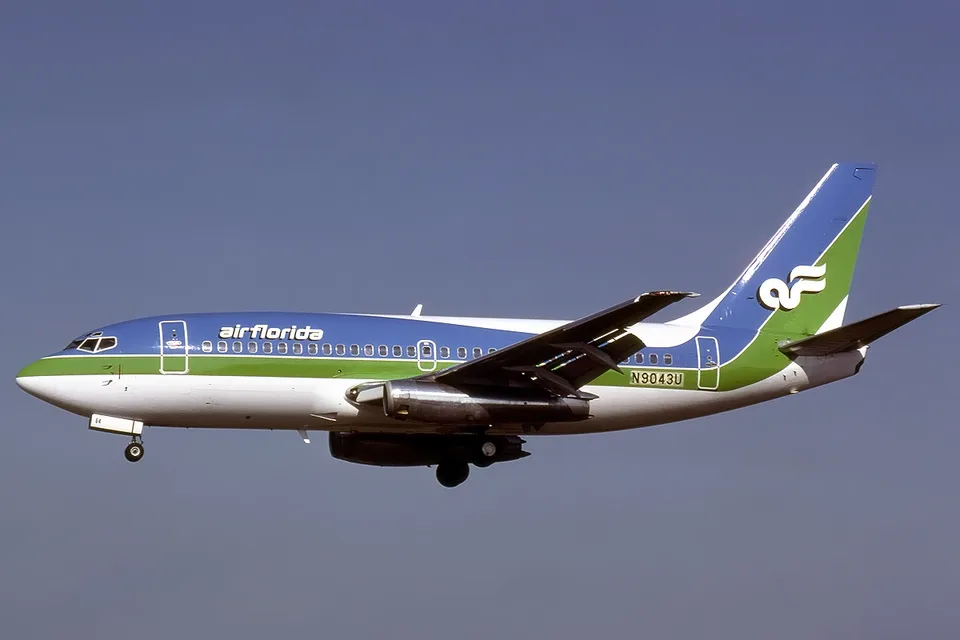
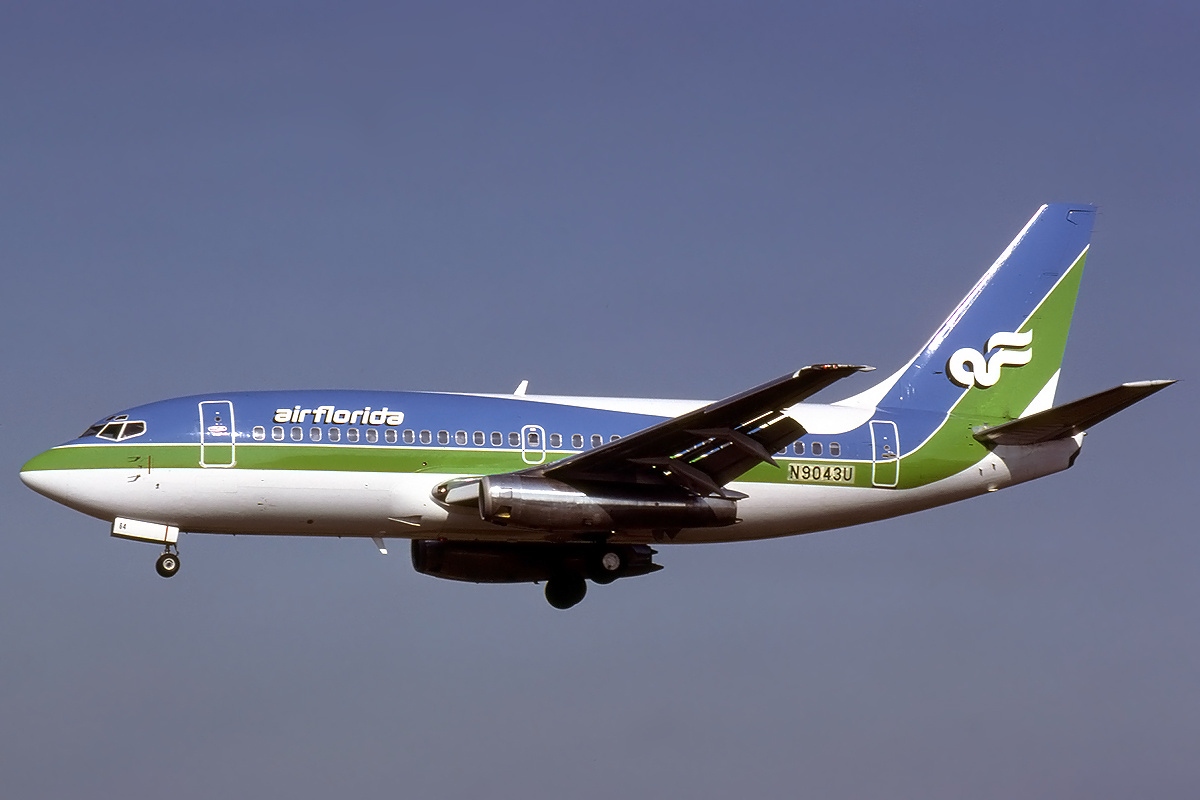
This is N9043U, a different Air Florida Boeing 737 from the accident aircraft, N62AF. Taken in November 1980. The aircraft was later registered N64AF. This is not the accident flight.
AirlineIncidents.com resized the photo for display on 7 October 2026 under GFDL 1.2, without cropping or retouching. Full licence: /media/airflorida90-photo-LICENSE.txt. Modification history: /media/airflorida90-photo-HISTORY.txt.
Geographic context
Washington National, departure
Tampa, planned stop
Fort Lauderdale, destination
Approximate airport markers for the planned route; they do not plot the brief accident flight. Basemap: Natural Earth, public domain.Read supporting evidence
Ice-blocked inlet pressure probes produced misleading thrust indications, while wing contamination degraded lift and increased drag. The combined effects prevented sustained flight.
Read the full incident Follow what happened, from the flight to the investigation findings.
What investigators concluded
NTSB cited failure to use engine anti-ice, takeoff with contaminated airfoils and failure to reject takeoff after anomalous indications. Delay, contaminated-wing pitch behaviour and limited winter experience contributed.
A winter departure with misleading thrust and a contaminated wing
1,586 words / about 8 minutes to read. Based on the investigation records cited below.
Snow, delay and an exposed aircraft
Air Florida flight 90 was scheduled from Washington National Airport to Fort Lauderdale, with an intermediate stop at Tampa, on 13 January 1982. Its Boeing 737-222 was registered N62AF and carried 74 passengers and five crew members. Moderate to heavy snowfall closed the airport temporarily and delayed the departure. The flight crew and aircraft were qualified and certificated, but the developing ground conditions created risks that a normal departure procedure and ordinary thrust indication could not resolve without effective winter-operation precautions.
American Airlines personnel deiced the aircraft. The investigation found shortcomings in the treatment, including differing procedures on the two sides and a nonstandard nozzle that delivered a less concentrated glycol solution than intended. Neither the maintenance representative nor the captain verified that the aircraft was free of contamination before pushback and taxi. The shortcomings affected the initial treatment and verification of the aircraft's condition before departure.
About 49 minutes passed between completion of deicing and initiation of takeoff. During that delay the aircraft remained in continuing precipitation. The crew attempted to use reverse thrust to move from the ramp, contrary to guidance, blowing snow that might adhere to the aircraft. A tug eventually completed the pushback. These actions and the long queue exposed the aircraft to further contamination. Deicing at one point in the departure process did not establish that its surfaces remained clean when takeoff began.
The captain responded that engine anti-ice was off during the after-start checklist at 15:38:16 eastern standard time. It remained unused during ground operation and takeoff. While waiting, the crew positioned the aircraft close to the exhaust of the aircraft ahead in an attempt to deice it. NTSB found this contrary to flight-manual guidance and considered that it may have contributed to wing icing and pressure-probe blockage.
Recorded conversation showed concern about deicing and differences in engine indications. The crew nevertheless proceeded to takeoff, setting thrust by reference to the engine pressure ratio gauges. Engine spool-up was recorded at 15:59:46. During the roll the first officer repeatedly expressed that something was not right, and the captain did not reject the takeoff. NTSB counted four expressions of concern.
The aircraft accelerated more slowly than normal. This reduced the runway remaining while the usual decision-speed assumptions depended on normal acceleration and power. The investigation discussed the difficulty of detecting that performance shortfall and the potential value of better references. In this accident, low thrust and an abnormal airframe condition had already undermined the assumptions behind an ordinary takeoff.
The cockpit recording followed the crew's concern about snow while they waited in line. They discussed returning for more deicing and the time since the treatment already performed. The captain remarked on the condition of his windshield and uncertainty about his wings, while the first officer discussed snow remaining on a wing. They also noticed a difference between the engine indications. The first officer suggested that hot exhaust entering an engine might explain it. Later he described the attempt to deice in the other aircraft's exhaust as providing a false feeling of security. The crew then completed their pretakeoff checks, including verification of the target EPR setting.
Ice blocked the inlet pressure probes on both engines before takeoff. Those probes supplied pressure information used in the engine pressure ratio indication. With that information corrupted, the gauges no longer reliably represented the thrust actually being produced. The crew set the target indication of 2.04 EPR, but NTSB reconstructed actual thrust equivalent to EPR 1.70. The difference meant substantially less power than the setting appeared to provide.
Snow or ice on the wing leading edges also changed the aircraft's aerodynamic response. The report found a nose-up pitching tendency during rotation, requiring abnormal forward control force. Contamination reduced lift and increased drag, leaving the aircraft unable to accelerate after liftoff despite initially climbing. These effects operated alongside the thrust deficit.
NTSB expressly concluded that the combined conditions prevented sustained flight and that either alone should not have prevented continuation. The stall-warning stickshaker activated almost immediately after liftoff and continued to impact. Appropriate pitch control was added, but additional thrust came too late. The Board considered continued flight potentially possible immediately after stickshaker activation with appropriate pitch and maximum available thrust.
At about 16:01 the aircraft struck the northbound span of the 14th Street Bridge and plunged into the ice-covered Potomac River. It hit occupied vehicles on the bridge before breaking through portions of the barrier and railing. Seventy passengers and four crew members died, as did four people in vehicles. Four passengers and one flight attendant survived with serious injuries. The disaster killed 78 people aboard the aircraft and on the bridge. Four people on the bridge were injured, one seriously.
The main cabin broke up extensively, violating occupiable space and removing occupant restraint. NTSB attributed the catastrophic injuries to secondary impact forces as the cabin broke apart. It classified the accident as nonsurvivable for cabin occupants while identifying a relatively intact aft seating area from which survivors escaped. The report concluded that rescue performance was not a factor in most onboard deaths.
Another passenger escaped the impact but drowned. The final five survivors were rescued through the response of a U.S. Park Police helicopter crew and a bystander who entered the water. NTSB commended their actions and the surviving flight attendant's assistance to an injured passenger. Airport and local rescue equipment was poorly suited to the ice-covered river; available boats could not provide effective timely access. The investigation therefore examined both the destructive cabin impact and the practical rescue capability required for those who reached the water alive.
The available lifevest was difficult to unpack in the river. Survivors had to use their teeth to tear open its plastic wrapping, and the flight attendant gave the inflated vest to a more seriously injured passenger. The Board had encountered similar packaging difficulties in an earlier water accident. It urged standards that would let survivors open life-preserver packages under adverse conditions. This was a practical obstacle faced by people already injured and exposed to frigid water. The flotation equipment could help only after the package had been opened and the vest made ready for use.
The adopted probable cause identified failure to use engine anti-ice, the decision to take off with contaminated airfoil surfaces and the captain's failure to reject takeoff after anomalous indications were brought to his attention. The prolonged delay in continuing precipitation, the aircraft's pitch response to leading-edge contamination and the crew's limited winter-operation experience contributed.
NTSB also criticised traffic management. The departure queue and inadequate flow control contributed to long delays after deicing. During the takeoff, separation from an arriving aircraft fell below the required standard. The Board regarded the controller's handling as unsafe, but found insufficient evidence to establish that particular handling as a cause of the crash. It found no evidence that the proximity of the arriving aircraft influenced the captain's decision.
The NTSB examined the means available to crews to recognise abnormal takeoff acceleration. It discussed earlier recommendations, industry concerns about unnecessary high-speed rejections and possible technological monitoring. A flight could consume more runway than expected while reaching the same indicated speed.
The takeoff-performance analysis identified distinct problems with stopping distance and acceleration. Certification stopping calculations used a clean, dry runway, while snow and ice reduced braking effectiveness. Low thrust created a further difficulty: reaching the decision speed took more runway than the normal-power calculation allowed. Less distance then remained for a rejected takeoff, even before the slippery surface was considered. The Board examined time and distance references as possible ways to identify that shortfall early. The manufacturer's investigation data also distinguished the runway available to a normally performing aircraft from the distance consumed by Flight 90's subnormal acceleration.
Urgent recommendations sought better recognition of inlet pressure probe icing and cross-checking of engine instruments when takeoff power was applied. Other proposals addressed the limits of deicing fluid, winter-operation training, contaminated leading edges and the need to confirm clear wing surfaces. The Board wanted the effect of pressure-probe blockage documented in flight-manual information and more effective anti-ice guidance. The common purpose was to prevent crews from treating one satisfactory instrument reading or an earlier deicing event as complete proof of a safe departure condition.
Recommendations and recorded responses also addressed ground delays and the risk of aircraft operating close together in freezing conditions. NTSB called for attention to gate-hold procedures, improved traffic coordination and appropriate separation during taxi. The FAA's response emphasised the clean-aircraft concept rather than reliance on a fixed elapsed time since deicing.
The rescue analysis identified a further gap between regulatory compliance and practical capability. Washington National had more equipment than minimum requirements demanded, yet it had not established effective performance on ice. NTSB sought equipment and planning matched to the water conditions around airports and noted the need for practical lifevest packaging under adverse conditions. The investigation thus extends from preventing the takeoff to rescuing possible survivors.
The winter-operation proposals included training for controllers in structural and engine icing hazards. Ground-control changes would increase separation during freezing weather and encourage use of gate holds when departure queues became long. In its recorded response, the FAA said its inspectors had been tasked to review operators' cold-weather manuals and guidance. It also described technical work on inlet icing, the resulting instrument readings, cross-check procedures and performance loss. The FAA opposed relying on a fixed time since deicing because ice could form sooner under some atmospheric conditions. Its response called for the aircraft's actual surface condition to govern the decision.
Did another aircraft force the captain to continue?
NTSB found unsafe ATC separation, but insufficient evidence that the handling of arriving traffic caused the crash or influenced the captain's decision.
Four passengers and one flight attendant were rescued and survived. Another passenger escaped impact but drowned; that person is included among the fatalities.
Matching dossiers for Prolonged ground exposure: No other dossier in this collection.
Read alongside
These comparisons connect specific research topics. Shared circumstances do not establish identical causes. Evidence from both investigations is provided below.
Air Florida 90 and AF447 both involved misleading instrument information and a subsequent stall. Air Florida combined ice-blocked engine pressure probes with wing contamination during takeoff; AF447 involved unreliable airspeed at cruise altitude. The measured systems, flight phases and physical mechanisms were different.
Explore the records below for additional context. They open on the publisher's site and are not all included in our report search. Source reuse terms apply.
The source photograph by Peter Duijnmayer, provided under GFDL 1.2.
Sources and transparency
Checked against the official final investigation report. No independent expert review.
Source limitations
The report reconstructs actual engine thrust and aerodynamic contamination from recordings, tests and analysis. It does not determine every detail of ice distribution.
NTSB AAR-82/08: Air Florida Boeing 737-222 N62AF
National Transportation Safety Board Final report adopted 10 August 1982.
Limited quotations for source-based commentary. Full report and illustrations are not republished. Wider reuse requires checking BEA terms. Source terms.
Kevin Murphy writes the incident accounts on AirlineIncidents.com, out of a long interest in aviation safety and the lessons each investigation leaves behind.
Prepared by
AirlineIncidents editorial desk
Report citation check
Independent expert review
Not completed
Citation checks compare supporting text with the indexed report pages. They do not constitute independent expert review. How these pages are prepared.
Revision history
: Published a sourced account, timeline, photographs and final investigation findings.