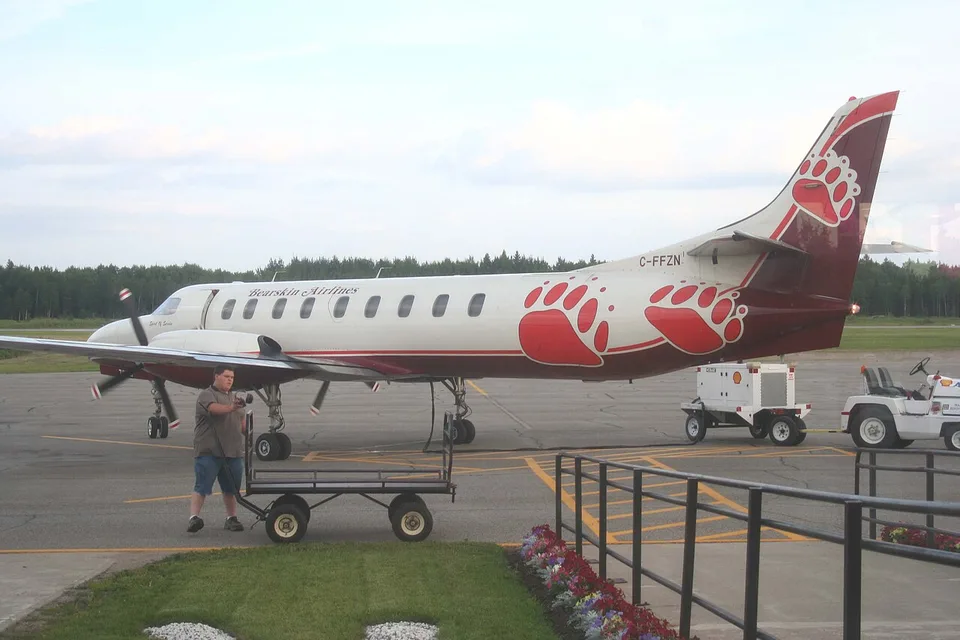
Commons-supplied 1280-pixel JPEG retained without cropping. Responsive WebP copies resized without cropping.
Geographic context
North Bay final-leg departure
Detour Lake destination
Schematic approximate airport markers, not a recorded flight track or navigation chart. Route names are documented in the report. Basemap: Natural Earth, public domain.Read supporting evidence
A second unstable approach ended with in-flight reverse thrust, loss of control and a crash beside a gravel runway. All ten occupants survived.
Read the full incident Follow what happened, from the flight to the investigation findings.
What investigators concluded
The TSB found that high workload and operational pressures narrowed attention towards landing. Expectation of aggressive braking, workload and a reflexive control action resulted in premature BETA selection and loss of control. Separate findings address stabilisation criteria, evacuation and cumulative operational risk.
Two approaches, then reverse thrust before touchdown
1,581 words / about 8 minutes to read. Based on the investigation records cited below.
A passenger charter with a changing plan
Bearskin Airlines flight 4330 was a passenger charter operated by Perimeter Aviation on 7 September 2023. Its Fairchild SA227-DC Metro 23, registered C-GJVW, was travelling from Toronto Pearson to Detour Lake Aerodrome with an intermediate stop at North Bay. Two pilots and eight passengers were aboard for the final leg. The aircraft was a pressurised twin turboprop with nineteen passenger seats. It had no autopilot or enroute vertical navigation automation, so the pilots were manually flying it throughout the journey and approaches.
Preparation began at Toronto early that morning. An administrative issue delayed departure by forty-nine minutes. Seven passengers boarded there, and an eighth joined at North Bay. The first officer gave passenger safety briefings before both departures. At 08:20 Eastern Daylight Time, the aircraft left North Bay for the privately operated mining aerodrome at Detour Lake. The captain occupied the left seat and was the pilot flying; the first officer monitored. The investigation records these roles because they changed later during the second approach.
At 09:01, forty-six nautical miles south of the destination and descending through about 16,000 feet above sea level, the cabin pressure differential fell and the cabin altitude annunciator illuminated. Passengers felt the pressure change, and some heard a squealing sound near the rear bulkhead. The pilots put on oxygen masks and made an emergency descent. They levelled at approximately 8,900 feet, removed the masks and began preparing to divert to Timmins. This earlier disruption added tasks before the demanding destination approach, but the TSB did not identify a mechanical system malfunction as causing the later loss of control.
The crew began the emergency-descent and cabin-low-pressure checklists. Selecting manual pressurisation restored the pressure trend, after which the remaining checklist items were not completed. The captain briefed the deviation from standard procedures. The first officer notified company operations by satellite text of the pressure problem and proposed diversion. After obtaining Timmins weather, the pilots reviewed the minimum equipment list, which allowed deferral with the controller in manual mode. At 09:18, they told air traffic control they wished to resume the original destination, and operations acknowledged their updated message.
Detour Lake's weather presented a very different challenge from the favourable conditions on the pilots' previous visits. The reported wind initially came from almost across runway 10, with a quartering tailwind component, and the ceiling was low. The RNAV approach had non-standard features: a steeper-than-usual glide path and a turn onto the final segment. Meeting its profile required active manual flight and coordination. The investigation did not describe an invalid approach or unlicensed crew. It examined how otherwise permitted elements combined to increase workload and reduce the safety margin.
During preparation, the first officer noticed the flaps had stayed at their quarter setting after the emergency descent. They were retracted. On the first approach the crew saw that the aircraft was not aligned with the runway centreline. The first officer called for a missed approach, and the captain complied, flying the published procedure. Aerodrome ground support asked whether they would return, and the pilots said they would. That successful decision to discontinue the first attempt is part of the sequence; the accident cannot fairly be described as a crew refusing every opportunity to go around.
For the next attempt the captain selected a pilot monitored approach. The first officer would fly on instruments, while the captain monitored and intended to take control after the runway became visible. The crew reactivated and briefed the approach, but did not complete the required review of the pilot monitored procedure. The TSB found that infrequent use and imperfect standard callouts added workload, rather than providing all the intended benefit of separating duties. The two pilots were working together, but their capacity to interpret the aircraft's changing state was constrained.
At 10:04:26, descent rate varied between 1,000 and 2,000 feet per minute and the ground proximity system gave a sink-rate warning. The first officer reduced the rate. The planned approach speed was 140 knots, reducing to a touchdown reference of 115 knots. At 10:05:05, with the runway visible, the captain took control and requested full flaps. A pull-up alert sounded about three-quarters of a nautical mile from the threshold, with descent rate around 2,000 feet per minute. The official reconstruction found that the operator's stabilised approach criteria were not met.
At half a nautical mile and 171 feet above touchdown zone elevation, the aircraft was still travelling about 150 knots. The captain needed to reduce speed while maintaining alignment in variable wind. The investigation found that workload, proximity to the destination and operational pressures narrowed attention towards landing. It also identified ambiguity in some stabilised-approach criteria and the lack of dedicated coverage in the training syllabus. These organisational observations are distinguished from the immediate control action. They explain risk and decision context without requiring invented cockpit dialogue or a claim that the pilots consciously accepted every danger.
BETA mode changes propeller blade angle through the power levers and is intended for ground manoeuvring and reverse thrust. The aircraft flight manual prohibited moving the levers behind the flight idle gate while airborne, warning of loss of control and possible engine overspeed. Finger-lift knobs must be raised to move past the mechanical stop. The TSB examined that physical arrangement and the captain's familiar landing actions to understand how an inappropriate selection occurred. The report did not identify a spontaneous reversal caused by a broken control system.
At 10:05:18, ninety-eight feet above the touchdown zone, the recorder registered negative torque indicating reverse thrust. The first officer called the BETA selection, the captain acknowledged it and positive torque returned one second later. A second negative torque episode occurred just before touchdown. The TSB found the initial selection was likely an attention-related slip while the captain prepared for braking. On the second episode, right-engine BETA selection was followed by loss of control, a nose-low attitude and a roll to the right. The first correction therefore did not end the developing danger.
At 10:05:25, the recorded roll angle was 15.4 degrees right and the aircraft was nose down near the runway. The right wing struck, the nose and right main landing gear collapsed, and the right propeller contacted the runway about 305 metres beyond the threshold. The left propeller also struck. The aircraft veered off the south side, slid down an embankment and stopped upright about forty-seven metres from the runway edge. The sequence caused substantial aircraft damage. It was a real loss of control and crash, despite the limited injury outcome.
Passengers began leaving through the over-wing exits before the flight crew issued an evacuation command. The engines were still running. After opening the main cabin door and recognising that condition, the first officer returned to the cockpit and shut them down. The captain needed help to evacuate because of his injury. Aerodrome personnel responded within minutes, followed by the mine's volunteer fire and medical personnel. The emergency locator transmitter did not activate. The investigation treated passenger movement around an aircraft before shutdown as an additional hazard, rather than assuming that opening an exit made all escape paths safe.
Three passengers and one crew member sustained minor injuries. There were no fatalities or serious injuries. Neither the cabin nor cockpit was compromised, but the underside was wrinkled and punctured, fuel tanks were damaged by loose rock and an unknown quantity of fuel spilled. The propellers shed their blades and both engines ingested runway material and fragments. Environmental personnel assessed the site and began cleanup planning. The report does not establish a post-crash fire. The narrow-escape assessment rests on the operational loss of control, impact, damaged landing gear and fuel tanks, rather than an invented fire or a claim that injuries were officially serious.
How individual and organisational factors combined
The captain's training associated gravel runways with short landing distances and the need to slow promptly. Detour Lake's runway was about 5,002 feet long, longer than the average gravel runway discussed in the report. Under high workload he could not recall the actual length and relied on the trained expectation of aggressive braking. The TSB described negative transfer of training and a highly practised action becoming vulnerable to an attention slip. Its cause finding connects that expectancy, workload and reflexive BETA action. It does not present deliberate airborne reverse thrust as a considered landing technique.
The wider operation had changed incrementally. An earlier assessment contemplated Dash 8 service, while later charter requirements introduced manually flown Metro 23 aircraft and a non-standard instrument approach. No new formal assessment captured the combined change. The TSB described a multi-dimensional hazard: less experience, no automation support, challenging weather and the unusual approach interacted. Each could comply with its individual limits while their combination eroded resilience. Findings about risk assessment and training therefore sit alongside the cause findings, with their different evidential roles made explicit.
Perimeter Aviation revised its procedures for instrument approaches, repeated attempts, briefings and stabilised approach calls. It added explicit briefing of landing distance and non-standard elements, and required stabilisation by 1,000 feet in instrument conditions. The report also records a flight risk assessment tool, Garmin equipment upgrades, recurrent training on approach criteria, line-oriented scenarios and a command course. Oversight measures included flight data monitoring, line operations safety audit and routine route checks. A fleet campaign addressed emergency locator transmitter installation. These are the actions reported in the final investigation, officially released on 15 July 2026. They do not establish that this account independently measured their later effectiveness or that any single measure would certainly have prevented the accident.
Actions and recommendations are described at the dates of the cited records. A recommendation is not proof of implementation.
Approach procedures
The operator introduced repeated-approach briefings, explicit landing-distance and threat discussions, and a 1,000-foot stabilisation requirement in instrument conditions.
These comparisons connect specific research topics. Shared circumstances do not establish identical causes. Evidence from both investigations is provided below.
Both investigations examine approach continuation and reverse-thrust-related decisions. Bearskin 4330 involved unintended airborne BETA and loss of control; American 1420 involved a thunderstorm landing and a different post-touchdown stopping sequence. Shared topics do not establish identical causes.
Explore the records below for additional context. They open on the publisher's site and are not all included in our report search. Source reuse terms apply.
Prepared 7 October 2026 from the cited final investigation. Unpublished; editorial approval and independent expert review have not been completed.
Source limitations
TSB human-performance explanations retain their likelihood wording. Four minor injuries qualify only through the documented exceptional crash sequence, not an invented serious-injury outcome. A fresh TSB download was blocked by HTTP 403; this account uses the retained official final edition, whose original-byte hash matches the verified cache.
Loss of control and impact with runway
TSB Official final report; cached original bytes and complete extraction checked 7 October 2026
US federal investigation report, attributed to the NTSB. Limited excerpts for commentary; third-party material and illustrations excluded. No NTSB endorsement. Source terms / provenance.
Kevin Murphy writes the incident accounts on AirlineIncidents.com, out of a long interest in aviation safety and the lessons each investigation leaves behind.
Prepared by
AirlineIncidents editorial desk
Report citation check
Independent expert review
Not completed
Citation checks compare supporting text with the indexed report pages. They do not constitute independent expert review. How these pages are prepared.
Revision history
: Published sourced incident account, timeline, photographs and investigation findings.