Original downloaded image unchanged. Responsive WebP copies resized without cropping.
Geographic context
New York JFK, departure
Belle Harbor, impact
Santo Domingo, intended destination
Approximate airport markers and the reported impact coordinates show departure, accident location and intended destination. Basemap: Natural Earth, public domain.Read supporting evidence
Flight 587 encountered wake turbulence during its climb from JFK. The first officer made repeated alternating rudder inputs, producing increasing sideslip and aerodynamic loads beyond the vertical stabilizer's ultimate design load. The stabilizer separated, the aircraft became uncontrollable, and both engines detached before the crash in Belle Harbor. All 260 occupants and five people on the ground died.
Read the full incident Follow what happened, from the flight to the investigation findings.
What investigators concluded
The NTSB found that unnecessary and excessive rudder pedal inputs created the loads that separated the vertical stabilizer. Characteristics of the A300-600 rudder system design and elements of American Airlines' Advanced Aircraft Maneuvering Program contributed to those inputs.
1,525 words / about 7 minutes to read. Based on the investigation records cited below.
A morning departure from Kennedy
American Airlines flight 587 was scheduled to fly from John F. Kennedy International Airport to Las Americas International Airport in Santo Domingo on 12 November 2001. The Airbus A300-605R, registered N14053, carried 251 passengers, two pilots and seven flight attendants. Five passengers were children under two travelling on adults' laps. The first officer was flying, with the captain handling the supporting duties. The flight was the first leg of their one-day return trip. Conditions were suitable for visual flight, and the aircraft was operating on an instrument flight rules flight plan.
N14053 had arrived in New York the previous evening after flying from Costa Rica via Miami. The pilots on the Miami to Kennedy leg described an uneventful flight. Before the morning departure, the captain reported that the number 2 pitch trim and yaw damper system would not engage. Technicians found a flight augmentation computer fault, reset its circuit breaker and repeated the checks successfully. The NTSB subsequently found that the aircraft had been properly maintained and dispatched. Its takeoff weight and centre of gravity were within the prescribed limits.
During taxi, the first officer checked the rudder pedals through their available travel. The crew then followed Japan Air Lines flight 47, a Boeing 747-400, to runway 31L. The tower warned flight 587 about wake turbulence as it instructed the aircraft to move onto the runway and wait. After receiving takeoff clearance, the first officer asked the captain whether he was satisfied with the separation from the preceding aircraft. The captain indicated that he was, and the departure continued.
Flight 587 began its takeoff roll at about 09:13:51 and became airborne at about 09:14:29. The performance study placed liftoff approximately one minute forty seconds after the 747's liftoff. The tower directed a left turn onto the bridge climb departure and transferred the crew to departure control. The A300 climbed through 500 feet and turned toward a heading of 220 degrees. The NTSB found that the controller had complied with the applicable wake turbulence spacing requirements. The autopilot remained disengaged throughout the flight.
Departure control cleared the flight to climb to 13,000 feet. By about 09:15:29, the landing gear, flaps and slats were retracted. At about 09:15:36, while the aircraft was climbing through roughly 1,700 feet, the flight data recorder registered brief changes in acceleration consistent with a wake turbulence encounter. The first officer moved the control wheel repeatedly in both directions. Rudder pedal movements were small, and the reconstructed rudder movements were within the yaw damper's authority. The captain acknowledged a clearance to proceed directly to the WAVEY intersection. That was the last radio transmission from flight 587.
The captain and first officer briefly discussed the wake encounter. The first officer then requested a selected airspeed of 250 knots. A second disturbance began at about 09:15:51, with the aircraft already in a left bank of about 23 degrees. The bank initially increased to about 25 degrees. The first officer moved the control wheel sharply right and pressed the right rudder pedal. The NTSB's simulation showed that the wake alone would have added approximately ten degrees of left bank. It found that the aircraft had remained controllable and that the initial rudder input was unnecessary.
Over the next several seconds, the rudder pedals and control wheel moved repeatedly from side to side. The recorded pedal sequence included right, left, right, further right, left and right movements. The aircraft's yaw and sideways motion grew as the rudder changed direction. At about 09:15:54, the first officer called for maximum power. The captain asked whether he was all right, then urged him to hold on. The recorder data showed that the captain did not subsequently change the power setting.
The performance study placed the fracture of the vertical stabilizer's right rear main attachment fitting at 09:15:58.4. The stabilizer separated immediately afterward, and the cockpit voice recorder captured a loud bang at 09:15:58.5. Airspeed was approximately 251 knots. At the calculated start of the fracture, the rudder was between ten and eleven degrees right and the sideslip angle was between eleven and twelve degrees right. Losing the vertical stabilizer left the aircraft uncontrollable. Both engines separated during the ensuing motion, and the aircraft struck Belle Harbor at about 09:16:15. All 260 occupants and five people on the ground died.
The flight data recorder stored filtered rudder position information. Investigators reconstructed the rapid rudder movements using the recorded data, the measured filter behaviour and the constraints imposed by the control system and aircraft motion. They also tested a rudder system on another A300-600. Inputs from the yaw damper and autopilot produced recorder traces with timing and sequences different from flight 587's. Pilot pedal inputs reproduced the accident trace. These tests supported the NTSB's finding that the first officer's pedal movements caused the cyclic rudder motion. The investigation also led to recommendations for flight recorders capable of accurately capturing rapid control movements and reversals.
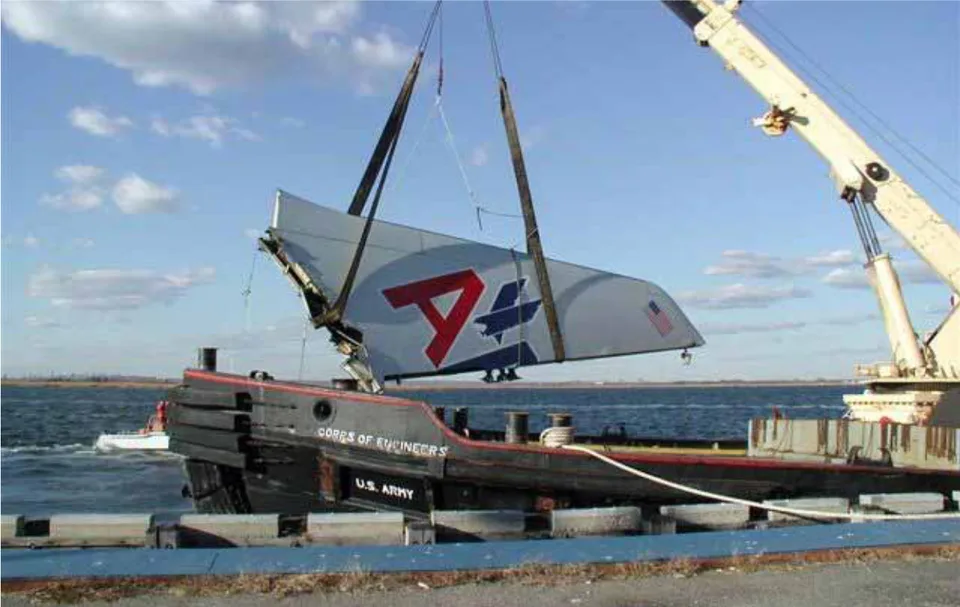
The vertical stabilizer and rudder were recovered from Jamaica Bay, separate from the main wreckage on land. The main impact area lay at Newport Avenue and Beach 131st Street. Four homes were destroyed, three suffered substantial damage and three received minor damage. The detached engines damaged other property near their landing points. Investigators accounted for all major aircraft sections. The recovered stabilizer was mostly intact, while its main attachment fittings and transverse load fittings had fractured.
The NTSB examined the composite structure, studied the fracture surfaces and compared predicted loads with structural tests. The attachment failures had the features of overstress. The examination found no fatigue or pre-existing degradation in the main fitting fractures. The right rear fitting's fracture and the damage to the other fittings supported a sequence beginning at the right rear lug. Computational models predicted that this fitting would fail first and that the remaining attachments would then fail. Three static lug tests provided results consistent with the models and with the fracture features found on the accident aircraft.
Sideslip measures an aircraft's sideways motion through the air. The rudder first creates a yawing motion, and the developing sideslip then produces a rolling moment. The NTSB explained that this introduces a delay between a pedal input and the roll response. A rolling moment can continue in one direction after the rudder has moved in the opposite direction, until the sideslip itself reverses. Repeated large rudder reversals can therefore build a rapidly changing combination of rudder angle and sideslip, with high aerodynamic loads on the vertical stabilizer.
For flight 587, the calculated stabilizer loads at separation were about twice the certified limit load envelope. Ultimate load was defined as one and a half times limit load. The NTSB found that the stabilizer had performed consistently with its design and certification, and that its failure occurred above the ultimate load envelope. Its performance study attributed the hazardous sideslip buildup to the rudder inputs. It concluded that stopping those inputs before the stabilizer separated would have allowed the aircraft's natural stability to reduce sideslip toward zero and avoid the accident.
The A300-600 used a variable stop rudder travel limiter. As airspeed rose, both the maximum rudder angle and the available pedal travel decreased. At high speed, a pilot could obtain full available rudder with a short pedal movement and comparatively light force. The NTSB compared several transport aircraft and found that the A300-600 had the lightest pedal forces among those evaluated. At 240 knots, reaching the pedal stop took about thirty percent of the pedal movement used during a ground rudder check. Pilots had received inadequate training in these changing characteristics.
American's Advanced Aircraft Maneuvering Program taught the use of rudder to assist roll control in upset recovery. Its excessive bank angle simulator exercise depicted a departure behind a heavy aircraft, followed by a roll beyond 90 degrees. During the initial part of that exercise, the effectiveness of the aileron and rudder inputs was suppressed. Pilots were unaware of the suppression. The NTSB found that this exercise could encourage exaggerated expectations of wake turbulence and control strategies that produced a surprising response in the real aircraft. It identified both the rudder system design and elements of the training program as contributors to the first officer's excessive inputs.
The NTSB adopted its report on 26 October 2004. Its probable cause was the in-flight separation of the vertical stabilizer after unnecessary and excessive rudder inputs generated loads beyond ultimate design. Members Carol Carmody and Richard Healing supported the staff draft's ordering of the contributing factors, placing the training program ahead of rudder system characteristics. Their statement objected to the reversal of that order in the adopted language.
The recommendations addressed yaw handling standards, rudder sensitivity, aircraft modifications, pilot guidance and upset training. The NTSB called for clearer explanations of maneuvering speed: operating below that speed provides no structural protection against repeated full control inputs in one axis or simultaneous full inputs in several axes. It also sought guidance that would prevent inaccurate simulator training. American had already provided all its A300 pilots with classroom training on the rudder system in early 2003. The NTSB's recommendations to the FAA and French aviation authority sought further protection against hazardous high-speed pedal inputs.
A simplified reading of the investigation findings. The sequence does not replace the full report or imply that every contributing factor is shown.
Sequence of events
Eastern standard time. Times marked about follow the report chronology; structural failure timing comes from the NTSB performance study. Expand an event to see its evidence.
About 09:13:51Takeoff roll begins
Flight 587 starts its departure from runway 31L behind Japan Air Lines flight 47.
The NTSB found that the second wake encounter left the aircraft controllable. Its simulation indicated roughly ten degrees of additional left bank from the wake alone.
American gave every company A300 pilot classroom training on rudder behaviour in early 2003. The NTSB also recommended standards and guidance for upset recovery training.
Rudder position data were filtered before recording. The NTSB reconstructed the angles using recorder data, measured filter characteristics, control system constraints and aircraft motion.
The NTSB found the captain's response understandable given his limited knowledge and the short sequence. It could not determine whether his feet were resting on the rudder pedals.
Actions and recommendations are described at the dates of the cited records. A recommendation is not proof of implementation.
American's 2003 training
In early 2003, every American A300 pilot received classroom training covering stabilizer loads, certification, the travel limiter, pedal forces and yaw damper interaction.
In October 2004 the NTSB called for yaw handling certification standards, review of existing aircraft and increased protection against hazardous high-speed rudder inputs.
Recommendation A-04-60 sought clearer guidance that maneuvering speed provides no protection against repeated full control inputs in one axis or simultaneous full inputs in several axes.
The NTSB sought written guidance and evaluation of the appropriate simulator automation for upset training. It classified the earlier unusual attitude training recommendation A-96-120 as Open, Unacceptable Response.
Matching dossiers for Structural overload: No other dossier in this collection.
Read alongside
These comparisons connect specific research topics. Shared circumstances do not establish identical causes. Evidence from both investigations is provided below.
American Airlines 587 and Japan Air Lines 123 both lost vertical stabilizer structure in flight. The NTSB attributed flight 587's separation to excessive rudder inputs and aerodynamic overload. For flight 123, the AAIC estimated that fatigue cracks from an improper aft pressure bulkhead repair led to bulkhead rupture; cabin air then entered the tail and vertical fin, causing structural failure and separation.
Explore the records below for additional context. They open on the publisher's site and are not all included in our report search. Source reuse terms apply.
United States federal government work; public domain in the United States. Third-party material carries any separately stated rights.
AAIC final report: Japan Air Lines Boeing 747SR-100 JA8119
Aircraft Accident Investigation Commission, Japan Official English tentative translation, dated 19 June 1987, hosted by JTSB. Japanese original is the reference language version.
Kevin Murphy writes the incident accounts on AirlineIncidents.com, out of a long interest in aviation safety and the lessons each investigation leaves behind.
Prepared by
AirlineIncidents editorial desk
Report citation check
Independent expert review
Not completed
Citation checks compare supporting text with the indexed report pages. They do not constitute independent expert review. How these pages are prepared.