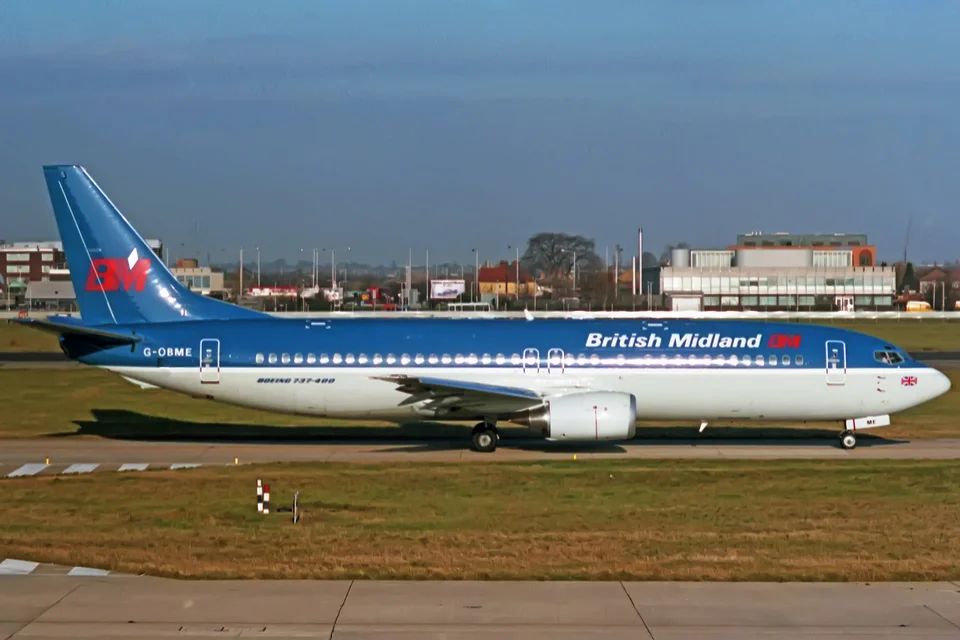
The copies shown here were resized without cropping or retouching.
Geographic context
Kegworth accident site
Runway 27, East Midlands Airport
Approximate accident-site and runway markers. The aircraft crashed about 900 metres short of the Runway 27 threshold. Basemap: Natural Earth, public domain.Read supporting evidence
A fan blade fractured in the left engine during climb, producing compressor stalls, vibration and fumes. The pilots identified the right engine as the source and shut it down. The damaged left engine continued during descent but suffered secondary fan damage and major thrust loss on final approach. Attempts to restart the right engine failed to restore power before the aircraft crashed short of East Midlands Airport. Forty-seven passengers died.
Read the full incident Follow what happened, from the flight to the investigation findings.
What investigators concluded
The AAIB found that the crew shut down the right engine after the left engine fan blade fracture. The left engine then lost thrust through secondary fan damage after approach power was increased. Unfamiliar symptoms, premature action, incomplete use of the instrument indications, the apparent improvement after throttling back the right engine and missing cabin observations contributed to the incorrect response.
1,515 words / about 7 minutes to read. Based on the investigation records cited below.
Climb from Heathrow
British Midland Flight 92 left London Heathrow for Belfast Aldergrove on 8 January 1989. The Boeing 737-400, registered G-OBME, carried 118 passengers, including an infant, and eight crew. It was operating a double shuttle between the two airports and had returned to Heathrow from the first shuttle at 18:45 UTC. The first officer was flying when it took off again at 19:52. After an initial level segment above cloud, air traffic control cleared the aircraft to climb towards its planned cruising level.
At 20:05:05, as the aircraft climbed through 28,300 feet, the outer part of a fan blade in the left engine detached. Compressor stalls followed. The airframe shuddered, a burning smell entered the flight deck and the engine indications fluctuated. The captain recalled seeing smoke from the air conditioning; the first officer remembered a strong smell of burning. No fire warning sounded during this initial event. The flight data recorder showed changes in left engine fan speed, exhaust gas temperature and fuel flow.
The captain took control and disconnected the autopilot. He later said that his look at the instruments gave him no clear indication of the source. He thought the smoke was coming forward from the cabin and associated it with the right engine through his understanding of the air conditioning system. Asked to identify the affected engine, the first officer selected the right one. The captain ordered its throttle closed about 19 seconds after the vibration began. The recorder showed steady indications from that engine at the time.
Within one or two seconds of the right throttle being closed, the aircraft rolled level and the pronounced shuddering stopped. The left engine fan speed and exhaust temperature settled, although its indicated vibration remained at maximum and its fuel flow was erratic. The AAIB linked this recovery to disengaging the autothrottle when it had demanded a lower left engine throttle setting. The improvement convinced the pilots that they had identified the fault. The first officer reported an emergency to London air traffic control, describing what appeared to be an engine fire.
The captain ordered a shutdown 43 seconds after the initial vibration. Its completion was delayed while the pilots assessed the apparent improvement, answered air traffic control and spoke to British Midland operations. Two minutes seven seconds after the first event, the first officer closed the right engine fuel cock and started the auxiliary power unit. The company requested a diversion to East Midlands. The captain subsequently recalled that the remaining smoke and smell cleared after the shutdown, reinforcing his belief that the emergency had been resolved.
Inside the cabin, several passengers and three attendants in the rear had seen flames or sparks from the left engine. The flight service manager confirmed to the captain that smoke had entered the cabin. The captain then announced that the right engine had caused the problem and had been shut down. The attendants who had seen the flames later said they had missed his reference to the right engine. Some passengers heard it and noticed the discrepancy, but none reported that discrepancy to the cabin crew.
Controllers directed the aircraft towards an instrument approach to Runway 27 at East Midlands. The captain continued to fly manually while the first officer handled communications and checklists. The left engine was reduced to descent power. Its vibration indication eventually fell, and the engine continued producing thrust. The first officer also tried to program the flight management system for the diversion. The unsuccessful attempt occupied him for two minutes while other duties continued.
At 20:12:28 the captain began reviewing the original symptoms. New headings, a descent clearance and a frequency change interrupted the discussion. Further radio calls interrupted the approach checklist, including a request to contact the airport fire service. The checklist was completed at 20:17:33 with the aircraft 15 nautical miles from touchdown. The captain accepted a vector that increased the distance available before landing and began extending the flaps.
At 20:20:03 power was increased on the left engine while the aircraft briefly levelled at 3,000 feet during a turn towards the runway centreline. Maximum vibration was again recorded. The crew continued descending, lowered the landing gear and selected further flap. At the outer marker, 4.3 nautical miles from touchdown, the captain called for 15 degrees of flap. The damaged engine was now supplying the power needed for the approach.
At 20:23:49, with the aircraft 2.4 nautical miles from touchdown and 900 feet above ground, the left engine abruptly lost power. The captain called for the right engine to be restarted and raised the nose to try to reach the runway. Seventeen seconds after the power loss a left engine fire warning sounded. A glideslope warning followed as the aircraft descended below the approach path. The captain instructed the first officer to leave the fire drill and continue the attempted restart.
The AAIB considered that the blade section released during climb had lodged temporarily in the acoustic lining of the engine intake. Increased vibration after approach power was applied probably shook it free, allowing it to enter the fan and cause extensive secondary damage. Investigators recovered fan blade fragments below the final approach, including two small pieces identified as remnants of the section that had detached during climb.
The right engine produced no power before impact. At 20:24:33 the captain warned the cabin to prepare for a crash landing. The stall warning stick shaker began shortly afterwards and continued until the aircraft hit the ground at 20:24:43. The last recorded airspeed was 115 knots. The initial contact occurred in a field east of the M1 motorway, with the aircraft in a nose-high attitude.
The aircraft crossed the motorway and struck its western side and embankment in a second, more severe impact. The fuselage broke into three main sections and came to rest on the wooded slope about 900 metres from the Runway 27 threshold. The forward cabin floor was destroyed and seats compressed together. Other severe disruption occurred behind the wing where the tail section folded over the fuselage. The overwing and rear areas retained more of their floor and seat structure.
The airport had declared a full emergency before the crash and fire vehicles were standing by near the runway. Crews moved towards the crash site after seeing the aircraft disappear below the motorway embankment. Airport and local fire services extinguished the fire around the left engine and maintained a protective foam blanket while survivors were removed. Passing motorists helped the emergency services in the first stages of the rescue.
Most passengers were trapped by their injuries, failed seating or overhead debris. Only 14 could contribute substantially to their own escape. Rescuers worked through the night to release the remaining occupants, with the last passenger extricated at 04:20. Ambulances and Royal Air Force helicopters carried casualties to hospitals. The final toll was 47 passenger deaths: 39 at the scene and eight later. All eight crew survived. Of the 79 survivors, 74 suffered serious injuries; the injury table grouped the remaining five as minor or none. Five firefighters sustained minor injuries during the rescue.
Examination identified high cycle fatigue in fan blade 17 of the left engine. The AAIB found that a fan system vibration mode at high corrected fan speed and altitude exposed the blade to stresses greater than its design allowance. Certification testing had missed that mode. Tests following the accident found a stronger fan vibration response in flight than in ground testing. The manufacturer pursued changes to the fan blade shroud contact angle to suppress the excitation and undertook recertification work.
The electronic engine displays were examined and tested. The AAIB concluded that both had been functioning at impact and correctly displaying their input information. The pilots had completed a one-day differences course covering the 737-400 and its electronic engine instruments, but British Midland had no simulator with those instruments available for their training. The report recommended specific instruction in using modern engine vibration indicators to identify failures in rotating assemblies.
Boeing training called for pilots to evaluate the cockpit indications and positively identify a problem before taking action. The captain's earlier type training had included no simulator exercise in high engine vibration and had placed no special emphasis on vibration monitors. The AAIB recommended simulator familiarisation with electronic displays, joint emergency exercises for pilots and cabin crew, and an alert drawing attention to maximum engine vibration. It also recommended instrumented engine flight tests across service altitudes and power settings, together with stronger dynamic loading requirements for cabin floors and stowage bins.
The AAIB identified the cause as the shutdown of the right engine following the left engine fan blade fracture, followed by major thrust loss from secondary fan damage when left engine power was increased on final approach. Five factors contributed to the mistaken response: the combination of vibration, noise, shuddering and burning smell exceeded the pilots' training and experience; they acted prematurely; they failed to assimilate the engine display indications; the simultaneous end of the shuddering reinforced their diagnosis; and observations of flames from the cabin never reached them. The investigation made 31 safety recommendations.
Disengaging the autothrottle at a reduced left throttle setting allowed the damaged engine to recover from compressor stalls. The simultaneous end of shuddering reinforced the pilots' diagnosis.
Why did the pilots think the right engine was faulty?
The captain associated smoke coming from the cabin with the right engine. The first officer identified that engine, and the end of the shuddering after its throttle was closed reinforced their decision.
The AAIB considered insufficient bleed air pressure from the left engine, an unconnected auxiliary power unit air supply and a closed crossfeed valve the probable reasons. It also considered the remaining time too short to obtain power even with pressure air available.
Actions and recommendations are described at the dates of the cited records. A recommendation is not proof of implementation.
Fan blade redesign
Flight tests revealed a stronger vibratory response than ground tests. The manufacturer selected a change in shroud contact angle and recertification at the higher engine rating.
Recommendations 4.7 and 4.9 sought instruction in using modern vibration indicators to identify engine failures and an alert drawing attention to maximum vibration readings.
Recommendations 4.26 and 4.30 sought dynamic loading criteria for cabin floors and stronger retention of cabin stowage bins and other items under crash loads.
Matching dossiers for Approach thrust loss: No other dossier in this collection.
Read alongside
These comparisons connect specific research topics. Shared circumstances do not establish identical causes. Evidence from both investigations is provided below.
Further investigation records
Explore the records below for additional context. They open on the publisher's site and are not all included in our report search. Source reuse terms apply.
Kevin Murphy writes the incident accounts on AirlineIncidents.com, out of a long interest in aviation safety and the lessons each investigation leaves behind.
Prepared by
AirlineIncidents editorial desk
Report citation check
Independent expert review
Not completed
Citation checks compare supporting text with the indexed report pages. They do not constitute independent expert review. How these pages are prepared.
Revision history
: Published a sourced account, timeline, photographs and final investigation findings.