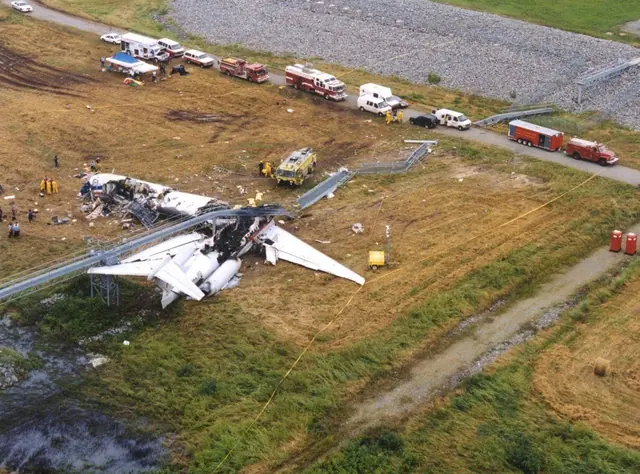
The aircraft and responding vehicles are visible in this aftermath view. The wreckage position provides context for the overrun, but the image alone cannot establish the touchdown speed, braking performance or cockpit decisions.
Resized and JPEG recompressed; no content changes.
Geographic context
Dallas/Fort Worth
Little Rock
Approximate airport and geographical reference positions. This schematic shows the planned journey and relevant locations, not a recorded flight track. Basemap: Natural Earth, public domain.Read supporting evidence
Flight 1420 approached Little Rock as severe thunderstorms reached the airport. The crew changed from Runway 22L to 4R to obtain a headwind, then continued through deteriorating visibility and repeated wind reports. After touchdown, the spoilers did not deploy symmetrically. The aircraft overran the runway, crossed an embankment and struck the approach lighting support structure. Impact and fire destroyed the aircraft.
Read the full incident Follow what happened, from the flight to the investigation findings.
What investigators concluded
The NTSB identified two probable causes: continuing the approach after severe thunderstorms and their hazards moved into the airport area, and failing to ensure spoiler extension after touchdown. It identified fatigue and situational stress, landing beyond the company crosswind limit, and excessive reverse thrust as contributing factors. The finding concerns this crew and sequence; it is not a claim that every thunderstorm landing has the same outcome.
1,736 words / about 8 minutes to read. Based on the investigation records cited below.
The delayed final sector
American Airlines flight 1420 was the crew's third and final sector of the day on 1 June 1999. They had already flown from Chicago to Salt Lake City and then to Dallas/Fort Worth. Weather had delayed the second flight's arrival, and the aircraft originally intended for the Little Rock service was itself late. A replacement MD-82, registered N215AA, was assigned. It departed Dallas/Fort Worth at about 22:40, two hours and 12 minutes after its scheduled departure.
The aircraft carried 139 passengers, four flight attendants and two pilots. The captain flew the sector, while the first officer handled monitoring duties. Before departure, the crew's paperwork included thunderstorm advisories for the route. The first officer had discussed the airline's duty-time limit with gate staff and contacted the dispatcher about obtaining another aircraft or cancelling the flight. The delay and replacement aircraft formed part of the operating circumstances investigated later; they did not by themselves explain the runway overrun.
During the flight, the dispatcher sent a message warning that weather near Little Rock might affect the arrival and suggesting that the crew expedite to get there before the thunderstorms if possible. The pilots acknowledged it. Their conversation recorded concern about lightning and the need to arrive quickly. The first officer later stated that they had not discussed delaying or diverting the landing because of the weather. Their paperwork nevertheless listed Nashville and Dallas/Fort Worth as alternate airports. The short flight was approaching its destination with severe weather moving towards the airport and an increasing sense of urgency in the cockpit.
When the crew contacted Little Rock's tower, the controller described a thunderstorm northwest of the airport and reported gusting winds. The initial plan was an instrument landing system approach to runway 22L. The crew could see lightning and believed there was still time to make the approach. They discussed the crosswind limit, with confusion over the figures for a dry and a wet runway. The captain correctly identified 20 knots as the wet-runway limit, but the report records that they did not check the figure in the flight manual.
A windshear alert and changing wind reports led the crew to request runway 4R instead, aiming for a headwind rather than a tailwind. Controllers vectored them away from the airport to establish the new approach. The first officer briefed its frequency, course, decision altitude and part of the missed-approach procedure. This change introduced more work while the thunderstorm continued moving through the area.
The pilots intermittently saw the airport through clouds. They accepted a visual approach, but then lost sight of it and told the controller. Radar vectors for the runway 4R instrument approach followed. The recorder captured repeated difficulty maintaining visual contact and continuing concern about the storm. The crew still sought a close approach rather than taking a wider route or discontinuing the arrival. These were successive decisions made as conditions changed, not one fixed assessment based solely on the weather information available at departure.
As the flight approached final, the controller reported heavy rain at the airport, visibility below a mile and a runway visual range of 3,000 feet. The previous automatic weather broadcast was no longer current. Another landing clearance came with a wind report of 30 knots gusting to 45. The first officer's readback differed from the wind direction and speed transmitted. The pilots continued preparing to land amid weather information that was both changing quickly and adding to their workload.
The runway visual range subsequently fell to 1,600 feet. The report explains that an aircraft established on the final approach segment could continue to the appropriate decision height under the applicable rules, so that single visibility report should not be used alone to describe the entire decision as unlawful. The investigation's judgement considered the severe thunderstorm, wind limits, crew performance and the complete approach sequence. The crew lowered the landing gear, selected landing flaps and continued towards the runway.
Near the ground, the aircraft drifted right of the localizer course. The first officer later reported that he had suggested a go-around in a weak voice; the report identifies this as his postaccident recollection. The recorder documented difficulty seeing the runway and comments about being off course. Two sink-rate warnings sounded when the aircraft was approximately 70 and 50 feet above the field. Touchdown occurred at about 23:50:20. The crew had reached the runway, but the storm and landing configuration left the aircraft with serious problems to resolve during the ground roll.
The MD-82's spoilers were central to its stopping performance. When raised after touchdown, they reduce wing lift and help put the aircraft's weight onto the wheels, allowing the brakes to work effectively. The flight data did not show the symmetrical spoiler deployment expected for landing. A brief left outboard spoiler movement accompanied an aileron movement, but that was not the normal lift-dumping action needed across the wings. The aircraft therefore retained lift that reduced the loading on its tyres.
The first officer reported that the aircraft was sliding shortly after touchdown. Both thrust reversers were deployed, and the crew used substantial reverse power. Brake pedal movement began several seconds after touchdown, with both pedals reaching full travel about 11 seconds after landing. The data showed changes in reverse-thrust selection and brake application as the pilots tried to slow the aircraft and maintain directional control. Later spoiler movement associated with aileron input did not replace the missing symmetrical landing deployment.
The stopping problem cannot be reduced to rain alone. The investigation found that the crew had not ensured the spoilers were armed and had not ensured that they deployed after touchdown. A wet runway and strong crosswind created demanding conditions, but the absent spoilers materially weakened braking performance. The aircraft continued consuming runway while the crew dealt with both deceleration and control. The report's reconstruction used the flight recorder and the cockpit recording to establish this sequence, separating the normal function of the landing system from what it actually did on the accident landing.
Excessive reverse thrust added to the directional-control difficulty. On this aircraft type, high reverse power could reduce the effectiveness of the rudder and vertical stabilizer. The NTSB found that the recorded heading changes and rudder inputs were consistent with that effect. Directional response improved when the reversers were briefly stowed and deteriorated again when high reverse thrust was applied. The crew were trying to stop, but the manner of using reverse thrust also made keeping the aircraft aligned more difficult.
At about 23:50:44, the aircraft overran the runway end. It struck parts of the localizer array, went through a security fence and descended over a rock embankment onto a floodplain below runway elevation. It then collided with the structure supporting the opposite-direction approach lights. The aircraft came to rest roughly 800 feet beyond the departure end. Impact forces and a postcrash fire destroyed it. The sequence from touchdown to initial impact lasted only about 24 seconds.
The captain and ten passengers died. The final injury table records 45 serious injuries, 65 minor injuries and 24 people without injury, among 145 occupants. Those figures describe the accident's human consequences without treating everyone who survived as uninjured. The investigation also examined the emergency response and concluded that some delay in locating the wreckage was preventable. It identified potential value in crash-location technology, better response coordination and structures beyond runways that could break away more readily when struck. These were distinct survival issues alongside the operational decisions and stopping performance that led to the overrun.
Why the investigation identified a chain of failures
The NTSB's probable-cause finding identified two failures: the crew did not discontinue the approach when severe thunderstorms and their associated hazards had moved into the airport area, and they did not ensure that the spoilers extended after touchdown. The report also identified fatigue and situational stress, continuation of the landing with a crosswind component above the airline limit, and reverse thrust above 1.3 engine-pressure ratio after landing as contributing factors. These were the adopted findings, rather than a general judgement that any landing in rain would have produced the same accident.
The cockpit sequence shows the crew becoming increasingly occupied with the changing approach, disappearing visual reference and urgent landing preparation. The report's fatigue and stress findings relate to degraded performance within those circumstances. They do not establish the pilots' private thoughts at each decision point. Nor does the investigation's use of the first officer's interview turn every remembered statement into something independently confirmed by the cockpit recorder. The account distinguishes recorded events from recollection where that distinction matters.
Once on the runway, separate technical effects interacted. Missing spoilers reduced the tyre loading needed for braking. Delayed full brake application consumed distance at high speed. Excessive reverse thrust reduced directional-control effectiveness. Strong winds and the wet surface complicated the pilots' attempts to recover the situation. The final report therefore treated the event as a combined failure of approach decision-making, landing preparation and ground-roll control. The weather was an essential part of the setting and the cause finding, but it did not replace the specific failures the evidence identified.
The investigation's recommendations addressed several levels of protection. It called for clearer guidance on landing during thunderstorms and for improved spoiler checks before and after touchdown. It examined the use of reverse thrust on wet or slippery runways and the value of automatic braking, which can apply braking promptly while pilots manage other control demands. These measures related directly to the approach and ground-roll sequence reconstructed from flight 1420.
The report also considered the availability and preservation of weather information. Rapidly changing conditions can make an older automatic report misleading, while stored runway visual range data can be important when an accident is investigated. Emergency response, crash-location information and the design of structures beyond the runway received attention because they affect survival after an aircraft leaves the paved surface. The recommendations did not all concern the crew; some addressed airline training, regulatory oversight and airport systems.
American had revised its MD-80 reverse-thrust guidance by the time of the final report. Other recommendations were directed to authorities and operators, and their presence in the report does not demonstrate present-day completion. A delayed evening service continued towards a deteriorating airport, touched down without the spoiler deployment needed for effective braking and encountered further control difficulties during a short ground roll. The investigation traced both the decisions that took it there and the barriers that failed to stop the accident from becoming fatal.
The NTSB identified a crosswind above the company limit and excessive reverse thrust as contributing factors, alongside fatigue and situational stress.
About 23:50:20Touchdown without symmetrical spoiler deployment
The aircraft touched down. Recorded spoiler data did not show symmetrical extension at touchdown. Reversers were used as the aircraft slid along the runway.
No. The probable-cause finding also included failure to ensure spoiler extension. Fatigue, situational stress, excessive crosswind and excessive reverse thrust were contributing factors.
Why was more reverse thrust not necessarily safer?
The investigation identified reverse thrust above 1.3 engine pressure ratio as a contributing factor and recommended highlighting the decrease in rudder effectiveness at higher reverse thrust.
Recorded spoiler behaviour is narrower than a blanket system claim
The report says the spoilers did not deploy symmetrically at touchdown. That finding should not be broadened into a claim that every part of the spoiler system was mechanically defective.
The NTSB identified decisions, stopping configuration and contributing factors for this flight. It did not conclude that weather exposure alone determines every landing outcome.
Actions and recommendations are described at the dates of the cited records. A recommendation is not proof of implementation.
Recommended: explicit spoiler checks and callouts
A-01-49 and A-01-50 called for dual-crew confirmation of spoiler arming and clear callouts for deployment or non-deployment. These are the recommendations in the 2001 report; present implementation status is not asserted.
Recommended: weather information and avoidance guidance
A-01-55 sought clearer strategies for avoiding thunderstorms. A-01-56 and A-01-57 sought improved radar information for controllers and dispatchers. Recommendation text is distinguished here from verified completion.
These comparisons connect specific research topics. Shared circumstances do not establish identical causes. Evidence from both investigations is provided below.
Both accidents occurred during landing in adverse weather, but their mechanisms differ: Flight 1420 overran after touchdown with stopping and control factors; Air Canada 624 struck terrain before the runway during a non-precision approach.
Explore the records below for additional context. They open on the publisher's site and are not all included in our report search. Source reuse terms apply.
Official case overview and supporting investigation links.
Sources and transparency
Source-based check against the NTSB final report. No independent expert review.
Source limitations
This dossier follows the NTSB final report adopted in October 2001. Approximate narrative times are retained as approximate. The report injury table includes fatalities and injuries across all occupants; no cockpit transcript or report illustration is reproduced.
Runway Overrun During Landing: American Airlines Flight 1420, McDonnell Douglas MD-82, N215AA, Little Rock, Arkansas, June 1, 1999
National Transportation Safety Board NTSB/AAR-01/02, adopted 23 October 2001
US federal investigation report, attributed to the NTSB. Limited excerpts for commentary; third-party material and illustrations excluded. No NTSB endorsement. Source terms / provenance.
Kevin Murphy writes the incident accounts on AirlineIncidents.com, out of a long interest in aviation safety and the lessons each investigation leaves behind.
Prepared by
AirlineIncidents editorial desk
Report citation check
Independent expert review
Not completed
Citation checks compare supporting text with the indexed report pages. They do not constitute independent expert review. How these pages are prepared.
Revision history
: Checked report citations and source hashes. Added credited photographs, geographic context, sequence diagrams, reader answers, evidence limits, report-era safety follow-up, further records, sourced incident comparisons and this editorial record.
: Added a full chronological account with section-level report references and links from the short summary.