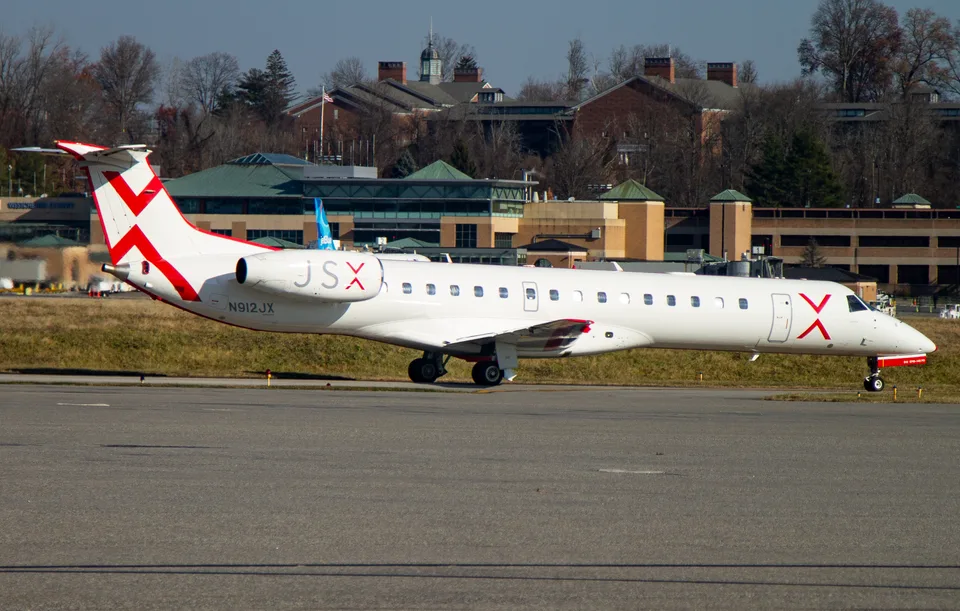
Unmodified source image. Display copies resized without cropping. Responsive WebP copies resized without cropping.
Geographic context
Dallas Love Field, departure
Houston Hobby, accident airport
Schematic geography only. Airport markers are approximate; these points do not show a recorded flight track. Basemap: Natural Earth, public domain.Read supporting evidence
JSX Flight 284 was approaching Houston Hobby from Dallas Love Field when repeated nose-down pitch trim inputs opposed the captain's efforts to raise the nose. A go-around was called just before touchdown, but the aircraft landed hard without a flare. The left main landing gear separated and the left wing sustained substantial structural damage. The report's casualty table records one minor crew injury and 23 uninjured occupants.
Read the full incident Follow what happened, from the flight to the investigation findings.
What investigators concluded
The NTSB identified the captain's unintentional nose-down pitch trim during final approach as the probable cause. The resulting loss of elevator authority led to the hard landing and left main gear collapse.
A crosswind approach, an opposing trim input and a landing without a flare
1,519 words / about 7 minutes to read. Based on the investigation records cited below.
The arrival into Houston
JSX Flight 284 was making a relatively short passenger flight from Dallas Love Field to Houston Hobby on 3 May 2024. The operator was Delux Public Charter, doing business as JSX Air, and the aircraft was an Embraer EMB-145LR registered N942JX. Twenty-one passengers and three crew were aboard. The captain was flying; the first officer was monitoring. The takeoff, climb and cruise gave the crew no indication that the landing would end in a damaged wing and a separated main landing gear.
During descent, air traffic control told the crew to expect runway 4. The reported wind was from 130 degrees at 16 knots, gusting to 24. That placed a substantial crosswind across the landing runway. The captain expressed concern about it, and the first officer sought to reassure her. He also asked whether she wanted another runway. She declined. In later interviews, the pilots explained that they expected Hobby to use runway 4 for arrivals and runway 13 for departures.
The weather was relevant, but the report did not describe a gust beyond the aircraft's recommended maximum. The stated gust of 24 knots was below the report's 30-knot recommendation. The investigation therefore followed the aircraft's actual control inputs rather than treating the crosswind as a complete explanation. Those inputs showed the crew approaching the runway with the elevator and stabilizer increasingly working against one another.
About 1,300 feet above the ground, roughly 93 seconds before touchdown, the captain disconnected the autopilot. The recorder showed a nose-up trim setting at that point. Around 25 seconds later, the trim began moving toward nose-down. Meanwhile, aft pressure on the control column increased to maintain the desired aircraft attitude. The direction of the trim change and the direction of the pilot's control input were becoming opposed.
The report describes the pitch trim as an electromechanically operated horizontal stabilizer system. Its purpose is to reduce the steady force needed on the flight controls when the aircraft is properly trimmed. It is not the same thing as the elevator movement commanded through the control column. The JSX operating procedure specifically linked correct approach trim to the elevator authority available for a landing flare or a missed approach.
The first officer made the 500-foot callout. The captain later recalled that the aircraft was somewhat faster than the intended approach speed, by approximately nine or ten knots, but considered that within the company's stable-approach parameters. The report does not turn that recollection into the probable cause. The important developing problem was that nose-down trim continued while increasing aft control input failed to produce the expected nose-up pitch response.
As the aircraft descended through the final part of the approach, the recorder showed increasing aft column and elevator movement. The aircraft's pitch did not increase correspondingly. The captain called for a go-around approximately two seconds before impact. The ground proximity system produced a sink-rate alert at about the time of touchdown, and the captain repeated the go-around call.
The captain told investigators that the call had come too late. She did not recall starting the manoeuvre, but the recorded data showed increased engine power and increased aft control-column movement. The nose-down trim inputs continued. Increasing thrust therefore did not erase the control configuration that had developed on approach, and the aircraft contacted the runway before the missed approach could be carried out.
The aircraft did not make the flare expected before landing. The NTSB linked that absence to excessive nose-down trim, which limited the captain's ability to arrest the descent with the elevator. The record does not support describing a complete loss of all flight controls or a trim motor running away on its own. It describes a functioning system being commanded in an inappropriate direction during a critical, very short period before ground contact.
The flight recorder captured a vertical load factor of approximately 3.9 g at touchdown. The left main landing gear failed and separated as the aircraft continued along the runway. The separation damaged the left wing structure. The aircraft stopped on the left side of the runway, about 567 feet from its far end. Emergency personnel responded and helped the passengers leave through the main cabin door.
The structural findings explain why the outcome was more than an unusually firm landing. A principal wing structural element was fractured at several locations and required major repair or replacement. The left gear's attachment points failed under the loading. The report explains that these attachment joints are designed to allow gear separation in a way intended to protect major structure and the fuel tank, although substantial structural damage still occurred.
Investigators found that the fuel tank's integrity was not compromised. There was no aircraft fire. Those findings limit the description of the consequences: the aircraft was substantially damaged, but the report does not document a fuel-fed fire or a tank rupture. The casualty table records one minor crew injury and 23 uninjured occupants. A later paragraph identifies the first officer as the person taken to hospital for minor injuries.
The investigation used both cockpit voice information and flight data. The cockpit record helped establish the discussion about the crosswind and the late go-around call. The flight data supplied the control-column, elevator, stabilizer and engine-power sequence. Together, they let investigators compare what the crew said with what the aircraft systems recorded. They did not need to infer the opposing trim direction merely from the damage found after landing.
There were limitations within that recorder evidence. The left elevator parameter was intermittent and invalid throughout the accident flight, whereas the right elevator parameter was valid. The recording also ended while the aircraft still had substantial ground speed. The report says the reason for that early ending could not be determined. It therefore does not provide a continuous recorded account through the final stopping position and passenger exit.
The aircraft itself was a twin-engine regional jet with a T-tail and retractable tricycle landing gear. JSX had acquired N942JX in August 2022. These details identify the machine and its control system; they do not imply that its age or ownership history caused the event. The engineering examination, flight recordings and interviews converge on the landing configuration and loading. Their combined value is the distinction between an observed input, an inferred handling technique and a structural consequence that investigators could examine directly.
The flight recorder contained the accident flight and earlier flights, giving investigators an opportunity to compare the captain's technique with other landings. In the accident approach, the trim oscillated between nose-up and nose-down settings before continuing strongly nose-down near touchdown. The NTSB considered this consistent with a technique being used to adjust pitch and vertical speed.
One earlier recorded landing was also flown by the accident captain. On that approach she again used alternating trim inputs, but in the last ten seconds she applied nose-up trim. Another pilot's landing contained no comparable approach trim inputs. The comparison did not mean that every use of trim inevitably produces an accident. It showed that the accident flight had a distinct, damaging final trim direction even within the captain's own previous pattern.
In interviews, the captain said she liked to trim late in an approach to help smooth the flare. JSX personnel and simulator instructors told investigators that this was not a technique they trained or encouraged, particularly close to the ground. The final report also describes a June 2024 functional test of the pitch trim system. All systems tested were operational, supporting the investigation's focus on commanded inputs rather than an established mechanical malfunction.
The NTSB determined that the captain's unintentional use of nose-down pitch trim during final approach limited elevator control authority. That produced the hard landing and collapse of the left main landing gear. The report identifies control action, monitoring and crosswind effects in its findings. It does not assign legal blame, and the causal wording should not be expanded into claims about deliberate misconduct.
Investigators also examined the captain's longstanding eye condition, amblyopia. They considered whether reduced binocular depth perception or associated visual processing effects could have contributed. The reviewed evidence provided no clear indication that the condition caused the accident. The existence of a medical condition and the existence of an accident are not enough to establish a causal connection, and this account preserves the report's qualified conclusion.
Several internal inconsistencies require care. The report's opening factual paragraph says nobody was injured, while its header, casualty table and later hospital account record a minor injury. Its overview gives an event time of about 18:20 local, but the detailed recorder chronology places touchdown at 17:59:21. It also describes the trim value at 250 feet differently in two passages. This narrative uses the supported sequence without claiming those discrepancies have been resolved.
The resulting account is a close-call study with substantial aircraft damage and a fortunate human outcome. It shows how a crosswind approach, an individual handling technique and an opposing stabilizer setting can converge in the seconds before landing. The report supports an explanation of reduced flare authority and a late recovery attempt. It does not establish a new fleet-wide defect, a tank fire, or a medical cause.
A simplified reading of the investigation findings. The sequence does not replace the full report or imply that every contributing factor is shown.
Sequence of events
Relative times use the report's recorded sequence. Its overview states about 18:20 CDT, while its detailed recorder chronology puts touchdown at 17:59:21. Those clock times have not been reconciled. Expand an event to see its evidence.
DescentCrosswind discussed
Runway 4 was assigned with wind from 130 degrees at 16 kt, gusting 24 kt.
The later functional test found it operational. The probable cause concerns unintentional use of nose-down trim, not a demonstrated system malfunction.
The landing's vertical loading exceeded the gear's design limits. The separation damaged the wing, but investigators found the fuel tank's integrity was maintained.
The opening factual paragraph says there were no injuries, but the casualty table and later hospital account record a minor injury to the first officer. This draft follows those more specific entries.
The final report describes the training investigation and standard operating procedure. It does not establish the current implementation of a new corrective training programme.
These comparisons connect specific research topics. Shared circumstances do not establish identical causes. Evidence from both investigations is provided below.
Both investigations examine landing decisions and aircraft configuration. JSX 284 involved nose-down trim and a hard landing; Flight 1420 involved a runway overrun with different braking and spoiler issues. Similar flight phase does not imply the same mechanism.
Explore the records below for additional context. They open on the publisher's site and are not all included in our report search. Source reuse terms apply.
Supporting investigation records. Availability and third-party reuse rights differ between documents.
Sources and transparency
5 October 2026, report text and citation locations checked. Independent expert review not completed.
Source limitations
The report conflicts internally on the overview time, trim value at 250 ft and initial injury description. This draft uses relative sequence, avoids the disputed 250-ft trim value and follows the casualty table and first officer hospital account. It omits the implausible landing-weight figure in the engineering paragraph.
JSX Flight 284: hard landing at Houston - NTSB DCA24FA179
National Transportation Safety Board Official final report, released 22 September 2026
US federal investigation report, attributed to the NTSB. Third-party photographs and illustrations are excluded from reuse. No NTSB endorsement. Source terms / provenance.
Runway Overrun During Landing: American Airlines Flight 1420, McDonnell Douglas MD-82, N215AA, Little Rock, Arkansas, June 1, 1999
National Transportation Safety Board NTSB/AAR-01/02, adopted 23 October 2001
US federal investigation report, attributed to the NTSB. Limited excerpts for commentary; third-party material and illustrations excluded. No NTSB endorsement. Source terms / provenance.
Kevin Murphy writes the incident accounts on AirlineIncidents.com, out of a long interest in aviation safety and the lessons each investigation leaves behind.
Prepared by
AirlineIncidents editorial desk
Report citation check
Independent expert review
Not completed
Citation checks compare supporting text with the indexed report pages. They do not constitute independent expert review. How these pages are prepared.
Revision history
: Published sourced incident account, timeline, photographs and investigation findings.