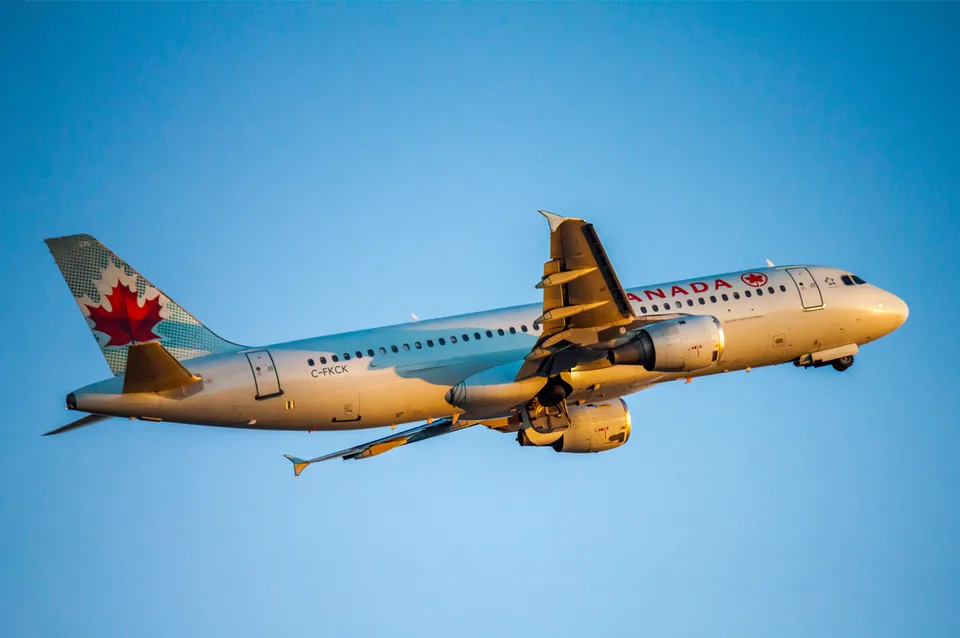
Original photograph unchanged. Responsive WebP copies resized without cropping.
Geographic context
Toronto Pearson, departure
San Francisco International Airport, taxiway overflight
Scheduled route from Toronto to San Francisco. Markers show approximate airport locations. Basemap: Natural Earth, public domain.Read supporting evidence
Flight 759 approached San Francisco at night with runway 28L closed. The crew mistook runway 28R for 28L and taxiway C for 28R. Four airliners were waiting on the taxiway. The A320 passed over the first at about 100 ft, began a go-around at about 89 ft and continued descending to about 60 ft over the second. It then climbed over the remaining aircraft. All occupants were uninjured and all five aircraft were undamaged.
Read the full incident Follow what happened, from the flight to the investigation findings.
What investigators concluded
The NTSB found that ineffective review of runway closure information led to the crew misidentifying taxiway C as the landing runway. Contributing factors were the untuned backup ILS, expectation bias, fatigue, breakdowns in crew resource management, and Air Canada's ineffective presentation of approach and runway closure information. The crew's go-around prevented a collision.
1,688 words / about 8 minutes to read. Based on the investigation records cited below.
A late flight to an altered airport
Air Canada flight 759 left Toronto for San Francisco on the evening of 7 July 2017 with 135 passengers and five crew aboard an Airbus A320-211, C-FKCK. The captain flew the aircraft and the first officer monitored it. The inbound aircraft had arrived late because of weather around Toronto. Flight 759 pushed back at 21:25 eastern daylight time, 30 minutes behind schedule, and takeoff power was selected about 21:58. The flight crossed an area of thunderstorms, after which both pilots reported beginning to feel tired.
At San Francisco, construction required runway 28L to close during the night. Its closure was scheduled from 23:00 until 08:00 the next morning, and the dispatch release included a notice announcing it. The captain later said he had seen the closure information. The first officer could not recall seeing the specific notice. In a later interview, the captain said the pilots had discussed the closure but placed little emphasis on it because he expected to arrive before it began. The NTSB noted that even the original arrival time, 23:03, was three minutes after the scheduled closure.
The pilots received another opportunity to identify the changed airport configuration before descent. About 23:21 PDT, ATIS information Quebec arrived through the aircraft's ACARS communications system. It identified the Quiet Bridge visual approach, runway 28R for landing, and the closure of runway 28L and its reciprocal designation, 10R. Both pilots recalled reviewing the ATIS but could not recall the closure notice. Airport logs showed that runway 28L's lights had been switched off about 23:12. The weather was clear with 10 statute miles of visibility when the incident occurred.
The captain briefed Air Canada's FMS Bridge visual approach to runway 28R. This procedure used the flight management system to bring the aircraft toward the airport, followed by a visual segment. For the A320, the approach required the first officer to enter the runway's ILS frequency manually. Its localizer would then provide backup lateral guidance to the runway centerline. The frequency was 111.7. Flight data showed that the first officer had entered no ILS frequency, and the captain's required review of the approach setup did not catch the omission.
This was the only approach in Air Canada's A320 database that required manual tuning of a navigation frequency. The NTSB found that the unusual manual step and the inconspicuous instruction on the second page of the approach chart contributed to its omission. The instruction sat within a paragraph. The pilots also discussed threats including the nighttime landing, busy airspace and their alertness, but neither could recall discussing the runway closure in the approach briefing.
At 23:51:11 the tower cleared Flight 759 to land on runway 28R. The landing gear was selected down at 23:52:46. The autopilot was disconnected at 23:53:28, at about 1,300 ft, and the flight directors were disengaged at 23:54:02. At 23:54:28 the A320 passed the final waypoint, F101D, at about 1,100 ft. The captain made the right turn toward the airport and aligned the aircraft with parallel taxiway C. The first officer was setting missed approach information and, at the captain's request, locating the runway heading. Those tasks kept his attention inside the cockpit during the alignment.
The captain believed he was seeing two runway surfaces. In his interpretation, the illuminated runway 28R was runway 28L, and taxiway C was runway 28R. Four airliners were waiting on taxiway C for takeoff clearance: United Airlines flight 1, a Boeing 787; Philippine Airlines flight 115, an Airbus A340; United Airlines flight 863, another Boeing 787; and United Airlines flight 1118, a Boeing 737. Lights from aircraft along the taxiway helped create the impression of a runway. The crew continued descending despite green taxiway centerline lights and flashing yellow guard lights.
The captain noticed lights across the surface he thought was the runway and asked the first officer to check whether it was clear. The first officer looked outside after his cockpit tasks and presumed the captain had aligned the aircraft with the intended runway. Radio congestion delayed the query. At 23:55:45, with the A320 at about 300 ft, Flight 759 asked the controller to confirm the landing clearance because the pilots could see lights across the runway. The controller checked his displays and scanned runway 28R again. At 23:55:52 he confirmed the clearance and said that the runway was clear.
The A320 was then about 200 ft high and 2,300 ft from the airport seawall. Its position symbol disappeared from the surface surveillance display for 12 seconds as it passed outside the system's coverage cone. The controller could still see the aircraft from the tower. At 23:55:59, the captain of United flight 1 transmitted a question about where the approaching aircraft was going. At 23:56:03 he reported that it was on the taxiway. Flight 759 passed over the United 787 at about 100 ft. Around that time, the Philippine Airlines crew switched on their landing gear and nose lights, illuminating the taxiway and the aircraft ahead.
At 23:56:05 the A320's thrust levers advanced and its engine power and pitch increased. The performance study placed the aircraft at about 89 ft when the go-around began. The captain said the appearance ahead had ceased to make sense to him. The first officer said he also called for a go-around, and the captain recalled that the call coincided with his own initiation of the maneuver. Neither pilot identified a specific visual cue that triggered the decision. The NTSB found that one or more of the salient cues present near the seawall likely prompted it.
The aircraft continued descending while the engines and elevators transitioned for the go-around. At 23:56:07 it reached its minimum height of about 60 ft as it passed over the Philippine Airlines A340. It began climbing one second later. During the three seconds between initiating the maneuver and beginning the climb, it traveled about 700 ft. The controller instructed the crew to go around at 23:56:09. Flight 759 then passed over United flights 863 and 1118 at about 200 and 250 ft respectively.
The NTSB reconstructed the close passage using flight data, radar and airport security video. The 60-ft figure represented the bottom of the A320's landing gear above the ground. From a scaled video image, investigators estimated about 13.5 ft between the A320 fuselage and the A340's vertical stabilizer. They gave a range of 10 to 20 ft because the image was small and pixelated. The measurement assumed that the A320 was directly above the A340; the image could not establish lateral separation. The NTSB concluded that the crew's low-altitude go-around prevented a collision with one or more waiting aircraft.
The tower gave Flight 759 a heading and a climb to 3,000 ft mean sea level. During the downwind leg for the second approach, the first officer asked whether they should tune the ILS frequency, and the captain agreed. Flight 759 landed successfully on runway 28R about 00:11 on 8 July. No occupants of Flight 759 or the waiting aircraft were injured, and none of the aircraft was damaged.
The NTSB identified runway misidentification arising from ineffective review of closure information as the probable cause. The pilots' experience of seeing two illuminated parallel runways at San Francisco reinforced their expectation of that configuration. Once they had identified the taxiway as runway 28R, the line of aircraft lights supported that belief. The available conflicting cues failed to overcome it. The report identified expectation bias, the untuned ILS and breakdowns in crew resource management among the contributing factors.
The investigation also found that both pilots were fatigued. At the time of the incident it was 02:56 by their normal eastern daylight body clock. The captain had been awake for more than 19 hours and the first officer for more than 12 hours. This combination of circadian disruption and continued wakefulness likely contributed to their misidentification, continuing expectation bias and delayed go-around. Their schedule complied with Canadian regulations. The NTSB found that those regulations could allow reserve pilots insufficient rest before evening flights extending into their circadian low.
Air Canada's presentation of information also contributed. The runway closure notice appeared within a 27-page dispatch package. The ATIS message displayed 14 continuous lines of uniformly capitalized text, with the closure information spanning the eighth and ninth lines. The NTSB found that the presentation did not effectively convey its importance or promote review and retention. The report called for clearer organization and prioritization of operational information.
The tower's surface surveillance system provided no taxiway landing alarm because its safety logic lacked that function. One controller was working all tower positions while the other took a break. The NTSB found that congestion delayed the crew's query, and that the controller responded appropriately once he became aware of the conflict. The agency also investigated additional warning technology. A simulation using a SmartLanding-equipped warning system generated a taxiway caution at 235 ft radio altitude, about 2,600 ft before the seawall. The incident aircraft had no SmartLanding or runway awareness option installed.
The captain reported the event to dispatch at 16:08 on 8 July. Senior Air Canada personnel learned of the close overflight on 9 July. By then the aircraft had flown about 40 more hours and its two-hour cockpit voice recording had been overwritten. The NTSB could therefore not determine whether distraction, workload or other factors contributed to the missed ILS tuning and verification. Flight data, certified radio recordings, security video and interviews supported the reconstruction.
The final report was adopted on 25 September 2018. Its seven recommendations addressed manual frequency entry and autotuning, presentation of flight information, cockpit warnings for incorrect surface alignment, development of intended-runway alerts, taxiway arrival alerts for controllers, more conspicuous runway closure indications, and Canadian reserve-pilot fatigue regulations.
Air Canada reported several changes in April 2018 correspondence included in the report. It revised the Bridge approach to use lateral and vertical navigation guidance on short final, reiterated electronic backup for approaches, added SFO familiarization training and improved the A320 simulator's airport graphics. It also introduced ways to highlight digital flight releases. In May 2018 it clarified event-reporting times and amended approach briefings to address the expected runway lighting and visual aids.
A simplified reading of the investigation findings. The sequence does not replace the full report or imply that every contributing factor is shown.
Sequence of events
Pacific daylight time (UTC-7). Heights are above ground level unless specified. The incident occurred shortly before midnight on 7 July; the second landing was on 8 July. Expand an event to see its evidence.
18:25, 7 JulyDelayed departure from Toronto
The A320 pushed back 30 minutes late. Takeoff power was selected about 18:58 PDT, or 21:58 in Toronto.
Thrust increased at about 89 ft. The A320 descended to about 60 ft over Philippine Airlines flight 115 at 23:56:07 and began climbing one second later.
How close did Flight 759 come to the aircraft on the taxiway?
The performance study estimated 10 to 20 ft between the A320 fuselage and the Philippine Airlines A340 vertical stabilizer, using a scaled security-camera image. It assumed the A320 was directly above the A340; lateral separation could not be determined.
The NTSB found that ineffective review of runway closure information left the crew unaware that runway 28L was closed. They expected two runway surfaces and identified taxiway C as runway 28R.
The video-based distance between the A320 fuselage and A340 stabilizer was estimated at 10 to 20 ft. Image resolution limited precision, and lateral separation could not be determined.
Differing pilot statements and the available recorded parameters prevented the NTSB from determining whether the approach used open or managed descent mode.
Actions and recommendations are described at the dates of the cited records. A recommendation is not proof of implementation.
Air Canada changes reported in 2018
April 2018 correspondence described revised approach guidance, simulator improvements, SFO familiarization and digital release annotation. May 2018 manual changes clarified event reporting and briefing of expected runway lighting.
These labels organise the evidence. They are not a ranking of causes. A shared label means a shared research topic, not an identical mechanism.
Probable causeLanding surface misidentification
Ineffective review of runway closure information left the crew unaware that runway 28L was closed and led them to identify taxiway C as the intended landing runway.
Matching dossiers for Landing surface misidentification: No other dossier in this collection.
Contributing factorBackup lateral guidance absent
The first officer omitted manual ILS tuning and the captain omitted verification, removing localizer guidance that could have helped identify the correct surface.
Matching dossiers for Expectation bias: No other dossier in this collection.
Contributing factorFatigue
Extended wakefulness and circadian disruption fatigued both pilots and likely contributed to surface misidentification, continuing expectation bias and the delayed go-around.
Matching dossiers for Approach and closure information: No other dossier in this collection.
Read alongside
These comparisons connect specific research topics. Shared circumstances do not establish identical causes. Evidence from both investigations is provided below.
Both investigations found that crews misidentified an airport surface and failed to use available cues or guidance to verify it. Comair 5191 began takeoff on runway 26 after clearance for runway 22; the NTSB found failures to identify the aircraft's position during taxi and verify the runway before takeoff. Flight 759 approached taxiway C after its crew missed runway closure information and omitted backup ILS tuning. Comair's takeoff ended in a crash that killed 49 people; Flight 759's low-altitude go-around prevented a collision with the waiting aircraft.
Explore the records below for additional context. They open on the publisher's site and are not all included in our report search. Source reuse terms apply.
Flight sequence, performance reconstruction, findings, recommendations and Air Canada postincident actions.
Sources and transparency
NTSB final investigation report AIR-18/01 adopted 25 September 2018.
Source limitations
The cockpit voice recording was overwritten after the aircraft returned to service. The NTSB could not determine whether distraction, workload or other factors contributed to the missed ILS tuning and verification.
Taxiway Overflight, Air Canada Flight 759, Airbus A320-211, C-FKCK, San Francisco, California, July 7, 2017
NTSB Final report NTSB/AIR-18/01, adopted 25 September 2018; includes October 2018 board member statements.
Kevin Murphy writes the incident accounts on AirlineIncidents.com, out of a long interest in aviation safety and the lessons each investigation leaves behind.
Prepared by
AirlineIncidents editorial desk
Report citation check
Independent expert review
Not completed
Citation checks compare supporting text with the indexed report pages. They do not constitute independent expert review. How these pages are prepared.
Revision history
: Final NTSB report AIR-18/01 adopted 25 September 2018.