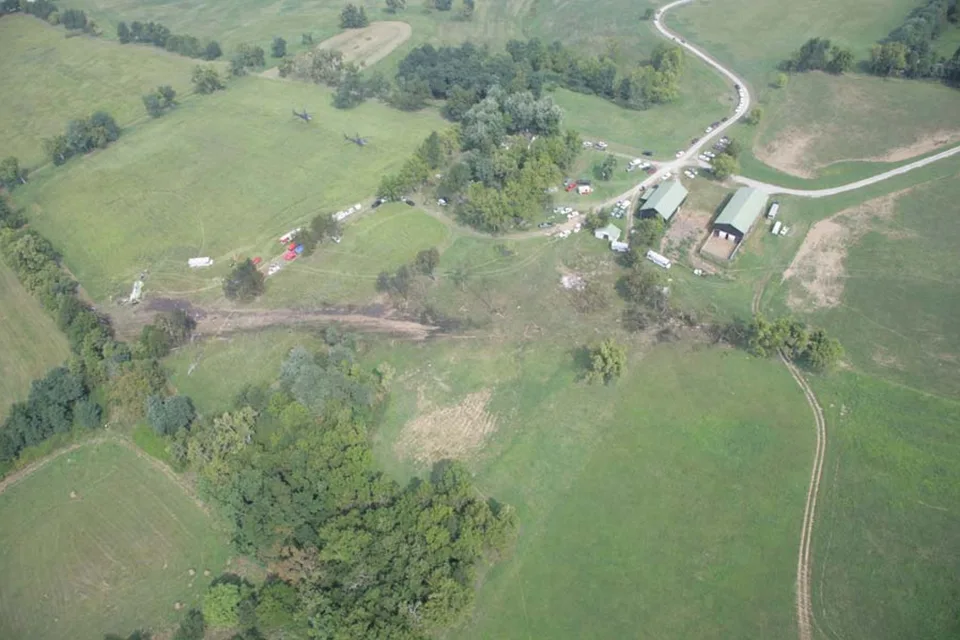
Original photograph downloaded at full size. Responsive WebP copies resized without cropping.
Geographic context
Blue Grass Airport, Lexington
Hartsfield-Jackson Atlanta, intended destination
Approximate airport markers for the planned Lexington to Atlanta route. The aircraft crashed beyond runway 26 during the departure. Basemap: Natural Earth, public domain.Read supporting evidence
Comair flight 5191 was a Part 121 passenger flight from Lexington to Atlanta. The captain taxied to the holding position for runway 26, then turned onto that runway after receiving takeoff clearance for runway 22. The first officer began the takeoff roll on the unlighted, 3,501-foot runway. The jet overran, struck a berm, fence and trees, and broke apart in a postcrash fire. Forty-nine people died; the first officer survived with serious injuries.
Read the full incident Follow what happened, from the flight to the investigation findings.
What investigators concluded
The NTSB found that the crew failed to use available cues to identify their position during taxi and failed to cross-check and verify the runway before takeoff. Contributing factors were their nonpertinent conversation during taxi, which caused a loss of positional awareness, and the FAA policy allowing runway crossings without specific clearances.
1,718 words / about 8 minutes to read. Based on the investigation records cited below.
A departure before sunrise
Comair flight 5191 was preparing to leave Blue Grass Airport in Lexington, Kentucky, for Atlanta on 27 August 2006. The Bombardier CL-600-2B19, registered N431CA, was a CRJ-100 carrying 47 passengers, two pilots and one flight attendant. Its scheduled airline operation fell under Part 121. The departure took place in night visual meteorological conditions, about an hour before sunrise. Visibility was eight miles in the preceding weather observation, and the moon was below the horizon. The NTSB found that weather was not a factor in the accident.
The crew reported for duty at about 05:15 and collected the flight release, weather information, notices to airmen and flight plan. Two Comair regional jets were parked on the ramp. The pilots initially entered the wrong aircraft and started its auxiliary power unit. A ramp agent alerted them, and they shut the unit down and moved to the assigned jet. During preparations in N431CA, the airport information broadcast identified runway 22 as the runway in use.
The captain offered the Atlanta leg to the first officer, who accepted. During the takeoff briefing the first officer initially referred to runway 24; the captain corrected him to runway 22. The briefing then included several further references to runway 22 and a short taxi along taxiway A. The crew briefed a decision speed of 137 knots and a rotation speed of 142 knots. Both heading bugs were set to 227 degrees, the magnetic heading of runway 22.
Blue Grass Airport had two intersecting runways. Runway 4/22, used by airline traffic, was 7,003 feet long and 150 feet wide. Its high-intensity edge lights were operating, although its centerline lights and runway end identifier lights were out of service during construction. Runway 8/26 was 3,501 feet long. Painted edge markings restricted its usable width to 75 feet. It was designated for daytime visual operations by aircraft weighing less than 12,500 pounds, and its runway edge lights had been disconnected since 2001.
A construction project had shifted runway 4/22 to the southwest. The airport had reopened a week before the accident after resurfacing, new markings and changes to taxiway signage. Part of taxiway A north of runway 8/26 was closed and barricaded. The former taxiway A5 had become the temporary continuation of taxiway A leading to runway 22. An aircraft following that route had to cross runway 26 before reaching the runway 22 holding position. The two holding positions were about 560 feet apart.
The Jeppesen chart issued to the crew showed earlier taxiway identifiers. The closure notice was absent from the flight release and the airport information broadcasts received that morning. In its analysis, the NTSB found that accurate runway signs, painted numbers and cockpit heading information remained available to identify the route. Its findings were that the missing closure notice in the flight paperwork was not a factor and that the controller failing to advise the crew of the changed configuration was likely not a factor.
At about 06:02:01, the first officer told the controller that the aircraft was ready to taxi. The controller instructed the crew to taxi to runway 22, and the first officer acknowledged that runway. The clearance permitted crossing the intersecting runway 26 under the FAA rule then in effect. The captain started taxiing at about 06:02:17. Two other regional jets had departed on runway 22 before Comair reached its holding position.
The pilots performed checklist duties during the taxi. Between about 06:03:16 and 06:03:56, they also resumed a discussion about job opportunities that had begun at the gate. This conversation was unrelated to the operation of the aircraft and violated the sterile cockpit rule. The NTSB found that the distraction likely contributed to their loss of awareness of the aircraft's position. The captain had also abbreviated the taxi briefing, although company procedures required a full briefing for their first flight together.
At about 06:04:33, the captain stopped at the runway 26 hold short line. The first officer made a passenger announcement and completed the before takeoff checklist. The aircraft remained stopped for about 50 seconds. Nighttime observations after the accident showed that illuminated runway signs, the painted runway 26 numbers and the continuation of the taxiway toward runway 22 were visible from that location. The crew made no recorded inquiry about its position.
At about 06:05:15, the first officer reported that the flight was ready to depart. The controller issued takeoff clearance about three seconds later, with an instruction to fly the runway heading. The request and clearance omitted the runway number, which the procedures then in force allowed. The NTSB concluded that this omission was not a factor because the crew already believed it was at the runway 22 holding position.
The captain resumed taxi at about 06:05:24, crossed the hold short line and called for the lineup checklist. The jet began turning onto runway 26 at about 06:05:41. The first officer declared the checklist complete five seconds later. At about 06:05:58, the captain handed control to him. By about 06:06:00, the aircraft was aligned with the runway 26 centerline. Its magnetic heading was approximately 266 degrees. The heading bugs still showed 227 degrees, leaving an offset of about 40 degrees on the flight displays.
The first officer advanced power, and the captain set the takeoff thrust. At about 06:06:16, as the aircraft passed through the runway intersection, the first officer commented on the absence of lights. The captain acknowledged the observation. The crew continued accelerating. The NTSB found that both pilots believed they were on runway 22 and had failed to verify their runway position. It also found that confirmation bias likely influenced their failure to respond to contradictory cues.
The captain called the 100-knot airspeed check at about 06:06:24. Around that time the aircraft passed the maximum speed at which it could stop on the available runway with maximum braking. Bombardier's calculations placed that stopping threshold at approximately 103 knots, reached 1,834 feet down runway 26 with 1,667 feet left for braking. The takeoff performance figures in the crew's paperwork had assumed runway 22.
At 06:06:31.2, the captain called the decision speed and rotation together. The aircraft was traveling at 131 knots, six knots below the briefed decision speed and eleven knots below the briefed rotation speed. The performance study placed it only 236 feet from the runway end. The first officer pulled the control column fully aft, producing a rotation rate of about ten degrees per second. The NTSB concluded that the pilots recognized trouble after the aircraft had passed the point where it could stop on the remaining runway.
The jet struck a berm roughly 265 feet beyond runway 26 and briefly became airborne, climbing less than 20 feet above the ground. It hit the perimeter fence and trees farther along the path. The first tree impacts opened the cockpit and ruptured the left wing fuel tank. Later impacts with large trees split the passenger cabin and forced fuel, fuel vapor and fire inside. The wreckage came to rest about 1,800 feet beyond the runway. Impact damage and the postcrash fire destroyed the aircraft.
One controller was working all tower and radar positions at Lexington. After transferring the preceding departure to Indianapolis control, he turned to an administrative traffic count. His normal practice was to accumulate the flight progress strips during the night and count them near the end of his shift. He did not see Comair's takeoff. The NTSB found that the lower-priority task could have waited and that visual monitoring offered an opportunity to detect the crew's error.
After hearing the crash and seeing fire west of the airport, the controller activated the crash phone at about 06:07:17. An airport public safety officer and a Lexington police officer were the first responders. They reached the vicinity about five and a half minutes after notification, then located the fuselage about three and a half minutes later. They freed the seriously injured first officer from the cockpit wreckage. An airport officer and the police officer transported him to hospital in a sport-utility vehicle; the airport officer estimated arrival before 06:30.
The first airport firefighting vehicle arrived about eleven minutes after notification, having traveled by public roads and difficult terrain. Fire suppression began immediately, and the airport incident record reported control of the fire within about three minutes. The captain, flight attendant and all passengers died. The NTSB found that the aircraft was partially survivable, but the rapid deterioration of the cabin from fire and smoke prevented evacuation. It described the emergency response as timely and well coordinated and directly credited the first officer's survival to his rescue and rapid hospital treatment.
The NTSB adopted its final report on 26 July 2007. Its probable cause was the crew's failure to identify its position during taxi and verify the runway before takeoff. It named the nonpertinent taxi conversation and the FAA's failure to require specific runway-crossing clearances as contributing factors. The investigation also identified deficiencies in controller monitoring policies. It found insufficient evidence to determine whether fatigue affected the pilots. The controller was most likely fatigued, but the degree to which fatigue affected his decision to stop monitoring the departure could not be determined.
Several changes had already occurred by the time of the final report. Comair added a departure-runway checklist item in March 2007. Lexington's January 2007 tower notice required controllers to observe an aircraft crossing runway 26 before issuing takeoff clearance for runway 22. After the accident, the midnight shift was consistently staffed with two controllers. These changes addressed opportunities to catch an aircraft approaching or entering the wrong departure runway.
The report recommended mandatory position cross-checks by flight deck crews, cockpit moving maps or automatic wrong-runway alerts, enhanced taxiway centerline markings and painted holding position signs. It also recommended delaying takeoff clearance until all intersecting runways had been crossed and giving aircraft monitoring priority over administrative work. Recommendations A-00-67 and A-00-68, calling for explicit runway-crossing instructions, were reiterated.
Board members Deborah Hersman and Kathryn Higgins filed concurring statements on 2 August 2007. Hersman agreed that pilot behavior was the chief component of causation and urged broader recognition of weaknesses in charts, procedures, staffing and oversight. Higgins emphasized the missed safeguards of a full taxi briefing and controller monitoring. She accepted the primary probable cause and argued that those failures also merited inclusion among contributing factors.
The captain corrected an initial reference to runway 24. The first officer briefed runway 22, taxiway A and takeoff speeds; the heading bugs were set to 227 degrees.
About 06:05:18 to 06:06:00Clearance and wrong-runway lineup
The controller issued takeoff clearance. The captain crossed the hold short line, turned onto runway 26, handed control to the first officer and aligned with its centerline.
06:06:31.2 to about 06:06:35Early rotation and impact
The captain called V1 and rotation at 131 knots, below the briefed speeds. The jet struck the berm, briefly became airborne and hit the fence and trees.
The NTSB found that the pilots lost positional awareness during taxi and believed they were on runway 22. They failed to verify the runway using available signs, markings and heading information, and confirmation bias likely affected their interpretation of the cues.
Could the aircraft have stopped after the rotation call?
The NTSB performance analysis placed the rotation call at 131 knots with 236 feet remaining. Bombardier calculated that maximum braking would have had to begin at about 103 knots for the aircraft to stop on runway 26.
The controller turned to a traffic count after handing off the preceding departure. The NTSB found that performing this lower-priority administrative task prevented him from detecting the wrong-runway takeoff.
The first officer was the sole survivor and sustained serious injuries. Responders extricated him from the cockpit and rapidly transported him to hospital.
The NTSB found insufficient evidence to determine whether fatigue affected the pilots. Their actual recent sleep times could not be established reliably.
The controller was most likely fatigued. The NTSB could not determine the extent to which fatigue affected his decision to perform the traffic count, partly because his usual practices did not consistently include watching takeoffs.
Hersman and Higgins concurred with the probable cause and sought broader recognition of contributing failures. Higgins identified the abbreviated taxi briefing and controller task prioritization as missed safeguards.
A notice issued on 4 January 2007 required physical observation of an aircraft completing the runway 26 crossing before clearance to take off on runway 22.
Runway 8/26 closed after the crash and reopened on 1 November 2006 when taxiway A7 opened. The midnight tower shift was consistently staffed with two controllers after the accident.
Recommendations A-07-44 and A-07-45 called for mandatory departure-runway position cross-checks and cockpit moving maps or automatic alerts for attempted takeoffs from the wrong surface.
Recommendations A-07-46 through A-07-48 called for enhanced markings, takeoff clearance after crossing intersecting runways, and restrictions on administrative tasks while moving aircraft were under a controller's responsibility.
The NTSB reiterated A-00-67 and A-00-68, seeking specific authority for every runway crossing and sequential explicit instructions for crossing multiple runways.
Matching dossiers for Night operations: No other dossier in this collection.
Read alongside
These comparisons connect specific research topics. Shared circumstances do not establish identical causes. Evidence from both investigations is provided below.
Further investigation records
Explore the records below for additional context. They open on the publisher's site and are not all included in our report search. Source reuse terms apply.
Kevin Murphy writes the incident accounts on AirlineIncidents.com, out of a long interest in aviation safety and the lessons each investigation leaves behind.
Prepared by
AirlineIncidents editorial desk
Report citation check
Independent expert review
Not completed
Citation checks compare supporting text with the indexed report pages. They do not constitute independent expert review. How these pages are prepared.
Revision history
: NTSB final findings and the Hersman and Higgins concurring statements of 2 August 2007.