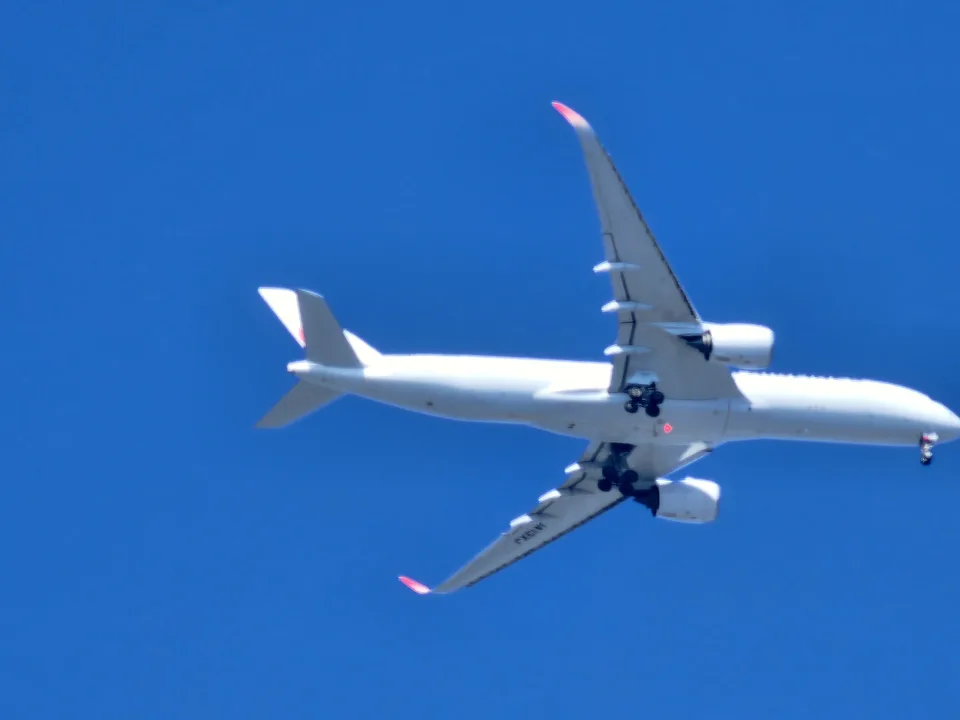
An arriving JAL A350 struck a Coast Guard DHC-8 on runway 34R. Interim evidence describes a clearance misunderstanding and undetected runway occupancy; causes remain under investigation.
No cropping or colour changes. Derivatives retain the stated source licence. Responsive WebP copies resized without cropping.
Geographic context
New Chitose
Haneda
Niigata
Approximate airport markers for the intended route, not an accident flight track or navigation chart. Basemap: Natural Earth, public domain.Read supporting evidence
JAL flight 516 collided with a Coast Guard DHC-8 at Haneda. Five Coast Guard crew members died; all 379 aboard the A350 evacuated. The investigation is ongoing.
Read the full incident Follow what happened, from the flight to the investigation findings.
What investigators concluded
The interim reports describe the Coast Guard crew understanding that they could enter the runway, the tower not recognising the occupancy and the arriving crew not seeing the aircraft until immediately before impact. These are matters under analysis, not final probable causes. Findings may change.
A runway collision whose causes remain under investigation
1,541 words / about 8 minutes to read. Based on the investigation records cited below.
Two missions meet at Haneda
On 2 January 2024 Japan Airlines flight 516 arrived at Tokyo Haneda from New Chitose. Its Airbus A350-941, registered JA13XJ, carried 367 passengers and twelve crew members. A Japan Coast Guard Bombardier DHC-8-315, JA722A, was preparing to depart Haneda for Niigata with six crew members. The aircraft collided on runway 34R at 17:47:27 Japan local time. Five Coast Guard crew members died and its captain sustained serious injuries. All 379 occupants of the A350 evacuated. One passenger was seriously injured, four received minor injuries and twelve were examined after feeling unwell.
This account is Information Level 2 and uses the JTSB first interim report of December 2024 and second interim report of December 2025. Neither is a final cause determination. Findings may change as the investigation gathers evidence, tests explanations and completes its analysis. The distinction is important throughout: the reports describe aircraft movement, recorded instructions, crew recollection, evacuation events and questions still being examined. A factual sequence can be well documented while the explanation of why its safeguards failed remains provisional. The reader should not mistake an interim analysis programme for an adopted probable-cause statement.
The Coast Guard activity followed the Noto Peninsula earthquake of the previous day. The first interim report describes relief-related flights and the arrangements for the intended journey to Niigata. The A350 departed New Chitose at 16:27 as scheduled flight 516. Its flying pilot was undergoing company A350 copilot training; the captain monitored and supervised, while a qualified safety pilot occupied the observer seat. These roles and missions establish the operating context. They do not independently establish blame or prove which organisational or human factors caused the later runway entry and failure to detect it.
The Coast Guard aircraft began taxiing around 17:32. It moved through the ground-control positions and was transferred to the east tower position as it approached the runway. At 17:45:14 the tower instructed it to taxi to holding point C5 and described it as number one in the departure order. The first interim report states that the aircraft read back the instruction. That wording concerns taxiing to a point before the runway. Departure order is not, by itself, permission to enter a runway or take off, and the report separately records how the captain understood the exchange.
The Coast Guard captain recalled being given an instruction to line up and wait and understood that the aircraft could enter from C5. He associated the perceived priority with its earthquake-relief mission. The crew checked the runway distance available from that intersection and began a checklist normally conducted after receiving runway-entry clearance. The aircraft crossed the holding-position marking at 17:46:13 and subsequently stopped aligned with the runway centreline, roughly 560 metres from its southeast end. This account attributes the understanding and recollection to the captain rather than asserting that the remembered clearance was actually transmitted by the tower.
At the same time, the aircraft received operational communication about later relief activity and the possibility of keeping an engine running at another airport. The captain was listening to both the Coast Guard station and tower frequencies. The first interim account includes his recollection of a takeoff clearance overlapping part of that exchange. The second interim report continues to analyse communication, judgement and other factors behind the runway entry. The presence of those recollections in an official report does not turn them into an independently confirmed instruction, nor does it resolve the full causal importance of the competing tasks.
The A350 contacted the tower at 17:43:02 and received landing clearance for runway 34R at 17:44:56. Its crew anticipated a possible wind change during the approach and intended to go around if a sudden speed change occurred. The trainee switched from autopilot to manual flying around 17:45:40 at approximately 1,140 feet. The captain and trainee used head-up displays. The first interim report records those operating details, while the second continues to examine visual detection and the potential influence of the displays. Their use is a matter being analysed, not an established final cause.
The tower did not recognise that the Coast Guard aircraft had entered the runway. Its controller was following the A350's approach and planning the departure interval before a following arrival. The A350 crew similarly did not recognise the smaller aircraft until immediately before impact, when it appeared in the landing lights. Around 17:47:26 the A350 main landing gear touched down; the collision followed almost immediately. Recorded ground speed at the collision was approximately 120 knots. The report describes the impact and resulting aircraft motions without requiring an invented account of what either crew privately thought at that instant.
After the collision the A350 continued its landing roll, deviated to the right and left the runway. It stopped in the grass at about 17:48:14. Fires affected both aircraft. The Coast Guard captain escaped, but five other crew members sustained fatal injuries. JTSB's second interim report frames the prevention investigation around the Coast Guard runway entry, the tower's failure to recognise the occupancy and the A350 crew's failure to detect the aircraft in time. Those are the observed problems to be explained. They do not yet provide a completed causal hierarchy or legal allocation of responsibility.
The A350 captain decided to evacuate after the aircraft stopped and began the emergency procedures. Cabin intercom, public-address equipment and the evacuation-command device did not function as expected. The captain therefore conveyed instructions directly to cabin crew. The left engine shut down after the attempted shutdown procedures, but the right engine continued running. The flight crew lacked instrument indications showing the engines' operating status. These are important qualifications to the successful evacuation: the passengers escaped despite significant damage and communication limitations, rather than because every emergency system remained available and performed normally.
Cabin attendants assessed conditions outside their assigned exits. Fire and other hazards made several doors unusable. The front left and right exits opened at approximately 17:51:30, and passengers began leaving through the deployed slides. Crew in the rear did not immediately receive the same instructions because the intercom was inoperative and smoke reduced visibility. Some attendants had to remain by unsafe exits to prevent passengers opening them. Direct shouting and movement through the cabin helped communicate the evacuation, but the report also records passengers who did not receive an instruction and reacted to the movement of others.
At around 17:55 the attendant responsible for the rear left exit L4 opened it after checking that there was no external fire or fuel leak and space existed for the slide. The captain searched for people remaining in the cabin and left through L4 at 17:58. All occupants ultimately evacuated. The second interim report states that no serious injury occurred during the emergency evacuation itself, which is compatible with its separate record of a seriously injured passenger from the accident. It is therefore necessary to distinguish injuries in the overall event from injuries caused during the escape process.
The December 2025 report adds detail to the investigation programme rather than announcing a final cause. For the Coast Guard aircraft, JTSB continues examining perception of clearance, communication and visual assistance for runway entry. Added issues include captain fatigue and work management, the interval since flying this aircraft type, checklist timing and the absence of a sterile cockpit rule at the Haneda air station. It also describes a possibility that mutual confirmation of the final approach area was not conducted before entry. These points retain the report's status as analytical matters and should not be labelled proved causal findings.
For tower operations, JTSB examines continuous monitoring, the introduction and operation of the runway-occupancy support system and the effectiveness of safety management after implementation. It notes that the flight-monitor position was principally assigned to a different runway. For the A350, the investigation continues testing visibility of the DHC-8 at night and factors affecting recognition. Experiments at Chubu Centrair used a similar aircraft and lighting conditions, but approaches were flown by smaller aircraft and a helicopter without head-up displays. That test design supplies evidence with limits; it is not an exact replay of the accident flight.
The visibility experiments also considered the relationship between aircraft lights and embedded runway lights. The second interim report states that the DHC-8 lights visible from behind were white, as were the runway centreline and touchdown-zone lights around its position. Investigators therefore tested changes to exterior-light colour and aircraft position relative to the centreline lighting. They documented differences between the Haneda and Chubu runways, including runway-edge light spacing, rather than treating the test environment as identical. The report says the resulting data were still under analysis. This describes the investigative method and its limitations, without asserting that a particular colour change would certainly have prevented the collision.
Damage-mitigation work includes aircraft-system damage, engine shutdown, fire spread, cabin smoke, evacuation communications and rescue. JTSB tested portable megaphones in an A350 cabin under differing acoustic conditions because the public-address system had failed and some attendants had stopped using megaphones when they appeared ineffective. It also continued analysing smoke and odour. The second report says further fact-finding, public hearings and comments from relevant parties and states remain part of the process. This private draft therefore reports the supported sequence and the ongoing questions plainly: the investigation is not final, and its findings may change.
These comparisons connect specific research topics. Shared circumstances do not establish identical causes. Evidence from both investigations is provided below.
Haneda and AF447 require careful separation of recorded facts and causal interpretation. Haneda is an ongoing runway-collision and evacuation investigation; AF447 is a completed loss-of-control investigation. They have different mechanisms and source maturity.
Explore the records below for additional context. They open on the publisher's site and are not all included in our report search. Source reuse terms apply.
Official English second interim report, 25 December 2025; further analysis ongoing
When is the Japan Airlines Flight 516 final report due?
No final report has been published yet. JTSB is leading the investigation. It has been 33 months since the accident. Under ICAO Annex 13, a final report or an interim statement is due by each anniversary of the accident. The next anniversary is 2 January 2027.
Checked against cached official report pages and specified official comments. No independent expert review.
Source limitations
Information Level 2. These are interim reports, not a final cause determination. Findings may change as further evidence and analysis become available.
JTSB Haneda collision: first interim report
JTSB Official English first interim report, 25 December 2024; no final cause determination
Private evidence cache. Only short attributed quotations in original commentary; full report and third-party illustrations are not redistributed. Source terms / provenance.
JTSB Haneda collision: second interim report
JTSB Official English second interim report, 25 December 2025; further analysis ongoing
Private evidence cache. Only short attributed quotations in original commentary; full report and third-party illustrations are not redistributed. Source terms / provenance.
Final Report: Accident on 1st June 2009 to the Airbus A330-203 registered F-GZCP operated by Air France flight AF 447
Bureau d'Enquetes et d'Analyses (BEA) English final report, 5 July 2012
Limited quotations for source-based commentary. Full report and illustrations are not republished. Wider reuse requires checking BEA terms. Source terms / provenance.
Kevin Murphy writes the incident accounts on AirlineIncidents.com, out of a long interest in aviation safety and the lessons each investigation leaves behind.
Prepared by
AirlineIncidents editorial desk
Report citation check
Independent expert review
Not completed
Citation checks compare supporting text with the indexed report pages. They do not constitute independent expert review. How these pages are prepared.
Revision history
: Private landmark Wave 2 original account with source-level citations.