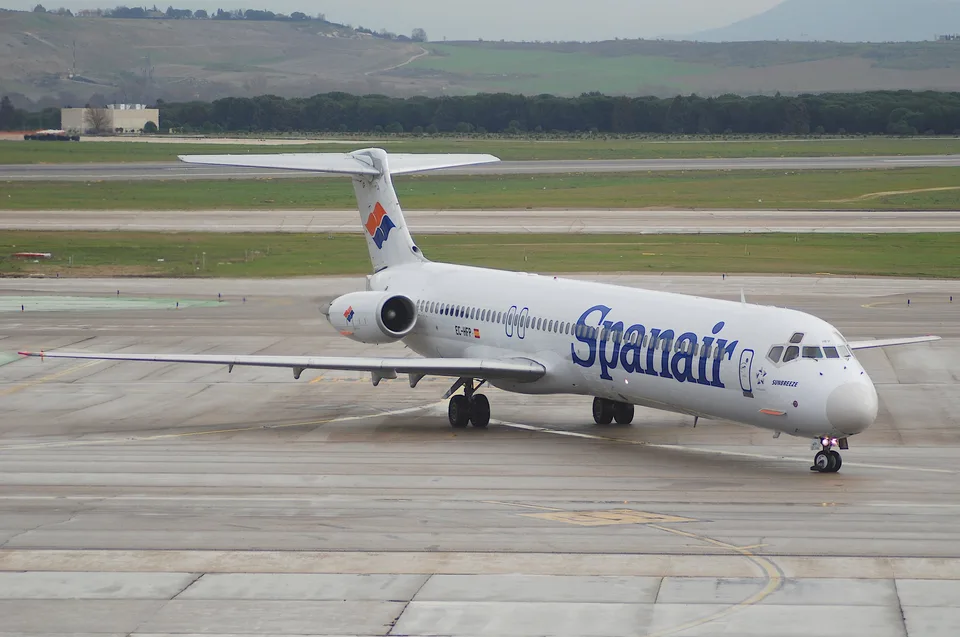
An MD-82 took off from Madrid with its flaps and slats retracted. The configuration warning stayed silent, and the aircraft stalled just above the runway.
After returning to parking for a temperature-probe malfunction, the crew omitted flap and slat selection and failed to catch the error in later checks. The takeoff warning system stayed silent. The aircraft stalled after liftoff, struck the ground and burned. Of 172 occupants, 154 died and 18 survived with serious injuries.
Read the full incident Follow what happened, from the flight to the investigation findings.
What investigators concluded
CIAIAC attributed the accident to loss of control after a takeoff stall with flaps and slats retracted, a sequence of checklist mistakes and omissions, and the absence of a configuration warning. Improper crew resource management contributed to the procedural deviations.
1,606 words / about 8 minutes to read. Based on the investigation records cited below.
A return from the runway
On 20 August 2008, Spanair's MD-82 EC-HFP arrived in Madrid from Barcelona at 10:13 after an uneventful flight. The same crew was scheduled to fly JKK5022 to Gran Canaria at 13:00. The aircraft carried 166 passengers and six crew members. After receiving engine-start clearance, it left stand T21 at Terminal 2 and taxied toward runway 36L. At 13:24:57, the tower cleared it for takeoff. The pilots then detected an abnormally high reading from the ram air temperature probe and stopped the departure.
The probe reading rose from 56 degrees Celsius at the start of the recorded taxi to 104 degrees. Its heater was operating on the ground, although it was designed to be disconnected there. The captain consulted Spanair's Maintenance Control Center by telephone and sought assistance at Barajas. Ground staff obtained permission to substitute another aircraft if EC-HFP had to be grounded. The crew decided to wait for the maintenance assessment. At about 13:42, the aircraft reached remote stand R11. Throughout the first taxi and return, the flight recorder showed the flaps at 11 degrees.
Two technicians attended the aircraft. Their visual inspection found no abnormality on the probe, and an electrical check confirmed that its heating circuit was energized. The cockpit recording began at 13:51:22 while those present were discussing cooling the probe with dry ice. The captain mentioned the delay and asked about the temperature in the passenger cabin. The purser confirmed that it was hot. A technician consulted item 30.8 of the minimum equipment list, which permitted dispatch with the probe heater inoperative when icing conditions were not forecast.
With the captain's agreement, maintenance opened circuit breaker Z-29 to remove power from the heater. The technicians checked that current was no longer being drawn, placed an inoperative label on the temperature display, and entered the deferred defect in the technical log. The aircraft was released for service. CIAIAC later found that this action followed an incomplete analysis of the malfunction: maintenance had not consulted the aircraft maintenance manual or identified the fault's source. Item 30.8 addressed a heater that failed to operate in flight; it did not address a heater energized on the ground.
The first officer repeatedly discussed whether the takeoff thrust could be controlled automatically. The captain left the aircraft at 14:02:36 to oversee refueling. Engine-start clearance followed at 14:08:08, and the crew began the start checklists. The departure preparations now included the maintenance deferral and calculations for manually setting thrust.
At 14:12:08, after both engines had started, the pilots performed the After Start checklist. When the flap and slat check should have occurred, the captain asked the first officer to request taxi clearance. That checklist item was omitted. While awaiting clearance, they calculated an engine pressure ratio of 1.95 and continued discussing manual or automatic thrust. The parking brake was released at 14:14:33. The flight recorder resumed and showed flap deflection at zero degrees, a value that remained unchanged through the takeoff and accident sequence.
The Taxi checklist followed at 14:15:56. The crew omitted the flap and slat check in the takeoff briefing. Later, the first officer read the Takeoff Imminent checklist, including final items, and called an eleven-degree flap setting. The visual check failed to confirm the actual indications. CIAIAC found that the crew had neither selected the flaps and slats nor verified their position through the successive opportunities provided by the checklists. It also found discrepancies in the assignment of flap-selection tasks between the operator's expanded and reduced checklists.
Conversations with a third person in the cockpit and the use of cellular telephones contributed to distraction. CIAIAC identified improper crew resource management as a contributing factor because it failed to prevent procedural deviations when preparations were interrupted. The first officer's attention to using the autothrottle also detracted from his other duties.
The tower issued takeoff clearance at 14:23:09. The throttles advanced and the brakes were released ten seconds later. During acceleration, the crew found that the autothrottle was not working and set thrust manually. Engine pressure ratio reached 1.95. The recorded airspeed was 154 knots at the V1 call and 157 knots at the rotation call. The nose-gear ground-sensing signal changed to air mode at 14:24:10, after an approximately 1,950-metre takeoff run. The cockpit recording contained no warning from the takeoff warning system during that run.
Four seconds after liftoff, the stick shaker, stall horn and synthetic stall voice activated. The first officer questioned whether there was an engine failure. At 14:24:15, the aircraft was about 25 feet above the ground, with a pitch angle of 15.5 degrees and a small right bank. The bank increased to 20 degrees. The throttle levers briefly moved toward reduced thrust before being advanced to maximum. Engine pressure ratio fell to about 1.65 and then rose to approximately 2.20, remaining there until the recording ended.
Stall warnings continued alongside bank-angle warnings. At 14:24:19, the aircraft reached a recorded maximum radio altitude of 40 feet and a pitch angle of 18.3 degrees. Initial ground impact occurred at 14:24:24 at 154 knots. CIAIAC found that the pilots failed to identify the stall and that the temporary thrust reduction, increased pitch and inadequate bank correction worsened it. The crew's training had not included stalls on takeoff, and the regulations had not required that training.
After the first ground contact, the aircraft crossed the runway strip and descended a 5.5-metre slope. It struck a road, passed through a fence, crossed another slope and hit an embankment. The severe impact ruptured the fuel system and a major fire followed. The main wreckage came to rest about 270 metres beyond that embankment impact. Much of the forward passenger cabin lay overturned in the De la Vega stream. The aft two-thirds of the aircraft were destroyed by fire.
At 14:24:36, another flight reported the accident to the tower. The alarm sounded at all three airport fire stations. The satellite station's brigade reached the internal perimeter fence at 14:26:56. One heavy firefighting vehicle crossed it; the fast intervention vehicle could not. Other responders approached from the opposite bank of the stream. Firefighters also experienced radio coordination problems with the tower. All three airport brigades eventually attended, leaving the airport without rescue and firefighting coverage for an estimated twenty minutes.
The accident killed 154 people, including all six operating crew members. Eighteen passengers survived, all seriously injured. They had been seated between rows 1 and 9. Rescuers moved fuselage structure to gain access to passengers near the stream, while other resources fought the fire and created safe areas. CIAIAC judged the emergency response good overall, while identifying departures from the emergency plan, access difficulties and communications problems.
Investigators combined recorder data, wreckage examinations, laboratory work and performance analysis to establish the aircraft's configuration. The flight recorder reliably recorded the flaps at zero degrees during the second taxi and takeoff. Its slat-position information could not be used because of a transmission problem between the flight guidance computer and the data acquisition unit. Recovered slat tracks from both wings were jammed in the retracted position. Impact marks on the damaged flap and slat control lever corresponded to the UP/RET setting.
The slat indicator bulbs supplied further evidence consistent with that setting. CIAIAC could not determine the flap position from the recovered flap actuators because hydraulic pressure had been lost and impact forces could have changed their positions. Taken together, the recorder evidence and the physical findings established that the flaps and slats were retracted when the aircraft took off. Examinations found no structural failure or engine malfunction. The aircraft's weight and balance were within limits, and weather did not adversely affect its takeoff performance.
The MD-82's takeoff warning system was designed to sound tones and a synthetic voice when the throttles were advanced on the ground with an unsafe configuration. Retracted slats and a mismatch between the selected takeoff flap setting and the actual flap position were among its monitored conditions. Relay R2-5 supplied ground-or-flight information to the warning system and also controlled the temperature probe heater. CIAIAC examined the relay and several possible failure paths. Functional tests did not reproduce a fault explaining either malfunction; metallurgical examinations found evidence that heater-circuit contacts had fused on occasions.
CIAIAC could not reliably establish why the takeoff warning system failed or whether its failure was connected to the probe overheating. Opening Z-29 removed power from the probe heater and thrust rating panel, and tests confirmed that it left the takeoff warning system unaffected. The investigation found that some warning-system failures could occur without a cockpit indication. Spanair required a functional check on the first flight of the day. After the accident, the airline changed its checklist to require a check on every flight.
CIAIAC issued thirty-three safety recommendations covering operations, training, maintenance, system design, oversight and emergency response. It called for takeoff stall recovery in initial and recurrent pilot training, simulator capability for sustained takeoff stalls, and clearer methods for selecting and checking critical aircraft configurations. It also recommended more explicit cockpit task sharing, stronger maintenance records and checks of the warning system when responding to probe-heating faults. Spanair added a flap check to its Taxi checklist and specified a two-pilot challenge-and-response method for final items.
The report recorded disagreement over several earlier recommendations. For the proposed mandatory warning-system check before each flight, the FAA pointed to existing operating-manual requirements. CIAIAC considered the response unsatisfactory and kept the recommendation open, arguing for instructions in the aircraft flight manual linked to the type certificate. AENA introduced a new Barajas emergency plan in October 2009. CIAIAC additionally recommended reviewing the internal fence around runway 36L and improving the control tower's assistance to rescue and firefighting crews.
Recovered flap actuators could have moved after hydraulic pressure was lost during impact. CIAIAC relied on the recorder and other evidence for flap configuration.
AENA introduced a replacement emergency plan in October 2009. Recommendations 38/11 and 39/11 sought improved fence access and tower assistance to rescue crews.
These comparisons connect specific research topics. Shared circumstances do not establish identical causes. Evidence from both investigations is provided below.
Further investigation records
Explore the records below for additional context. They open on the publisher's site and are not all included in our report search. Source reuse terms apply.
Earlier recommendations and responses, followed by the recommendations issued with the final report.
Sources and transparency
CIAIAC approved its final report on 26 July 2011.
Source limitations
The flight recorder slat-position data were unusable because of a transmission fault. CIAIAC established the retracted slat position using wreckage, control-lever and indicator evidence.
Report A-032/2008: Accident involving MD-82 EC-HFP at Madrid-Barajas on 20 August 2008
CIAIAC Official English translation of the final report approved 26 July 2011
Kevin Murphy writes the incident accounts on AirlineIncidents.com, out of a long interest in aviation safety and the lessons each investigation leaves behind.
Prepared by
AirlineIncidents editorial desk
Report citation check
Independent expert review
Not completed
Citation checks compare supporting text with the indexed report pages. They do not constitute independent expert review. How these pages are prepared.
Revision history
: Published sourced incident account, timeline, photographs and investigation findings.