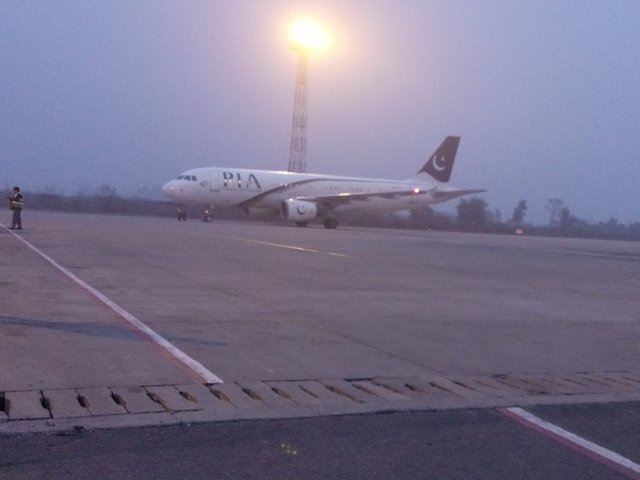
Resized and recompressed for display; full frame retained.
Geographic context
Jinnah International Airport, Karachi
Model Colony impact area
Approximate airport and accident-area markers. The aircraft struck houses about 1,340 metres from the runway 25L threshold. Basemap: Natural Earth, public domain.Read supporting evidence
Flight 8303 continued a high, fast approach with its landing gear retracted. Both engine nacelles struck runway 25L. The crew took off again, but damage to both engines caused oil loss and sequential failures. The aircraft crashed among houses in Model Colony.
Read the full incident Follow what happened, from the flight to the investigation findings.
What investigators concluded
The AAIB identified the gear-up landing and consequent engine failures, procedural noncompliance and disregarded air traffic instructions, and the failure to communicate the gear-up contact as primary causes. It also identified weaknesses in crew coordination, flight data analysis, regulatory oversight and fasting regulations.
From an unstable approach to a dual engine failure
1,506 words / about 7 minutes to read. Based on the investigation records cited below.
The arrival from Lahore
Pakistan International Airlines flight 8303 took off from Allama Iqbal International Airport in Lahore at 08:05:30 UTC on 22 May 2020. The Airbus A320-214, AP-BLD, carried 91 passengers and eight crew members on the scheduled flight to Karachi. The aircraft had been manufactured in 2004 and entered PIA service in October 2014. Investigators found that it was airworthy before the accident flight and that both pilots were licensed, qualified and medically fit.
The first officer was flying and the captain was monitoring as the aircraft approached the end of its cruise at flight level 340. Karachi Area Control had initially assigned the NAWABSHAH 2A arrival and an expected instrument landing system approach to runway 25L. At 09:15:07, the controller cleared the aircraft to descend to flight level 100 at the pilots' discretion and proceed directly to MAKLI. The crew began descending shortly afterwards.
The flight management system still contained a holding pattern in its flight path. The AAIB found that the crew had failed to clear that path, so the system calculated its descent profile using the holding distance. An approach briefing had not been conducted. The investigation also found no flight mode annunciator callouts or crosschecks of the flight management settings from the beginning of the descent. Several radio calls went unanswered during the transfer to Approach Control; the AAIB considered a mistuned frequency probable.
At MAKLI, the aircraft was at 9,363 feet and 245 knots. The crew told Approach Control that the remaining distance was comfortable for descent. At SABEN, 11.4 nautical miles from the runway threshold, it passed at 7,830 feet against the published 3,000-foot initial approach altitude. The approach had developed a large vertical discrepancy while the aircraft continued towards the runway.
The crew selected open descent, extended the speed brakes and tried to intercept the glide slope from above. The tower noticed the aircraft was too high and discussed it with Approach Control. At 09:31:39, the landing gear was selected down; it locked down 13 seconds later. Approach Control offered an orbit to lose height. The crew declined. The captain and first officer continued the approach with a descent rate that subsequently exceeded 4,000 feet per minute.
Approach Control twice instructed a left turn onto heading 180. The crew responded that they were comfortable and established on the instrument approach. At 09:32:47, the aircraft's nose-down attitude reached 13.7 degrees and both autopilots disconnected because of excessive negative pitch. The descent rate reached 6,800 feet per minute. An overspeed warning sounded as slats and flaps were extended beyond their speed limits. Ground proximity alerts followed, including sink-rate and pull-up warnings.
At 09:32:57, the landing gear was selected up. The speed brakes were also retracted. The gear completed a normal retraction sequence and remained up through the runway contact. The AAIB found that the selection changes had not been verbalized. It considered the first officer the most probable person to have retracted the gear and speed brakes, and recorded his later suggestion of an orbit. The captain declined and took over flying; neither pilot verbalized the transfer of control.
Below 750 feet radio altitude, the aircraft generated a landing-gear-not-down warning and illuminated the red arrow beside the gear lever. The emergency cancel button was pressed twice during the final approach, silencing associated aural warnings while the warning messages remained displayed. At the 500-foot stabilization gate, speed was 220 knots, descent rate about 2,000 feet per minute, and the aircraft remained above the glide slope. The crew continued. The AAIB found that they had failed to make the required unstable-approach callouts or initiate a go-around before touchdown.
The aircraft crossed 24 feet radio altitude at about 205 knots. Both thrust levers were moved to idle. At seven feet, full reverse thrust was selected, but the reversers remained locked because the engines' control units had received no ground condition. At 09:34:28, both engine nacelles struck runway 25L approximately 4,500 feet beyond the threshold. The sound of impact, recorded acceleration changes, runway marks and airport camera images all supported the reconstruction of the gear-up landing.
The aircraft made intermittent contact with the runway. Both pilots applied opposing sidestick inputs: the captain's input reached full nose down while the first officer applied nose-up input. Maximum brake pedal inputs were recorded, although the landing gear remained retracted. Each engine left several scratch marks. The combined marked length was 2,194 feet for the right engine and 583 feet for the left. The right engine spent considerably longer against the concrete surface.
The contact damaged the accessory and transfer gearboxes beneath the engines. Both transfer gearbox casings were punctured, providing paths for engine oil to escape. A right-engine fire warning appeared during the runway contact. The right engine also probably stalled and temporarily lost its electronic control power supply. The investigation found sparks and fire in airport camera images during the scraping, and found no indication of an in-flight fire before the later crash.
The first officer prompted the captain to take off, and the thrust levers were advanced to takeoff and go-around power. The aircraft became airborne at about 09:34:45. The left engine initially delivered high power while the right engine recovered from its start status. The AAIB found that initiating the go-around after reverse selection and the engine fire warning was contrary to procedures and good airmanship. The crew then intended another instrument approach to runway 25L.
Oil loss, electrical failure and the return towards Karachi
Tower Control told Approach Control that the aircraft had touched the runway with its gear up. Approach Control asked about its position but did not relay the gear-up contact to the pilots. The crew reported a go-around at 09:35:00, and the tower declared a full-scale emergency. A later tower request to ask whether the gear was down also failed to produce a direct exchange about the damage sustained during the first landing attempt.
As the aircraft climbed, recorded oil quantities fell sharply: the left engine decreased from 16 to four quarts and the right from 15 to five quarts between samples 64 seconds apart. Persistent low-oil-pressure warnings followed. The aircraft briefly reached more than 3,000 feet radio altitude. At 09:36:00, the left engine's actual speed began decreasing despite a continuing high thrust command, marking an uncommanded shutdown. The first officer then asked for the right thrust lever to be moved to idle, leaving the only running engine at idle for about a minute.
The loss of normal electrical generation stopped the flight data recorder at 09:36:17. The cockpit voice recorder stopped two seconds later, then resumed after an eight-second interruption as the ram air turbine supplied the emergency electrical network. Investigators used the remaining voice recording, sound analysis and radar information to reconstruct the final minutes. They found that the electrical system's transition to emergency supply was consistent with its design.
The right engine accelerated again, but stall-like noises appeared on the recording and its speed subsequently declined. By 09:38:46, its engine sound could no longer be detected in the spectral analysis. The crew told Approach Control that they had lost the engines. Sounds consistent with landing gear extension were recorded at 09:39:39. Wreckage examination and camera footage showed the gear down at the crash. A mayday call followed while stall warnings continued. The voice recorder ended with an impact sound at 09:40:18.
The aircraft crashed among houses in Model Colony, short of Karachi's runway. Impact forces and the ensuing ground fire destroyed it and damaged homes and vehicles. Ninety-seven occupants died, including all eight crew members. Two passengers survived with serious injuries. One person on the ground died and three sustained serious injuries. Airport fire vehicles and ambulances reached the site within ten minutes, joined by military, local government and other emergency services.
Narrow streets, parked vehicles and crowds hampered rescue work. The AAIB found that response personnel were inadequately equipped or informed about hazards at an aircraft accident site. It also found deficiencies in evidence preservation before its investigators arrived. The final report recommended that the regulator establish training and equipment arrangements for accident-site hazards and evidence preservation, including awareness among other responding agencies.
The AAIB identified three primary causes: the gear-up landing and resulting engine damage, oil loss and failures; non-adherence to operating procedures and disregard of air traffic instructions; and the failure of controllers and pilots to communicate about the gear-up runway contact. Contributing factors included ineffective flight data analysis, ineffective regulatory oversight of that programme, inadequate crew resource management during the flight, and unclear restrictions on flying while fasting.
PIA had analysed less than five percent of its flights at the time of the accident and had no dedicated flight data analyst in its safety department. The captain's preceding flight history contained repeated unstable approaches that had continued to landing. The AAIB found that the operator's safety management and data analysis weaknesses had prevented effective oversight. It recorded that a dedicated analyst was analysing almost all flights from July 2020. Its recommendations called for effective data analysis integrated into safety management, better cockpit communication training, compliance with operating procedures and medical checks, and consistent fasting regulations.
Follow the main stages, then open the evidence beneath each step.
1
Approach remains high and fast
The aircraft passed SABEN 4,830 feet above its published approach altitude and continued through the stabilization gate at excessive speed and descent rate.
A simplified reading of the investigation findings. The sequence does not replace the full report or imply that every contributing factor is shown.
Sequence of events
Times are UTC. Pakistan local time was UTC plus five hours. The report gives an approximate two-second tolerance for event markers. Expand an event to see its evidence.
Could the aircraft have landed safely after the go-around?
The AAIB could not establish whether a safe landing was possible after the go-around because damaged-engine thrust and the additional power available from the right engine could not be estimated.
Flight data recording ended at 09:36:17. The voice recorder resumed after eight seconds, and investigators used audio analysis and radar for the subsequent sequence.
Actions and recommendations are described at the dates of the cited records. A recommendation is not proof of implementation.
Flight data analysis
The report records that almost all PIA flights were being analysed by a dedicated analyst from July 2020. It recommended effective integration of flight data analysis into safety management.
Matching dossiers for Runway damage and engine failure: No other dossier in this collection.
causeProcedures and communication
The crew continued an unstable approach and disregarded controller instructions. The controllers failed to pass the gear-up contact information to the crew.
These comparisons connect specific research topics. Shared circumstances do not establish identical causes. Evidence from both investigations is provided below.
Both investigations identified weaknesses in approach management, crew coordination and go-around decisions. Flight 8303 approached high and fast, contacted the runway with its gear up, and lost both engines after damage. Asiana 214 descended below the required flight path with low airspeed after automatic speed control was unintentionally deactivated.
Explore the records below for additional context. They open on the publisher's site and are not all included in our report search. Source reuse terms apply.
Kevin Murphy writes the incident accounts on AirlineIncidents.com, out of a long interest in aviation safety and the lessons each investigation leaves behind.
Prepared by
AirlineIncidents editorial desk
Report citation check
Independent expert review
Not completed
Citation checks compare supporting text with the indexed report pages. They do not constitute independent expert review. How these pages are prepared.
Revision history
: Published sourced incident account, timeline, photographs and investigation findings.
.jpg)