No cropping or colour changes. Derivatives retain the stated source licence. Responsive WebP copies resized without cropping.
Geographic context
Incheon
San Francisco
Approximate airport markers for the intended route, not an accident flight track or navigation chart. Basemap: Natural Earth, public domain.Read supporting evidence
Asiana flight 214 struck the seawall short of San Francisco runway 28L after a visual approach became low and slow. Three passengers died and 49 occupants sustained serious injuries.
Read the full incident Follow what happened, from the flight to the investigation findings.
What investigators concluded
NTSB identified descent mismanagement, unintended deactivation of automatic airspeed control, inadequate speed monitoring and a delayed go-around. Contributing factors included automation complexity, crew coordination, training, supervision and likely fatigue.
1,563 words / about 8 minutes to read. Based on the investigation records cited below.
A visual arrival at San Francisco
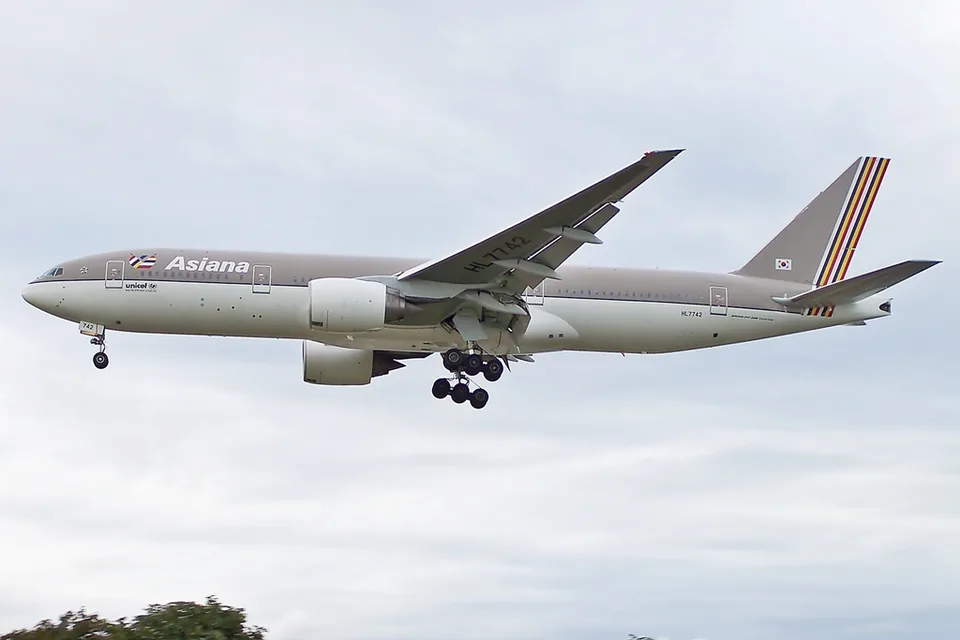
Asiana Airlines flight 214 arrived at San Francisco from Incheon on 6 July 2013. The Boeing 777-200ER, registered HL7742, carried 291 passengers, four flight crew members and twelve flight attendants. At about 11:28 Pacific daylight time it struck the seawall before runway 28L. Three passengers were fatally injured and 49 occupants received serious injuries. The aircraft was destroyed by impact forces and a subsequent fire. This account follows the NTSB final report, including its appended statements and Korean investigation authority comments, and keeps the agency's adopted conclusions distinct from those differing assessments.
Visual meteorological conditions prevailed and the crew was vectored for a visual approach. The pilot flying was gaining operating experience as a 777 captain. The monitoring pilot was an experienced 777 captain on his first flight as an instructor supervising a trainee captain. The report did not treat that qualification alone as adequate preparation for every supervisory challenge. It found that instructor training lacked an opportunity to supervise a trainee in line operations while being observed by an experienced instructor. This became one of the training issues examined alongside the handling of the actual approach.
The aircraft intercepted the final approach course about fourteen nautical miles from the threshold, slightly above the intended three-degree glidepath. The crew accepted an instruction to maintain 180 knots until five miles from the runway. Their subsequent management of the descent left the aircraft well above the desired path at that point. The problem initially involved excess height, rather than an aircraft already below the runway approach. The investigation reconstructs how efforts to correct that high position produced a different hazard when descent rate, thrust and airspeed were not effectively managed together.
An automation mode changes the protection available
To increase descent rate, the flying pilot selected flight level change speed mode, abbreviated FLCH SPD. Because the aircraft was below the altitude selected in the system, that mode instead initiated a climb. The pilot disconnected the autopilot and manually moved the thrust levers to idle. That intervention changed the autothrottle to HOLD, a mode in which it does not control airspeed. The pilot then pitched the aircraft down to increase descent. NTSB found that neither the flying pilot, monitoring pilot nor observer recognised the autothrottle's transition to HOLD.
This was not equivalent to all automation being switched off or to a mechanical throttle failure. The report describes a particular interaction between selections, manual override and mode logic. The flying pilot's mental model did not accurately capture how autopilot and autothrottle behaviour interacted in that situation. NTSB considered both design complexity and inadequate documentation and training important. A simplified claim that an armed autothrottle always guarantees protection from low speed would repeat the misunderstanding addressed by the investigation. The system's selected mode and conditions determined which protection was actually available.
The crew also did not consistently make the required mode-selection callouts. NTSB found that the flying pilot probably did not announce the flight-level-change selection, while the monitoring pilot's attention was likely on flap changes. The report discusses an informal practice of switching flight directors off and then restoring one during visual approaches. On this flight they were not both off simultaneously; had they been, autothrottle mode would have changed to speed control. That conditional finding describes the system interaction. It does not make the informal practice an endorsed substitute for monitoring the actual aircraft energy state.
At 500 feet above airport elevation, Asiana procedures required the approach to be stabilized. Airspeed had just reached the correct approach value of 137 knots, but it was decreasing rapidly. The thrust levers remained at idle and descent rate was approximately 1,200 feet per minute, compared with about 700 feet per minute needed to maintain the desired glidepath. NTSB regarded those indications as evidence that the approach was unstable and a go-around should have been initiated. Reaching the target speed for a moment did not mean speed and path were being sustained.
As the descent continued, the aircraft went below the intended glidepath and the visual path indicator changed through three to four red lights. Airspeed continued decreasing. At approximately 200 feet the crew became aware of the low-speed and low-path condition, but did not initiate a go-around until below 100 feet. At that point NTSB found that the aircraft lacked the performance capability to complete the manoeuvre. The account therefore distinguishes awareness, decision and execution. Recognising a developing problem did not restore the height and energy already lost during the continued approach.
The report attributes inadequate speed monitoring to expectancy, increased workload, fatigue and reliance on automation. It also identifies inadequate visual-approach training and supervision as contributing factors. These are related findings, but they are not interchangeable with the actual control sequence. The probable cause incorporates descent mismanagement, unintended loss of automatic speed control, inadequate monitoring and delayed go-around execution. The investigation's finding of likely fatigue-related degradation should similarly be kept at that evidential strength. This account does not invent a specific moment of sleep or claim that a single factor independently explains the entire arrival.
The main landing gear and aft fuselage struck the seawall, and the tail separated at the aft pressure bulkhead. The aircraft slid along the runway, lifted partly into the air, rotated about 330 degrees and impacted the ground again. Six occupants were ejected during the impact sequence: two passengers who were among the fatalities and four seriously injured flight attendants. The attendants had been restrained, but destruction of the aft galley ejected them. NTSB found that the two ejected passengers were not wearing seatbelts and would likely have remained inside and survived if restrained.
The impact also caused two slide-rafts to inflate inside the cabin, injuring and temporarily trapping two attendants. The investigation found that impact forces exceeded the equipment's certification limits. After the aircraft stopped, a fire developed in the separated right engine beside the fuselage. A flight attendant who became aware of the fire initiated evacuation. Most passengers self-evacuated, but firefighters entered the aircraft and rescued five injured passengers unable to leave on their own. One of those rescued passengers subsequently died. The high survival rate does not erase the fatalities or serious injuries.
One ejected passenger was later rolled over by firefighting vehicles. NTSB treated protection of people near a burning aircraft as an important rescue issue. The report does not attribute further injury or death to the untrained fire-attack supervisor specifically, although it criticises the absence of aircraft-rescue training for that command role. Those distinctions matter when describing emergency-response weaknesses: a risk, a training deficiency and a demonstrated injury mechanism are different claims. The account follows the report's stated consequences rather than assuming that every identified rescue shortcoming produced an additional casualty.
The survivability investigation also considered the forces inside the cabin. Occupants experienced forward motion together with substantial lateral loading. NTSB identified a need to understand the unusually numerous serious upper-thoracic spinal injuries and to evaluate how seat certification tests represented these interactions. Its discussion of slide-raft release mechanisms similarly distinguished overload during this accident from ordinary deployment behaviour. Those findings did not imply that every injury could be prevented by a single design change. They identified evidence and research questions arising from a survivable accident with forces beyond some certification assumptions.
NTSB's adopted probable cause gives substantial weight to the crew's approach management and monitoring while also recognising automation complexity and training. The Korean Aviation and Railway Accident Investigation Board comments, reproduced in the final report, argue for stronger causal emphasis on the low-speed alert and inconsistencies in airspeed protection. Its proposed additional contributing factor addresses those system inadequacies. Those are the Korean authority's comments, rather than an extra clause silently inserted into NTSB's probable-cause statement. The private source cache preserves the full appendix so readers can examine the disagreement in context.
The disagreement is meaningful because alert timing and clarity can influence the remaining opportunity to recover. The Korean comments argue that a more distinct warning could have prompted a quicker response. NTSB's own discussion also recognises the need for a context-dependent low-energy alert, taking account of speed, height and engine response during approach. Agreement on the value of better alerts does not establish agreement on every causal attribution. A source-based account can describe the technical concern while remaining clear about who made each finding and which statement was formally adopted by the investigating authority.
The report's follow-up addresses flight training, automation design and emergency preparedness. It seeks better systems understanding and opportunities for manual flying, as well as alerting suited to the approach environment. Rescue concerns include communications between airport and mutual-aid units, medical-supply deployment, command training and protection against vehicle strikes. These actions are described as recommendations and report-era evidence, without asserting current completion. The resulting account connects the descent and energy-management failure to survivability and rescue questions, while retaining the difference between an unstable approach, a late attempted recovery and the consequences after impact.
Airport rescue resources were another part of the safety assessment. The initial response involved seven rescue vehicles and 23 personnel, exceeding the minimum vehicle requirement then applicable. NTSB noted that no corresponding FAA minimum staffing level existed and warned that another airport might not offer the same protection. The available personnel could fight the exterior fire while entering the cabin to rescue trapped passengers. That specific observation supports a staffing concern without claiming that a different airport or response would necessarily have produced a particular death toll.
Matching dossiers for Automation and training complexity: No other dossier in this collection.
Read alongside
These comparisons connect specific research topics. Shared circumstances do not establish identical causes. Evidence from both investigations is provided below.
Asiana 214 and AF447 both examine monitoring and understanding of automated systems. Asiana involved a visual approach and energy management close to the runway; AF447 involved unreliable airspeed and loss of control at cruise. They do not share an identical sequence.
Explore the records below for additional context. They open on the publisher's site and are not all included in our report search. Source reuse terms apply.
Final report adopted 24 June 2014, including board statements and Korean ARAIB comments
Sources and transparency
Checked against cached official report pages and specified official comments. No independent expert review.
Source limitations
The Korean authority comments and NTSB member statements differ on the emphasis of automation and warning design. The cause statement remains NTSB adopted findings, with differing views separately attributed.
NTSB AAR-14/01: Asiana Airlines 214
NTSB Final report adopted 24 June 2014, including board statements and Korean ARAIB comments
Private evidence cache. Only short attributed quotations in original commentary; full report and third-party illustrations are not redistributed. Source terms / provenance.
Final Report: Accident on 1st June 2009 to the Airbus A330-203 registered F-GZCP operated by Air France flight AF 447
Bureau d'Enquetes et d'Analyses (BEA) English final report, 5 July 2012
Limited quotations for source-based commentary. Full report and illustrations are not republished. Wider reuse requires checking BEA terms. Source terms / provenance.
Kevin Murphy writes the incident accounts on AirlineIncidents.com, out of a long interest in aviation safety and the lessons each investigation leaves behind.
Prepared by
AirlineIncidents editorial desk
Report citation check
Independent expert review
Not completed
Citation checks compare supporting text with the indexed report pages. They do not constitute independent expert review. How these pages are prepared.
Revision history
: Private landmark Wave 2 original account with source-level citations.
.jpg)