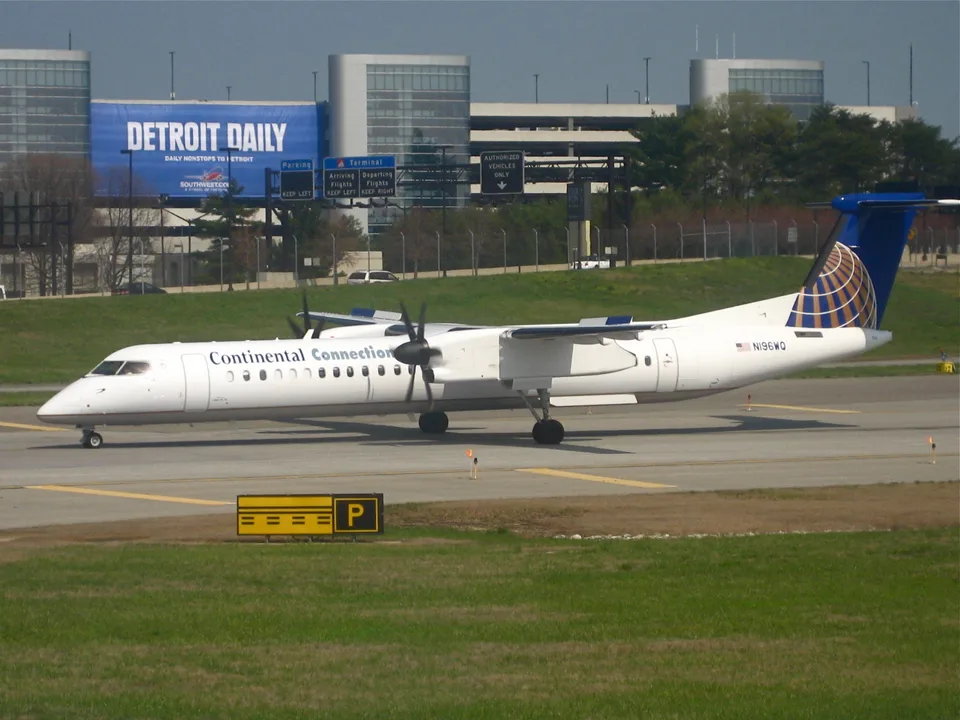
NTSB found that the captain responded inappropriately to the stick shaker and stalled the aircraft. Monitoring and airspeed-management weaknesses contributed.
No cropping or colour changes. Derivatives retain the stated source licence. Responsive WebP copies resized without cropping.
Geographic context
Newark Liberty
Buffalo Niagara
Approximate airport markers for the intended route, not an accident flight track or navigation chart. Basemap: Natural Earth, public domain.Read supporting evidence
A Colgan Q400 operating as Continental Connection 3407 stalled during approach to Buffalo and struck a house in Clarence Center. All 49 occupants and one person on the ground died.
Read the full incident Follow what happened, from the flight to the investigation findings.
What investigators concluded
NTSB attributed the accident to the captain response to stick-shaker activation, with failures in airspeed monitoring, sterile cockpit discipline, command and Colgan approach procedures as contributing factors.
An approach warning followed by the wrong recovery response
1,526 words / about 7 minutes to read. Based on the investigation records cited below.
A delayed flight from Newark
On 12 February 2009 Colgan Air operated Continental Connection flight 3407 from Newark Liberty to Buffalo Niagara. The aircraft was a Bombardier DHC-8-400, commonly called a Q400, registered N200WQ. It carried 45 passengers, two pilots and two flight attendants. About 22:17 eastern standard time it crashed into a home in Clarence Center, approximately five nautical miles northeast of the destination airport. All 49 occupants and one person in the house died. The aircraft was destroyed by the impact and subsequent fire. This account follows the NTSB final report adopted on 2 February 2010.
Continental and Colgan were in a code-sharing arrangement, but they held separate operating certificates and were overseen by separate FAA certificate-management teams. The Continental Connection branding therefore did not make Continental the aircraft's operating carrier. The report identifies Colgan as responsible for the flight. It records that both pilots were based at Newark. Their first two scheduled flights that day had been cancelled because high winds and resulting delays affected operations there. The dispatch release for flight 3407 initially anticipated a departure at 19:10 and an en-route time of 53 minutes.
The aircraft arrived at Newark at 18:54, and ACARS recorded pushback at 19:45. Ground control issued taxi instructions around 20:30, followed by takeoff clearance at approximately 21:18. The flight climbed to 16,000 feet with its ice-protection equipment operating and the autopilot engaged. The report describes the cruise as routine. These details establish the operational progression without asserting that every delay or earlier activity directly caused the accident. NTSB examined the pilots' schedules and rest separately when considering fatigue, keeping those issues distinct from the eventual control response.
During cruise the pilots discussed the landing winds and planned to use runway 23. The first officer briefed a reference landing speed of 118 knots for flaps 15 and a go-around speed of 114 knots. Cleveland control subsequently cleared the flight down, and Buffalo approach assigned an instrument landing system approach to runway 23. As the aircraft descended through 10,000 feet, the sterile cockpit rule required attention to essential flight duties. The recorder nevertheless documented nonessential conversation during parts of the approach. NTSB later included failure to adhere to that rule among the contributing factors.
The crew discussed ice visible on the windscreen and leading edges. Icing was relevant to the procedures and the displayed low-speed protection threshold, but the investigation did not find that ice had made the aircraft uncontrollable. The final findings describe the performance degradation from accumulation as minimal. Recovered components showed no indication of an ice-protection malfunction or a preimpact structural, engine or system failure. A report of visible ice is therefore not sufficient to explain the accident as a mechanical inability to maintain flight. The evidence instead required attention to speed selection, warning logic and handling.
The aircraft levelled near 2,300 feet at approximately 22:14:30 with an airspeed near 180 knots. The captain called for flaps 5 and prepared to slow for the landing configuration. The report documents a mismatch between the landing speed bugs and the reference-speeds switch position. It found that Colgan procedures and training did not specifically require cross-checking those selections. This could lead to an earlier stall warning than the crew expected. It does not mean the warning could safely be ignored, or that an eventual aerodynamic stall was only a misleading instrument indication.
The captain reduced power about 22:16:00. Engine torque reached minimum thrust shortly afterwards. Gear deployment and propeller selections added to the configuration changes, while the autopilot applied nose-up pitch trim as the aircraft held altitude and slowed. At approximately 22:16:21 the first officer reported the gear down, with airspeed around 145 knots. The captain called for flaps 15 and the before-landing checklist. The flap handle moved through the ten-degree setting, and speed was about 135 knots during this part of the sequence. The low-speed margin was narrowing while the crew completed other tasks.
At 22:16:27.4 the stick shaker activated and the autopilot disengaged. The shaker warns of an impending wing stall through vibrations of the control column, producing tactile and audible cues. Its activation required a recovery response. NTSB found that earlier flight-instrument cues had been available: decreasing margin to the low-speed indication, a downward speed trend, changing display numerals and excessive nose-up pitch. Neither pilot acted on those cues in time. The report's emphasis on monitoring is therefore grounded in indications that existed before the more dramatic warning began.
The flight data recorder showed the columns moving aft almost immediately after autopilot disengagement. Power increased, but the captain's aft column input increased the wing angle of attack. The aircraft pitched up and began rolling. NTSB found that this inappropriate reaction to the shaker caused the wing to stall. Increasing power did not compensate for the wrong control response. The report could not determine why the captain failed to recognise the impending warning, and it describes the response as consistent with startle and confusion rather than deliberately establishing a motive.
At about 22:16:34 the stick pusher activated as the aircraft rolled back through wings level. The pusher commands a nose-down column movement to reduce angle of attack after a stall. NTSB concluded that the captain did not recognise its action as a proper recovery step and overrode it, worsening the situation. The first officer selected flaps up and subsequently suggested raising the landing gear. The investigation could not determine the reasons for those actions, but found them inconsistent with the company's stall-recovery procedures and training. That limitation is retained rather than supplying an invented cockpit rationale.
The aircraft developed large alternating bank angles, including more than 100 degrees to the right. The pusher activated repeatedly. Speed was near 100 knots as the flaps began retracting, and the final sequence involved a steep descent. The CVR ended at approximately 22:16:54 after the aircraft struck the house. The postcrash fire involved aircraft fuel and a severed natural-gas service line at the residence. NTSB classified the accident as unsurvivable. This account reports those consequences from the investigation without adding unsupported passenger experiences, dramatic dialogue or an imagined last view from the cabin.
Although icing was part of the operating context, NTSB found no evidence that the Q400 was susceptible to a tailplane stall and judged a deliberate attempt at tailplane-stall recovery unlikely. A generic account of recovery techniques from another aircraft type would therefore misdescribe this event. The final probable cause was the captain's inappropriate shaker response, leading to a stall from which the aircraft did not recover. Contributing factors included speed monitoring, sterile cockpit discipline, flight management and the company's approach-speed procedures in icing. Each is preserved with its investigation category rather than being merged into a single vague label.
NTSB found that the pilots' performance was likely impaired by fatigue, but it could not conclusively determine the extent of impairment or how much it contributed to the observed deficiencies. That is a qualified finding, and fatigue was not substituted for the adopted probable cause. The report addressed commuting hazards and inadequate rest facilities while also noting the pilots' personal responsibility to manage off-duty time. Recommendations called for operators to identify commuting pilots, develop mitigation strategies and provide or identify suitable rest facilities. These proposals describe the report-era response, not proof of current policy or compliance.
The investigation also examined the captain's earlier performance and the carrier's training records. It found weaknesses in basic aircraft control and instrument-flying skills that were not adequately identified and addressed. Electronic records lacked enough detail for the airline or its principal operations inspector to analyse the trend of unsatisfactory performance. NTSB sought retained, detailed records of training and checking, accurate sharing with hiring employers and remedial training linked to the full performance history. These were organisational safeguards intended to identify and correct deficiencies before they reappeared in operational flight.
The training recommendations went beyond rehearsed approaches to the first sign of a stall. NTSB called for unexpected and fully developed stalls, autopilot disengagement, aircraft-specific warning features and stick-pusher familiarisation. It also sought more realistic simulator modelling for the post-stall regime. The report concluded that existing approach-to-stall training had not prepared this crew adequately for the unexpected event. Its account connects monitoring before the warning, the response when it activated and the realism of training for what followed. It does not attribute the crash to an ice-induced loss of capability which the final findings expressly rejected.
NTSB also sought earlier and more redundant low-speed cues. Its recommendations proposed an amber caution region or changing digit colours as airspeed approached the low-speed cue, together with aural and visual warning systems. This addressed the opportunity to respond before the shaker rather than relying entirely on a correct recovery once it activated. Separate recommendations called for flight operational quality assurance programmes which collect and analyse objective operating data. NTSB wanted operators to use that information to detect procedural deviations and emerging hazards, with protections for confidentiality and use for safety rather than punishment. Those recommendations connect individual-flight monitoring to organisational monitoring across many flights. The final report also sought stronger FAA surveillance of carriers experiencing growth or operational complexity, instead of assuming a certificate alone demonstrated that all changing risks were controlled.
Matching dossiers for Icing approach procedures: No other dossier in this collection.
Read alongside
These comparisons connect specific research topics. Shared circumstances do not establish identical causes. Evidence from both investigations is provided below.
Colgan 3407 and AF447 both concern aerodynamic stalls and recovery training, but their circumstances differ. Colgan involved a low-speed approach and inappropriate response to a stick shaker; AF447 began with unreliable airspeed at cruise altitude. This comparison does not equate their causes.
Explore the records below for additional context. They open on the publisher's site and are not all included in our report search. Source reuse terms apply.
Checked against cached official report pages and specified official comments. No independent expert review.
Source limitations
NTSB found likely fatigue impairment but could not conclusively determine its extent or contribution. Ice had only minimal performance effects and did not prevent aircraft control.
NTSB AAR-10/01: Loss of control on approach, Colgan Air 3407
Private evidence cache. Only short attributed quotations in original commentary; full report and third-party illustrations are not redistributed. Source terms / provenance.
Final Report: Accident on 1st June 2009 to the Airbus A330-203 registered F-GZCP operated by Air France flight AF 447
Bureau d'Enquetes et d'Analyses (BEA) English final report, 5 July 2012
Limited quotations for source-based commentary. Full report and illustrations are not republished. Wider reuse requires checking BEA terms. Source terms / provenance.
Kevin Murphy writes the incident accounts on AirlineIncidents.com, out of a long interest in aviation safety and the lessons each investigation leaves behind.
Prepared by
AirlineIncidents editorial desk
Report citation check
Independent expert review
Not completed
Citation checks compare supporting text with the indexed report pages. They do not constitute independent expert review. How these pages are prepared.
Revision history
: Private landmark Wave 2 original account with source-level citations.