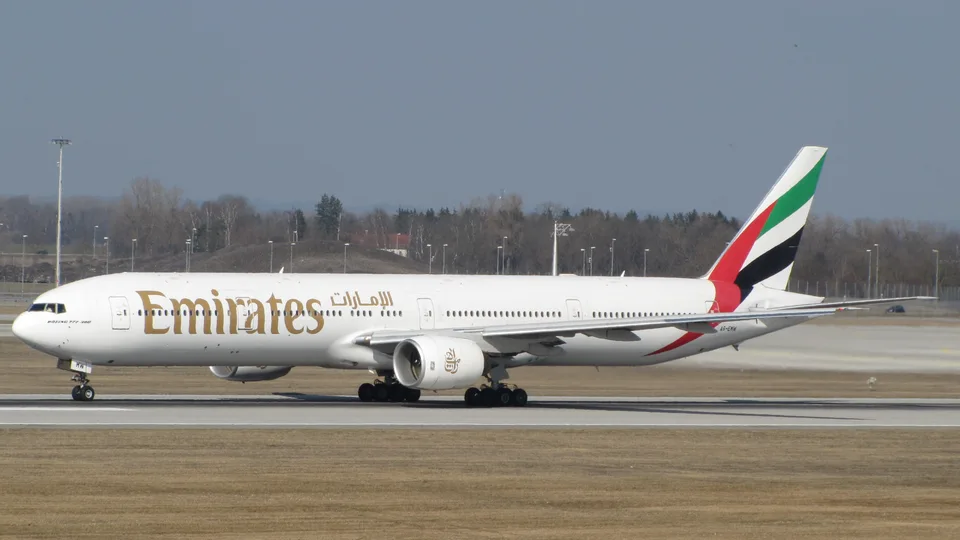
A Boeing 777 lifted off after a brief touchdown at Dubai with its engines still at idle, then struck the runway. All 300 occupants survived; a firefighter died after a fuel-tank explosion.
After a prolonged flare and brief main-gear contact, the crew attempted a go-around. Touchdown had inhibited the TO/GA switches, and the crew missed the idle thrust state. The aircraft climbed to 85 ft radio altitude, lost speed and descended onto the runway.
Read the full incident Follow what happened, from the flight to the investigation findings.
What investigators concluded
The AAIS attributed the accident to idle thrust, ineffective instrument monitoring, failure to recognize the autothrottle response and omitted thrust verification. Training, procedures, alerts, wind information and controller workload contributed.
1,551 words / about 8 minutes to read. Based on the investigation records cited below.
A scheduled arrival in changing winds
Emirates flight 521 departed Trivandrum International Airport in India at 05:06 UTC on 3 August 2016, bound for Dubai. The Boeing 777-31H, registered A6-EMW, carried 282 passengers, two pilots and 16 cabin crewmembers. The commander flew from the left seat and the copilot monitored the flight. The pilots had received approximately 30 hours of rest before the flight. The aircraft's calculated landing weight was 229,682 kg, within its limits. Investigators found that the aircraft had been maintained under its approved program and that its systems and engines performed as designed.
About an hour before landing, the pilots briefed approaches to Dubai's runways 12L and 30L. Their missed approach briefing specified flaps 20 and a climb to 3,000 ft. A moderate windshear warning applied to every runway from 07:40 to 09:00 UTC. The pilots confirmed receiving the airport information broadcast that carried the warning. At 08:06, they discussed a windshear escape maneuver, including use of the takeoff/go-around switch and keeping the aircraft configuration unchanged. The commander later told investigators that similar warnings were familiar at Dubai and that he expected the landing to be manageable.
Air traffic control vectored the aircraft for the RNAV approach to runway 12L. Two earlier aircraft went around at 08:29 and 08:31, followed by two Emirates 777s that landed at 08:33 and 08:35. Flight 521's crew received no information about those go-arounds. With the landing gear down, speedbrakes armed and flaps 30 selected, they completed the landing checklist. The approach was stabilized before 1,000 ft radio altitude. The commander disconnected the autopilot at 930 ft and continued manually, with the autothrottle engaged and the flight directors on.
The copilot called a 16 kt tailwind at 190 ft radio altitude and then reported it reducing to 13 kt. The reference landing speed was 147 kt, with 152 kt selected for the approach. The aircraft crossed the runway threshold at approximately 54 ft radio altitude and 159 kt indicated airspeed. About 100 m beyond the threshold, the commander began the flare at approximately 40 ft. The investigation considered that initiation earlier than recommended and identified it as a contributor to the extended landing distance.
At 25 ft radio altitude, the autothrottle changed from SPEED to IDLE and brought the thrust levers back. Airspeed initially fell to 153 kt, then increased to 165 kt as the aircraft floated just above the runway. The recorded increase of 12 kt occurred over approximately four seconds. Investigators attributed it to horizontal windshear as the wind shifted from a tailwind to a headwind. The additional lift prolonged the float. Both pilots were looking outside and missed the increasing airspeed. The commander referred to thermals and made several control inputs while trying to bring the aircraft onto the runway.
At 08:37:16, a correction following a left roll produced a right bank of 7.4 degrees. The right main landing gear contacted the runway approximately 1,090 m beyond the threshold, at 161 kt indicated airspeed. During the next six seconds, the main gear cycled through air and ground indications. Both main gear were simultaneously in ground mode for less than two seconds. The nose gear remained airborne. The pilots did not recognize that the main gear had touched down, and the commander believed the aircraft was still flying above the runway.
Approximately two and a half seconds after the right main gear first contacted the runway, the commander called for a go-around and pushed the left TO/GA switch. A long-landing alert followed. Weight on the main gear had inhibited the switches, so the push left the autothrottle in IDLE and the thrust levers at idle. Neither pilot checked the flight mode annunciations. The commander pulled back on the control column and called for flaps 20. The copilot selected that setting as the aircraft became airborne again at approximately 153 kt.
The aircraft initially gained height despite the idle engines. Its remaining speed, headwind and landing configuration supplied enough lift for this brief climb. The copilot announced positive climb at approximately 47 ft radio altitude. The commander called for gear up at 58 ft, with airspeed down to 145 kt. The go-around procedure required both pilots to verify that engine thrust was increasing after the flap selection, followed by the monitoring pilot verifying sufficient thrust and adjusting it as necessary. They omitted these checks. The procedure had no verbal announcement for either verification, leaving each pilot unaware that the other had missed it.
During gear retraction, the tower instructed flight 521 to continue straight ahead and climb to 4,000 ft. The copilot read back the instruction and changed the selected altitude from the briefed 3,000 ft. The investigation found that the transmission added workload and momentarily affected flying and monitoring. At 08:37:31, the aircraft reached its maximum radio altitude of 85 ft at 131 kt, then began descending. The pilots still had not identified the idle thrust state. Their expectation that the autothrottle would manage thrust continued through most of the attempted go-around.
Three seconds later, the commander called a windshear escape maneuver. At 08:37:35 he manually advanced both thrust levers fully forward. The cockpit issued a don't-sink warning, and the copilot called attention to speed. An airspeed-low caution followed as the aircraft descended at approximately 800 ft per minute. At 08:37:38, its aft fuselage struck the runway at 124 kt, above the stall speed. The engines had begun responding to the lever movement, but the remaining height allowed too little time to develop sufficient thrust. Impact occurred 18 seconds after the go-around began.
With its gear retracting, the aircraft struck near taxiway November 7. The right engine and pylon separated as the aircraft slid along the runway on its lower fuselage for approximately 32 seconds. It stopped near taxiway Mike 13, approximately 70 m right of the runway centerline, on a heading of about 250 degrees. Fire appeared at the detached right engine and beneath the left engine. Dense smoke emerged from the right side near the main landing gear bay. The first rescue vehicles and fire commander reached the site within 90 seconds of the aircraft stopping.
The commander transmitted a mayday at 08:39:04 and advised the tower that the aircraft was being evacuated. The flight crew completed the evacuation checklist and ordered evacuation. Smoke formed a barrier between the forward and aft cabin. Resting on the fuselage lowered the doors and reduced the slide slope to approximately 14 degrees. Winds of roughly 12 to 15 kt, gusting to 18 kt, disrupted several slides. Cabin crew blocked unusable doors and redirected passengers as conditions changed. The L1 slide detached, while the R1 slide became usable briefly before damage caused it to deflate.
The L2 and L4 slides were lifted against the fuselage by wind. The R4 slide bowed and evacuation there was interrupted for approximately 40 seconds. A crewmember went onto that slide to help passengers, then returned inside to continue the evacuation. The L5 slide served passengers before wind lifted it against the aircraft. A firefighter stabilized the twisted R5 slide, enabling evacuation through that exit. Crew instructed passengers to leave baggage, but several took belongings. Most occupants escaped through the usable slides in approximately 6 minutes 40 seconds.
The commander and senior cabin crewmember remained inside to search for passengers, including a child separated from her family. Dense smoke forced them back toward the forward cabin. Approximately 9 minutes 40 seconds after the aircraft stopped, the center wing tank exploded. A large section of upper right-wing skin struck and killed a firefighter. The two remaining crewmembers subsequently jumped from L1 onto the detached slide. All 300 occupants survived. Four cabin crewmembers suffered serious injuries; 28 occupants suffered minor injuries. The report also records seven minor injuries among rescue and firefighting personnel.
Investigators also examined the firefighting response. Video and witness evidence showed that the foam applied lacked a secure blanket. They attributed this to application methods: jets struck the aircraft at near right angles, breaking down foam bubbles, while water applied elsewhere washed foam away. Tests of samples from the same concentrate batches met the applicable performance standards. The report recommended training that would help crews identify confined heat sources, understand fire dynamics and choose appropriate tactics.
The AAIS identified four causes: idle thrust during almost the entire attempted go-around; ineffective scanning and monitoring of primary flight instruments; failure to recognize that the autothrottle had not advanced the levers; and omitted thrust verification that prevented timely corrective action. Its contributing factors included the early flare and wind shift, inaccurate awareness of touchdown, reliance on automation and inadequate training for low-level go-arounds with inhibited TO/GA switches. The aircraft provided no alert for inhibited switches or for the mismatch between go-around configuration and insufficient thrust. The procedures also lacked thrust-verification and flight-mode-change callouts.
The final report recorded Emirates introducing training for go-arounds after touchdown and with TO/GA switches inhibited. It added simulator exercises involving subtle instructor errors, revised briefings and training on switch logic, and promoted tactile feedback from moving thrust levers. The AAIS recommended further improvements to go-around training and cockpit monitoring. Recommendations to Boeing covered alerts for insufficient go-around thrust, clearer switch-inhibit information and verbal thrust checks. Other recommendations addressed controller communications, windshear information, firefighting tactics, passenger management and slide performance after landing-gear collapse. The final investigation report was issued on 20 January 2020.
Both engines remained at idle until the final three seconds before impact. The crew omitted thrust verification and the aircraft had insufficient energy to sustain flight.
Passengers and most crew left through the usable slides in approximately 6 minutes 40 seconds. The commander and senior cabin crewmember left through L1 after the center wing tank exploded.
Matching dossiers for Automation and training gaps: No other dossier in this collection.
Read alongside
These comparisons connect specific research topics. Shared circumstances do not establish identical causes. Evidence from both investigations is provided below.
Both Boeing 777 accidents involved idle thrust, missed automation cues and ineffective airspeed or thrust monitoring. At Dubai, main-gear contact inhibited the TO/GA switches, and the Emirates crew omitted thrust verification during the attempted go-around. During Asiana 214's visual approach at San Francisco, the pilot manually resisted advancing thrust levers, causing the autothrottle to enter HOLD and stop controlling thrust or airspeed. The NTSB identified unintended deactivation of automatic airspeed control, inadequate airspeed monitoring and delayed execution of a go-around among the probable causes. Both investigations identified weaknesses in automation training and operating information.
Explore the records below for additional context. They open on the publisher's site and are not all included in our report search. Source reuse terms apply.
Kevin Murphy writes the incident accounts on AirlineIncidents.com, out of a long interest in aviation safety and the lessons each investigation leaves behind.
Prepared by
AirlineIncidents editorial desk
Report citation check
Independent expert review
Not completed
Citation checks compare supporting text with the indexed report pages. They do not constitute independent expert review. How these pages are prepared.
Revision history
: Final investigation completed; GCAA AAIS report issued 20 January 2020.