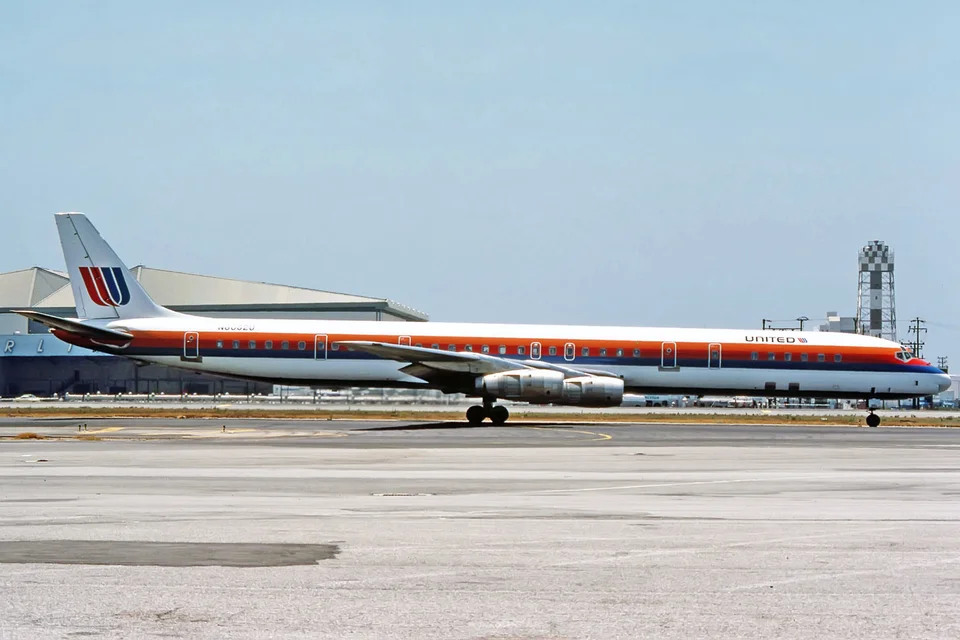
The copies shown here were resized without cropping or retouching.
Geographic context
Portland International Airport, intended landing
Accident location, suburban Portland
The airport lies near the south shore of the Columbia River. The accident site was about six nautical miles east-southeast of the airport; its coordinates are given in section 1.1. Basemap: Natural Earth, public domain.Read supporting evidence
Flight 173 held at 5,000 feet while the crew investigated abnormal landing gear indications and prepared for an emergency landing. The captain failed to relate fuel remaining to consumption, time and distance from the airport. All four engines stopped from fuel exhaustion, and the aircraft crashed in suburban Portland. Ten occupants died and 179 survived.
Read the full incident Follow what happened, from the flight to the investigation findings.
What investigators concluded
The NTSB found that the captain failed to monitor the fuel state properly and respond to low fuel and crew advisories. His attention was concentrated on the gear malfunction and emergency landing preparations. The other flight crewmembers contributed by failing either to understand fully the urgency of the fuel state or to communicate their concern successfully.
1,667 words / about 8 minutes to read. Based on the investigation records cited below.
The descent into Portland
United Airlines Flight 173 left Denver at about 14:47 on 28 December 1978, continuing a scheduled journey from New York to Portland. The McDonnell-Douglas DC-8-61, registered N8082U, carried 181 passengers and eight crewmembers. Six passengers were infants. The planned flight time from Denver was two hours 26 minutes, with arrival at Portland expected at 17:13.
The aircraft left the Denver gate with 46,700 pounds of fuel. The flight plan allowed 31,900 pounds for the journey to Portland, together with the regulatory reserve and company contingency fuel. The captain later described the flight to the Portland area as normal, with consumption close to the predicted figures. The NTSB calculated that the aircraft reached the area with about 13,800 pounds remaining.
At 17:05:47 the crew contacted Portland Approach at 10,000 feet and reported slowing down. The airport was in sight. During the descent through about 8,000 feet, the first officer, who was flying, requested 15 degrees of flap and then landing gear extension. The captain lowered the gear. An unusually loud thump, a jolt and a yaw to the right followed. The nose gear showed a green light, while the main gear indications failed to confirm normal extension.
At 17:12:20 the crew declined a transfer to the tower and told Approach that they had a gear problem. The controller kept the flight at 5,000 feet and began giving vectors for a holding pattern south and east of the airport. For the next 23 minutes the pilots and flight engineer worked through the emergency and precautionary checks. The flight engineer checked the visual indicators above the wings, which indicated that both main landing gears were down and locked.
The nose gear's separate visual indicator could not be illuminated because its light was inoperative. Its cockpit indicator did show green. The airline's procedures allowed the captain to land when the visual indicators showed the gear down. The flight continued circling at 5,000 feet with its gear extended and flaps at 15 degrees, generally within about 20 nautical miles of the airport.
At about 17:38 the crew contacted United's maintenance control in San Francisco through the airline radio service. At 17:40:47 the captain described the abnormal extension and the checks already made. He reported approximately 7,000 pounds of fuel and planned another 15 or 20 minutes of holding to prepare the passengers for an evacuation. At 17:44:03 he agreed with the company that about 18:05 was a reasonable landing estimate.
The captain then discussed passenger preparation, crash landing procedures and evacuation with the first flight attendant. He gave her no specific deadline and did not ask how long the work would take. He later said he had assumed 10 or 15 minutes and thought some preparations could continue during the final approach. The flight manual required the captain to advise the first flight attendant of the time available.
At 17:46:52 the first officer asked the flight engineer how much fuel remained and received an answer of 5,000 pounds. At 17:48:54 he asked the captain, who gave the same figure. Around 17:49 the crew discussed blinking fuel feed pump lights. The manufacturer associated illumination of the inboard feed pump lights with approximately 5,000 pounds of usable fuel remaining.
At about 17:50:20 the captain asked the flight engineer to calculate a new landing weight for another 15 minutes of flight, using 3,000 or 4,000 pounds above the aircraft's zero fuel weight. The flight engineer warned that another 15 minutes would leave them very low on fuel. The captain nevertheless instructed him to tell United's Portland representative that they expected to land with about 4,000 pounds. The estimate of landing at 18:05 was confirmed again.
At 17:56:53 the flight engineer reported approximately 3,000 pounds remaining. Less than a minute later the captain sent him into the cabin to check the preparations. While he was away, the pilots discussed evacuation responsibilities, antiskid protection and the intended landing technique. At 18:01:34 the engineer returned and reported that the cabin needed another two or three minutes. The aircraft was then about five nautical miles southeast of the airport.
At 18:02:22 the engineer again advised that about 3,000 pounds remained. The captain responded with instructions about switching off boost pumps if the gear collapsed on touchdown. The crew told Approach that they intended to land on runway 28L in about five minutes and requested emergency equipment. Further cockpit discussion concerned the landing gear warning horn, circuit breakers, automatic spoilers and antiskid operation.
At 18:06:19 the first flight attendant reported that the cabin was ready. The aircraft had continued away from the airport and was about 17 nautical miles south of it. As the captain said they would now go in and should land in about five minutes, the first officer reported the loss of the No. 4 engine. He identified fuel as the reason and urged the flight engineer to open crossfeeds. The conversation became confused over the quantities still available.
At 18:07:12 the captain requested an approach to runway 28L. It was the first approach request since the landing gear problem began. The aircraft was about 19 nautical miles south-southwest of the airport, turning left. Approach immediately provided vectors for a visual approach. The flight engineer warned that No. 3 would also stop, while the crew tried to move the remaining fuel between engine feed systems.
By 18:09:16 the engineer reported about 1,000 pounds on the totalizer and an empty No. 2 tank. The captain told Approach they would turn toward the airport, and the flight received visual approach clearance. At 18:10:17 he still asked the engineer to reset a circuit breaker to check the gear lights. The controller estimated 18 flying miles to the airport at 18:10:47 and 12 flying miles at 18:12:42.
At 18:13:21 the engineer reported that two more engines had been lost, identifying them as Nos. 1 and 2. The captain concluded they could not reach Troutdale, a smaller airport along the approach path, and ordered a Mayday. At 18:13:50 the first officer told Portland tower that the engines were flaming out and the aircraft could not reach the airport. It was the flight's final radio transmission.
At about 18:15 the DC-8 crashed into a wooded residential area approximately six nautical miles east-southeast of Portland International Airport. The aircraft struck trees, crossed a street and destroyed two unoccupied houses. The wreckage path extended about 1,554 feet. The forward fuselage suffered severe damage; the cabin from row six rearward remained relatively intact, apart from local damage and disrupted seats around rows 20 through 22.
Ten occupants died from impact injuries: eight passengers, the flight engineer and a flight attendant. All the passengers who died had been seated on the right side of the forward cabin. Twenty-three occupants sustained serious injuries, comprising 21 passengers and two crewmembers. The report grouped another 156 occupants as having minor injuries or none. There were no ground casualties and no fire.
Evacuation took about two minutes. Several exit doors were obstructed by wreckage or trees, and some slides inflated inside the cabin. Other slides were punctured or torn by debris. Two passengers suffered fractures during evacuation, with others receiving cuts and abrasions while leaving the aircraft or crossing debris. Examination found the slides' installation, maintenance, manufacture and design satisfactory. Emergency lighting provided adequate illumination.
Three fire departments sent 39 fire units and 108 on-duty personnel, with additional off-duty personnel also responding. Rescuers searched the wreckage, freed trapped occupants, provided medical care and transported casualties to hospitals by ambulance and helicopter. A nearby church became a gathering point for ambulatory survivors.
Investigators found severe corrosion in the mating threads joining the right main landing gear retract cylinder to its rod end. The weakened joint pulled apart under a comparatively low tensile load. The cylinder normally cushioned extension; its separation allowed the gear to fall rapidly. That movement damaged the position indication microswitch. The NTSB considered unequal extension timing the probable source of the transient yaw. All three landing gears were fully extended in the wreckage.
Examination found all four engines capable of operation, with no signs of rotation at impact. There was no usable fuel remaining. Fuel burn studies by Douglas and United agreed that consumption during the accident flight had been normal. For the gear-down holding period the NTSB used Douglas's estimate of approximately 13,209 pounds per hour, or 220 pounds per minute. At that rate the approximately 13,334 pounds available at the beginning of the delay would be consumed in about an hour.
The NTSB found that the quantity system had accurately indicated fuel to the crew. Its analysis concluded that relating the reported quantities to fuel flow would have shown exhaustion at about 18:15. The captain's expectation of landing at 18:05 with 4,000 pounds was inconsistent with the 5,000-pound reading around 17:49 and the consumption over the intervening minutes.
The NTSB attributed the accident to the captain's failure to monitor fuel and respond properly to the low quantities and crew advisories. It linked his inattention to preoccupation with the gear malfunction and emergency landing preparations. The other two flight crewmembers contributed by failing either to comprehend fully the urgency of the fuel state or to communicate their concern successfully. Apparently no crewmember had been specifically assigned fuel monitoring while the malfunction was being resolved.
The aircraft had recently received three-digit fuel gauges. Individual tank readings required multiplication by 100, while the similarly presented totalizer required multiplication by 1,000. The NTSB considered that the captain and flight engineer might have confused these multipliers during the final minutes; earlier comments gave no indication of such confusion. It recommended training on instrument differences, attention to cockpit displays during engineering changes and an audit of system calibration under the supplemental type certificate.
The Board also called for flightdeck resource management training, emphasizing participative management by captains and assertiveness by other cockpit crewmembers. Its analysis identified the need for responsibilities to be divided during system malfunctions and for concerns to be expressed effectively. The NTSB adopted its final report on 7 June 1979.
The captain continued the delay while preparing for a possible emergency landing; the flightcrew failed to equate the fuel remaining with time and distance.
Both main landing gear visual indicators showed down and locked, and the nose gear cockpit indicator showed green. All three gears were fully extended in the wreckage.
What did the NTSB recommend about cockpit teamwork?
It recommended flightdeck resource management training, with participative management for captains and assertiveness training for other cockpit crewmembers.
Only three recovered tank gauges could be repaired sufficiently for functional tests; each met specifications. The totalizer was too damaged to repair for testing.
Douglas and United obtained different holding consumption estimates from their interpretations of weather and recorder data. The NTSB selected the Douglas estimate for the holding period.
The Board recommended attention to cockpit configuration and instrument scale factors when approving engineering changes, and an audit of the supplemental type certificate for system calibration.
Matching dossiers for Landing gear malfunction: No other dossier in this collection.
Probable causeFuel monitoring
The captain failed to monitor fuel and respond properly to low fuel and crew advisories while concentrating on the gear problem and landing preparations.
Matching dossiers for Fuel monitoring: No other dossier in this collection.
Read alongside
These comparisons connect specific research topics. Shared circumstances do not establish identical causes. Evidence from both investigations is provided below.
Further investigation records
Explore the records below for additional context. They open on the publisher's site and are not all included in our report search. Source reuse terms apply.
Kevin Murphy writes the incident accounts on AirlineIncidents.com, out of a long interest in aviation safety and the lessons each investigation leaves behind.
Prepared by
AirlineIncidents editorial desk
Report citation check
Independent expert review
Not completed
Citation checks compare supporting text with the indexed report pages. They do not constitute independent expert review. How these pages are prepared.
Revision history
: Published a sourced account, timeline, photographs and final investigation findings.