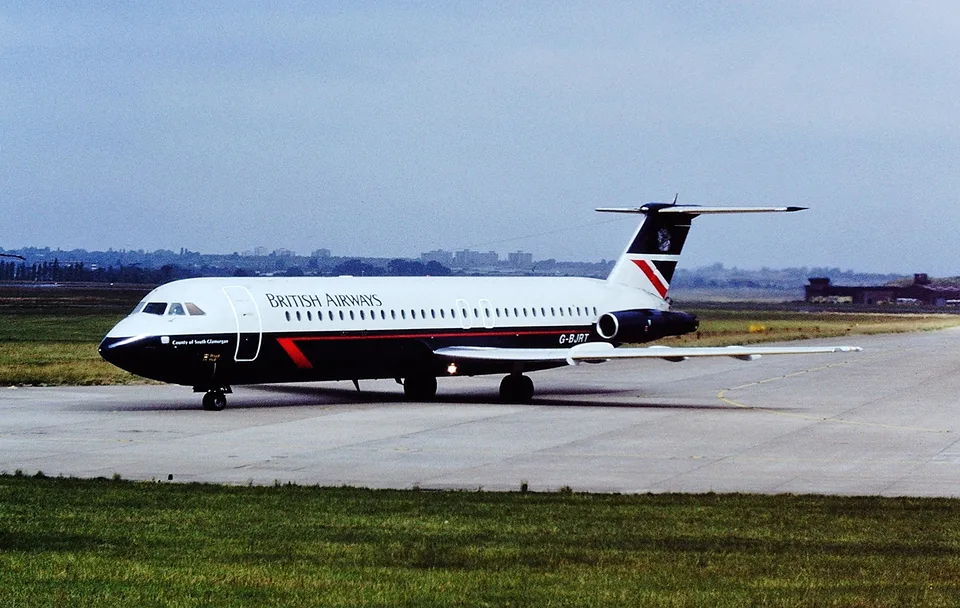
Original photograph unchanged. Responsive WebP copies resized without cropping.
Geographic context
Birmingham departure
Didcot area
Southampton landing
Malaga planned destination
Approximate geographic markers for the departure, accident area, diversion and planned destination. Basemap: Natural Earth, public domain.Read supporting evidence
At 07:33 UTC, the left windscreen of G-BJRT separated during the climb through about 17,300 feet. The commander was forced partly through the opening. Cabin crew held him while the co-pilot regained control, descended and diverted to Southampton. The aircraft landed at 07:55. All 87 occupants survived; the commander was seriously injured and one steward sustained minor injuries.
Read the full incident Follow what happened, from the flight to the investigation findings.
What investigators concluded
AAIB found that incorrect bolts allowed cabin pressure to overcome the windscreen attachment. The safety critical replacement was carried out and certified by one manager with no duplicate inspection. His poor working practices and unsuitable equipment combined with failures of management and quality monitoring to detect inadequate standards.
British Airways 5390: windscreen loss and emergency landing
1,518 words / about 7 minutes to read. Based on the investigation records cited below.
The replacement before departure
During the night of 8 to 9 June 1990, British Airways replaced the left windscreen of its BAC One-Eleven, G-BJRT, at Birmingham. Darkening and bubbling had been reported in a small area of the windscreen. The shift maintenance manager decided to do the replacement himself while other engineers dealt with their assigned work. G-BJRT was not needed for flying the next day, but he wanted it ready for a booked aircraft wash and knew the morning shift would be short of staff. The work took place between about 03:00 and 05:00 on Saturday.
He briefly consulted the maintenance manual but did not use the Illustrated Parts Catalogue to identify the required bolts. Instead, he took a bolt removed from the old windscreen to the stores and matched it against the stock. The old fitting had mainly used A211-7D bolts, which were shorter than the specified A211-8D bolts. The stores supervisor told him that the windscreen used A211-8Ds. He nevertheless decided to replace the removed bolts with others of the same size.
Finding too few of the bolts he wanted in the hangar store, he went to an unmanned carousel beneath the International Pier. Lighting there was poor, and access to the drawers put his body between the parts and the light. He compared bolts by sight and touch and selected A211-8C bolts. Their diameter was smaller than the specified type, although their thread pitch was the same. He also collected longer bolts for the corner fairing, then reused six old bolts when the longer ones proved unsuitable.
The maintenance manual specified an initial bolt torque of 15 pound-force inches. Based on his experience of bolts loosening before a later retorque, the manager chose 20. The usual calibrated wrench was unavailable. A torque limiting screwdriver that was outside its calibration date was set to the requested value and supplied to him; he checked its setting against two gauges. The staging was poorly positioned, and he had to stretch across the aircraft nose to reach many of the bolts.
The screwdriver bit repeatedly fell from its holder. To keep it in place, he held the socket with his left hand while turning the tool with his right. His hand obscured the bolt head, and stretching put the operation outside his direct view. He interpreted the feel of the undersized threads slipping in the anchor nuts as satisfactory tightening. The smaller bolt heads also sat deeper in the countersinks, leaving a visible ring around them. That cue, differences from the adjacent right windscreen bolts, and differences from the reused fairing bolts went unrecognised.
The following night he changed another windscreen and saw that its supplied bolts were A211-8Ds. He explained the difference to himself as a consequence of different aircraft modification standards. The G-BJRT task had been signed off by the same manager who carried it out. Its recorded functional check concerned windscreen heating. No duplicate inspection took place. The aircraft had not flown after the replacement, leaving its first passenger flight to expose the attachment to flight pressurisation.
On Sunday 10 June, flight BA 5390 took off from Birmingham for Malaga at 07:20 UTC. There were 81 passengers, four cabin crew and two pilots. The co-pilot handled the takeoff, and the commander took over during the climb in accordance with company procedures. Air traffic control cleared the aircraft to climb towards Flight Level 230. Both pilots released their shoulder harnesses once established in the climb, and the commander loosened his lap belt.
At 07:33, as the aircraft climbed through about 17,300 feet, the left windscreen separated from its frame. A bang was followed by condensation mist in the fuselage. The pressure change forced the commander partly through the opening and blew the flight deck door onto the radio and navigation console. The No 3 steward, working beside the door, entered the flight deck and gripped the commander around the waist. The purser removed the door debris, then returned to help hold him. The other cabin staff told passengers to fasten their belts and took their emergency positions.
Movement of the control column disconnected the autopilot. Recorded data showed a pitch to six degrees nose down and a bank of 25 degrees to the right. The co-pilot regained control, closed the throttles and began a rapid descent. Indicated speed rose from 300 to 340 knots during the descent, which reached 4,600 feet per minute. He then reduced speed and extended flap as the aircraft levelled at Flight Level 110. The recorder measured 148 seconds between the depressurisation and level flight.
The cabin crew could see the commander's head and torso through the side window, but the slipstream prevented them from pulling him back inside. The No 3 steward's arms weakened as he suffered frostbite and bruising against the windscreen frame. The No 2 steward relieved him, secured himself in the left jump seat and held the commander by both ankles. The commander remained outside the opening throughout the descent and landing.
The co-pilot made distress calls but could not hear the controller's acknowledgments through the airflow noise. The appendix transcript records repeated attempts to establish communication. The Bristol sector continued handling other aircraft, while its chief sector controller alerted neighbouring sectors, the watch supervisor and the RAF distress and diversion service. The delayed understanding of the emergency also delayed notification to British Airways and activation of its emergency information arrangements.
Once two-way communication improved, the co-pilot asked for radar assistance to the nearest airfield. He initially mentioned Gatwick because he knew it, then accepted Southampton with radar guidance. On reaching Southampton's frequency he asked the controller to guide him onto the runway because he was unfamiliar with the airport. He subsequently told that controller that the commander was partly outside the aircraft and requested emergency services.
The Southampton controller supplied pressure settings, runway information and headings for the approach. The co-pilot checked that the runway length was acceptable. He requested more distance to prepare and asked for gentle turns. By about 07:48 he reported landing gear indications and flap set for the approach. Southampton had no instrument landing system for this recovery; the controller provided radar vectors towards a visual final approach. At about 07:52:30 the co-pilot reported the runway in sight.
The aircraft landed on runway 02 and stopped at 07:55. The co-pilot shut down the engines and kept the auxiliary power unit running to supply electrical power. Passengers left by the front and rear airstairs. Airport and local fire crews brought the commander back through the opening, and he was taken to Southampton General Hospital. He had fractures of the right arm and wrist and left thumb, together with bruising, frostbite and shock. One steward sustained cuts and bruising to an arm. All 87 people survived.
AAIB found that the co-pilot and cabin crew had averted a potential major catastrophe. He had handled the simultaneous decompression and loss of the handling pilot, while cabin crew physically restrained the commander. The commander recalled being able to breathe while lying against the exterior of the flight deck before losing consciousness. During the later descent, at about 3,000 feet, he began moving his legs.
Investigators recovered the windscreen near Cholsey, Oxfordshire, with bolts and its corner fairing. Examination established that the replacement had used 84 A211-8C bolts about 0.026 inch smaller in diameter than specified, plus six A211-7D bolts of the correct diameter but 0.1 inch too short. The windscreen was mounted from outside and depended on its fasteners to resist cabin pressure. The undersized bolts engaged the larger anchor nuts sufficiently to give a misleading impression during fitting, but the attachment failed as pressure loaded it in flight.
Tests reproduced the fitting of smaller bolts into the specified nuts. Across the combined trials, their threads slipped at an average torque of 4.7 pound-force inches, with a maximum of 12. Examination also found that deteriorated grease gave the screwdriver excessive residual friction after release. The excess friction occurred after the set torque had been reached and did not change the torque at which the screwdriver operated. AAIB identified multiple missed cues and departures from the prescribed procedure. Its findings said sleep deprivation and the timing at the end of a first night shift increased the likelihood of errors.
The investigation's three causal factors covered the safety critical task being performed and certified by one person, the manager's inadequate care and working practices, and the failure of local management and quality checks to detect those practices. AAIB judged the procedural failures symptomatic of a longer period of noncompliance. It found that management, product sampling and quality audits had not directly monitored how shift maintenance managers did their work.
After the accident, British Airways ordered checks of windscreen bolt length across its One-Eleven fleet. Two aircraft were found with a total of 41 short bolts. A later visual inspection of all windscreen bolt head diameters passed across the fleet. AAIB made eight recommendations addressing self-certification of safety critical maintenance, quality feedback, management duties, independent product sampling, CAA supervisory visits, engineer training and testing, prescribed corrective glasses, and practical emergency training for air traffic controllers.
Follow the main stages, then open the evidence beneath each step.
1
Incorrect bolts selected
Visual matching of removed bolts led to the selection of undersized replacements. The specified part number was available in the Illustrated Parts Catalogue.
The smaller bolts engaged the larger nuts, and thread slip was mistaken for satisfactory tightening. Deeply recessed bolt heads provided a missed visual cue.
A simplified reading of the investigation findings. The sequence does not replace the full report or imply that every contributing factor is shown.
Sequence of events
UTC. Appendix A records a slight difference between the London and Southampton clock signals; AAIB left them unadjusted. Expand an event to see its evidence.
9 June, about 03:00-05:00Replacement at Birmingham
The shift maintenance manager changed and certified the left windscreen. Incorrect bolts and missed fitting cues remained undetected.
The windscreen replacement had not been designated a 'Vital Point' task requiring duplicate inspection. The manager's work was also outside review by another manager.
He expected to reach a lower flight level quickly and wanted to communicate with the cabin crew. AAIB judged this probably sensible in the circumstances, while finding that a mask would have been imperative at a higher decompression altitude, such as above 20,000 feet.
AAIB could not determine exactly what initially prevented the commander from leaving the aircraft completely. It considered restraint by his legs likely.
Actions and recommendations are described at the dates of the cited records. A recommendation is not proof of implementation.
Immediate windscreen bolt checks
British Airways ordered bolt-length checks before further flight. Two aircraft had a total of 41 short bolts. A subsequent complete visual check of bolt head diameter passed across the fleet.
AAIB recommended CAA review of self-certification for safety critical tasks cleared without functional checks. It called for British Airways to clarify quality reporting, management duties and independent product sampling, and for a CAA review of supervisory visits.
Recommendations addressed periodic engineer training and testing, use of prescribed corrective glasses, and theoretical and practical emergency instruction for controllers followed by continuation and refresher exercises.
Contributing factorMaintenance supervision and quality monitoring
The installer also certified the work. No duplicate inspection took place, and local management and quality monitoring had not detected inadequate work practices.
Matching dossiers for Pilot incapacitation and emergency recovery: No other dossier in this collection.
Read alongside
These comparisons connect specific research topics. Shared circumstances do not establish identical causes. Evidence from both investigations is provided below.
Further investigation records
Explore the records below for additional context. They open on the publisher's site and are not all included in our report search. Source reuse terms apply.
Kevin Murphy writes the incident accounts on AirlineIncidents.com, out of a long interest in aviation safety and the lessons each investigation leaves behind.
Prepared by
AirlineIncidents editorial desk
Report citation check
Independent expert review
Not completed
Citation checks compare supporting text with the indexed report pages. They do not constitute independent expert review. How these pages are prepared.
.jpg)