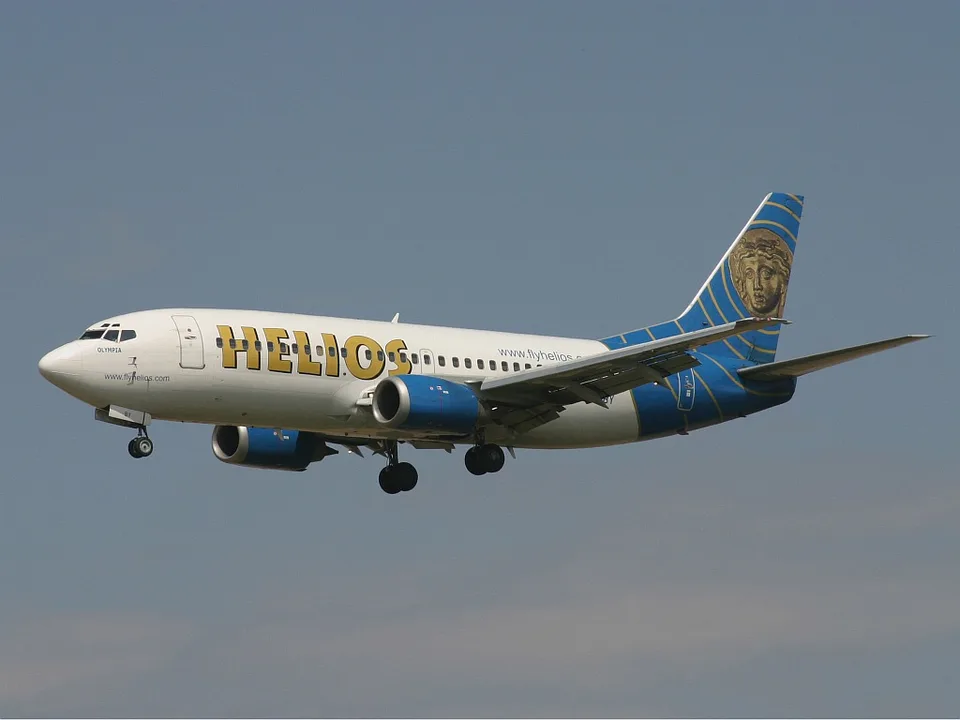
No cropping or colour changes. Derivatives retain the stated source licence. Responsive WebP copies resized without cropping.
Geographic context
Larnaca
Athens
Prague
Approximate airport markers for the intended route, not an accident flight track or navigation chart. Basemap: Natural Earth, public domain.Read supporting evidence
A Helios Boeing 737 left Larnaca for Athens and Prague with its pressurization mode selector in manual. The flight crew became incapacitated by hypoxia, and the aircraft continued until both engines flamed out.
Read the full incident Follow what happened, from the flight to the investigation findings.
What investigators concluded
AAIASB identified missed pressurization configuration checks, failure to identify warnings and hypoxic incapacitation as direct causes. It also identified operator, regulatory oversight, crew coordination and manufacturer-response weaknesses.
1,531 words / about 7 minutes to read. Based on the investigation records cited below.
Maintenance before the morning departure
Helios Airways flight HCY522 departed Larnaca on 14 August 2005 for Prague with an intermediate stop at Athens. Its Boeing 737-31S, registered 5B-DBY, carried 115 passengers and six crew members. It ultimately struck hilly terrain near Grammatiko, northwest of Athens airport, after continuing without effective flight-crew control and exhausting its fuel. All 121 occupants died. The Greek AAIASB final report distinguishes the operational sequence from the organisational conditions behind it. Times in this account are UTC, following the report, rather than the Greek local clock.
The previous flight arrived from London Heathrow at 01:25. During that journey cabin crew had reported freezing around the right aft service-door seal and loud bangs in flight. The flight crew transferred that concern into the technical log as a requirement for inspection. A ground engineer inspected the door and conducted a cabin pressurization leakage check. No defect or leakage was found in that check, and the aircraft was released at 03:15. The recorded maintenance result does not establish that the later flight was correctly configured for automatic pressurization.
AAIASB found that the pressurization mode selector was not returned to AUTO after the test. The maintenance manual's instruction to restore the aircraft to its initial condition did not explicitly require that step. The report describes returning it as prudent even though its omission was not then a formal maintenance-procedure violation. That distinction matters: the initiating configuration cannot be reduced to an invented claim that an engineer ignored an explicit instruction. The investigation addressed maintenance wording, subsequent flight-crew checks and the opportunity for more than one safeguard to detect the setting.
The crew arrived for its briefing before 05:00 and took off at 06:07:13. Nicosia control cleared the aircraft to flight level 340. At 06:12:38, while the aircraft was climbing through approximately 12,040 feet, the cabin altitude warning horn sounded. The cabin pressure then corresponded to an altitude of 10,000 feet. AAIASB found that the flight crew interpreted the horn as a takeoff-configuration warning. It did not identify that cabin pressurization was inadequate and did not arrest the climb in response to the underlying condition.
At approximately 16,000 feet the captain called the company operations centre and reported a configuration warning together with an equipment-cooling concern. The dispatcher brought an on-duty engineer into the exchange. The engineer's subsequent statements describe efforts to understand the cooling indication and questions about circuit breakers. These company communications were not recorded, so the report's account relies partly on witness statements. They should not be presented as a complete verbatim cockpit history. The distinction between recorded flight information and later recollection is particularly important during this early portion of the flight.
Passenger oxygen masks deployed at an aircraft altitude of about 18,200 feet. The aircraft nevertheless continued climbing and levelled at flight level 340. The investigation found that the selector's manual position had escaped recognition during the preflight procedure and the before-start and after-takeoff checklists. It also identified weaknesses in warning recognition and crew coordination. The issue was therefore not simply the existence of an alarm: warnings occurred, but their meaning and the required response were not established while the crew still had an opportunity to deal with the condition.
The cabin and aircraft altitudes were different quantities. AAIASB calculated a cabin altitude of about 24,000 feet while the aircraft was cruising at 34,000 feet. The aircraft's reaching its cleared level did not mean the pressure inside had followed a safe schedule. The warning at a cabin altitude of 10,000 feet was an indication about the environment occupants were breathing, rather than the aircraft's clearance or height over terrain. The final findings also identify how workload and the uncancelled horn complicated diagnosis, while describing crew coordination deficiencies before hypoxia began affecting performance.
AAIASB concluded that hypoxia incapacitated the flight crew. Its findings place probable loss of useful consciousness sometime after the final company-radio communication at 06:20:21, approximately thirteen minutes after departure. The aircraft continued under its flight management computer and autopilot. It flew over the KEA navigation aid at 07:21, passed Athens and entered the published holding pattern at 07:38. Continued flight along a programmed route did not demonstrate that the crew were consciously navigating or that the cabin environment was safe.
At 08:24 two Hellenic Air Force F-16s intercepted the aircraft during its sixth holding circuit. One pilot approached closely and reported that the captain's seat was empty, the occupant of the first officer's seat was slumped forward and passenger oxygen masks were hanging in the cabin. Some seated passengers were visible wearing masks. No external damage or fire was observed. These observations are limited to what could be seen from another aircraft, and this account does not extend them into imagined cabin scenes or a claim that every occupant's medical state was externally observable.
At 08:49 a person was seen entering the cockpit and occupying the captain's seat. AAIASB identified that person as a cabin attendant with a commercial pilot licence. The fighter pilot tried unsuccessfully to attract his attention. The report concludes that he attempted to gain control, but his performance was very likely impaired by hypoxic and stressful conditions. His presence does not demonstrate a fully capable pilot had recovered the aircraft. It belongs to the evidence of a late intervention under extremely difficult conditions, rather than a fictional rescue narrative.
The left engine flamed out from fuel depletion at approximately 08:50, and the aircraft began descending from the holding pattern. The cockpit recorder preserved two attempted distress messages around 08:54. The report's findings state that those messages were not transmitted over VHF because the microphone key was not pressed. It is therefore inaccurate to describe them as distress calls successfully received by controllers. The recorder documented an effort to transmit, while other evidence limited what that effort achieved.
The right engine flamed out at approximately 09:00, when the aircraft was near 7,100 feet. It continued in a rapid descent and impacted near Grammatiko around 09:03. The report states that it had been structurally intact before impact. It also finds that the required amount of fuel had been supplied before departure. Fuel exhaustion was the end of a prolonged uncontrolled continuation, rather than evidence that the aircraft originally departed with an inadequate fuel load. That distinction separates the terminal mechanism from the pressurization and incapacitation sequence which led to it.
The evidence has important boundaries. The installed cockpit voice recorder retained only thirty minutes and did not preserve the climb, when the warning misunderstanding and incapacitation developed. Investigators could not determine every action by cabin crew after masks deployed, including whether they tried to contact or enter the flight deck. Three portable oxygen cylinders were considered most likely to have been used. These findings support a qualified reconstruction, not a complete account of individual behaviour throughout the cabin. Unknown early actions remain unknown even though the overall causal sequence was established.
Direct causes, latent weaknesses and corrective work
The direct causes adopted by AAIASB were non-recognition of the manual pressurization setting, failure to identify the warnings and hypoxic incapacitation which permitted automatic flight to continue until fuel depletion and impact. Its latent causes included deficiencies in the operator's organisation, quality management and safety culture, inadequate regulatory oversight, deficient crew resource management and ineffective manufacturer responses to earlier pressurization incidents. The report thus treats the cockpit outcome and the system surrounding it as connected. A final cause finding should not be shortened to a claim that one switch alone explains the accident.
AAIASB's organisational findings included incomplete manual updating, weaknesses in operational supervision and inadequate responses to earlier audit findings. Some key positions were vacant at times, while management personnel sometimes performed more than one role. The authority's deficiencies included limited resources and qualified staff, inadequate training for inspectors and ineffective implementation of corrective action plans. These are the specific forms of oversight weakness described in the final findings. They are not a claim that a regulator directly moved the selector or that every administrative failing independently caused the accident. Their significance is that repeated checks and audits did not reliably turn identified deficiencies into an effective safety barrier.
The findings criticised the use of the same warning sound for cabin altitude and takeoff configuration, and inconsistencies in procedures and checklists. They also identified the absence of appropriate cabin procedures for a situation in which oxygen masks deploy but the aircraft continues climbing without an announcement. The report records Cyprus comments appended to the final edition, which remain in the private source cache. This account follows AAIASB's adopted findings while keeping that source edition intact. It does not convert safety-investigation conclusions into a separate determination of legal liability.
The safety response described in the report included clearer maintenance instructions to return the mode selector to AUTO after pressure testing and revised guidance for recognising the warning horn. FAA AD Invalid Date required flight-manual revisions and took effect in July 2006. Further recommendations sought additional cabin-altitude alerts, practical hypoxia training and prompt cabin notification to the flight crew after masks deploy during continued climb. Those are report-era actions and recommendations, not a claim of present compliance. They address the repeated opportunities to detect configuration, understand warning information and interrupt incapacitation before automatic flight carries an aircraft beyond recovery.
These comparisons connect specific research topics. Shared circumstances do not establish identical causes. Evidence from both investigations is provided below.
Helios 522 and AF447 both examine crew response to system information and training. Helios involved pressurization and hypoxia with prolonged automatic flight; AF447 involved unreliable airspeed and a loss of control. The mechanisms differ.
Explore the records below for additional context. They open on the publisher's site and are not all included in our report search. Source reuse terms apply.
Official English final report, October 2006, including Cyprus comments
Sources and transparency
Checked against cached official report pages and specified official comments. No independent expert review.
Source limitations
The 30-minute cockpit recording did not preserve the climb and cannot resolve every early cockpit or cabin action. The report distinguishes direct causes, latent causes and contributing factors.
AAIASB 11/2006: Helios Airways HCY522
AAIASB Official English final report, October 2006, including Cyprus comments
Private evidence cache. Only short attributed quotations in original commentary; full report and third-party illustrations are not redistributed. Source terms / provenance.
Final Report: Accident on 1st June 2009 to the Airbus A330-203 registered F-GZCP operated by Air France flight AF 447
Bureau d'Enquetes et d'Analyses (BEA) English final report, 5 July 2012
Limited quotations for source-based commentary. Full report and illustrations are not republished. Wider reuse requires checking BEA terms. Source terms / provenance.
Kevin Murphy writes the incident accounts on AirlineIncidents.com, out of a long interest in aviation safety and the lessons each investigation leaves behind.
Prepared by
AirlineIncidents editorial desk
Report citation check
Independent expert review
Not completed
Citation checks compare supporting text with the indexed report pages. They do not constitute independent expert review. How these pages are prepared.
Revision history
: Private landmark Wave 2 original account with source-level citations.