The copies shown here were resized without cropping or retouching.
Geographic context
London Heathrow, departure
Lockerbie area, breakup
New York Kennedy, intended destination
Approximate place markers for geographical context, not a reconstructed radar track or precise blast position. Basemap: Natural Earth, public domain.Read supporting evidence
A bomb detonated in the forward cargo hold during normal cruise. Direct blast damage and transmitted explosive effects destroyed the forward fuselage, followed by progressive disintegration and impacts in Lockerbie.
Read the full incident Follow what happened, from the flight to the investigation findings.
What investigators concluded
AAIB found that an improvised explosive device in a baggage container on the left side of the forward cargo hold caused the in-flight disintegration.
1,565 words / about 8 minutes to read. Based on the investigation records cited below.
Departure from London
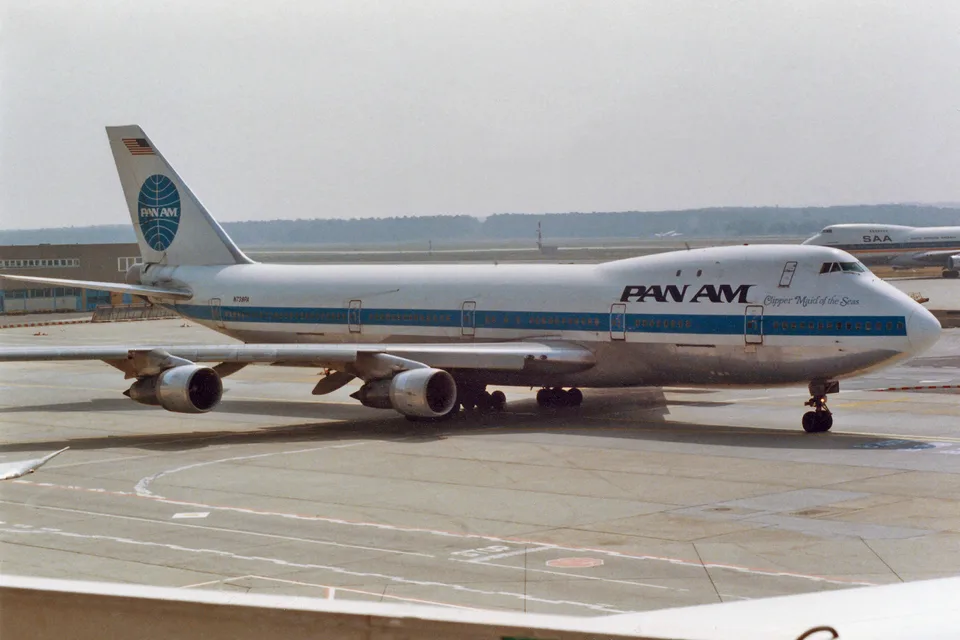
Pan American World Airways flight PA103 was a scheduled passenger service from London Heathrow to New York Kennedy on 21 December 1988. The Boeing 747-121 was registered N739PA. Some passengers had reached Heathrow on a connecting service from Frankfurt and transferred with their baggage; others joined from different flights. The AAIB describes an unremarkable departure.
The aircraft took off at 18:25 UTC and climbed under air traffic control instructions. At 18:56 it levelled at flight level 310, equivalent to 31,000 feet. Its communications with the departure and en route controllers were normal. Shortly afterwards the crew established contact for its oceanic clearance. The weather evidence and routine flight sequence provided context, while the later investigation found no aircraft defect or malfunction that could explain the destruction.
There were 243 passengers and sixteen crew members aboard, a total of 259. All died, and eleven people in Lockerbie also died when wreckage struck the town. The injury table additionally records two serious ground injuries.
The oceanic clearance was being transmitted when the aircraft ceased to behave as a single radar target. The crew did not acknowledge the message. Secondary radar information disappeared and primary returns spread downwind, indicating separated objects rather than an intact aircraft continuing along its route. The AAIB combined radar with radio, recorder and physical evidence to reconstruct the failure.
The initiating recorded event was placed at about 19:02:50 UTC. A loud sound appeared at the end of the cockpit recording, almost immediately followed by loss of recording power. The flight data recording also stopped. The AAIB correlated these events with the wreckage distribution and concluded that they were directly associated with the explosive destruction. It nevertheless cautioned that the sound itself might have resulted from structural breakup rather than being a direct acoustic recording of the detonation.
Major components fell into Lockerbie, while the nose and flight deck and other large parts landed in the surrounding countryside. Lighter material travelled much farther east under the winds. The wing impact produced a crater and a fireball that ignited nearby buildings. Emergency services faced fires, damaged housing and injuries on the ground as well as a dispersed aircraft accident. The AAIB judged the accident unsurvivable.
The ground emergency continued after the aircraft had fallen. Fire appliances attended several sites in the town, including Sherwood Crescent, Park Place and Rosebank Crescent. Water and electricity supplies were interrupted, requiring water to be brought in for the firefighting effort. Ambulances took injured residents to the Dumfries and Galloway Royal Infirmary, and residents from the affected neighbourhoods were evacuated to the town hall. The response developed into a major operation under the regional peacetime emergency plan. Other police forces reinforced the local constabulary, and military resources were made available to support the civil authorities.
The investigation mapped the dispersed wreckage and distinguished a southern trail from a northern trail. Items shed early at cruising altitude drifted and fell differently from pieces released later during the steep descent over the town. Investigators reconstructed structure and examined fracture surfaces, paint transfers and contact damage. The distribution of individual pieces helped place their separation relative to the aircraft's motion, making the ground evidence a record of events that the flight recorders could not preserve.
Forensic examination established explosive damage on recovered material. Reconstruction of baggage containers placed the device inside one container in the forward hold on the left side of the aircraft. The AAIB found no evidence of more than one charge.
The airframe's ordinary condition was also examined. The adopted findings state that it had a valid certificate, had been maintained in compliance with regulations and had no contributing defect or malfunction. Minimal corrosion and a minor fatigue crack did not explain the breakup. In the detailed analysis, the investigators differentiated tears caused by blast and subsequent loads from any pre-existing weakness.
The wreckage survey preserved the location and description of significant recovered items in a computer database. Investigators marked the fracture boundaries on a model of the aircraft and used colour coding to show which pieces came from the town and from each debris trail. This allowed scattered fragments to be related back to their positions in the original structure. The complete primary wing structure, including its centre section, had reached the southern edge of Lockerbie. Large fuselage pieces lay in the countryside, while lighter debris extended east to the North Sea. Mapping this distribution helped distinguish material released at altitude from the major assemblies that struck the town.
The southern trail contained substantial forward-fuselage material and much of the separated tailplane structure. Some tailplane skin carried contact marks from debris moving outward and backward relative to the fuselage. Investigators also recovered isolated frame sections from the crown above the forward upper deck. They plotted the locations of fragments bearing explosive evidence together with heavily distorted neighbouring structure. Those pieces lay around a common line within the southern trail. Their pattern provided a geographical reference for analysing the early separation, alongside the fracture and contact evidence on the recovered metal.
The explosive forces first shattered and tore structure near the baggage container, opening a large hole and disrupting the cabin floor. Cracks then continued to propagate under the aircraft's normal pressure differential. Damage was not confined to the immediate blast site. The AAIB identified indirect explosive effects in remote parts of the forward hull, where localised pressure impulses had acted on internal surfaces.
The report examined how shock waves and high-pressure gas could travel through interconnected spaces between the fuselage skin, cargo arrangements and cabin structure. These paths could transmit energy to places distant from the charge and allow waves to reflect or recombine. Floor-level air-conditioning vents also connected the lower hull to the passenger cabin, potentially allowing explosive energy into that larger space. Hard cabin surfaces could reflect the transmitted waves and contribute to local pressure loading. The investigators explicitly described this part of the analysis as qualitative. Available computing and theoretical methods did not permit a complete numerical reconstruction of every interaction.
Once forward fuselage integrity was lost, aerodynamic and structural loads drove rapid separation. The AAIB reconstructed the nose and flight deck detaching within about two to three seconds. It also considered a marked nose-down and left-roll manoeuvre, probably caused by displaced structure acting on control cables.
The engines supplied additional evidence of the aircraft's movement during breakup. Fan-blade tip rubbing was present across the engines, consistent with airflow inclined to their axes during a marked nose-down change and left roll. The engine nearest the explosion also showed overlapping blade damage from ingestion while it was delivering substantial power. Its intake contained paint smears, foreign-object damage and evidence of a strike by a cable resembling a baggage-container closure cable. The AAIB used the location of this engine behind the blast site and the aircraft's forward motion to explain how explosive debris could reach the intake almost immediately. Comparing ingestion and rubbing damage helped place the manoeuvre early in the breakup sequence.
The separating forward structure struck other parts of the aircraft and contributed to damage farther aft. The AAIB found that an engine detached after being hit by the forward fuselage, while tail surfaces were struck by ejected structure and cargo. The remaining aircraft entered an increasingly steep descent. Later disintegration produced the northern debris trail and left major wing structure to reach the town.
Some later details remained less certain than the cause. The report suspected flutter in the fin's failure but did not identify a single conclusive mode. It also considered side loads during yaw as possible contributors to further separations.
The AAIB stated that accepted recorder-analysis techniques had not themselves produced positive evidence of an explosive event. Forensic and structural evidence, correlated with the recorder timing, established the cause. Very rapid electrical interruption limited what could be recorded.
The safety work identified by the technical inquiry
The AAIB's recommendations addressed the limitations revealed by this sudden catastrophe. It asked recorder manufacturers to consider making buffered data recoverable after power loss and asked airworthiness authorities to reconsider volatile buffer memory. Data still awaiting permanent recording can disappear precisely when a rapid accident removes electrical power.
A further recommendation sought consideration of a short backup supply for cockpit voice recording. Another called for a funded study of ways to record violent positive and negative pressure pulses, potentially helping distinguish an internal explosion from a structural failure. The report also called for systematic work by manufacturers and regulators on improving aircraft tolerance to explosive damage. It recognised that blocking explosives from entering an aircraft was the most effective protection, while examining whether structural vulnerability could be reduced when that protection failed.
The AAIB described its mitigation ideas as a stimulus for further research. It recommended that manufacturers and airworthiness authorities study ways to improve the tolerance of aircraft structure and systems to explosive damage.
The recorder recommendations addressed different ways in which the final evidence had been lost. Making buffered data non-volatile would preserve information already collected but not yet transferred into permanent storage. A brief independent supply for the cockpit voice recorder would allow it to respond when aircraft electrical power failed almost immediately. The proposed pressure-pulse study concerned both positive and negative pulses and preferably would use the aircraft's recorder systems. The AAIB sought methods that could distinguish the rapid pressure changes of an internal explosion from those of structural failure. It directed the structural-tolerance study to both manufacturers and airworthiness authorities.
A simplified reading of the investigation findings. The sequence does not replace the full report or imply that every contributing factor is shown.
Sequence of events
All occurrence times are UTC, as specified by the AAIB. The initiating event is timed at 19:02:50 with an uncertainty of about one second. Expand an event to see its evidence.
Matching dossiers for Immediate recorder power loss: No other dossier in this collection.
Read alongside
These comparisons connect specific research topics. Shared circumstances do not establish identical causes. Evidence from both investigations is provided below.
Lockerbie involved an explosive structural breakup with almost immediate power loss; AF447 involved unreliable airspeed and a stall. The mechanisms and opportunities for crew intervention were different.
Explore the records below for additional context. They open on the publisher's site and are not all included in our report search. Source reuse terms apply.
Final technical report, July 1990. The 66-page main report does not include its separately referenced appendices.
Sources and transparency
Checked against the official final investigation report. No independent expert review.
Source limitations
The AAIB report concerns technical disintegration. Airport security, criminal responsibility and later legal proceedings fall outside its scope. Some breakup details remain qualified inferences.
AAIB Aircraft Accident Report 2/90: Boeing 747-121 N739PA, Lockerbie
UK Air Accidents Investigation Branch Final technical report, July 1990. The 66-page main report does not include its separately referenced appendices.
Official report PDF, hosted by assets.digital.cabinet-office.gov.uk
Limited quotations for source-based commentary. Full report and illustrations are not republished. Wider reuse requires checking BEA terms. Source terms.
Kevin Murphy writes the incident accounts on AirlineIncidents.com, out of a long interest in aviation safety and the lessons each investigation leaves behind.
Prepared by
AirlineIncidents editorial desk
Report citation check
Independent expert review
Not completed
Citation checks compare supporting text with the indexed report pages. They do not constitute independent expert review. How these pages are prepared.
Revision history
: Published a sourced account, timeline, photographs and final investigation findings.
.jpg)