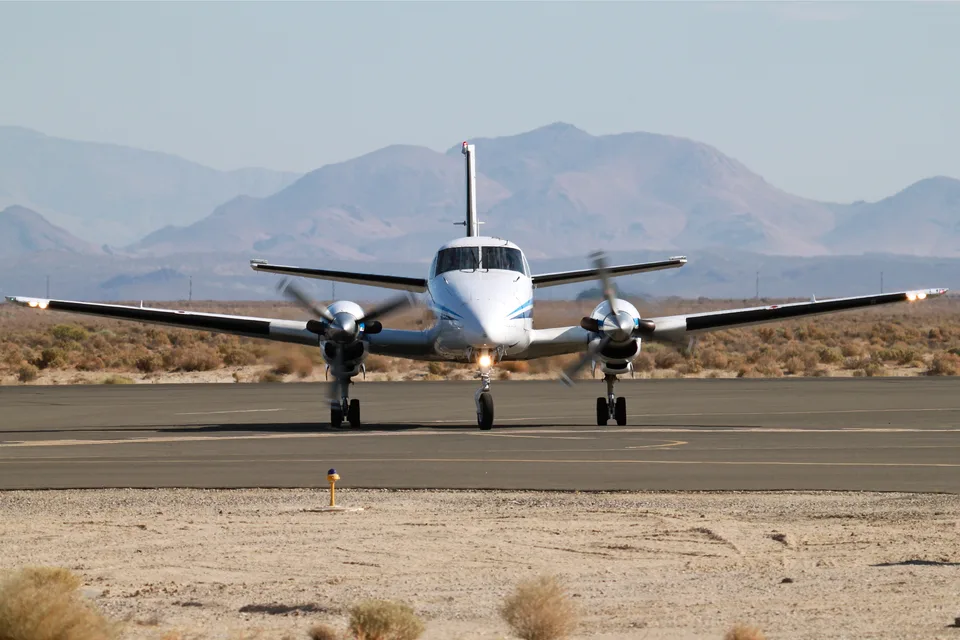
Original source photograph retained without cropping. Responsive WebP copies resized without cropping.
Geographic context
Norfolk Regional, accident departure
Omaha Eppley, intended destination
Schematic geography only. Airport markers are approximate; these points do not show a recorded flight track. Basemap: Natural Earth, public domain.Read supporting evidence
An Ameriflight Beech C99 departed Norfolk, Nebraska, for Omaha on 7 October 2024. After a partial loss of left-engine power, its speed decreased and it entered a low-altitude loss of control. The aircraft crashed near the departure end of runway 20 and burned; the sole pilot died. The NTSB linked the accident to failure to maintain airspeed after the partial power loss, with fatigue failure of a compressor turbine blade contributing.
Read the full incident Follow what happened, from the flight to the investigation findings.
What investigators concluded
The NTSB identified failure to maintain adequate airspeed after a partial engine power loss during takeoff as the probable cause. Fatigue failure of the compressor turbine disk blade contributed. The origin of the fatigue and its detectability at the previous inspection could not be established.
A partial engine failure during the first moments after takeoff
1,539 words / about 7 minutes to read. Based on the investigation records cited below.
The cargo flight's final departure
The Beech C99 registered N130GP was on the final cargo leg of the pilot's day when it left Norfolk, Nebraska, on 7 October 2024. The operator was UAS Transervices, doing business as Ameriflight. The return destination was Eppley Airfield in Omaha. There were no passengers and no second pilot aboard. The aircraft's freight role places the occurrence within airline cargo operations, despite the relatively small twin-turboprop aircraft.
The route had begun in Omaha, with a stop at O'Neill where the pilot received cargo and additional fuel, followed by Norfolk where more cargo was collected. The accident happened during departure from Norfolk's runway 20 around dusk. The recorded airport conditions were clear, with ten miles of visibility and a light wind. The report does not identify adverse weather as the initiating problem.
The loading documentation showed the cargo within weight and centre-of-gravity limits. Estimated takeoff weight was 9,034 pounds. That finding matters because it separates this accident from an overload explanation. Investigators instead concentrated on the initial climb, a partial left-engine power loss, the aircraft's declining speed and the limited altitude available when control was lost.
The aircraft was a 1984 Beech C99 with two Pratt & Whitney Canada PT6A-36 turboprop engines and a cargo pod. Its operator held an on-demand air-taxi certificate under Part 135. These details identify the commercial cargo operation and the machine involved. They do not establish that the aircraft's age caused the accident. The investigation's technical conclusion rests on the failed turbine blade and the flight response after power was reduced.
Airport surveillance video showed the aircraft climb from the runway, enter a left bank and start descending. It disappeared behind a building in a steep left bank with its nose down. Public tracking supplied eight ADS-B points across twenty-four seconds. That was a brief and incomplete record, but it gave investigators a sequence against which to compare the video and physical evidence.
The first point, at 19:37:52 local, showed ground speed of approximately 105 knots. As the aircraft climbed and moved left of the extended runway centreline, recorded ground speed decreased. Its highest recorded altitude occurred around 19:38:07, when the ground speed was about 84 knots. The NTSB estimated the peak height at roughly 160 feet above the ground. The final recorded point, nine seconds later, showed about 88 feet above the ground and 85 knots ground speed.
Those are ground speeds, not direct measurements of indicated or calibrated airspeed. The report relates the trend to the aircraft's aerodynamic performance, but the values should not be treated as interchangeable with the handbook's calibrated stall or control speeds. The supported conclusion is a substantial speed decay during the initial climb, coupled with bank, descent and loss of control at very low height.
The aircraft struck terrain approximately 640 yards beyond the runway's departure end. The wreckage distribution and ground marks indicated a nearly wings-level impact with relatively little forward motion. The NTSB considered that consistent with a stall or a near-recovery from a stall. That does not contradict the steep bank seen earlier: the video described a moment before impact, while the ground evidence described the aircraft's contact with the terrain.
A postimpact fire consumed much of the wreckage. The pilot died. All major aircraft components were present at the site, and examination did not identify a preimpact break in flight-control continuity. The flaps were retracted, and the landing gear was found extended. Investigators did not recover a device containing useful non-volatile memory that could provide a cockpit or detailed flight-data account.
Engine and propeller examination produced an important asymmetry. The left propeller's damage was consistent with rotation at low power. The right propeller's damage was consistent with high power, possibly close to takeoff power. Both engines showed evidence of operating at impact. The evidence therefore did not point to both engines simply stopping; it pointed to a reduced-power left engine while the right engine continued delivering substantial power.
Examination found broken compressor turbine blades and damage through the left engine's gas path. Most fracture surfaces showed signatures consistent with overstress or secondary damage. One blade had a different fracture region: a relatively flat surface and features consistent with fatigue. Laboratory examination found that the fracture had propagated through the blade and across grains without the plastic deformation associated with an overstress failure.
The report considers it likely that this blade failed first through fatigue, producing secondary damage to other blades and downstream components. That damage would disrupt engine power. Investigators described unusual vibration and possible exhaust sparks as plausible consequences, rather than claiming a recorded account of exactly what the pilot heard or saw.
Metallurgical and microhardness examinations did not identify a defect explaining the fatigue's origin. The root cause of the cracking remained undetermined. This is an important boundary in the account: identifying fatigue at a fracture surface does not automatically establish a manufacturing defect, an overdue maintenance task or a crack that an earlier inspection necessarily should have found. The report's laboratory conclusions support the failure mechanism, while leaving its origin unresolved.
The aircraft had an autofeather system intended to turn a failed engine's propeller blades toward a low-drag position when specified conditions were sensed. The left propeller was not found feathered. The NTSB considered it unlikely that the engine had ceased producing power entirely; instead it likely continued operating at low power after the turbine damage. A partial failure can therefore present a different state from a complete, straightforward shutdown.
The flight manual described positive single-engine climb capability under particular conditions, including a feathered inoperative-engine propeller and appropriate aircraft configuration. The report also reproduced the operator's immediate actions for an engine failure after takeoff, emphasising directional control, prompt action, power and propeller state. Those are cited as historical context for this investigation, not as instructions for operating another aircraft.
A claim that any twin-engine aircraft can climb safely after any power loss would go beyond that evidence. Performance depends on configuration and the condition of the remaining systems. Here, the recorded speed decline, unfeathered left propeller and low-altitude loss of control prevented the aircraft from achieving the stable single-engine climb contemplated by the handbook. The NTSB's causal finding focuses on maintaining adequate airspeed after the partial loss of power.
The pilot had completed the operator's training programme approximately a month before the accident and was approved for line operations on 3 September 2024. He had about 2,058 hours total flight time and roughly 97 hours in the aircraft type. The report reviewed his training because responses to an engine problem just after takeoff leave little time for diagnosis and recovery.
Several training-flight comments had recorded deficiencies during simulated engine failures after takeoff. One mock check described his response as slow while still satisfactory. These were actual training observations; they should not be rewritten as a claim that he had been prohibited from operating the aircraft. The report records that the programme was completed and line approval given.
The NTSB considered it likely that the pilot became distracted while managing and diagnosing the partial left-engine power loss and failed to preserve adequate airspeed. Without cockpit recordings, investigators could not narrate his precise sequence of checks, thoughts or attempted switch selections. The supported account therefore attributes the workload explanation to the NTSB and retains its likelihood wording rather than inventing dialogue or a detailed cockpit scene.
The turbine blades had accumulated approximately 3,382 hours of operation. Their recurring inspection interval was 2,000 hours, and the prescribed removal time was 5,000 hours. The most recent inspection had occurred around twenty months before the accident. The blades were therefore below the stated removal-time limit, and the report does not describe an overdue replacement as the causal finding.
Their history included installation in another company aircraft before the gas-generator assembly was moved to N130GP. The report traced that history and the later inspections to understand the failed blade. It could not determine whether fatigue cracking existed at the most recent inspection or would have been detectable then. That uncertainty limits any claim that a particular inspection failure caused the accident.
The final report also contains differing minimum-control-speed figures: 89 KCAS in its analysis and 94 KCAS in its factual discussion. This draft does not silently select one figure or use it to claim the exact second at which a control boundary was crossed. The larger supported trend remains clear: speed decreased after a partial power loss, and the aircraft lost control too close to the ground for recovery.
The NTSB determined that the pilot failed to maintain adequate airspeed following a partial engine power loss during takeoff, resulting in loss of control. Fatigue failure of the compressor turbine disk blade was a contributing factor. That statement connects a mechanical initiating event with the aircraft's subsequent handling; it does not replace either strand with a single generic explanation.
The accident also illustrates the evidential limits of a short, low-altitude sequence. Video, tracking, wreckage and laboratory analysis establish substantial parts of what happened. They do not supply every cockpit action, a definitive origin for the blade crack, or proof that an earlier inspection should have prevented it. The report was published on 18 September 2026, and this account does not claim a later corrective programme has been completed.
A simplified reading of the investigation findings. The sequence does not replace the full report or imply that every contributing factor is shown.
Sequence of events
Central daylight time, UTC minus 5 hours. The local event date is 7 October 2024; the discovery export used the next UTC calendar day. Ground-speed data are not calibrated or indicated airspeed measurements. Expand an event to see its evidence.
EarlierCargo route flown
The pilot flew from Omaha through O'Neill and Norfolk, collecting cargo and additional fuel at O'Neill.
The blades had about 3,382 hours against a 5,000-hour removal limit. The report could not determine whether the crack existed or could have been detected at the previous inspection.
ADS-B records supplied ground speed. The cited aerodynamic thresholds are calibrated airspeeds under specified conditions, so exact equality should not be asserted.
The report states 89 KCAS in its analysis and 94 KCAS in the factual performance discussion. This draft preserves the discrepancy without selecting a definitive figure.
Actions and recommendations are described at the dates of the cited records. A recommendation is not proof of implementation.
Emergency response context
The final report sets out the operator's engine-failure procedure, including directional control, prompt action and propeller feathering. This historical description is not operational guidance.
These comparisons connect specific research topics. Shared circumstances do not establish identical causes. Evidence from both investigations is provided below.
Both reports examine an engine blade fatigue mechanism and its downstream consequences. Ameriflight's compressor turbine failure caused partial power loss during takeoff; Southwest 1380 involved a different fan-blade failure, nacelle damage and cabin consequences. The components and accident sequences differ.
Explore the records below for additional context. They open on the publisher's site and are not all included in our report search. Source reuse terms apply.
Supporting investigation records. Availability and third-party reuse rights differ between documents.
Sources and transparency
Prepared 7 October 2026 from the cited final investigation. Unpublished; editorial approval and independent expert review have not been completed.
Source limitations
Only eight ADS-B points over 24 seconds supported the recorded flight track, and no cockpit memory device was recovered. Ground speed differs from calibrated airspeed. The report gives conflicting minimum-control-speed values of 89 and 94 KCAS, so this draft does not choose one as definitive. A fresh original-byte NTSB download was blocked by HTTP 403. The official final PDF remained readable through the web fallback and matched the cited account; this bundle retains the previously verified original bytes.
CEN25FA006: UAS Transervices Inc.: N130GP
NTSB Official final report; cached original bytes and complete extraction checked 7 October 2026
Source used for original commentary and short verification snippets; illustrations not reused unless separately licensed. Consult the official NTSB source for its terms. Third-party illustrations are excluded.
Left Engine Failure and Subsequent Depressurization: Southwest Airlines Flight 1380, Boeing 737-7H4, N772SW, Philadelphia, Pennsylvania, April 17, 2018
National Transportation Safety Board NTSB/AAR-19/03, adopted 19 November 2019
US federal investigation report, attributed to the NTSB. Limited excerpts for commentary; third-party material and illustrations excluded. No NTSB endorsement. Source terms / provenance.
Kevin Murphy writes the incident accounts on AirlineIncidents.com, out of a long interest in aviation safety and the lessons each investigation leaves behind.
Prepared by
AirlineIncidents editorial desk
Report citation check
Independent expert review
Not completed
Citation checks compare supporting text with the indexed report pages. They do not constitute independent expert review. How these pages are prepared.
Revision history
: First unpublished report-based draft, with narrative, verified citation locations, credited aircraft photograph and source limitations.
.jpg)