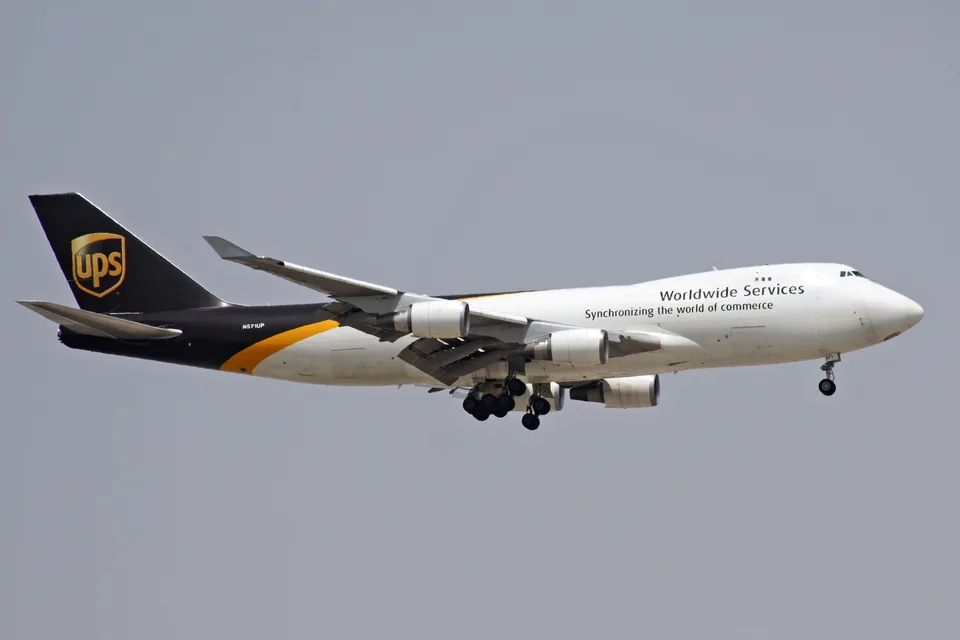
A main deck cargo fire overwhelmed a UPS Boeing 747 returning to Dubai. Smoke, damaged flight controls and loss of the captain's oxygen supply left the first officer alone in a cockpit he could barely see.
Original photograph unchanged. Responsive WebP copies resized without cropping.
Geographic context
Dubai International Airport
Nad Al Sheba accident site, approximate
The aircraft returned toward Dubai, overflew the airport and crashed at Nad Al Sheba. The accident-site marker is approximate. Basemap: Natural Earth, public domain.Read supporting evidence
UPS 6 departed Dubai for Cologne with two pilots. A forward main deck fire warning prompted an emergency return. Heat damaged the manual control system and the captain's oxygen supply, while continuous smoke obscured the instruments and radio controls. The aircraft overflew Dubai and crashed at Nad Al Sheba, killing both pilots.
Read the full incident Follow what happened, from the flight to the investigation findings.
What investigators concluded
The GCAA identified a rapidly escalating fire in palletized cargo at or near positions 4 or 5. Failure of the cargo liner exposed critical systems and the cockpit to heat and smoke. The resulting control, oxygen and visibility failures prevented a safe landing.
1,523 words / about 7 minutes to read. Based on the investigation records cited below.
Cargo retained for the next sector
N571UP arrived in Dubai from Hong Kong on 3 September 2010. Its forward main deck cargo included mixed consignments with substantial quantities of batteries, including lithium types. Cargo pallets in the forward section stayed aboard while other load positions were unloaded or replaced for the next flight. Investigators later identified at least three lithium battery shipments in positions 4 and 5 that should have been declared as hazardous materials. The accident flight carried no declared hazardous-material shipments.
The Boeing 747-44AF was scheduled to continue from Dubai to Cologne Bonn in Germany. Only the captain and first officer were aboard. The GCAA found the crew appropriately licensed and rested, and the aircraft airworthy at dispatch. The first officer flew the departure from runway 30R at 14:50:53 UTC. An air conditioning Pack 1 fault appeared during the climb; the captain reset it successfully. The aircraft continued toward its selected altitude of 32,000 feet and entered Bahrain airspace.
At about 15:13, the forward main deck fire warning sounded. The captain took over flying and told the first officer they would return to Dubai. He advised Bahrain East Control that the aircraft had a main deck fire indication and needed to land as soon as possible. The controller offered Doha, about 100 nautical miles away. The captain elected to turn back to Dubai and declared an emergency.
The first officer began the main deck fire checklist. Activation of the main deck fire switch started depressurization, the aircraft's method of reducing oxygen available to a cargo fire. The pilots donned their oxygen masks and initially had difficulty hearing each other through the mask microphones. As they turned and descended, the captain requested clearance down to 10,000 feet. The checklist called for a fire suppression altitude of 25,000 feet, alongside an instruction to plan a landing at the nearest available airport. The crew did not complete the checklist as failures and smoke accumulated.
Heat damages the controls and smoke fills the cockpit
The manual control problem became apparent during the turn back. The captain moved the control column, but the elevators responded only weakly. The fire had attacked the supporting structure and cables that transmitted the pilots' inputs. Loss of cable tension progressively disrupted the relationship between control-column movement and elevator movement. Other affected functions included rudder, speed brake, brake and landing gear control.
The autopilot retained effective elevator and rudder control. Its electrical commands and hydraulic actuators operated through a different control path, and the pitch actuators were in the tail beyond the fire-damaged area. The aircraft could therefore maintain stable flight with the autopilot engaged while manual handling was severely impaired.
Within minutes, dense smoke obscured the flight displays, radio panels and cockpit windows. Opening the smoke evacuation shutter failed to clear it. The investigation found that the open shutter could draw a continuous smoke source through the cockpit. With the instruments difficult to see, the first officer struggled to enter Dubai runway 12L approach information into the flight management computer. The recorded data nevertheless showed that the correct instrument landing system frequency had been entered.
Around 15:20, after commenting on the heat, the captain reported that his oxygen supply had stopped. He repeatedly asked the first officer for oxygen. The first officer was unable to provide the assistance he needed. The captain handed over control, moved his seat back and left it to seek an alternative supply. He did not return to his position. Pathological evidence showed incapacitation by toxic gases, and the post-mortem examination attributed his death to carbon monoxide inhalation.
The GCAA found that heat from the cargo fire had exposed the oxygen system to extreme temperatures and caused a supply disruption. A possible failure point was the flexible oxygen hose near its connector, where heat could be transmitted through the metal supply lines. The first officer remained at the controls for the rest of the flight. Analysis of breathing sounds indicated that his mask was in Normal mode, which mixed ambient air with oxygen; this likely allowed smoke-contaminated air into the mask. The crew faced continuing breathing and visibility problems while the aircraft returned toward Dubai.
Investigators tested the oxygen delivery system using representative components, heated air and a simulated breathing device. In two elevated-temperature tests the flexible hose connected to the mask stowage box failed. Tests with a failed hose indicated that the first officer's mask could continue operating for a limited period as oxygen escaped elsewhere in the system. Subsequent examination of the test mask found no functional, material or operating defect. The tests supported the investigation of heat damage to the oxygen supply path as an explanation for the captain's abrupt loss of oxygen.
The return took the aircraft away from effective direct radio coverage with Bahrain East Control. The first officer could not see the audio control panel well enough to change frequency, so he stayed on the Bahrain channel. Controllers enlisted aircraft in the area to relay messages. Information passed between the first officer, relay aircraft and Bahrain controllers, then onward by telephone to controllers in the United Arab Emirates and Dubai.
The first officer repeatedly requested headings, altitude, speed and position information because smoke prevented him from obtaining those cues normally. Changes between relay aircraft added to the difficulty. Dubai controllers knew the aircraft was in an emergency but lacked a complete understanding of the cockpit conditions and the precise assistance required. The GCAA identified incomplete and delayed relayed communication as a contributor to the pilot's extreme workload. Calls on the emergency frequency also failed to establish a sustained direct exchange with the relevant controllers.
Approaching Dubai runway 12L, the aircraft was too high and fast for a landing. During the inbound approach the report records 350 knots at 9,000 feet. The approach mode acquired the glide slope, but the autopilot did not transition into localizer mode. The first officer declined a request to make a full turn. He selected the landing gear down at 15:38, but it failed to extend. The GCAA considered loss of control-cable tension the likely reason.
After the aircraft passed north of Dubai airport, Sharjah was offered about 10 nautical miles away. The first officer accepted the option and was given a heading of 095 degrees. A heading of 195 degrees was entered on the mode control panel for an undetermined reason. The aircraft turned right, and the autopilot was disconnected during the final sequence. With manual pitch control severely degraded, the first officer's repeated control-column inputs had diminishing effect as the aircraft descended.
Terrain and sink-rate warnings sounded. Near the end, the control column was fully aft with negligible elevator response. The aircraft struck inside Nad Al Sheba military base at about 15:41 UTC, hitting a service road and buildings. Ground impact and a subsequent fire destroyed the aircraft. Both pilots were killed, and the report records no fatalities among other people.
The investigation combined recorder data, aircraft health monitoring messages, cargo documents, wreckage examination and fire testing. Although heat and impact had damaged the flight recorder, its memory was read successfully. The cockpit voice recorder also yielded usable audio. Fire indications and system failures located the fire in the forward main deck cargo. The GCAA placed the large fire at or near pallet positions 4 or 5, in Fire Zone 3, among lithium batteries and other combustible materials.
Cargo container and pallet tests showed how smoke could remain concealed until a fire had grown substantially. Once smoke escaped in detectable quantities, the rise to a destructive fire could be extremely rapid. The cargo liner then failed under combined heat and mechanical loads. As the liner and its supports deteriorated, the fire reached the area above the cargo compartment, exposing control systems, oxygen equipment and occupied spaces.
The main deck Class E compartment had no requirement for active fire suppression. Its protection depended on fire-resistant barriers, airflow control and reduced oxygen following depressurization. The GCAA found these measures inadequate for the large cargo fire and the battery-related hazards involved. Descending could supply more oxygen to a continuing fire. The report also found that task saturation from smoke and multiple failures prevented effective use of the checklist.
The investigation examined the loss of ventilation as well as the fire barrier. After Packs 2 and 3 shut down for the fire procedure, Pack 1 was the remaining supply of conditioned air to the flight deck. Losing that supply removed the positive pressure intended to resist smoke entry and changed equipment cooling to a recirculating configuration. Boeing subsequently revised the procedure to remove the instruction to select Pack 3 off, allowing automatic restoration of that pack if Pack 1 was detected off.
The GCAA recommended stronger cargo fire protection, including active suppression for Class E compartments and early detection combining heat sensing with smoke sampling. Other recommendations sought more resilient containers, better battery packaging against fire propagation and liner testing under combined thermal and mechanical loads. Recommendations for the cockpit included improved vision through continuous smoke, full-face oxygen protection and realistic smoke training. The GCAA also called for training for pilot incapacitation, emergency radio equipment that could tune across aviation frequencies, and mutual radar data sharing between Bahrain and the United Arab Emirates.
The first officer cannot reliably see instruments, radio controls or outside references. Relayed communications and cascading failures add to his workload.
A simplified reading of the investigation findings. The sequence does not replace the full report or imply that every contributing factor is shown.
Sequence of events
Times are UTC. Gulf Standard Time is UTC plus four hours. Recorder time correlation has an uncertainty of approximately three seconds. Expand an event to see its evidence.
14:50:53Departure from Dubai
N571UP takes off on a scheduled cargo service to Cologne.
A heading of 195 degrees is selected after 095 degrees has been relayed. The aircraft turns right and descends with severely degraded manual pitch control.
What did investigators find about the source of the cargo fire?
The GCAA located the fire in cargo containing lithium batteries. It considered battery thermal runaway a possible initiating event; the reason for that possible battery failure could not be established.
Why could the autopilot still control the aircraft after manual control deteriorated?
The autopilot used electrical commands and hydraulic actuators, with the pitch actuators in the tail beyond the damaged control-cable area. The fire had not compromised their electrical cabling.
Why did Pack 1 stop supplying air to the flight deck?
The aircraft health monitoring and flight recorder data were inconclusive about why Pack 1 stopped operating. Its shutdown removed the last source of flight deck ventilation and changed equipment cooling to recirculated air.
The GCAA could not resolve why the captain chose Dubai over the closer Doha option. At the time of the turn-back decision, the crew had not yet experienced the full effects of the fire.
The reason for entering 195 degrees after receiving 095 degrees was undetermined. The GCAA considered spatial disorientation possible in the smoke-obscured cockpit.
Actions and recommendations are described at the dates of the cited records. A recommendation is not proof of implementation.
Boeing revised the pack procedure
The report records that Boeing removed the instruction to select Pack 3 off during the main deck fire procedure, enabling automatic Pack 3 restoration after loss of Pack 1.
Recommendations SR 25/2013 and SR 27/2013 called for active suppression and earlier fire detection. SR 52/2013 sought package protection that would retard battery fire propagation.
SR 59/2013 called for emergency transceivers that could tune throughout the aviation bands. SR 60/2013 requested mutual radar data sharing between Bahrain and the UAE.
These comparisons connect specific research topics. Shared circumstances do not establish identical causes. Evidence from both investigations is provided below.
UPS 6 and Swissair 111 both suffered fires that degraded aircraft systems and the cockpit environment before loss of control. The GCAA located the UPS fire in palletized cargo containing lithium batteries. The TSB found that the Swissair fire most likely began with wire arcing above the cockpit ceiling and spread through flammable materials.
Explore the records below for additional context. They open on the publisher's site and are not all included in our report search. Source reuse terms apply.
Kevin Murphy writes the incident accounts on AirlineIncidents.com, out of a long interest in aviation safety and the lessons each investigation leaves behind.
Prepared by
AirlineIncidents editorial desk
Report citation check
Independent expert review
Not completed
Citation checks compare supporting text with the indexed report pages. They do not constitute independent expert review. How these pages are prepared.
Revision history
: GCAA Final Report 13/2010 identifies cargo fire, critical system damage, continuous cockpit smoke and loss of control.