Combustible insulation and material standards, Likely electrical arcing, No built-in detection or suppression, No integrated firefighting plan, Common-source recorder interruption
Uncropped source image; responsive WebP derivatives retain the source licence. Responsive WebP copies resized without cropping.
Geographic context
New York JFK
Halifax, diversion airport
Geneva, intended destination
Approximate airport context for the planned flight and diversion. Markers are not the accident flight track. Basemap: Natural Earth, public domain.Read supporting evidence
Swissair's MD-11 diverted toward Halifax after its crew detected odour and smoke. An unseen fire above the ceiling spread through combustible materials, degraded cockpit conditions and aircraft systems, and led to loss of control.
Read the full incident Follow what happened, from the flight to the investigation findings.
What investigators concluded
The TSB found inadequate material-flammability standards, combustible insulation and other materials, likely wire arcing, absent detection and suppression, and an inadequate integrated firefighting plan among the causes and contributing factors. A specific initiating arc was not conclusively established.
A hidden fire with less time than the crew could see
1,588 words / about 8 minutes to read. Based on the investigation records cited below.
Departure and the first indication
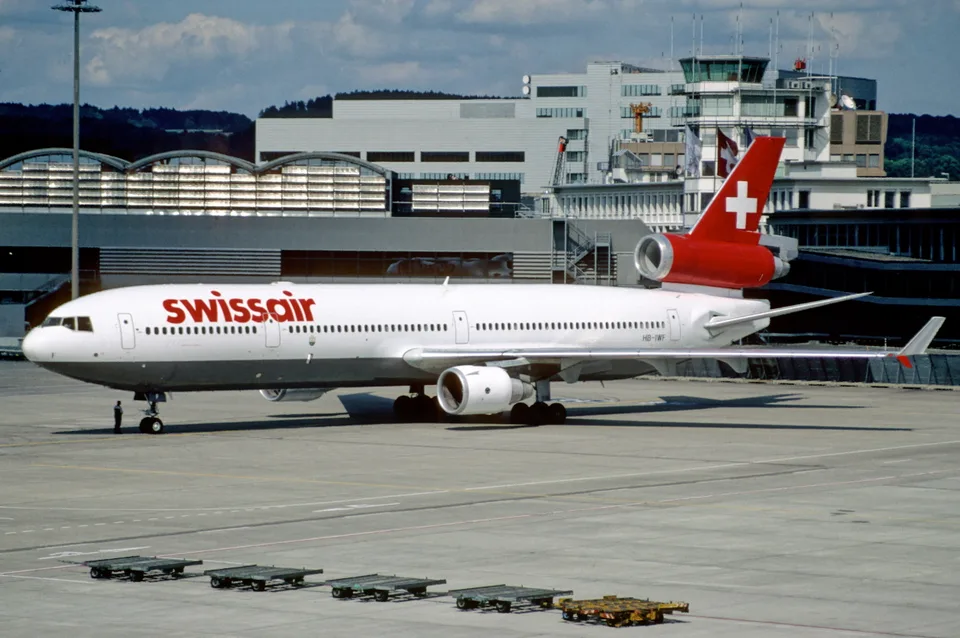
Swissair flight 111 departed New York JFK for Geneva on the evening of 2 September 1998 with 215 passengers and fourteen crew members. The aircraft was a McDonnell Douglas MD-11 registered HB-IWF. Two pilots and twelve flight attendants made up the crew, and the first officer was flying. The TSB uses the local occurrence date in its report heading; its detailed chronology uses UTC, under which the flight occurred on 3 September. This account follows that distinction rather than moving the accident to a different calendar date without explaining the clock basis.
At 01:10:38 UTC the pilots detected an unusual odour in the cockpit and began investigating. They subsequently assessed that some smoke was present there, while none had been reported in the passenger cabin. Their initial explanation was an air-conditioning anomaly. The synopsis describes attention being drawn to an unspecified area behind and above the pilots, with the initial indication then no longer apparent. Those limited cues did not reveal the fire spreading above the ceiling. The account therefore separates the crew's contemporary assessment from the mechanism established later by investigators.
At 01:14:15 the crew transmitted an urgency call and asked for a diversion to a convenient airport, initially naming Boston. The aircraft was about 66 nautical miles southwest of Halifax airport. The controller cleared it toward Boston before offering Halifax, which was much closer. The pilots accepted Halifax and were cleared directly toward it. They put on their oxygen masks during this part of the diversion. The TSB ultimately found that the decision to divert was timely, despite the crew not yet recognising an emergency requiring the fastest possible landing response.
Controllers provided a descent and then instructions for an approach to runway 06. At 01:19:28 they advised that the aircraft was thirty nautical miles from the threshold. The pilots, still descending through approximately flight level 210, said that they needed more distance. A turn was issued to allow further altitude loss. The relevant problem was not merely horizontal proximity to an airport. The aircraft also had to descend, slow and configure for landing. The investigation's later calculations explicitly considered these requirements when assessing whether an earlier arrival could have changed the outcome.
The pilots discussed dumping fuel because of the aircraft's gross weight and their assessment of its condition. They told the controller that fuel dumping was needed before landing. A transmitted figure of 230 tonnes referred to aircraft weight, although it was communicated as if it were fuel quantity. The controller asked whether they wished to stay closer to the airport or could turn south for dumping; they accepted the southern turn. The report preserves these exchanges as part of the sequence but found that pilot-controller interactions did not affect the accident's outcome.
Cabin preparations were underway as the aircraft descended. The pilots requested an intermediate altitude while the cabin was made ready. A radio transmission intended as internal communication referred to the air-conditioning smoke checklist, consistent with their initial diagnosis. The TSB later found that preparing the cabin and planning fuel dumping were consistent with being unaware of a propagating onboard fire. Those findings do not justify treating the crew as if they had seen the concealed fire's full extent, or as if they knowingly chose an ordinary approach in the face of information that was not available to them.
At 01:24:09 the autopilot disengaged and recorded systems failures began. The pilots advised that they had to fly manually and requested an altitude block. At 01:24:42 both declared an emergency. Eleven seconds later they indicated that fuel dumping was starting and that they needed to land immediately. Another emergency call followed. This progression shows how the perceived situation changed from a diversion prompted by smoke to a recognised emergency as fire-related failures developed. It does not establish that the earlier cues had accurately disclosed the urgency or location of the hidden fire.
The last communication received by air traffic services was at approximately 01:25:02. The controller repeated subsequent fuel-dumping clearances without a reply. Both flight recorders stopped at about 01:25:41 because of fire-related electrical power interruptions. The TSB identified the power arrangements as a safety concern: although the recorders used separate electrical buses, those buses were supplied by the same generator. The permitted arrangement left a gap in the final sequence. Loss of a recording is an evidence limit, not proof that a particular unrecorded cockpit action occurred.
At 01:31:18 the aircraft struck the ocean near Peggy's Cove. The timing coincided with a seismic event recorded in Halifax and Moncton. The impact destroyed the aircraft and all 229 occupants died. The wreckage lay in water about 55 metres deep. There were witness observations of an aircraft at low altitude shortly before the impact, but these did not replace the missing recorder information. The investigation reconstructed the final period from physical evidence and surviving system data, while leaving unresolved questions about crew positions, indications and actions where the available evidence could not support certainty.
The TSB located the most likely origin in a relatively small area above the right rear cockpit ceiling near the cockpit rear wall. Its analysis drew on fire and heat-damage patterns, airflow, the timing of recorded failures, the initial indications and the presence of wiring and easily ignited insulation. Within that area it considered an electrical wire arc the only plausible ignition source. This is a stronger conclusion about the mechanism and origin region than about the identity of a single first-failing wire. The report's uncertainty on that narrower question remains part of the finding.
A recovered segment of an in-flight entertainment network power-supply cable showed resolidified copper from arcing near the likely origin area. The TSB judged that arc likely associated with initiation, but could not determine whether it was the lead event. An entertainment-system label therefore does not establish the entire chain with certainty. The report also found no link between the manner in which that system was integrated with aircraft power and the fire's initiation or propagation. It identified certification and integration deficiencies as risks without converting every deficiency into an accident cause.
Metallized polyethylene terephthalate covering on thermal-acoustic insulation was flammable and was most likely the first material ignited. It also formed the largest portion of the combustible material that fed propagation and intensity. Other blanket coverings, foams, adhesives, fasteners, tape and duct end caps contributed. The TSB found that material-flammability certification standards allowed materials capable of sustaining or spreading fire. The accident was thus not explained solely by an electrical fault: once ignition occurred, the surrounding materials and airflow enabled a hidden fire to grow into a threat to both systems and cockpit habitability.
The origin and propagation space had no built-in smoke or fire detection and suppression, and regulations did not require them. The crew relied on sight and smell to distinguish the anomaly's source. That reliance contributed to the air-conditioning diagnosis. The TSB also found no integrated firefighting plan directing the crew to locate and eliminate the smoke source aggressively while expediting emergency landing preparations. The findings connect aircraft design, regulatory requirements, procedures and training. They do not reduce the event to a claim that one checklist selection or one individual action alone caused the loss.
Fire eventually degraded the aircraft's systems and cockpit environment. The loss of primary displays, darkness outside and difficult standby-instrument use limited the pilots' ability to maintain orientation. Wreckage examination supported a steeply banked, nose-down impact, but the TSB warned that the surviving standby indicator's displayed values might not represent actual attitude. It concluded that the aircraft was not in controlled flight at impact. Whether the pilots were still making effective inputs at particular final moments could not be established. This account preserves that distinction between the terminal loss of control and uncertain details of individual actions.
The investigation also calculated an ideal emergency descent. Even under favourable assumptions, the earliest landing would have followed the onset of severe fire-related failures. Real cockpit conditions and system degradation made those ideal assumptions unattainable. The TSB found that from any point after the initial odour, approach and landing would have required more time than was available before safe landing became impossible. This finding prevents a misleading claim that omitting fuel dumping would certainly have saved the aircraft. It is an assessment of the actual sequence and fire progression, not a reason to disregard urgent landing preparation in other smoke events.
The final report separates causes and contributing factors from findings as to risk and other findings. Causes included combustible materials, inadequate flammability standards, likely arcing, absent protection in the concealed space and the lack of an integrated firefighting plan. Risk findings extended to wiring practices, checklist duration, recorder protection and certification processes. These categories matter because a deficiency discovered during an investigation need not have contributed to this occurrence. The account follows the TSB's adopted distinctions and does not assign civil or criminal liability beyond the safety investigation's purpose.
The report records wiring inspections and FAA corrective directives, together with broader work on ageing wiring and maintenance training. It called for stronger insulation testing and mitigation of the risk from installed materials that failed the radiant panel test. Recorder power and duration were also addressed because valuable evidence disappeared before impact. These are the actions, recommendations and concerns documented in the 2003 report, rather than assertions of present compliance. Their common purpose was to prevent a concealed fire from growing unchecked and to improve crews' ability to recognise and respond to it while preserving better evidence if an accident occurred.
A simplified reading of the investigation findings. The sequence does not replace the full report or imply that every contributing factor is shown.
Sequence of events
Occurrence date is local 2 September 1998. Detailed flight times are UTC on 3 September; Atlantic daylight time is UTC minus three hours. Expand an event to see its evidence.
TSB found that from any point after the initial odour, the time needed to approach and land exceeded the available time before fire damage precluded a safe landing. It did not conclude that fuel dumping alone determined the outcome.
Findings as to risk include deficiencies that were not shown to contribute directly. The IFEN power-integration arrangement was not linked to initiation or propagation.
Matching dossiers for Common-source recorder interruption: No other dossier in this collection.
Read alongside
These comparisons connect specific research topics. Shared circumstances do not establish identical causes. Evidence from both investigations is provided below.
Swissair 111 and AF447 both required reconstruction of a fatal sequence from recorder and technical evidence and examined crew training and system information. Swissair involved a rapidly spreading fire; AF447 involved unreliable airspeed and a stall. Their initiating mechanisms and available interventions differ.
Explore the records below for additional context. They open on the publisher's site and are not all included in our report search. Source reuse terms apply.
Final report, release authorised 27 March 2003; complete 351-sheet official English PDF
Sources and transparency
Checked against cached official report evidence. No independent expert review.
Source limitations
The fire recorders stopped about five and a half minutes before impact. The TSB could not identify the initiating wire with certainty or reconstruct every action in the final minutes.
TSB A98H0003: In-flight fire leading to collision with water
Transportation Safety Board of Canada Final report, release authorised 27 March 2003; complete 351-sheet official English PDF
Limited quotations for source-based commentary. Full report and illustrations are not republished. Wider reuse requires checking BEA terms. Source terms / provenance.
Kevin Murphy writes the incident accounts on AirlineIncidents.com, out of a long interest in aviation safety and the lessons each investigation leaves behind.
Prepared by
AirlineIncidents editorial desk
Report citation check
Independent expert review
Not completed
Citation checks compare supporting text with the indexed report pages. They do not constitute independent expert review. How these pages are prepared.
Revision history
: Private landmark original account with official source citations.
.jpg)