Uncropped source image; responsive WebP derivatives retain the source licence. Responsive WebP copies resized without cropping.
Geographic context
Amsterdam Schiphol, KLM departure
Los Rodeos, diversion and collision
Las Palmas, intended destination
Approximate airport markers show the KLM intended destination and diversion. They are not a flight track. Pan Am approached via New York; both intended to reach Las Palmas. Basemap: Natural Earth, public domain.Read supporting evidence
Two diverted Boeing 747 passenger flights shared the runway at Los Rodeos. The Spanish investigation found that the KLM captain began takeoff without permission while Pan Am was still on the runway.
Read the full incident Follow what happened, from the flight to the investigation findings.
What investigators concluded
The Spanish report identified the KLM captain's unauthorised takeoff and continuation despite warnings as the fundamental cause. It also addressed ambiguous radio language, overlapping transmissions, variable visibility and unusual congestion.
1,564 words / about 8 minutes to read. Based on the investigation records cited below.
Diversions brought the aircraft together
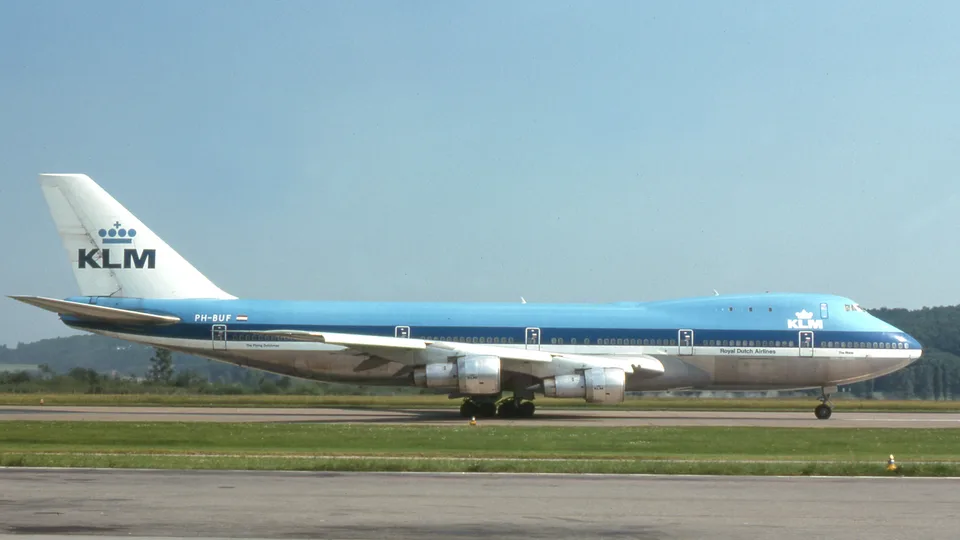
KLM flight 4805 and Pan Am flight 1736 were passenger services bound for Las Palmas on 27 March 1977. KLM's Boeing 747-206 B, PH-BUF, had departed Amsterdam. Pan Am's Boeing 747-121, N736PA, had travelled from Los Angeles through New York JFK before crossing the Atlantic. A bomb exploded in the Las Palmas passenger terminal, and a warning of a possible second bomb kept that airport closed. Both flights diverted to Los Rodeos on Tenerife. The Spanish report describes the disruption as the setting for the later accident, without treating the explosion as its direct cause.
KLM arrived at 13:38 GMT and Pan Am at 14:15. Diverted traffic filled the available parking space and occupied parts of the taxiway system. The two large aircraft were parked with other diverted airliners. KLM passengers were taken to the terminal after an initial wait; Pan Am's passengers remained aboard. One KLM tour guide stayed in Tenerife when the flight reboarded. The accident's occupant figures concern those actually aboard at the collision, rather than everybody who had originally travelled on the service.
After Las Palmas reopened, Pan Am was ready to continue, but KLM blocked the available taxiway passage. Pan Am crew members checked the clearance on the ground and found insufficient room to pass. KLM refuelled during the delay. The investigation records a load of 55,500 litres and discusses the likely benefit of avoiding another refuelling delay at Las Palmas. That explanation belongs to the investigators' analysis; the fuel stop is not recast here as a direct accident cause. The practical effect was that Pan Am had to await KLM's movement.
Los Rodeos had a main runway designated 12/30. Congestion prevented normal use of the parallel taxiway, so the aircraft were instructed to taxi along the runway itself. KLM was ultimately told to proceed to the far end and turn through 180 degrees for departure from runway 30. The recorded exchanges show earlier uncertainty about whether it should leave at an intersection. Those exchanges matter because a clearance to taxi, and even instructions positioning an aircraft for departure, did not constitute permission to start the takeoff.
Pan Am followed on the runway and was instructed to leave by the third exit on its left. Its crew sought confirmation of the instruction, and the controller repeated the exit count. The aircraft did not leave at that intersection. The Spanish conclusions criticise the absence of further clarification if the crew remained uncertain about which exit was intended. They also preserve a decisive distinction: Pan Am never reported the runway clear and twice advised that it was still taxiing on it. A missed exit did not provide the missing takeoff authorisation.
Cloud at ground level made visibility change rapidly. The report explains that these moving cloud layers could produce abrupt losses and recoveries of sight, rather than a uniform fog condition. The tower eventually could not see the aircraft on the runway. Runway centreline lights were out of service, a condition communicated to both crews. The environment therefore weakened visual confirmation precisely while two aircraft were sharing a runway. These circumstances help explain the setting, but the investigation did not equate bad visibility with permission to assume that the runway was empty.
At the runway end KLM completed its turn and its departure checklist. The analysis describes an initial movement of the thrust controls before the first officer reminded the captain that ATC clearance had not yet been received. At 17:05:44.6 the crew called the tower, reported ready for takeoff and requested that clearance. The controller then issued instructions for the route after departure, including a navigation beacon, a climb level and a turn. The distinction between those route instructions and authority to use the runway is central to the Spanish findings.
KLM began to move while the first officer was still reading back the instructions. Recorder analysis places brake release at 17:06:11.08. The readback ended with wording indicating that the aircraft was at takeoff. The controller did not understand that as an announcement that the aircraft had actually begun departing. The report notes that investigators listening to the recording initially also failed to hear an unequivocal declaration of a takeoff roll. The account therefore follows the source's explanation of ambiguous phraseology, rather than inventing a clear takeoff clearance that the recording did not contain.
The controller acknowledged the readback and then told KLM to wait for takeoff and that it would be called. Pan Am transmitted at nearly the same time to say that it was still taxiing on the runway. The overlapping transmissions produced a squeal in KLM's cockpit lasting almost three seconds. The Spanish report found the communication less clear than desirable, while also describing it as intelligible. The aircraft's acceleration had already begun. Radio interference and imperfect wording form part of the investigation's contributing factors, not a replacement for its finding that takeoff lacked authorisation.
The next exchanges gave further information about the occupied runway. The controller asked Pan Am to report when it was clear, and Pan Am agreed to do so. These transmissions were audible in KLM's cockpit. The flight engineer then questioned whether Pan Am had actually left the runway. After asking what he meant, the captain answered firmly that it had. The Spanish report records no further objection from the other crew members. That sequence establishes a missed opportunity to challenge the assumption of a clear runway without requiring imagined dialogue or a claim about unrecorded intentions.
The investigation discusses the captain's standing and experience as possible influences on the absence of further challenge. It also considers accumulated concerns about duty limits, passenger inconvenience and rapidly worsening weather. These are the Spanish investigators' explanations for how an experienced captain could make a basic error. They are not a direct measurement of his thoughts, and the wording here retains their qualified status. The report's fundamental finding rests on the actual departure and the ignored or unresolved information, rather than on an asserted emotional state.
Pan Am's cockpit recording indicated that its crew saw KLM about 9.5 seconds before impact. KLM rotated, but the aircraft did not clear Pan Am. The wreckage account states that KLM was airborne at the collision and describes a tail scrape associated with excessive rotation. Parts of its landing gear and structure struck Pan Am, damaging the fuselage and tail. KLM then struck the runway beyond it and slid farther before burning. The official history gives the accident time as approximately 17:06:50 GMT; this account does not manufacture greater timing precision from the rounded history entry.
Fire followed the collision in both aircraft. The tower heard explosions but could not immediately identify their location through the cloud. A parked aircraft reported a fire, and the alarm was raised. Fire crews initially received only a vague direction and moved through a crowded apron with very poor visibility. They reached one burning aircraft and subsequently recognised that a more distant glow came from a second aircraft. The Spanish account makes clear that the weather impaired both accident detection and the emergency response; it does not support a claim that responders had a clear view of the collision.
There were no survivors aboard KLM. The report considered the immediate intense fire an obstacle to evacuation. Pan Am suffered extensive destruction of its upper fuselage, but some occupants escaped through openings on the left side and by a functioning exit. Other survivors crossed the left wing and jumped to the ground. The report describes crew and extra crew helping the evacuation, followed by airport personnel and others. It estimates that evacuation took about a minute. Those descriptions concern the documented escape routes and response, without imagined individual experiences inside either aircraft.
The injuries table lists 14 crew and 234 passengers aboard KLM, all fatally injured. For Pan Am it lists 16 crew, 378 passengers and two company employees in extra seats. It initially lists 326 fatalities and notes that nine injured passengers subsequently died. Adding those later deaths gives 335 Pan Am deaths; together with KLM's 248, the total is 583. The same accounting gives 61 Pan Am survivors from 396 occupants. These totals are calculations from the official table and its footnotes, including the two extra occupants, rather than figures imported from another account.
The Spanish investigation identified the KLM captain's conduct as the fundamental cause: taking off without permission, not obeying the instruction to wait, not stopping when Pan Am said it remained on the runway and firmly answering the engineer's question as if Pan Am had left. Its conclusions also identify inadequate language, simultaneous radio transmissions, rapidly changing visibility and unusual traffic congestion. The report addresses Pan Am's failure to use the instructed exit, while stressing that it never announced a clear runway. These findings are attributed to Spain's official report and are not presented as a separately agreed statement by every participating authority.
The recommendations called for exact compliance with instructions and authorisations, concise standard aviation language and sufficient separation between route and takeoff clearances. The report specifically sought to keep the word takeoff out of the route clearance. These were measures aimed at reducing ambiguity around a high-consequence transition from taxiing to departure. They complement the account's distinction between information about a route and permission to begin the manoeuvre. This bundle records those recommendations as report-era proposals, with no unsupported assertion about when every authority or operator implemented them.
No. The Spanish investigation identified takeoff without authorisation as the fundamental cause. The route clearance was not permission to begin takeoff.
The injuries table records nine Pan Am passengers who died later from their injuries. Including them gives 335 Pan Am deaths and 583 across both aircraft.
The official Spanish copy removes some names and does not include every annex. Its HTML formatting also contains transcription irregularities. No inference rests on a corrupted coordinate or aircraft identifier.
The report offers possible explanations for the captain's error. Those are attributed investigative assessments, not independently established private thoughts.
Matching dossiers for Variable visibility and congestion: No other dossier in this collection.
Read alongside
These comparisons connect specific research topics. Shared circumstances do not establish identical causes. Evidence from both investigations is provided below.
Tenerife and AF447 both examine how crews interpreted operational information and how safeguards failed. Tenerife was a runway collision during an unauthorised takeoff; AF447 was an in-flight loss of control after unreliable airspeed. The mechanisms differ.
Explore the records below for additional context. They open on the publisher's site and are not all included in our report search. Source reuse terms apply.
Official Spanish report, numbered HTML section; no printed pages
Sources and transparency
Checked against cached official report evidence. No independent expert review.
Source limitations
English original account based on the official Spanish HTML report. No official English edition or separately published Netherlands comments were obtained. Names removed in the official copy remain omitted. Scanned annexes are not text sources.
CIAIAC Tenerife report: 1.1
Spanish accident investigation, official CIAIAC publication Official Spanish report, numbered HTML section; no printed pages
Limited quotations for source-based commentary. Full report and illustrations are not republished. Wider reuse requires checking BEA terms. Source terms / provenance.
Kevin Murphy writes the incident accounts on AirlineIncidents.com, out of a long interest in aviation safety and the lessons each investigation leaves behind.
Prepared by
AirlineIncidents editorial desk
Report citation check
Independent expert review
Not completed
Citation checks compare supporting text with the indexed report pages. They do not constitute independent expert review. How these pages are prepared.
Revision history
: Private landmark original account with official source citations.
.jpg)