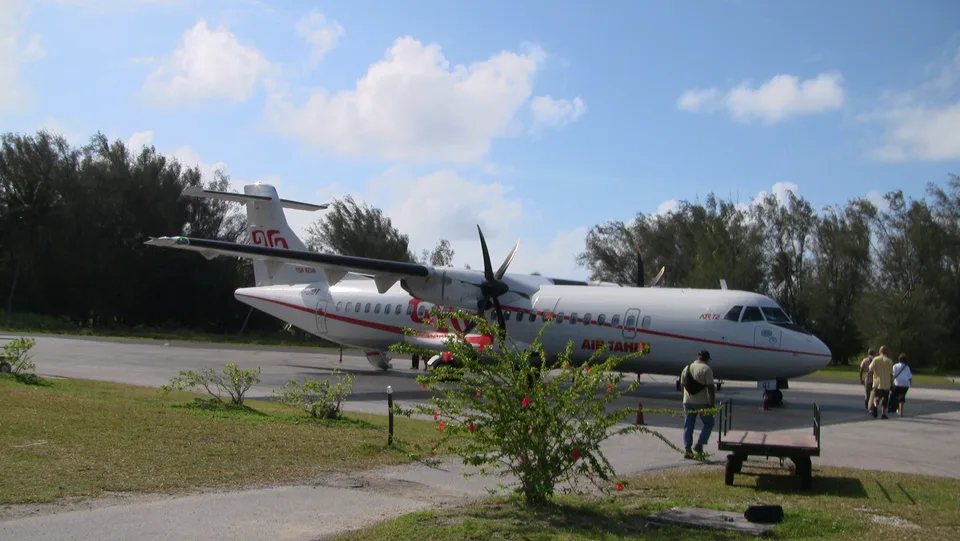
Original photograph. Responsive WebP copies resized without cropping.
Geographic context
Hiva Oa departure airport
Nuku Hiva destination airport
Approximate airport markers for the departure and destination. The restriction occurred on final approach to Nuku Hiva at about 80 ft. Basemap: Natural Earth, public domain.Read supporting evidence
The co-pilot encountered a jam while pushing the control column forward at about 80 ft. During the go-around, her inputs activated the mechanism separating the two elevator controls. The crew tested each side, identified the restriction on the captain's channel, and the co-pilot landed safely.
Read the full incident Follow what happened, from the flight to the investigation findings.
What investigators concluded
The BEA found that the PUM operated as designed and that the pilots responded appropriately. The cause of the nose-down restriction remained undetermined.
Elevator restriction on final approach to Nuku Hiva
740 words / about 4 minutes to read. The official report for this event is short, so this account is shorter than most and covers only what the report documents.
Flight VT807 approaches Nuku Hiva
On 29 September 2025, Air Tahiti flight VT807 was operating from Hiva Oa to Nuku Hiva in French Polynesia. The aircraft was an ATR72-212A registered F-ORVO. Its 44 occupants comprised 40 passengers, the captain, the co-pilot and two cabin crew members. The co-pilot was the pilot flying and the captain was the pilot monitoring. During taxi, the crew checked the full deflection of the flight controls in accordance with procedures. They took off at 14:47 local time.
At around 15:20, during final approach to Nuku Hiva, the co-pilot felt the control column jam as she tried to push it forward. The aircraft was at a height of about 80 ft. For around ten seconds, she applied nose-down inputs, but the position of the control column, the elevators and the aircraft's attitude remained unaffected by those inputs. She announced a go-around and said that the control was jammed while advancing the power levers.
During the go-around, the pitch attitude increased. The recorded force on the co-pilot's control column reached 44 daN, or decanewtons, with no effect on the elevators. Her nose-down inputs activated the Pitch Uncoupling Mechanism, known as the PUM. One second later, the PITCH DISC warning appeared. The co-pilot then regained use of her control column. The PUM separates the captain's and co-pilot's elevator controls, allowing each pilot to control the elevator on their own side independently.
Immediately after uncoupling, the captain announced that he was taking the controls and applied nose-up inputs. Both pilots made slight simultaneous inputs for a few seconds. The captain continued the go-around, and his nose-up inputs produced corresponding movement of the left-hand elevator. The flight data subsequently confirmed that the restriction affected nose-down deflection on the captain's control channel.
At an altitude of about 1,800 ft, the pilots tested the flight controls in turn, following the PITCH DISCONNECT procedure. The tests established that the elevator control was jammed only on the captain's side. The crew continued the procedure, and the co-pilot resumed the pilot-flying role. She landed without further incident. All 44 occupants survived, with no injuries or aircraft damage recorded.
The BEA reconstructed the flight mainly from the cockpit voice recorder and flight data recorder. In its conclusions, it found that the pilots reacted appropriately and continued working together until landing. It also found that the PUM functioned according to its specifications for jammed controls. The mechanism allowed the crew to control the aircraft through the go-around and the co-pilot's subsequent landing.
The recorded flight parameters confirmed the restriction on the captain's elevator control channel. Investigators considered whether an object in the cockpit could have jammed it. Inputs to the controls are measured by a dynamometric rod beneath the cockpit floor, before the control cables leave that area. The BEA used this arrangement to exclude a cockpit object as the explanation. The different elevator positions recorded during the restriction also allowed investigators to exclude jamming caused by the Gust Lock and the Stick Pusher.
Between 30 September and 21 October, Air Tahiti inspected the complete elevator control channel in coordination with the BEA and ATR. Bird nests were found at the top of the vertical stabilizer. Apart from these nests, no anomaly was reported during the inspection.
Air Tahiti found nests or nesting material inside the vertical stabilizers of several aircraft, including F-ORVO. Material was found particularly at the openings through which the elevator control rods passed. On F-ORVO, the first nests were detected and removed on the day of the incident. Further material was identified during the complete control-channel inspection several days later, including during a borescope examination.
Other ATR operators had previously reported nests found during inspections. Crews had completed their before-takeoff control-deflection checks without detecting those nests, and the nests had caused no operational impact in those cases. With no other hypothesis available to explain F-ORVO's restriction, investigators arranged ground tests to assess whether nest material inside the vertical stabilizer could jam the elevator controls.
The ground tests used an ATR test aircraft in the presence of the BEA. They examined the area at the junction of the horizontal and vertical stabilizers where Air Tahiti had found nests. None of the tests reproduced jamming of the elevator controls by nest material. The BEA could not determine what caused the restriction in nose-down deflection.
The final report, BEA2025-0445, is dated August 2026. It records that no further anomaly affecting F-ORVO's elevator control was reported after the aircraft returned to service.
Around 15:20, about 80 ftNose-down control restricted
The co-pilot applied forward inputs for about ten seconds without changing the control-column position, elevators or aircraft attitude, then announced a go-around.
The recorded control force reached 44 daN. The PUM activated, the PITCH DISC warning appeared one second later, and the co-pilot recovered control-column movement.
How did investigators rule out an object jamming the controls in the cockpit?
The BEA used the recorded inputs and the force sensor's position beneath the cockpit floor, before the control cables, to exclude a cockpit object as the source of the jam.
Could the ground tests reproduce a jam caused by nesting material?
No. Tests on an ATR aircraft in the presence of the BEA failed to reproduce an elevator-control jam caused by nesting material at the stabilizer junction.
These comparisons connect specific research topics. Shared circumstances do not establish identical causes. Evidence from both investigations is provided below.
Air Tahiti F-ORVO and Alaska Airlines 261 both involved pitch-control difficulties. F-ORVO's elevator restriction was followed by successful control-channel separation and landing. For Alaska 261, the NTSB identified failure of the horizontal-stabilizer jackscrew acme nut threads and the absence of a fail-safe mechanism to prevent catastrophic effects after total thread loss.
Explore the records below for additional context. They open on the publisher's site and are not all included in our report search. Source reuse terms apply.
Kevin Murphy writes the incident accounts on AirlineIncidents.com, out of a long interest in aviation safety and the lessons each investigation leaves behind.
Prepared by
AirlineIncidents editorial desk
Report citation check
Independent expert review
Not completed
Citation checks compare supporting text with the indexed report pages. They do not constitute independent expert review. How these pages are prepared.
Revision history
: BEA final report BEA2025-0445, English courtesy translation, August 2026.