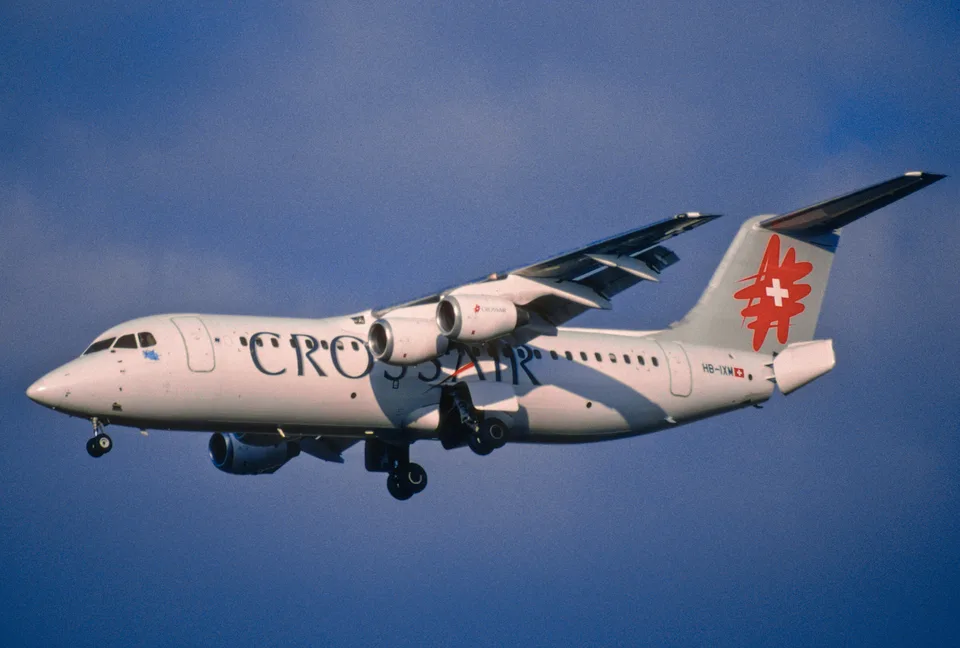
The Commons source includes a tint adjustment by Nilo1926. Original framing retained. Responsive WebP copies resized without cropping.
Geographic context
Accident site, first tree contact near Bassersdorf
Zurich airport, intended destination
The accident marker uses the report's coordinates for first tree contact. The Zurich airport marker is approximate. Basemap: Natural Earth, public domain.Read supporting evidence
Crossair 3597 was a scheduled passenger flight from Berlin-Tegel to Zurich. On the VOR/DME approach to runway 28, the crew continued below the 2,390-foot minimum descent altitude without visual contact with the approach lights or runway. The aircraft struck trees near Bassersdorf during a late go-around and broke apart. Twenty-four of the 33 people aboard died.
Read the full incident Follow what happened, from the flight to the investigation findings.
What investigators concluded
The Swiss AAIB final investigation attributed the accident to controlled flight into terrain after deliberate descent below the approach minimum under instrument conditions and a go-around initiated too late. It identified the commander's descent without the required visual references and the copilot's failure to intervene as causal factors. Contributing factors included fatigue, inappropriate task-sharing, inadequate assessment of the commander's performance, missing charted obstacles, unrepresentative visibility information, inappropriate visual minimums and the absence of a minimum safe altitude warning system for runway 28.
1,593 words / about 8 minutes to read. Based on the investigation records cited below.
A return flight and a changed approach
Crossair 3597 left Berlin-Tegel for Zurich in darkness on 24 November 2001. HB-IXM, an AVRO 146-RJ100, carried 28 passengers and five crew members. The same crew had flown the outward sector from Zurich. The commander was pilot flying, while the copilot handled radio communications. The aircraft took off from runway 26L at 20:01 UTC and later cruised at flight level 270. The early flight profile and radio exchanges showed no unusual features.
The crew initially prepared for an instrument landing system approach to Zurich runway 14. During that briefing the copilot drew attention to increasing airspeed, and the commander reduced it. When the flight contacted Zurich Arrival, it was told to expect the standard VOR/DME approach to runway 28. The crew then briefed that procedure while holding at RILAX. The commander identified the approach minimum as 2,390 feet QNH and described the missed approach to 6,000 feet.
The runway change followed the airport operating concept then in force. Restrictions on flying below flight level 100 over German territory applied from 21:00 UTC. Under the prevailing weather and published minimums, Zurich arrivals were consequently directed to the runway 28 procedure. This approach used the aircraft's own navigation.
At 20:58:50 the aircraft received approach clearance. The pilots set and cross-checked the pressure reference on their altimeters. Air traffic control later transferred the flight to the tower as it turned towards the final approach course, about eleven nautical miles east of the airport. The commander mentioned seeing the ground during that turn.
Ahead of Crossair 3597, another Crossair aircraft had landed on runway 28. Its crew reported that the weather was close to the minimum and that the runway had become visible at about 2.2 nautical miles from Kloten VOR/DME. Air traffic control did not relay this report to the following aircraft. The cockpit recording nevertheless showed that the commander of flight 3597 knew of it.
The airport weather observation gave 3,500 metres visibility, light snow and a broken cloud layer at 1,500 feet above aerodrome level. Changes to the broadcast visibility and ceiling information had not been passed to the crew. Investigators found substantial differences between conditions observed at the airport and those in the runway 28 approach sector. Pilots described the main cloud base near the accident area as about 1,000 feet above aerodrome level.
The commander instructed the copilot to set the go-around altitude of 6,000 feet on the mode control panel. That setting complied with Crossair's procedure. It required the crew to hold each intermediate altitude, including MDA, by selecting altitude hold. An earlier procedure had put MDA in the altitude selector, allowing the autopilot to level the aircraft automatically at that height.
At 21:04:36 the aircraft left 4,000 feet QNH at 160 knots. Its initial descent rate was about 1,000 feet per minute and was later increased to 1,200. The crew continued configuring the aircraft for landing after the final approach fix, although the procedure called for configuration before that fix. As horizontal speed fell, they did not adjust the descent rate accordingly. The resulting flight path grew steeper.
At six nautical miles from Kloten VOR/DME, the prescribed minimum altitude was 3,360 feet. HB-IXM passed that point at 3,240 feet. The commander checked the altitude but either missed the 120-foot deviation or considered it acceptable. The copilot was occupied with check items and radio work. Neither pilot corrected the descent rate. Investigators found that this workload and the absence of a clearly communicated configuration plan weakened monitoring of the approach.
As the aircraft approached MDA, the commander repeatedly mentioned ground contact. At 21:06:10 it reached 2,390 feet QNH. He recognised the minimum and announced that the descent would continue. The copilot quietly acknowledged the altitude. The descent continued at the same rate.
The aircraft was then about 3.5 nautical miles from the runway threshold. Investigators found that neither pilot had visual contact with the approach lights or runway. The required conditions for descending below MDA were therefore absent. The commander was looking outside for at least part of this period and was increasingly using inadequate visual references. The crew did not follow the prescribed division of duties for the transition from instrument to visual flight.
At 21:06:22 the radio-altimeter system announced 500 feet above ground. The commander recalled the preceding aircraft's report of seeing the runway at about two miles. He continued reading the altitude, but apparently stopped checking distance. At 21:06:31 he called 2,000 feet. A second later the system made the minimums callout at the preselected radio height of 300 feet. Tower issued landing clearance at the same time. The commander then considered a go-around.
At 21:06:34 the commander initiated a go-around and disconnected the autopilot. The thrust levers moved forward and engine speed increased. Contact with trees followed two seconds later. The AAIB's simulator tests indicated that a go-around initiated when the commander first considered it might just have avoided the trees.
The aircraft first struck treetops at an elevation of 1,854 feet above sea level. During the attempted go-around its pitch rose from about two degrees nose down to five degrees nose up, and its descent rate reduced towards zero. Collision with the trees rapidly slowed the aircraft and damaged fuel tanks. About 200 metres farther along the path, the right wing and right engines struck the ground. The airframe broke into several sections.
Fire developed rapidly and destroyed the cockpit, forward and central fuselage, and much of the wings. The separated aft fuselage escaped the fire. Twenty-one passengers and three crew members died; seven passengers and two crew survived. Five survivors sustained serious injuries, while four were classified as having minor or no injuries. The highest alarm was raised at 21:10:32. Airport fire vehicles and medical rescue services reached the site at 21:22. The AAIB judged the rescue and firefighting response timely and appropriate.
The technical investigation found the aircraft airworthy up to its first collision with obstacles. The autopilot followed the selected modes normally. Correct altitude and speed information was available to the crew, and the ground navigation aids were functioning normally. The flight data recorder's primary control-position channels could not be analysed, but the recorded flight path supported the conclusion that the primary controls were functioning correctly.
The installed ground proximity warning system did not generate a warning because the aircraft's flight path remained outside its envelopes for excessive sink rate and excessive terrain closure rate. The 500-foot and 300-foot height callouts operated normally. The AAIB found that terrain awareness equipment with a topographical database could have detected the dangerous approach to the Bassersdorf terrain and warned the crew.
The ground system also lacked an altitude warning in the runway 28 approach sector. Minimum safe altitude warning equipment was already installed for runways 14 and 16. Investigators judged that an equivalent system for runway 28 would very probably have alerted controllers early enough to warn the crew. The final report listed its absence as a contributing factor.
The AAIB identified the commander's deliberate descent below MDA without the required visual references, and the copilot's failure to prevent it, as causal factors. Its analysis also traced how those actions had developed. The commander's much greater total flying experience and seniority produced a pronounced authority gap. The copilot recognised the minimum altitude but made no recorded intervention during the following 24 seconds before the go-around.
Fatigue impaired the commander's concentration, decisions and ability to analyse complex processes. His work included instruction flights as well as airline duties. The day before the accident his combined duty lasted 15 hours 31 minutes. By the accident he had been on duty for 13 hours 37 minutes. Crossair and the flying school did not monitor his combined duty time.
The airline had also failed over a long period to assess his performance correctly and respond to weaknesses. Earlier conversion attempts to the MD 80 had revealed basic flying and decision-making difficulties. The airline had not brought separate occurrences together to identify their common patterns. The AAIB found further contributing factors in inappropriate task-sharing, hills missing from the chart used by the crew, unrepresentative visibility reporting and unsuitable visual minimums. Its thirteen recommendations addressed these operational and organisational weaknesses, altitude selection, terrain warning equipment, weather observation, approach charts and pilot checks.
The approach chart in the cockpit omitted obstacles that appeared in the Swiss AIP chart. These included the wooded rise struck by HB-IXM. The AAIB recommended adding obstacles to widely distributed approach publications and considering side-view terrain profiles. It also recommended reviewing visibility minimums so that crews could obtain the required visual references at a point from which a normal final descent was possible. A separate recommendation asked whether visual descent points should be added to non-precision approach charts.
The investigation examined oversight beyond the airline. Before the accident, FOCA had carried out no operational audit of Crossair and had not monitored the airline examiners who performed checks on its behalf. The AAIB recommended that FOCA inspectors or independent experts administer a sample of qualifications and proficiency checks. It also sought complete monitoring of total duty and rest time across employers and qualitative criteria for pairing crew members.
Some responses were recorded before the final report was completed. FOCA agreed in May 2002 with reviewing altitude selection and accelerating terrain awareness retrofits. In its comment dated 5 December 2003, it reported that the runway 28 minimum safe altitude warning system was operating. The final report recorded FOCA responses as pending for the later recommendations on visual descent points, minimum visibility, terrain profiles, crew times, operator quality systems and independent checks.
Follow the main stages, then open the evidence beneath each step.
1
Configuration continued during final descent
Landing configuration changed after the final approach fix. Descent rate was not reduced with horizontal speed, and the flight path steepened below the nominal profile.
The commander continued below 2,390 feet while the aircraft was still about 3.5 nautical miles from the threshold. Neither pilot had the required approach or runway lights in sight.
The copilot recognised the minimum altitude but made no attempt to prevent further descent. The AAIB found that the crew's task-sharing did not follow the prescribed procedures.
A simplified reading of the investigation findings. The sequence does not replace the full report or imply that every contributing factor is shown.
Sequence of events
UTC. Swiss local time was UTC plus one hour. The detailed flight history gives first tree contact at 21:06:36; the synopsis rounds the accident time to 21:07. Expand an event to see its evidence.
20:01Departure from Berlin
HB-IXM took off from runway 26L at Berlin-Tegel with the commander flying and the copilot handling radio communications.
Why did the commander continue below the minimum descent altitude?
He reported ground contact and expected the runway to become visible. The AAIB found that he deliberately continued below the minimum without the required visual contact with the approach lights or runway. At MDA the aircraft was still about 3.5 nautical miles from the threshold.
Why did the ground proximity warning system give no terrain warning?
The approach remained outside the GPWS envelopes for excessive descent rate and excessive terrain closure rate. Its normal 500-foot and 300-foot height callouts sounded. The AAIB found that a terrain awareness system using a topographical database could have warned of the dangerous proximity to Bassersdorf.
How did airline oversight contribute to the accident?
The AAIB found that Crossair had failed over a long period to assess the commander's performance correctly and respond appropriately to weaknesses. It found that the airline had not brought earlier occurrences together to identify common patterns and take suitable measures.
The aileron, elevator and rudder recordings could not be analysed. Recorded flight-path parameters remained usable until tree contact and supported the finding that the primary controls were working correctly.
The AAIB could reconstruct likely display selections from recovered switches. The precise display combinations remained uncertain because the selections were not recorded.
Actions and recommendations are described at the dates of the cited records. A recommendation is not proof of implementation.
Altitude selection and terrain awareness
Recommendations 2002-4 and 2002-5 asked FOCA to review selecting MDA on the mode control panel and accelerate terrain awareness retrofits. FOCA agreed with both recommendations in its 6 May 2002 comments.
Recommendation 2002-7 called for an automatic visual and acoustic altitude warning system for the runway 28 approach sector. FOCA reported on 5 December 2003 that MSAW 28 was operating.
The AAIB recommended improved weather observation, obstacles on widely used approach charts, consideration of a visual descent point, revised visibility minimums and terrain profiles. The report records FOCA comments as pending for recommendations 94, 95 and 96.
The recommendations included qualitative crew-pairing criteria, monitoring of pilots' performance, complete checks of combined duty and rest times, stronger operator quality systems and sample checks by FOCA inspectors or independent experts.
Matching dossiers for Approach visibility: No other dossier in this collection.
Read alongside
These comparisons connect specific research topics. Shared circumstances do not establish identical causes. Evidence from both investigations is provided below.
Crossair 3597 and Air Canada 624 both struck terrain during non-precision approaches in restricted visual conditions. In the Crossair investigation, the commander knowingly continued below MDA without the required visual references and the copilot did not intervene. In the Air Canada investigation, the TSB found that the crew failed to notice the aircraft drifting below its planned descent profile and crossing MDA farther from the threshold. Limited visual cues and reduced approach-light brightness also impaired detection of the low path at Halifax.
Explore the records below for additional context. They open on the publisher's site and are not all included in our report search. Source reuse terms apply.
English final report covering the flight sequence, recorded evidence, crew performance, approach environment, causes and thirteen safety recommendations.
Sources and transparency
Swiss AAIB Final Report No. 1793, English translation.
Source limitations
The report states that the German-language version is authoritative.
Final Report No. 1793: AVRO 146-RJ100 HB-IXM, Crossair CRX 3597, 24 November 2001
Aircraft Accident Investigation Bureau of Switzerland Final Report No. 1793, English translation. The German-language version is authoritative.
Kevin Murphy writes the incident accounts on AirlineIncidents.com, out of a long interest in aviation safety and the lessons each investigation leaves behind.
Prepared by
AirlineIncidents editorial desk
Report citation check
Independent expert review
Not completed
Citation checks compare supporting text with the indexed report pages. They do not constitute independent expert review. How these pages are prepared.
Revision history
: Published sourced incident account, timeline, photographs and investigation findings.