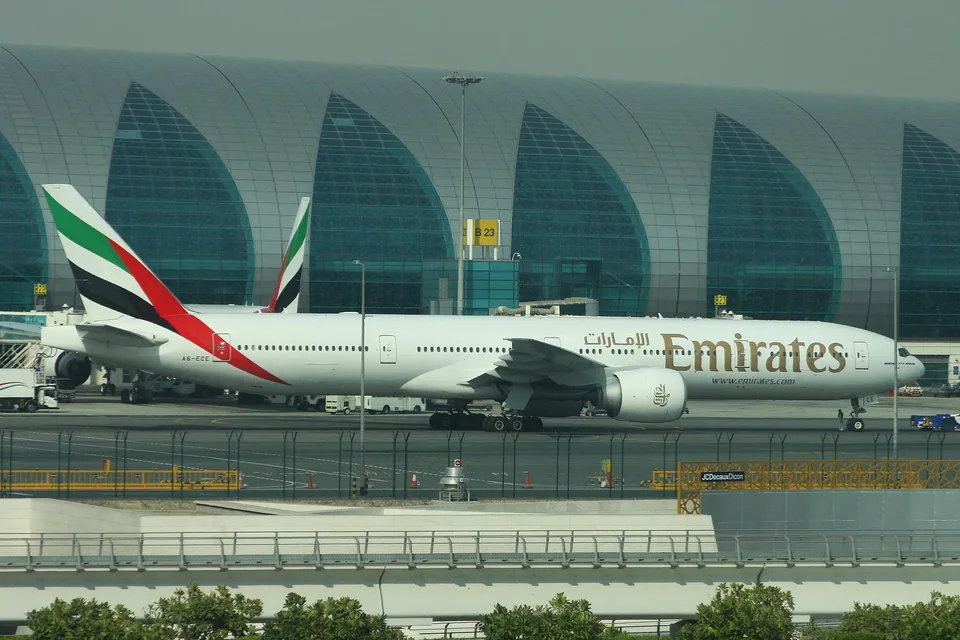
Recurring cabin fumes diverted Emirates flight EK203 to Stockholm. The GCAA completed its investigation with a published summary report and an undetermined cause.
Original framing and colour retained. Responsive WebP copies resized without cropping.
Geographic context
Dubai International, departure
Stockholm Arlanda, diversion landing
New York JFK, intended destination
The scheduled route was Dubai to New York JFK, with a diversion to Stockholm Arlanda and a subsequent flight from Arlanda to JFK. Airport markers give geographic context. The summary locates the occurrence near Stockholm and gives no precise airborne position. Basemap: Natural Earth, public domain.Read supporting evidence
During cruise from Dubai to New York, a burning rubber and sulphur odor spread through A6-ECE. Equipment isolation failed to stop it, and the crew diverted to Stockholm Arlanda. The odor returned on two later sectors and subsided after the right air conditioning pack was switched off.
Read the full incident Follow what happened, from the flight to the investigation findings.
What investigators concluded
AAIS could not determine the cause of the disturbing odor. It found that the crew managed the situation effectively, reclassified the occurrence as an Incident, and issued no safety recommendations.
1,045 words / about 5 minutes to read. The official report for this event is short, so this account is shorter than most and covers only what the report documents.
A smell during the Atlantic service
Emirates flight EK203 was cruising from Dubai to New York on 14 February 2011 when cabin crew reported a smell of burning rubber and sulphur in the rear cabin. Some crewmembers described it as resembling rotten eggs. The aircraft was Boeing 777-300ER A6-ECE. There were 341 passengers and 20 crew aboard. The smell initially subsided, then returned through cabin air vents near the overwing area.
The flight crew consulted the airline's Maintenance Control Centre. They isolated the recirculation fans, galley equipment and in flight entertainment system. The smell persisted and grew stronger toward the forward cabin and flight deck. Its source remained unknown to those on board. The commander decided that continuing across the Atlantic would be unsafe in those circumstances and elected to divert to Stockholm Arlanda.
The crew completed the Smoke Fire Fumes checklist and jettisoned 43 tons of fuel. During the descent, an in flight entertainment cooling fan status message appeared. The aircraft landed uneventfully at maximum landing weight. Engineers investigated the message, isolated the entertainment cooling fan and released the aircraft for flight. No one was injured, the aircraft was undamaged and there was no other damage.
The next sector took A6-ECE from Stockholm to New York JFK. Shortly after the aircraft levelled at FL300, cabin crew reported the odor again. The flight crew consulted maintenance control and switched off the right air conditioning pack to isolate the ozone system. Within a few minutes the smell subsided, and the flight continued uneventfully.
The crewmembers described good cooperation during the unexpected events on the journey through Stockholm to New York. Information passed between the cabin and flight deck while the crews worked through the problem. AAIS later found their crew resource management effective and efficient, with workload managed and ambiguities communicated and resolved.
At JFK, engineers replaced the entertainment cooling fan and checked the entertainment system, which functioned correctly. Troubleshooting then examined the right air conditioning pack. Its upper flow control valve was deactivated in the closed position, forcing the ozone converter into the operational airflow circuit through the lower valve. A strong smell reappeared in the cockpit, with an odor also present in the passenger cabin.
Engineers next deactivated the lower flow control valve. They selected full heat and ran the pack for ten minutes, then restored normal zone temperature. Four people and the outbound flight crew confirmed that no smell remained. The aircraft was dispatched with the lower valve closed and the right pack ozone converter inoperative under the minimum equipment list provisions identified in the summary.
The smell returned on the third sector. Following another consultation with maintenance control, the crew switched off the right pack, and the flight continued normally. The summary says that subsequent flights were odor free. Investigators examined the heat exchanger, condenser/reheater and ozone converter.
Water and protective coating in the pack components
The heat exchanger and condenser/reheater were sent to Hamilton Sundstrand for inspection. Maintenance records showed that the heat exchanger had been cleaned in June or July 2010, stored, and installed on A6-ECE two days before the incident. External inspection found no unusual condition or obvious smell in either component. Inside the heat exchanger, a wet patch in the secondary inlet appeared to be evaporating liquid. Inspectors could not pour out a sample and determined that the patch was water.
The condenser/reheater also had a wet area, at the reheater hot inlet. An attempt to collect residual liquid yielded nothing. Water was poured through its core to obtain a sample of any foreign material. A reddish brown substance on the interior walls was identified as Rockhard Stoving Enamel, a protective coating applied during production and subsequent shop work. Spraying, running and oven curing formed part of its normal application.
Most of the coating remained intact, although some areas had eroded. The examination concluded that erosion would not produce a sulphurous smell. Water covering the coating was considered the likely explanation for material initially thought to be liquid enamel. The condenser/reheater passed its prescribed tests before cleaning, with a greater pressure drop margin than many units achieved after cleaning. No foreign contamination was found in either component, and the inspection concluded that neither had contributed to the odor.
The inspection facility considered the ozone converter the most likely source because the smell had been strong with it in the airflow circuit and had lessened when it was bypassed. The same heat exchanger and condenser/reheater were installed during both conditions. The facility recommended examining the converter, which had been removed at the same time as those components.
The summary describes a possible chemical process: catalytic converters can produce sulphur dioxide under certain conditions when exposed to exhaust from burning hydrocarbon fuels. It gives ingestion of another aircraft's exhaust while waiting on a taxiway as a conceivable route into the bleed air supply. This was a proposed mechanism during the component investigation. The final cause finding remained undetermined.
Honeywell LORI received the ozone converter in its removed condition. It was lightly fouled with carbon black. Engineers found a faint smell comparable with other units of the same part number at the facility. The brownish core colour was normal. Laboratory staff passed solvent through the converter, concentrated part of the collected liquid and examined it using Fourier Transform Infrared Spectroscopy. The extract was consistent with silicone oil. The summary describes silicone lubricants as installation aids for environmental control systems and as non odor causing materials.
Sweden offered to delegate the investigation to the GCAA on 15 February 2011, and the GCAA accepted. Swedish and United States investigators appointed accredited representatives. The aircraft's flight recorders were downloaded, and quick access recorder data and recorded communications were made available. AAIS found the aircraft airworthy at dispatch and the crew qualified, medically fit and adequately rested. It found no evidence of a pre incident system malfunction.
The occurrence was initially classified as a Serious Incident. AAIS reclassified it as an Incident after review, explaining that an accident had been unlikely. Its completed publication is the Incident Investigation Summary Report AIFN/0009/2011, dated 4 June 2015. The summary contains no CVR transcript, detailed recorder plots, full laboratory reports or cabin air concentration measurements. AAIS concluded that the component inspections supplied no solid evidence confirming the source of the smell. The cause remained undetermined, and the investigation produced no safety recommendations.
A smell appeared with the converter in the airflow circuit and lessened when it was bypassed, leading the inspection facility to suspect the converter.
A simplified reading of the investigation findings. The sequence does not replace the full report or imply that every contributing factor is shown.
Sequence of events
The report uses UTC unless otherwise stated. It gives the order of events but no clock times for odor onset, diversion or landing. Expand an event to see its evidence.
14 February 2011, cruiseOdor reaches the forward cabin
Cabin crew first reported burning rubber and sulphur smells aft. The odor returned near the overwing vents, then spread toward the front and flight deck despite equipment isolation.
Stockholm to New York, after level offOdor returns at FL300
The cabin crew again reported the smell. Switching off the right pack after consultation with maintenance control was followed by the odor subsiding within a few minutes.
At New York JFKAir conditioning tests reproduce the smell
With the ozone converter in the airflow circuit, a strong smell reappeared. After the lower flow control valve was deactivated, heating and temperature reset produced no odor.
The odor spread toward the forward cabin and flight deck despite equipment isolation. The commander judged an Atlantic crossing unsafe while its source was unknown. The crew completed the Smoke Fire Fumes checklist, jettisoned 43 tons of fuel and landed at Arlanda.
What was the reddish material inside the condenser and reheater?
It was a corrosion preventive coating called Rockhard Stoving Enamel. Most of the coating remained intact. Investigators considered it likely that water covering the coating had been mistaken for liquid enamel; erosion of the material would not produce the sulphurous smell.
The laboratory extract was consistent with silicone oil, an installation aid that the summary describes as non odor causing. The component inspections supplied no solid evidence confirming the source, and AAIS could not determine the cause.
The published summary contains no cockpit voice recorder transcript, detailed recorder plots, full laboratory test reports, cabin air concentration measurements, or precise airborne coordinates for odor onset.
Actions and recommendations are described at the dates of the cited records. A recommendation is not proof of implementation.
Maintenance and component examination
The entertainment cooling fan was replaced. The heat exchanger, condenser/reheater and ozone converter underwent examination; no corrective action was required for the heat exchanger or condenser/reheater.
AAIS reclassified the occurrence as an Incident because the probability of an accident had been low. Its completed summary investigation issued no safety recommendations.
These comparisons connect specific research topics. Shared circumstances do not establish identical causes. Evidence from both investigations is provided below.
Both investigations examined cabin indications and the crew's decision to divert. On Air Canada 797, the NTSB found a hidden fire, an underestimate of its severity and misleading progress information; 23 passengers died after landing. On A6-ECE, AAIS recorded no fire, no injuries and effective crew coordination, with the odor source undetermined.
Explore the records below for additional context. They open on the publisher's site and are not all included in our report search. Source reuse terms apply.
Completed summary investigation of recurring cabin fumes, the Stockholm diversion, pack troubleshooting and component examinations.
Sources and transparency
GCAA AAIS completed the investigation in Summary Report AIFN/0009/2011, dated 4 June 2015.
Source limitations
The published summary contains no cockpit voice recorder transcript, detailed recorder plots, full laboratory test reports, cabin air concentration measurements, or precise airborne coordinates for odor onset.
Fumes in Passenger Cabin, Emirates Boeing 777-300ER A6-ECE
UAE GCAA Air Accident Investigation Sector Final summary report AIFN/0009/2011, dated 4 June 2015
Kevin Murphy writes the incident accounts on AirlineIncidents.com, out of a long interest in aviation safety and the lessons each investigation leaves behind.
Prepared by
AirlineIncidents editorial desk
Report citation check
Independent expert review
Not completed
Citation checks compare supporting text with the indexed report pages. They do not constitute independent expert review. How these pages are prepared.
Revision history
: GCAA summary investigation completed on 4 June 2015.