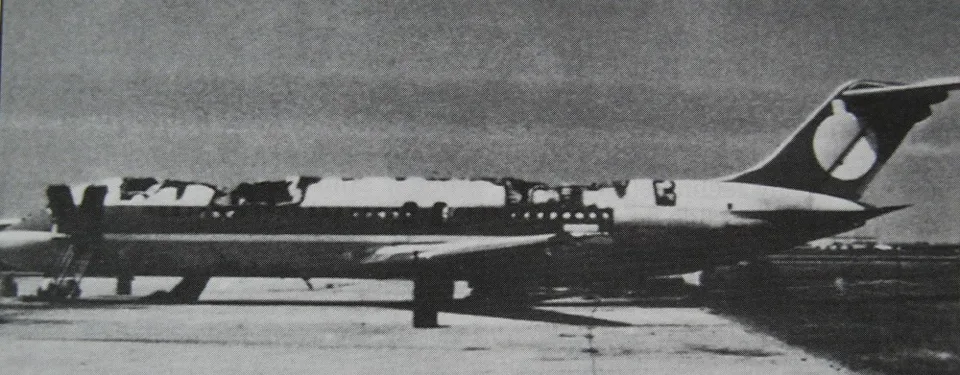
A concealed lavatory fire filled the DC-9 with smoke. It landed at Cincinnati, where 23 passengers died and 23 occupants escaped before a cabin flashfire.
Original image saved unchanged. Responsive WebP copies resized without cropping.
Geographic context
Dallas departure
Greater Cincinnati emergency landing
Toronto planned stop
Montreal destination
Flight 797 departed Dallas for Toronto and Montreal. It diverted to Greater Cincinnati International Airport for an emergency landing on runway 27L. Markers show approximate airport locations. Basemap: Natural Earth, public domain.Read supporting evidence
Smoke from the aft lavatory was reported to the cockpit at 19:02:40. Crew members tried to assess and extinguish the concealed fire while passengers moved forward. Electrical power and instruments failed as the fire spread. The crew descended from 33,000 feet and landed at Cincinnati. Dense smoke obstructed the evacuation, and a flashfire engulfed the cabin about 60 to 90 seconds after exits were opened.
Read the full incident Follow what happened, from the flight to the investigation findings.
What investigators concluded
The NTSB found three probable causes: a fire of undetermined origin, an underestimate of its severity and misleading fire progress information given to the captain. The time spent evaluating the fire and deciding to descend contributed to the accident's severity.
1,669 words / about 8 minutes to read. Based on the investigation records cited below.
An international flight at cruise
Air Canada Flight 797 left Dallas at 16:25 central daylight time on 2 June 1983. Its planned journey continued to Montreal through Toronto. The McDonnell Douglas DC-9-32, registered C-FTLU, carried 41 passengers, two pilots and three flight attendants. It climbed to flight level 330, about 33,000 feet. The aircraft had been delivered to Air Canada in April 1968. The flight diverted south of its filed route to avoid weather before entering Indianapolis Center airspace.
About half an hour after departure, a louvered panel at the bottom of the cockpit door was accidentally dislodged. The crew placed it aside and continued. At 18:51:14 eastern daylight time, the three circuit breakers protecting the aft lavatory flush motor tripped in rapid succession. The captain tried to reset them and assumed that the motor had seized when they would not latch. He tried again at about 18:59:58, with the same result.
The cockpit voice recorder captured signals resembling electrical arcing before the breakers tripped. The NTSB concluded that the signals had been induced electromagnetically into the recording circuitry and were inaudible to the pilots. The circuit breaker trips were the first malfunction the crew noticed. Examination later showed that an established fire had damaged the flush motor wiring, and the reset attempts had no effect on the subsequent sequence.
At about 19:00, a passenger in the last row asked a flight attendant about a strange odor. She took a carbon dioxide extinguisher and opened the aft lavatory door a few inches. Gray smoke filled the compartment from floor to ceiling. She saw no flames, inhaled smoke and closed the door. Another attendant informed the flight attendant in charge, who sent her to notify the captain while passengers were moved forward.
The attendant in charge opened the lavatory door more widely. Black smoke curled from seams around the vanity and ceiling. He discharged carbon dioxide toward the paneling, the seams emitting smoke and the trash bin door, then shut the lavatory door. He told the first officer that he had been unable to locate the smoke source and believed the fire was outside the trash container. The first officer could not reach the lavatory through the smoke on his first trip aft.
The captain received the fire report at 19:02:40 and donned his oxygen mask. At 19:04:07 the first officer returned and suggested going down. Almost immediately, the attendant in charge reported that the smoke appeared to be easing. The first officer also saw an apparent improvement. The captain lent him smoke goggles and sent him aft again. On this second visit, the first officer found the lavatory door hot and kept it closed. He returned at 19:07:11 and urged a descent.
Electrical failures developed while the first officer was inspecting the cabin. At about 19:05:35, the master caution indicated loss of the left alternating and direct current systems. The captain warned Indianapolis Center of an electrical problem at 19:06:12. The transponder stopped providing its radar beacon signal, leaving controllers to follow the aircraft using primary radar returns. Both flight recorders stopped at 19:07:41.
At about that same time, emergency electrical buses lost power and the main attitude indicators tumbled. The crew selected emergency battery power. Horizontal stabilizer trim remained inoperative for the rest of the flight. Later, near 8,000 feet, the emergency inverter failed, taking the emergency alternating current supply with it. The captain continued with the small standby attitude indicator and airspeed indicator while smoke increasingly obscured his instruments.
Flight 797 transmitted its Mayday at 19:08:12 and reported leaving flight level 330 at 19:09:05. The captain reduced thrust to idle and extended the speed brakes. He flew the descent at about 310 knots indicated airspeed, with the vertical speed indicator beyond its 6,000 feet per minute scale. The crew wore oxygen masks. The captain also used smoke goggles, which fogged with perspiration and required clearing. The cockpit door remained open, allowing smoke to flow forward from the cabin.
Indianapolis Center cleared the aircraft down to 5,000 feet and directed it toward Greater Cincinnati International Airport. During the handoff, the Cincinnati approach controller initially mistook Continental Flight 383's beacon target for Flight 797. The receiving controller had not been told that Air Canada's transponder was inoperative. After observing a primary target and checking the reported altitude, he began monitoring the correct aircraft.
The initial plan used runway 36. By 19:12:54 the controller knew that Flight 797 was too high and fast for that approach and selected runway 27L. The aircraft descended through cloud and reached visual conditions near 2,000 feet. Airport firefighters had already been alerted. The runway and approach lights were raised to full intensity, and the crew reported the airport in sight at 19:17:35.
The captain ordered the aircraft depressurized for landing. The first officer also switched off the air conditioning and pressurization packs because he believed they were feeding the fire. The NTSB found that shutting them off removed the best available means of clearing smoke, accelerating the buildup of heat and toxic gases. With stabilizer trim unavailable, the captain extended the flaps in stages and stabilized the speed after each change. He flew the final approach at 140 knots indicated airspeed.
Flight 797 touched down at 19:20:09. The captain used spoilers and full braking to stop just short of taxiway J. The antiskid system had lost power, and all four main wheel tires burst. The landing left the fuselage intact and exposed occupants to deceleration within human tolerance. The NTSB classified the accident as survivable and credited the captain with outstanding airmanship under the conditions confronting him.
Before landing, the cabin crew had moved passengers into the forward cabin, briefed selected passengers to open the overwing exits and distributed wet towels. Visibility deteriorated severely. After the aircraft stopped, the two forward doors and three overwing exits opened. Eighteen passengers and all three flight attendants escaped through them. Both pilots tried to enter the cabin to help but were driven back by smoke and heat; they left through their cockpit sliding windows.
Passengers who reached the overwing exits sometimes counted rows by feeling the seatbacks. Others found a faint glow or felt a small breeze at an opening. Smoke and toxic gases weakened occupants and made shouted commands difficult to hear. About 60 to 90 seconds after the doors and exits opened, a flashfire swept the cabin. The NTSB found that oxygen entering through the exits ignited the accumulated combustible gases around heated ceiling materials. Twenty-three passengers died. Three survivors suffered serious injuries and 13 suffered minor injuries.
The investigation traced intense burning to the lower outboard portion of the lavatory vanity's amenities section. Smoke and hot gases initially vented beneath the toilet shroud and overboard, allowing the concealed fire to burn undetected for almost 15 minutes. It then penetrated the lavatory liner and entered the cabin through wall and ceiling seams. Fire and hot gases spread upward and forward into the space above the cabin ceiling.
The trash container held scorched, unburned paper, and its automatic Halon extinguisher had discharged into the trash chute. Damage patterns showed that the fire had originated outside the chute. The recovered flush motor showed no internal failure consistent with ignition. Tests of an overheated motor did not ignite adjacent lavatory materials. The NTSB considered a cigarette entering a concealed void, damage to the flush motor harness and arcing at generator feeder cables. Extensive destruction prevented a conclusive identification of the ignition source.
Airport firefighters followed the aircraft down the runway, assisted survivors and attacked the cabin fire. Smoke and heat repeatedly prevented entry. Their protective hoods would not fit over their breathing apparatus, which impeded interior attacks. The NTSB judged the initial decision to attack through an overwing exit reasonable. The aircraft's fuel tanks remained intact, and jet fuel was uninvolved in the fire. Firefighting continued until 20:17, when the fire was extinguished.
The NTSB concluded that the time spent assessing the fire and deciding to descend increased the accident's severity. Its analysis placed an earlier opportunity at 19:04:07, when the first officer returned from his first inspection. A descent then could probably have enabled a landing at Louisville 3 to 5 minutes earlier. Research could not determine whether that shorter flight would have delayed or prevented the flashfire, but reduced exposure to the toxic cabin environment would have improved passengers' ability to escape.
The Board found that the faulty radar handoff did not appreciably delay the Cincinnati landing. Once the emergency descent began, the aircraft still needed distance to lose altitude, slow down and configure for landing. The final report attributed the accident to the concealed fire, an underestimate of its severity and misleading progress information given to the captain.
The original report was adopted in August 1984. The Air Line Pilots Association petitioned for reconsideration that December, challenging findings about the captain's assessment and the descent delay. The Board granted the petition in part and revised finding 8 and the probable cause. It agreed that the captain had been misled by crew reports that smoke was subsiding. The revised report, adopted on 31 January 1986, continued to identify the evaluation and descent decision time as a contributing factor.
Flight 797's lavatory had no smoke detector, and the aircraft carried no full-face breathing equipment for cabin firefighting. The NTSB found that earlier detection and suitable protective breathing equipment could have reduced the consequences. Its recommendations called for crews to determine fire location and severity urgently, and to begin an emergency descent when the source could not be quickly established or immediate extinction assured.
The Board also called for hands-on training with breathing equipment, fire axes and extinguishers. Manuals were to identify panels that could be penetrated safely to reach a hidden fire, and the panels themselves were to carry standardized markings. The report described FAA proposals for more stringent cabin material standards, floor proximity escape path markings, automatic lavatory waste extinguishers, smoke detection and additional hand extinguishers. These measures addressed earlier warning, access to concealed fires and escape through a smoke-filled cabin.
A simplified reading of the investigation findings. The sequence does not replace the full report or imply that every contributing factor is shown.
Sequence of events
Times are eastern daylight time, using the 24-hour clock. Touchdown was recorded at 19:20:09. The flashfire interval is an estimate from witnesses. Expand an event to see its evidence.
16:25 CDTDeparture from Dallas
Flight 797 left Dallas with 41 passengers and five crew and climbed to flight level 330.
Smoke prevented him from reaching the lavatory. He suggested descending, then he and the flight attendant in charge reported that smoke appeared to be clearing.
19:07:11 to 19:07:41Urgent descent advice and further power loss
After finding the lavatory door hot, the first officer returned and urged a descent. Emergency electrical buses then lost power; the crew selected battery emergency power.
The DC-9 landed on runway 27L. Eighteen passengers and the cabin crew escaped through forward doors and overwing exits. Both pilots used cockpit windows.
About 60 to 90 seconds after exits openedCabin flashfire
Fresh oxygen entering the open exits combined with accumulated combustible gases and heated ceiling materials. The flashfire spread rapidly through the cabin.
The NTSB attributed the temporary reduction to dilution from the carbon dioxide discharge and increased venting after the lavatory vent line and flush and fill connections failed. Smoke and gases were being drawn below the lavatory floor and overboard while the concealed fire continued.
The NTSB calculated that a descent begun earlier could have enabled a landing at Louisville 3 to 5 minutes before the Cincinnati landing. The additional exposure to the toxic cabin environment reduced the passengers' ability to escape.
Survivors counted seat rows by touch, followed a dim glow through an open exit or felt a breeze near their legs. Some could see and breathe slightly better when bending down or crawling.
Research could not determine whether an earlier landing at Louisville would have delayed or prevented the flashfire. The NTSB found that shorter exposure to toxic gases would have improved escape capability.
Evidence about the effect of opening the specified cabin doors during the continuing fire was conflicting. The NTSB reached no conclusion about the outcome of using that procedure.
Actions and recommendations are described at the dates of the cited records. A recommendation is not proof of implementation.
Urgent fire assessment and descent
Recommendation A-84-76 called for training that emphasizes immediate assessment, clear crew communication and descent for landing or ditching when fire severity cannot quickly be established or extinction assured.
Recommendations A-84-77 and A-84-78 called for illustrated instructions on safe fire axe use and standardized identification of cabin panels that could be penetrated safely.
The report described proposals issued in 1983 and 1984 for stronger material flammability standards, floor proximity escape markings, lavatory detection and extinguishing equipment, and additional hand extinguishers.
These comparisons connect specific research topics. Shared circumstances do not establish identical causes. Evidence from both investigations is provided below.
Both investigations involved concealed fires aboard DC-9-32 passenger aircraft and examined early warning and fire suppression. Air Canada 797's fire spread through an aft lavatory; ValuJet 592's fire began when chemical oxygen generators activated in the forward cargo compartment. The ValuJet investigation found that earlier warning and suppression would likely have allowed a safe landing.
Explore the records below for additional context. They open on the publisher's site and are not all included in our report search. Source reuse terms apply.
United States government report. Original commentary and brief attributed extracts; individual third-party materials may have separate rights. Source terms.
Kevin Murphy writes the incident accounts on AirlineIncidents.com, out of a long interest in aviation safety and the lessons each investigation leaves behind.
Prepared by
AirlineIncidents editorial desk
Report citation check
Independent expert review
Not completed
Citation checks compare supporting text with the indexed report pages. They do not constitute independent expert review. How these pages are prepared.
Revision history
: The NTSB revised finding 8 and the probable cause after considering the Air Line Pilots Association petition.