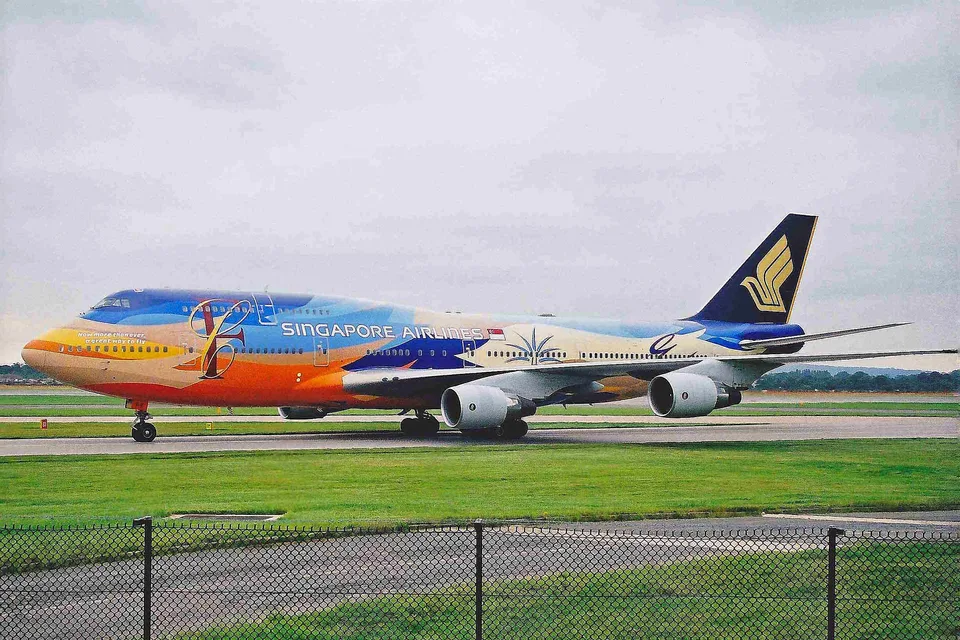
Cleared for Runway 05L in typhoon weather, Flight 006 began takeoff on partially closed 05R and struck construction equipment. Eighty-three people died.
Original photograph unchanged. Responsive WebP copies resized without cropping.
Geographic context
CKS Airport, Taoyuan
Los Angeles International Airport
Flight 006 was scheduled from Taipei CKS to Los Angeles. The collision occurred on Runway 05R between Taxiways N4 and N5. Airport markers show approximate geographic positions. Basemap: Natural Earth, public domain.Read supporting evidence
Flight 006 was cleared to take off from Runway 05L. During taxi in darkness, heavy rain and strong winds, the captain followed green lights through a continuous right turn onto parallel Runway 05R. Part of 05R was closed for construction. The aircraft accelerated into barriers, construction pits and heavy equipment, broke apart and caught fire.
Read the full incident Follow what happened, from the flight to the investigation findings.
What investigators concluded
ASC found that the crew lost situational awareness and took off from the wrong runway. It identified deficiencies in airport guidance, warnings, airline procedures and oversight as risks. Singapore's Ministry of Transport argued that the airport deficiencies were major causal factors.
1,780 words / about 9 minutes to read. Based on the investigation records cited below.
A departure in typhoon weather
On the night of 31 October 2000, Singapore Airlines Flight 006 was preparing to leave Chiang Kai-Shek International Airport in Taoyuan for Los Angeles. The aircraft was 9V-SPK, a Boeing 747-400 identified in the aircraft records as a Boeing 747-412B. There were 179 people aboard: 159 passengers, three pilots and 17 cabin crewmembers. Heavy rain, strong winds and reduced visibility accompanied the approaching typhoon Xangsane. The aircraft carried approximately 124,800 kilograms of fuel for the flight across the Pacific.
The pilots had flown the preceding sector from Singapore to Taipei and rested at a hotel. They reported for duty at 21:53 and reviewed their departure documents before boarding at Bay B5. Those documents included a notice that construction had closed part of Runway 05R between Taxiways N4 and N5. The crew knew about the closure and understood that the remaining portions of 05R were available for taxiing. The captain would taxi the aircraft and conduct the takeoff.
Runway 05R lay beside the intended departure runway, 05L. It had originated as a parallel taxiway in the airport design and retained green taxiway centerline lights. A plan to redesignate it as Taxiway NC had been delayed. On the accident night, it still carried runway markings while sections outside the construction area continued to serve taxi traffic.
After pushback, the crew received taxi clearance at 23:05:57. The controller initially named Runway 06, immediately corrected the instruction to 05L, and specified Taxiways Sierra Sierra, West Cross and November Papa. The first officer acknowledged November Papa for Runway 05L after the captain repeated the route. As they taxied, the pilots discussed slippery pavement, crosswind and alternate airports. Kaohsiung and Hong Kong had closed, adding to the operational decisions they were making during the ground movement.
At 23:12:58, shortly after the aircraft turned onto November Papa, the crew changed to the tower frequency. The tower told Flight 006 to hold short of Runway 05L. Approaching the southwest end of November Papa, the pilots discussed the next turn as November One. At 23:14:58 the captain asked the first officer to report that they were ready. The tower then cleared them to enter Runway 05L and hold, followed by takeoff clearance for 05L. The wind was reported from 020 degrees at 28 knots, gusting to 50.
Reaching 05L required a right turn of about 90 degrees from November Papa onto November One, followed by a straight section past the threshold area of 05R. The aircraft needed to continue toward 05L before turning onto its centerline. That intermediate straight section was missed. The captain followed the curved green lights through a continuous right turn of about 180 degrees and lined up on 05R.
The before takeoff checklist was completed at 23:15:48. Two seconds later the first officer referred to the green lights. The captain slowed for the turn because of the slippery surface. None of the three pilots verified the taxi route during the continuous turn or orally confirmed which runway they had entered. All three believed the aircraft was on the cleared departure runway.
The first officer then observed that the Para-Visual Display, or PVD, had not lined up. This instrument used the instrument landing system localizer signal to provide centerline guidance. The captain and first officer had activated it as an additional reference. ASC found that it remained shuttered because the aircraft was outside the valid localizer region for 05L. The crew continued preparing for a visual takeoff, increased the windshield wiper speed and accepted the runway view ahead.
Engine noise increased at 23:16:44 as the takeoff roll began. Both the first officer and relief pilot called 80 knots eleven seconds later. At 23:17:16, the captain reacted to an obstacle ahead; the first impact sound followed a second later. The aircraft had accelerated for about 33 seconds before reaching the construction area. At the end of the flight data recording, indicated airspeed was about 158 knots and ground speed about 131 knots.
The aircraft struck concrete barriers and heavy equipment in the closed section between N4 and N5. The obstacles included two excavators, two vibrating rollers, a bulldozer, an air compressor cart and a pile of reinforcing steel. ASC reconstructed the breakup from the wreckage distribution, marks on the pavement, equipment positions and the site survey.
The reconstruction began with a body landing gear door striking a concrete barrier and the left body gear crossing a construction pit. Its forward tires hit the far edge, causing at least one tire to fail. One excavator then damaged the lower left fuselage and main equipment center as it moved beneath the aircraft. It subsequently struck the horizontal stabilizer, damaging the structure and compromising its fuel supply.
The left engines struck reinforcing steel and a second excavator and separated from the wing. Impacts on the left side and unequal thrust began a counterclockwise rotation. The right inboard engine also struck the ground and separated. After further collisions, the aft fuselage most likely broke away before Taxiway N6 and rolled onto its left side. Additional impacts tore away the left wingtip and the remaining engine as the wreckage continued moving. Fuel spilled and burned along the path. Impact forces and the resulting fire destroyed the aircraft.
The breakup left occupants facing damaged exits, dense smoke, fire, unusual cabin attitudes and strong wind outside. The public address system failed. ASC could not determine whether that failure significantly delayed evacuation or affected survival. Much of the evacuation equipment and training was overwhelmed by the combined conditions. No escape slide remained fully functional for the survivors. Wind blew the left upper deck slide over the fuselage, while lateral impact forces caused the slides at doors 4R and 5R to inflate inside the cabin.
At 23:17:36, the tower controller activated the emergency bell after seeing explosions and fire along the aircraft's path. Airport rescue and fire fighting personnel reached the site in approximately three minutes. They extinguished a small fire in the tail section immediately. In severe weather, the forward and middle fuselage fires were suppressed in 15 minutes and brought under positive control in 40 minutes. Strong wind and heavy rain disrupted medical and rescue procedures; the first ten survivors taken to hospital in airport ambulances had received no proper triage.
Eighty-three people died: 79 passengers and four cabin crewmembers. Thirty-nine people suffered serious injuries and 32 had minor injuries. Twenty-five were uninjured, giving a total of 96 survivors. The concentration of fire strongly affected survival. In the main deck cabin between rows 31 and 48, 64 of 76 passengers died and the remaining twelve were seriously injured. All passengers in the tail section survived, where there was less fire.
ASC found that the crew lost situational awareness and commenced takeoff from the wrong runway. The taxi route had not been reviewed sufficiently to ensure that every pilot understood the need to pass 05R before reaching 05L. Charts were available, but the pilots did not verify the route during the turn or confirm the runway aloud. The captain's expectation of reaching the departure runway and the conspicuous curved green lights directed his attention toward 05R. The other two pilots did not challenge the takeoff.
The council placed the effects of weather and moderate pressure to depart before the typhoon among its findings related to probable causes. It found that strong crosswind, low visibility and slippery pavement subtly affected decisions and situational awareness. The aircraft was airworthy before the accident. ASC also found no undue organizational pressure from the airline to depart that evening.
Separate findings related to risk covered deficiencies in the airport and airline systems. The straight section toward 05L had only four unevenly spaced centerline lights where ASC said sixteen closely spaced lights were appropriate. Guard lights and stop bars were absent. Warnings at the entrance to 05R failed to provide a final defense against mistaken entry. Airline procedures lacked an active runway confirmation check and detailed low visibility taxi procedures. The relief pilot's duties also depended on the captain's discretion; the captain had assigned him to check crosswind limitations.
Singapore's Ministry of Transport investigation team disputed the balance and causal classification of ASC's conclusions. Its comments were appended to the final report. The Singapore team accepted that the pilots mistakenly attempted takeoff from 05R while believing they were on 05L. It argued that major deficiencies in airport design, lighting, signs and markings played a critical causal role and belonged among the findings related to probable causes.
The team said that there were no visual warnings or physical barriers preventing lineup on 05R. It described missing or defective guidance toward 05L and concluded that the crew had followed a single visible line of lights onto 05R. Its comments emphasized the runway threshold markings that remained in place, the powerful visual impression of an operating runway, and airport defenses that could have interrupted the error.
Singapore also challenged ASC's investigation method and some cockpit instrument analysis. It objected to exclusion of accredited representatives from deliberations about analysis, causes and recommendations. On the PVD, it argued that the approved flight manual supplement did not refer to using the instrument to identify the correct departure runway. ASC's position was that the display provided information about whether the aircraft was correctly positioned for takeoff. The authorities therefore differed over both the contribution of airport deficiencies and the interpretation of some indications available to the crew.
ASC approved its final investigation report on 23 April 2002. Its recommendations to Singapore Airlines included a surface movement training program, progressive taxi instructions in low visibility, closer attention to relevant instrument indications and a checklist item requiring positive visual identification of the departure runway. It also called for improved crew resource management and an alternate method of commanding evacuation after public address failure. Recommendations to Taiwan's CAA addressed progressive taxi guidance, airport surface detection equipment and stronger safety oversight.
The report recorded changes submitted by the participating authorities. According to Singapore's ministry, checklists had been amended to require everyone in the cockpit to visually confirm the runway designation before takeoff. Operating instructions now required the taxiing pilot to refer to signs and markings, and the other pilot to confirm the route against airport charts. Training documentation had also been amended to cover ground operations in poor visibility.
Taiwan's CAA reported new markings, additional taxiway centerline lighting from N1 and runway guard lights, with several installations recorded as completed by 31 January 2002. Stop bars were still listed as planned. ASC stated that it had not verified the safety actions submitted for this part of the report. The recommendations addressed the navigation error, airport guidance and warning systems, crew coordination, and the difficulties of escaping a damaged aircraft in severe weather.
The aircraft turned continuously from Taxiway NP through N1 onto 05R. The route to 05L required a right turn onto N1 and then a straight section past 05R. None of the pilots confirmed the runway aloud.
ASC found that impact forces, fire and strong wind prevented every slide from being fully functional. The upper deck slide blew over the fuselage, and two main deck slides inflated inside the cabin.
Singapore's investigation team said the airport guidance led the crew along a single visible line of lights onto 05R. It argued that airport deficiencies played a critical causal role and should be included among the findings related to probable causes.
Four days after the accident, one guidance light toward 05L was unserviceable and the following light was dim. ASC could not determine their condition on the accident night.
Taiwan's CAA reported new N1 centerline lighting, signs, markings and runway guard lights. Stop bars were listed as planned. ASC had not verified the submitted safety action status.
Risk finding and disputed causal contributionAirport guidance and warnings
ASC identified deficient lighting, markings and runway entrance warnings as risks. Singapore's team considered airport deficiencies major causal factors.
The pilots did not confirm their runway or challenge the takeoff. The airline lacked specific relief pilot duties and an active runway confirmation checklist item.
These comparisons connect specific research topics. Shared circumstances do not establish identical causes. Evidence from both investigations is provided below.
Comair 5191 also began takeoff from the wrong runway. The NTSB attributed that accident to failures to use available location cues and crosscheck the runway before takeoff. Flight 006 collided with construction equipment on partially closed 05R in typhoon weather. Comair's causal findings additionally included nonpertinent cockpit conversation and the clearance rules for runway crossings.
Explore the records below for additional context. They open on the publisher's site and are not all included in our report search. Source reuse terms apply.
Copyright 2002 Aviation Safety Council. Short excerpts support original analysis; the full report and its figures remain with the authority. Source terms.
Kevin Murphy writes the incident accounts on AirlineIncidents.com, out of a long interest in aviation safety and the lessons each investigation leaves behind.
Prepared by
AirlineIncidents editorial desk
Report citation check
Independent expert review
Not completed
Citation checks compare supporting text with the indexed report pages. They do not constitute independent expert review. How these pages are prepared.
Revision history
: ASC final investigation findings and the appended Singapore Ministry of Transport disagreement.