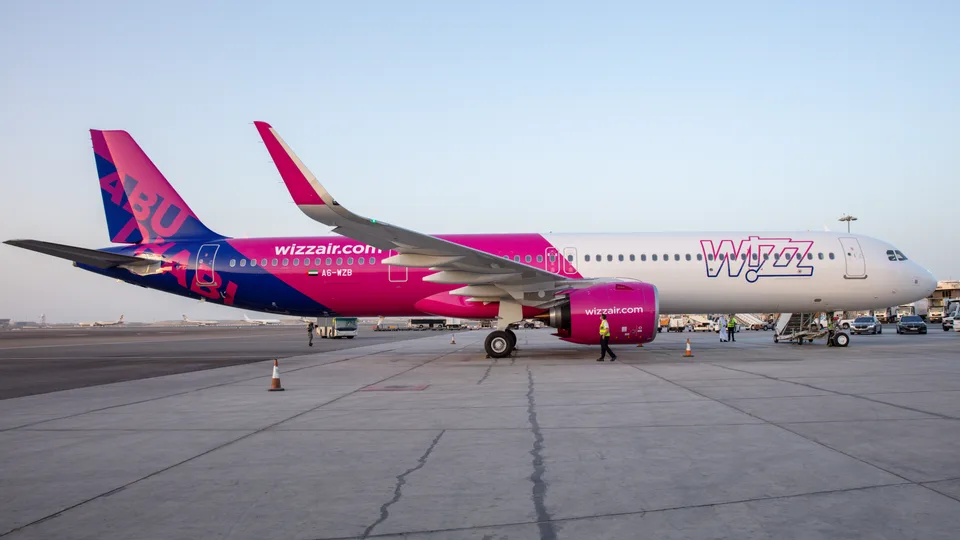
Original photograph unchanged. Responsive WebP copies resized without cropping.
Geographic context
Runway 31L, tail strike
Abu Dhabi, subsequent landing
The tail strike and the subsequent landing occurred on runway 31L at Abu Dhabi. Both markers use the runway midpoint coordinates given by the AAIS. Basemap: Natural Earth, public domain.Read supporting evidence
After a smooth main-gear touchdown, both pilots believed the A321 was still airborne. Reverse thrust was selected unnoticed, a first go-around attempt was interrupted, and the commander then selected TOGA while speed was low. Nose-up inputs raised the tail strike risk before liftoff. The aircraft returned for an uneventful landing.
Read the full incident Follow what happened, from the flight to the investigation findings.
What investigators concluded
The AAIS found that improper high pitch control during a go-around at low airspeed caused the tail strike. Contributing factors included gusty winds, missed monitoring cues, unnoticed reverse selection, excessive rudder corrections, unclear communication and the commander's mistaken assessment of excess energy.
A smooth touchdown followed by a low-speed go-around
1,541 words / about 8 minutes to read. Based on the investigation records cited below.
Arrival from Baku
On 29 April 2023, Wizz Air Abu Dhabi flight WAZ25GR departed Heydar Aliyev International Airport in Baku for Abu Dhabi. The Airbus A321-271NX, registered A6-WZG, carried 208 passengers, two pilots and five cabin crewmembers. The copilot was flying; the commander was monitoring. Takeoff from runway 17 was at 06:15 UTC. The aircraft climbed to flight level 350 and later cruised briefly at flight level 270 before beginning its descent at 08:20.
The crew established the aircraft on the instrument landing system approach to runway 31L. At 08:40:30, the tower cleared it to land and gave a surface wind of 300 degrees at 11 knots. The landing gear was lowered, the spoilers armed and full landing flaps selected. Managed approach speed was set to 137 knots. The pilots disconnected both autopilots at 08:43:54, at 540 feet radio altitude, and continued manually. The AAIS found the aircraft airworthy at dispatch and the flight crew qualified for the flight.
The approach remained on profile apart from a brief excursion about 20 feet below the glideslope at 300 feet radio altitude. Near the threshold, recorder data showed fluctuating airspeed and vertical acceleration consistent with the thermals described by the commander. From 70 feet radio altitude to touchdown, wind direction varied between 305 and 248 degrees and speed between 6 and 20 knots. The peak crosswind component reached approximately 17 knots during the initial flare.
The aircraft crossed the threshold at about 25 feet radio altitude at 08:44:37. The copilot made rudder and sidestick corrections as its heading, bank and drift changed. At 08:44:39, three automatic retard callouts sounded and the thrust levers moved to idle, disconnecting autothrust. The commander made his own retard callout at the same time. He later recalled hearing the 40-foot height callout but could not recall the remaining height calls. The AAIS found that his attention to the aircraft's alignment affected his monitoring of these cues.
The left main gear touched down first at 08:44:43, followed about half a second later by the right main gear. The touchdown was smooth, at approximately 135 knots and eight metres right of the runway centreline. The right gear contacted the runway about 430 metres beyond the threshold, within the touchdown zone. The main gear remained on the runway for roughly 17 seconds, while the nosewheel stayed airborne. Ground spoilers deployed and the aircraft began losing speed.
Both pilots continued to believe that the aircraft was airborne. The copilot made successive rudder corrections as drift changed direction. Investigators considered those inputs slightly disproportionate, contributing to heading and drift fluctuations. About one second after touchdown, the thrust levers moved from idle to maximum reverse and then to reverse idle. Neither pilot recognized the reverse selection. The copilot later said he had never touched down or selected reverse. The AAIS found that his intense focus on alignment probably affected his awareness of touchdown and lever movement.
The recorder showed the right engine reverser deploying for about two seconds and the left for about one second. The idle detent normally prevents movement into reverse during flight and can be overridden on the ground. Investigators considered it possible that the copilot inadvertently used the levers to steady himself during the changing lateral accelerations. They described that physical explanation as a possibility. The movement into reverse was recorded directly.
At 08:44:49, the copilot advanced the thrust levers towards TOGA, the takeoff and go-around position. He believed the aircraft was still airborne and was concerned about its position along the runway. The commander began using his own sidestick while the copilot was still making inputs. The first TOGA selection started retracting the spoilers and increasing engine speed. The commander then pulled the thrust levers back to idle because he intended to continue the landing. The spoilers began deploying again.
The required go-around and control-transfer announcements were omitted. The commander took control without the standard declaration, and the copilot did not acknowledge the handover. At about 08:44:53, the commander reversed his decision and began advancing the levers to TOGA. The copilot asked whether they were on the ground. The commander believed the aircraft had excess energy and assumed its speed remained similar to its threshold speed. Investigators found that he had not checked the actual airspeed. The recorded speed fell to a minimum of 108 knots at 08:44:55.
Simultaneous sidestick inputs continued for about seven seconds, from 08:44:49 to 08:44:56. The A321 added the two pilots' commands algebraically, with the combined command limited to the equivalent of one fully deflected sidestick. When the dual-input warning sounded, the copilot released his stick. The commander called for a go-around at 08:44:57. At that moment pitch was increasing through approximately 9.8 degrees and airspeed was about 111 knots.
TOGA selection retracted the spoilers and deactivated the landing tail strike protection. That protection had previously limited the pitch response despite nose-up commands. With it deactivated, sustained nose-up input and the pitching effect of increasing thrust raised the nose rapidly. The AAIS estimated that tail contact began when pitch reached the 9.7 degree limit while the main gear was still compressed. Contact lasted about three seconds. At 08:45:00, the aircraft lifted off at 118 knots and a maximum pitch of 10.81 degrees. A configuration warning sounded because the flaps and slats remained fully extended.
The go-around continued, but the pilots' duties remained confused. The commander made the positive-climb call normally assigned to the monitoring pilot. The copilot called for gear retraction, normally commanded by the flying pilot. Landing gear retraction occurred before the flaps were moved from full to position 3. The AAIS calculated a 28-second delay between the commander's go-around announcement and that flap selection. It found that the coordination problems had continued into the climb.
At 08:45:38, the crew of another aircraft, GFA543, reported a possible tail strike to ground control. WAZ25GR's crew initially told controllers that they had gone around because of an unstable approach. At 08:55:22, GFA543 contacted them directly and explained that the tail had looked very close to the runway, although its crew was uncertain about contact. The commander checked pressurization and found a normal indication. WAZ25GR completed another ILS approach to runway 31L and landed uneventfully at 09:02:55. No occupant was injured. Inspection found abrasion on the aft lower fuselage between frames 65 and 67 and stringers 42L and 42R. The drain mast assembly required replacement before the next flight.
The aircraft carried two combined cockpit voice and data recorders. Investigators successfully downloaded both the cockpit audio and flight data and also received quick access recorder data. They synchronized the recorder evidence with air traffic control communications. That evidence established main-gear contact, the reverse selections and the overlapping sidestick inputs, despite the pilots' recollections that touchdown had not occurred. The duration of tail contact was estimated from pitch, landing gear state and the aircraft's ground clearance geometry.
The AAIS concluded that improper high pitch control during initiation of a go-around at low airspeed caused the tail strike. It identified gusty landing conditions, missed height and retard callouts, unnoticed idle and reverse selections, slightly excessive rudder inputs and unclear communication as contributing factors. The commander's mistaken belief that the aircraft had excess energy also contributed. Investigators assessed the pilots' attention and awareness using the recorder data, their statements and the sequence of control movements.
The aircraft's tail strike protections operated according to their design. Go-around mode gives the crew full pitch authority so that a required avoidance manoeuvre can be flown. The pitch warning is also inhibited during that phase. The operating manuals required a full-stop landing once reverse thrust had been selected. Existing simulator exercises included rejected landings below 100 feet while airborne, but did not specifically address a go-around after touchdown. The AAIS accepted Airbus's explanation that a prescribed technique for that situation could encourage departures from the normal landing procedure.
The manufacturer explained that an immediate collision threat after touchdown could require a go-around, but that the circumstances could be difficult to distinguish in advance. The AAIS agreed that safety in such an emergency depended on the crew's awareness, basic skills and airmanship. Its analysis found that awareness and airmanship had degraded during this landing. The manuals also cautioned against excessive rotation rate when a go-around was flown near the ground.
The final report recorded remedial simulator training and subsequent line checks for both pilots. The commander received further training in command duties, assertiveness and taking over control during low-altitude, low-energy balked landings, followed by four supervised sectors. The copilot practised crosswind landings and correction after an off-centre touchdown, followed by ten supervised sectors. Wizz Air Abu Dhabi added a policy about rostering new pilots together and circulated safety material stressing standard callouts, timely intervention and the requirement to complete a landing after reverse selection.
Airbus issued training recommendations for go-arounds at very low height, addressing the risk of excessive pitch and tail contact. The AAIS issued three recommendations to Wizz Air Abu Dhabi. SR11/2024 called for training in low-energy rejected landings close to the ground, including simulator practice. SR12/2024 called for renewed emphasis on the monitoring role and its callouts. SR13/2024 called for reinforcement of crew resource management requirements and identification of CRM issues during pilot checks. The AAIS issued its final report on 6 August 2024.
TOGA selection retracted the spoilers and deactivated the landing tail strike protection. Both pilots were applying nose-up commands during part of the sequence.
Pitch reached the tail clearance limit before the aircraft had enough speed to lift off. Contact lasted approximately three seconds, ending at liftoff.
Both pilots made sidestick inputs for about seven seconds. The commander interrupted the first TOGA selection and then initiated another go-around at 08:44:53.
The AAIS estimated that the tail struck when pitch reached the 9.7 degree limit. Contact lasted about three seconds. Liftoff followed at 118 knots and 10.81 degrees of pitch.
The crew of GFA543 told WAZ25GR that its tail had appeared very close to the runway during the go-around. They were uncertain whether contact had occurred.
Why did the aircraft strike its tail during the go-around?
The AAIS found that excessive pitch control was applied while airspeed remained low. The aircraft reached the tail strike pitch limit before its main landing gear left the runway.
The protections were designed to switch off during a go-around to give pilots full pitch authority. TOGA selection retracted the spoilers and deactivated the landing tail strike protection.
What did the investigation recommend for crew coordination?
SR13/2024 asked Wizz Air Abu Dhabi to reinforce its crew resource management requirements and identify CRM issues during pilot checks so individual skills and the overall CRM system could improve.
The AAIS considered it probable that intense attention to alignment affected the copilot's awareness. It also considered that lateral acceleration may have prompted him to use the levers to steady himself.
Cockpit voice and flight data were successfully downloaded. Appendix 2 gives a synchronized event sequence with selected cockpit words and aircraft parameters.
SR11/2024 recommended that Wizz Air Abu Dhabi include techniques for low-energy rejected landings close to the ground and practise them in the simulator.
The copilot omitted the initial go-around callout, and control changed hands without the required announcements. The pilots continued with confused flying and monitoring roles.
Simulator exercises covered rejected landings while airborne, including below 100 feet. The AAIS recommended practice of low-energy rejected landings close to the ground.
These comparisons connect specific research topics. Shared circumstances do not establish identical causes. Evidence from both investigations is provided below.
Both investigations found that the crews had failed to recognize main-gear touchdown before attempting a go-around and had lost awareness of the aircraft's energy state. A6-WZG developed excessive pitch at low airspeed after TOGA selection. Emirates 521's engines remained at idle until the final three seconds before impact, leaving insufficient energy to sustain flight.
Explore the records below for additional context. They open on the publisher's site and are not all included in our report search. Source reuse terms apply.
The final investigation report includes the flight history, recorder sequence, analysis, findings and safety recommendations.
Sources and transparency
The AAIS issued its final investigation report on 6 August 2024.
Source limitations
The AAIS assessed several effects on the pilots' attention and awareness as probable. Recorder data established the touchdown, thrust-lever movements and simultaneous sidestick inputs.
Tail Strike: Wizz Air Abu Dhabi Airbus A321-271NX A6-WZG
UAE GCAA Air Accident Investigation Sector Final report AIFN/0006/2023, issued 6 August 2024
Kevin Murphy writes the incident accounts on AirlineIncidents.com, out of a long interest in aviation safety and the lessons each investigation leaves behind.
Prepared by
AirlineIncidents editorial desk
Report citation check
Independent expert review
Not completed
Citation checks compare supporting text with the indexed report pages. They do not constitute independent expert review. How these pages are prepared.
Revision history
: AAIS final investigation report issued 6 August 2024.
Quoting this account or linking to it? Please use the page address below, and credit the investigation report it is built from.
Credit line
AirlineIncidents.com. Wizz Air Abu Dhabi A6-WZG accident account. Published 31 October 2026. https://airlineincidents.com/incidents/wizz-air-abu-dhabi-a6-wzg-2023/
HTML link
<a href="https://airlineincidents.com/incidents/wizz-air-abu-dhabi-a6-wzg-2023/">Wizz Air Abu Dhabi A6-WZG accident account (AirlineIncidents.com)</a>
Select a box to copy it. Spotted something wrong? Send a correction.