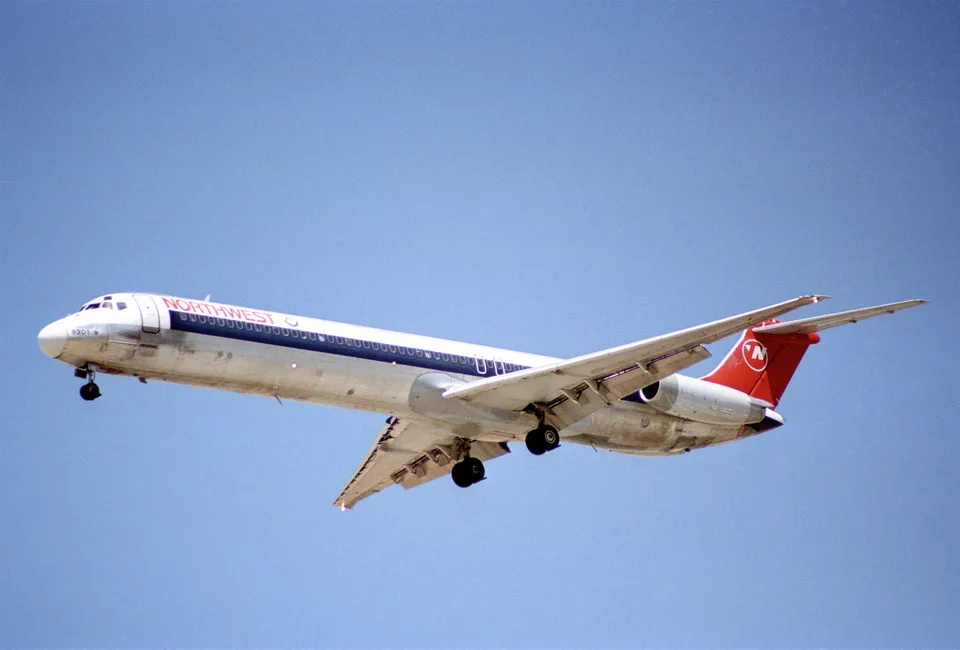
Original photograph downloaded without alteration. Responsive WebP copies resized without cropping.
Geographic context
Detroit accident area
Saginaw, origin
Phoenix, planned next stop
Santa Ana, planned destination
City markers are approximate. The accident marker uses the coordinates given by the NTSB. The Detroit departure ended near the airport. Basemap: Natural Earth, public domain.Read supporting evidence
Flight 255 took off from Detroit with both flaps and slats retracted. Stall warnings began at liftoff, and the aircraft gained little height before its left wing struck a light pole. It hit further obstacles, broke apart and burned. A child was the sole survivor aboard.
Read the full incident Follow what happened, from the flight to the investigation findings.
What investigators concluded
The NTSB attributed the accident to the crew's failure to use the taxi checklist to ensure flap and slat extension. The absence of electrical power to the takeoff warning system was a contributing factor. The investigation could not determine why that power was absent.
Northwest 255: the takeoff configuration and the missing warning
1,577 words / about 8 minutes to read. Based on the investigation records cited below.
The Detroit stop
On 16 August 1987, Northwest Airlines flight 255 was operating a scheduled passenger service from Saginaw, Michigan, to Santa Ana, California, with stops at Detroit and Phoenix. The aircraft was N312RC, a McDonnell Douglas DC-9-82, also known as an MD-82. The same flightcrew had flown it into Saginaw earlier that evening and then brought it to Detroit. The departure from Detroit carried 149 passengers and six crewmembers.
Flight 255 reached its Detroit gate at about 19:42. After passengers disembarked, a mechanic reviewed the aircraft and cabin maintenance logs and found no discrepancies. The report recorded no maintenance work during the stop. The first officer signed the flight release while the captain was outside conducting a walkaround inspection. The captain then examined the signed release and accepted it.
The final weight information arrived before pushback. At about 20:32, flight 255 left the gate. During pushback, the pilots worked through the before-start checklist and began starting the engines. The captain subsequently taxied the aircraft toward its departure runway.
Detroit had changed its active runway direction shortly before flight 255 began taxiing. The dispatch performance information covered departures from runways 21L or 21R, but ground control assigned runway 3C, the shortest of the three available runways. The updated airport information included a temperature of 88 degrees Fahrenheit and low-level windshear advisories.
At 20:37:08, the captain asked whether runway 3C could be used. The first officer consulted the runway takeoff weight charts. Their aircraft weighed 144,047 pounds, and the chart permitted the departure with the planned 11-degree flap setting and takeoff slat position. The first officer confirmed that the runway was usable, and the captain agreed.
Other taxi tasks competed for attention. The first officer listened to the updated airport broadcast but initially failed to change to the ground frequency specified by the controller. The captain missed the turn at taxiway Charlie. Ground control supplied a revised route and repeated the frequency change. The flight was also behind schedule, with a curfew at Santa Ana and weather that could bring further delay. The NTSB identified these circumstances as distractions during the departure preparations.
The MD-82 used trailing-edge flaps and leading-edge slats to increase wing lift for takeoff. A single control handle selected their positions. Northwest procedures assigned the first officer the task of extending them after taxi began and the aircraft cleared the parking ramp and nearby obstacles. The first item of the taxi checklist then required both pilots to check and verbally verify the flap and slat positions.
The cockpit voice recording showed that neither pilot called for or completed the taxi checklist. The first officer was handling the airport broadcast and the new runway performance calculation around the time he would normally extend the flaps. The NTSB could not conclusively determine why he omitted that action. It considered that the interruptions and the familiar habit of completing the task early in taxi could have led the crew to believe it was already done.
Company procedures required the captain to initiate each ground checklist by name, with the first officer prompting him if necessary. Completion also required a spoken announcement identifying the finished checklist. Only the before-start checklist received that closure during the departure preparations. The captain did not call for the after-start, taxi or before-takeoff checklists. The NTSB found that this departure from the prescribed structure removed the backup provided by joint checklist initiation and increased vulnerability to distraction and memory lapses.
The tower cleared flight 255 into position at 20:42:11 and issued takeoff clearance at 20:44:04. During the takeoff roll the pilots initially could not engage the autothrottles because the thrust computer had not been placed in takeoff mode, another taxi-checklist item. They corrected that omission before reaching 100 knots. The takeoff configuration warning remained silent.
The first officer called for rotation at 20:44:57.7. The aircraft lifted off at about 169 knots indicated airspeed. The stick shaker began operating at liftoff, and supplemental audible stall warnings followed. During the approximately 14 seconds in which the aircraft remained flyable, its indicated airspeed increased to about 184 knots, while it climbed only about 48 feet.
After liftoff the captain raised the nose further, and the aircraft began rolling from side to side. The NTSB calculated that the rolls and the control inputs used to oppose them reduced climb capability by about 20 percent. The left wing struck a light pole 2,760 feet beyond the runway end. The impact ruptured wing fuel tanks, and released fuel entered the left engine and ignited. The aircraft struck further obstacles and a rental car building, hit a road outside the airport boundary, and broke apart as it crossed a railroad embankment and continued along the ground.
All six crewmembers and 148 passengers died. One passenger, a four-year-old child, survived with serious injuries. Two people on the ground were killed, one was seriously injured and four suffered minor injuries. The total death toll was 156. Three occupied road vehicles and numerous unoccupied vehicles in the rental car lots were destroyed by impact or fire.
The airport fire department received the tower notification at 20:46 and dispatched all available crash equipment. Airport firefighters reached the scene at 20:49. Units from the Romulus Fire Department arrived at the highway overpass where the cockpit wreckage lay and began rescue and firefighting work. Localized fuselage and spot fires had been extinguished by 21:02.
The surviving child was found in wreckage beneath a highway overpass. Her assigned seat was 8F. The impact sequence destroyed the cabin space and separated the passenger seats from the fuselage. The NTSB found that the fatalities resulted from multiple blunt force trauma and that the crash forces exceeded human tolerance. It attributed the child's survival to a combination of fortuitous circumstances.
Recorder data and wreckage established the wing configuration
The investigation examined windshear because alerts and pilot reports had occurred near the airport before the accident. Recorder data showed increasing indicated airspeed during the short flight, and the relationship between airspeed and groundspeed supported the finding that flight 255 had not encountered windshear. The persistent stall warnings at the recorded speeds were consistent with both flaps and slats remaining retracted.
The digital flight recorder showed retracted flaps and slats throughout the recorded departure. Two brief recording gaps occurred when the parking brakes were applied. The configuration values before and after each gap were identical, and the data showed no movement of the slats or disagreement between the slats and the handle selection. The NTSB concluded that the handle had remained in its UP/RET position.
Physical evidence supported that conclusion. Damage on the inboard flap tracks matched the locations of the fuselage rollers when the flaps were fully retracted. Broken slat drive cables in the wing section that separated at the first pole strike aligned with the wing fracture when the slats were retracted. Impact marks in the recovered handle mechanism also supported its position before impact.
Two pilot witnesses recalled seeing extended lift devices during the takeoff. Their observations occurred in twilight. The NTSB judged the recorder data, physical damage and aerodynamic performance more reliable. Its performance study showed that extending the slats, with either the planned flaps or retracted flaps, would have provided clearance of roughly 400 to 600 feet over the first pole.
The takeoff warning was part of the central aural warning system. Its second internal power supply received 28-volt direct current from the aircraft's left electrical bus through circuit breaker P-40. That supply also served the captain's supplemental stall alarm. The first officer's stall alarm used a different power supply.
Analysis of the recorded stall warning found only the first officer's alarm. The normal echo produced by both channels was absent. The recovered warning unit passed functional testing, and its internal fault relay had not latched. Other recorded systems showed that the left electrical bus remained powered. The NTSB traced the interruption to the input circuit at P-40.
The breaker was badly damaged, preventing a positive determination of its condition before impact. Investigators considered intentional opening, a trip caused by a transient overload, and failure to conduct current while appearing closed. The NTSB could not determine which condition interrupted the power. The report's correction sheet added a finding that loss of aircraft input power to the warning unit did not illuminate the cockpit CAWS fail light.
The NTSB adopted its final report on 10 May 1988. It found that the probable cause was the crew's failure to use the taxi checklist to ensure that the flaps and slats were extended. The missing electrical power to the takeoff warning system contributed by leaving the crew without the warning of their incorrect configuration.
The Board also examined the response after liftoff. It believed the crew interpreted the stall warnings as a windshear encounter, influenced by repeated advisories and their belief that the aircraft was correctly configured. The combination of rolling, continuous warnings and imminent ground contact concentrated their attention on aircraft control. The report judged the short time available probably inadequate for a complete assessment of the condition.
On 1 September 1987, McDonnell Douglas had recommended checking the takeoff warning before departing the gate on every flight. The final report stated that all DC-9-80 operators had incorporated that checklist change. The NTSB recommended research into circuit-breaker reliability, a warning-system modification to indicate lost input power, clearer design guidance, disciplined checklist use, research into checklist presentation and team-oriented crew training. It also called for MD-80 training to address lateral control and loss of climb capability near the supplemental stall warning activation point.
A simplified reading of the investigation findings. The sequence does not replace the full report or imply that every contributing factor is shown.
Sequence of events
Times are eastern daylight time. The report synopsis gives the accident time as about 20:46; the detailed departure sequence uses cockpit recorder times. Expand an event to see its evidence.
About 20:32Departure from the gate
Flight 255 leaves the Detroit gate with 149 passengers and six crewmembers.
The captain asks whether runway 3C can be used. The first officer checks the weight charts and confirms it is usable with the planned takeoff configuration.
The NTSB found that the crew failed to use the taxi checklist to ensure that the flaps and slats were extended for takeoff. Loss of electrical power to the takeoff warning system contributed to the accident.
The takeoff warning system lacked its 28-volt electrical input through circuit breaker P-40. The NTSB could not determine which of the three possible breaker conditions interrupted the power.
One of the 155 people aboard survived: a four-year-old passenger with serious injuries. There were 154 deaths aboard and two deaths on the ground. Five people on the ground were injured, one seriously and four with minor injuries.
The damaged P-40 breaker prevented a positive determination of its condition before impact. The NTSB considered intentional opening, a transient-overload trip and failure to conduct while appearing closed; it could not choose between them.
The NTSB could not determine conclusively why the first officer failed to lower the flaps. It identified competing taxi tasks and familiar task habits as possible influences.
The NTSB believed the crew thought they had encountered windshear. It judged the 14 seconds of flyable time probably inadequate to assess the complete condition while responding to rolling, stall warnings and imminent ground contact.
Actions and recommendations are described at the dates of the cited records. A recommendation is not proof of implementation.
Warning check before every flight
McDonnell Douglas recommended a takeoff warning check before every gate departure on 1 September 1987. By the final report's adoption, all DC-9-80 operators had incorporated the checklist change.
Recommendations A-88-64 through A-88-66 addressed breaker reliability, indication of lost CAWS input power and guidelines for central warning-system design.
Recommendations A-88-69 through A-88-71 called for team-oriented training, MD-80 instruction on lateral control and climb loss near stall, and exercises evaluating coordinated crew performance.
These comparisons connect specific research topics. Shared circumstances do not establish identical causes. Evidence from both investigations is provided below.
Northwest 255 and Spanair 5022 both involved MD-82 departures with the flaps and slats undeployed and no takeoff configuration warning. The NTSB found an omitted taxi checklist and an electrical input interruption at P-40 in Northwest 255. The CIAIAC identified missed selection and verification steps across several checklists in Spanair 5022, together with a failed warning system whose failure mechanism could not be reliably established.
Explore the records below for additional context. They open on the publisher's site and are not all included in our report search. Source reuse terms apply.
The NTSB's final investigation report, including factual information, performance analysis, conclusions, safety recommendations and the correction sheet.
Sources and transparency
NTSB final report adopted 10 May 1988.
Source limitations
The NTSB could not determine conclusively why the first officer omitted flap extension.
Northwest Airlines flight 255, Detroit, 16 August 1987
NTSB Final report NTSB/AAR-88/05, adopted 10 May 1988, with correction sheet.
Kevin Murphy writes the incident accounts on AirlineIncidents.com, out of a long interest in aviation safety and the lessons each investigation leaves behind.
Prepared by
AirlineIncidents editorial desk
Report citation check
Independent expert review
Not completed
Citation checks compare supporting text with the indexed report pages. They do not constitute independent expert review. How these pages are prepared.
Revision history
: NTSB final report adopted 10 May 1988, including its correction sheet.