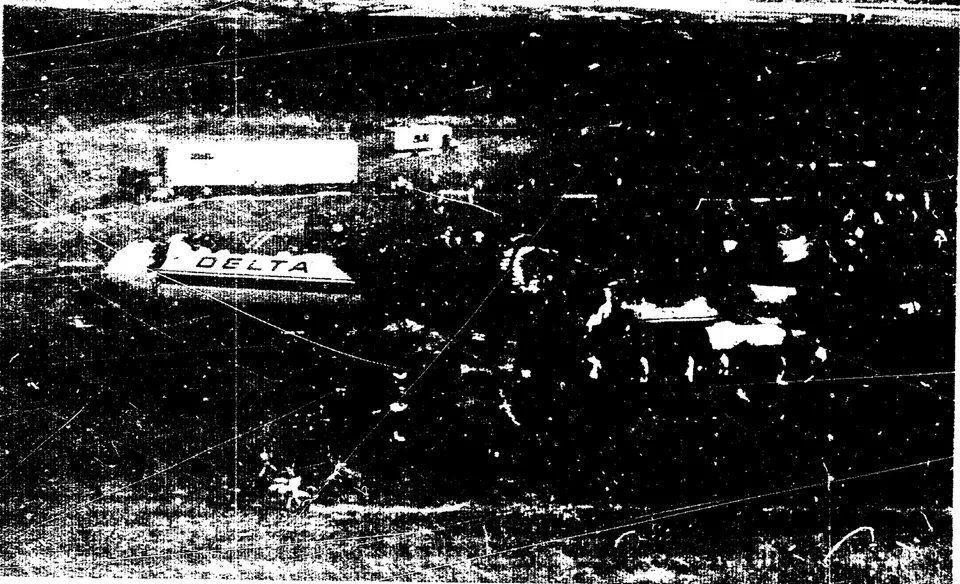
A Boeing 727 lifted off at Dallas-Fort Worth with its flaps and slats retracted. The configuration warning stayed silent, and the aircraft stalled close to the ground.
Photograph cropped from the report figure and resized. Scan marks remain visible. Responsive WebP copies resized without cropping.
Geographic context
Accident site at Dallas-Fort Worth
Salt Lake City destination
The accident marker uses the coordinates given by the NTSB. Salt Lake City is the planned destination. The destination marker identifies the airport approximately. Basemap: Natural Earth, public domain.Read supporting evidence
Delta Flight 1141 accelerated normally, but its retracted flaps and slats left insufficient lift for the planned takeoff. After liftoff it stalled, rolled and struck the localizer installation beyond the runway. Impact damage and a fuel fire destroyed the aircraft.
Read the full incident Follow what happened, from the flight to the investigation findings.
What investigators concluded
The NTSB attributed the accident to inadequate cockpit discipline by the captain and first officer, which led to takeoff with the flaps and slats improperly configured, and failure of the takeoff configuration warning. Delta's slow procedural changes and insufficient FAA action and inspector accountability contributed.
1,772 words / about 9 minutes to read. Based on the investigation records cited below.
The stop before Salt Lake City
Delta Flight 1141 arrived at Dallas-Fort Worth on the morning of 31 August 1988 after an uneventful flight from Jackson, Mississippi. The Boeing 727-232, registration N473DA, was operating a scheduled passenger service to Salt Lake City with an intermediate stop in Texas. The first officer had flown the incoming leg. The captain and first officer went to company operations, while the second officer stayed with the aircraft and carried out his walkaround duties.
An inoperative main fuel tank quantity gauge was the recorded defect. Delta's minimum equipment list permitted operation with that gauge unavailable, and ground staff used measurements to establish the fuel already aboard and the amount to add. The NTSB later found that the aircraft had been refueled properly. It found no fuel imbalance that could have caused the loss of control.
There were 101 passengers and seven crew aboard for the next leg. Pushback took place at 08:30. All three engines were initially started, but as a departure delay developed the captain shut down the third engine to conserve fuel. Part of the taxi checklist and the before takeoff checklist would be completed after that engine was restarted.
Delta's procedure assigned the first officer the action of setting the flaps after leaving the ramp area. At the point when that action would normally have occurred, ramp control instructed the aircraft to give way to another airplane. The first officer became involved in a discussion with the captain about its position. When Flight 1141 moved again, the second officer began the taxi checklist and the first officer responded to its items. A lengthy conversation with a flight attendant followed. The NTSB found that interruptions at these points displaced the first officer's normal sequence of actions.
The captain allowed conversations unrelated to the flight to continue during ground preparations. He relied on the other crewmembers to carry out cockpit activities and did not actively set their pace. The second officer initiated checks and the cabin preparation announcement. The NTSB found that cockpit discipline and coordination had deteriorated and that the crew failed to discover the retracted flaps during the available taxi time.
The aircraft was fourth in the departure queue when preparations to restart the third engine began. The tower then cleared Flight 1141 onto runway 18L ahead of the aircraft waiting on the taxiway. The crew hurried to complete the deferred items. When the second officer challenged the flap setting, the first officer answered, "Fifteen, fifteen, green light." The responses followed the challenges so quickly that there was little time to carry out or verify the actions.
At the public hearing the crewmembers said that they normally checked the flap indicators and the leading edge light, but none specifically recalled doing so on this flight. The NTSB concluded that the first officer answered the flap challenge without examining the indicators and light. The captain was occupied with taxiing onto the runway, and the second officer was completing his checks.
The tower issued takeoff clearance at 08:59:17. Increasing engine noise was recorded at 08:59:35, followed by calls that power was set and the engine instruments looked good. The takeoff configuration horn remained silent. The second officer noticed that the auto pack trip arming light had not illuminated. He did not tell the captain because the system was not required for that takeoff. The NTSB found that this malfunction should have been reported.
The takeoff roll accelerated normally, and the captain began rotation at the speed appropriate for the intended flap setting. The aircraft's geometry limited the noseup attitude while its main wheels were still on the runway. Marks showed that the tail skid contacted the surface around liftoff. The airplane finally became airborne at about 158 knots calibrated airspeed, substantially later in the acceleration than the performance calculations predicted for the planned configuration.
The stickshaker sounded at 09:00:15.1. The aircraft rolled sharply right, its right wingtip contacted the runway, and compressor surge sounds followed. It reached only about 20 feet above its liftoff point before descending. The captain continued to increase the angle of attack as he tried to climb. Aerodynamic separation over the wings reduced lift and produced the rolling instability. Turbulent airflow reaching the rear mounted engines was consistent with the compressor surges.
The captain called for full power at 09:00:34.7. The first impact sound followed at 09:00:35.3. Flight 1141 struck the localizer installation beyond runway 18L and continued across the ground, stopping about 3,200 feet beyond the departure end. The report calculated approximately 22 seconds between liftoff and the impact near the localizer. Impact forces and the ensuing fire destroyed the aircraft.
Investigators examined the flap control lever, flap drive mechanisms, aileron lockouts and leading edge actuators. The flap lever was in the retracted detent. Its intact locking mechanism required a sequence of deliberate movements to bring it back from a takeoff setting. The trailing edge flap drives were also near their fully retracted positions. Their irreversible design prevented loads applied to the flap surfaces during impact from rotating the jackscrews backward. The aileron lockout mechanisms provided further evidence of retracted flaps.
The wreckage contained leading edge actuators in different positions. The NTSB traced those differences to structural separation and a possible momentary movement of the control linkage while hydraulic pressure remained. It assessed each mechanism's locking behavior and the sequence in which the leading edge devices extended or retracted. The combined physical evidence supported full retraction before impact.
The performance study then compared the recorded flight with calculated configurations. A wing with only the inboard flaps retracted would have retained the stall margin provided by extended leading edge devices and would have climbed. The delayed liftoff, sudden roll, compressor surges and low flight path instead matched a wing with all its high lift devices retracted. The NTSB also ruled out weather, wake vortices and a preimpact engine failure as causes.
The second officer's observation of the unlit auto pack trip light supplied another indication. That system's arming circuit depended on the inboard flaps being out of the retracted position. Investigators found the flap up limit switch open. The NTSB's performance calculations identified a marginal opportunity to recover after liftoff through prompt maximum thrust and reducing the angle of attack. The captain continued to increase that angle and failed to apply maximum power in accordance with Delta's procedures.
The takeoff warning system was intended to sound when the third engine thrust lever was advanced with an unsuitable configuration. The throttle switch first had to arm the circuit. A cam and actuator transferred thrust lever movement to the switch plunger, completing the electrical path to the warning horn and the aircraft's configuration switches.
During the initial examinations, the recovered switch failed to show electrical continuity on its first two activations and operated on the third. Investigators saw blue green corrosion around its terminals. Further examinations revealed contamination inside the switch and inconsistent contact between its actuator button and plunger. They also found conflicting adjustment guidance in Boeing's maintenance manual and service bulletin.
A weak and intermittent warning horn had been recorded during maintenance about three weeks before the accident. Maintenance personnel replaced the horn and tested the system. The removed horn worked after its contacts were cleaned. The NTSB found that an intermittent warning system problem had survived that maintenance intervention and appeared during Flight 1141's takeoff. It recommended an engineering study of the system, particular attention to the throttle switch installation, and changes based on the study's results.
The fuselage separated in several places, but much of the cabin's occupiable space remained. People escaped through breaks in the fuselage and usable exits on the left side. Fire spread from the right side into the rear cabin, through damaged cargo areas and openings in the aircraft. The left aft service door could not be opened because repeated ground impacts had distorted its frame. The aft airstairs were unusable with the aircraft resting on its fuselage, and the pressure bulkhead door was jammed.
Fire blocking material covering the seat cushions slowed the spread of fire and gave occupants additional time to leave. Some cushions remained intact or showed the material had inhibited burning. The forward cabin remained survivable until firefighters were applying extinguishing agents about four minutes and twenty seconds after the accident. The last people escaping reported being struck by foam.
The airport's initial emergency notification was timely and efficient. Automated calls and radio alerts brought firefighters, police and medical personnel into a coordinated response. Paramedics stabilized injured people and transported them to area hospitals in less than an hour. Cellular telephones in ambulances and command vehicles helped coordinate medical care and track patients.
Fourteen people died: twelve passengers and two flight attendants. Smoke inhalation caused the deaths of eleven passengers and the two flight attendants. Another passenger escaped and then attempted to reenter the burning cabin; he died from severe burns eleven days later. The injury table records twenty six serious injuries, fifty minor injuries and eighteen uninjured occupants. Ninety four of the 108 people aboard survived.
The NTSB found that the FAA already knew about deficiencies in Delta's crew performance, training and checking programs. Inspection teams had observed poor cockpit discipline, coordination problems and improper checklist use. Delta's philosophy gave captains extensive discretion, while guidance about specific crew responsibilities was inadequate. Different answers about who should verify the flaps revealed that uncertainty within the airline's operating and training organization.
The Board found that neither Delta nor the FAA had taken sufficient corrective action. Its probable cause statement identified the captain's and first officer's inadequate cockpit discipline and failure of the configuration warning. It also identified Delta's slow implementation of changes following growth and merger, insufficiently aggressive FAA action and weak inspector accountability as contributing factors. Board member Jim Burnett agreed with the facts and findings and dissented from the probable cause statement. He considered Delta's management and the FAA to have been direct causes.
By February 1989, Delta had received FAA approval for revised operating and training procedures. New checks identified critical items, required verification and clarified crew duties. The revised Boeing 727 checklist required the first officer to verify the flap position during taxi and both pilots to verify it before takeoff. Delta also introduced organizational changes and a cockpit resource management training program.
The NTSB's final report called for clearly assigned visual checks, flap verification during stall recognition and recovery, stronger followup of airline inspection findings and required cockpit resource management training. It recommended checking the Boeing 727 takeoff warning system before each flight. Recommendations also addressed airline flight safety programs, refueling with inoperative quantity gauges, emergency notification systems and bolt cutters for rescue vehicles.
A simplified reading of the investigation findings. The sequence does not replace the full report or imply that every contributing factor is shown.
Sequence of events
Times are central daylight time. The report summarizes the accident as about 09:01; the recorder places the first impact at 09:00:35.3. Expand an event to see its evidence.
08:30Pushback at Dallas-Fort Worth
The aircraft pushed back for the Salt Lake City leg. During the departure delay, the captain shut down the third engine to conserve fuel.
The crew restarted the third engine and completed deferred checklist items. The first officer gave the flap response of fifteen degrees and a green light.
The aircraft struck the localizer installation and continued across the ground. It stopped about 3,200 feet beyond the runway departure end and burned.
People escaped through fuselage breaks and usable exits as fire spread through the cabin. Firefighters applied extinguishing agents about four minutes and twenty seconds after the accident.
How did investigators establish that the flaps were retracted?
The flap drive mechanisms were found near the retracted position and could not be driven backward by impact loads on the flap surfaces. The control lever and aileron lockout mechanisms supported that evidence. The recorded takeoff performance matched a wing with its flaps and slats retracted.
The recovered throttle switch operated intermittently during examination and showed corrosion contamination. The NTSB found that contamination or misalignment of the switch most likely prevented the system from warning the crew.
Breaks in the fuselage and usable left side exits provided escape routes. Fire blocking material on the seat cushions slowed the fire and saved lives. Airport firefighters and medical teams carried out a coordinated rescue.
Actions and recommendations are described at the dates of the cited records. A recommendation is not proof of implementation.
Delta revised checks and crew duties
The report records FAA approval of revised operating and training procedures in February 1989. The new Boeing 727 checks required flap verification during taxi and before takeoff.
Recommendations A-89-125 and A-89-126 sought an engineering study and warning system modifications based on its results. A-89-127 sought a functional check before each flight.
These comparisons connect specific research topics. Shared circumstances do not establish identical causes. Evidence from both investigations is provided below.
Both investigations found that checklist failures allowed takeoff with the flaps and slats retracted while the configuration warning failed. For Delta 1141, the NTSB examined an intermittently operating throttle switch. For Spanair 5022, the CIAIAC could not reliably establish why the warning system failed.
Explore the records below for additional context. They open on the publisher's site and are not all included in our report search. Source reuse terms apply.
Official English translation of the Spanair 5022 investigation, including configuration checks and the failed takeoff warning.
Sources and transparency
The NTSB adopted its final investigation report on 26 September 1989.
Source limitations
The foil flight data recorder recorded altitude, airspeed, heading and normal acceleration. Investigators established wing configuration from wreckage, recorded sounds and performance calculations.
Delta Air Lines Boeing 727-232 accident at Dallas-Fort Worth
NTSB Final report NTSB/AAR-89/04, adopted 26 September 1989
Public domain United States government report. NTSB reproduction policy applies to government material. Separately credited third party material retains its own rights.
Report A-032/2008: Accident involving MD-82 EC-HFP at Madrid-Barajas on 20 August 2008
CIAIAC Official English translation of the final report approved 26 July 2011
Kevin Murphy writes the incident accounts on AirlineIncidents.com, out of a long interest in aviation safety and the lessons each investigation leaves behind.
Prepared by
AirlineIncidents editorial desk
Report citation check
Independent expert review
Not completed
Citation checks compare supporting text with the indexed report pages. They do not constitute independent expert review. How these pages are prepared.
Revision history
: Published sourced incident account, timeline, photographs and investigation findings.