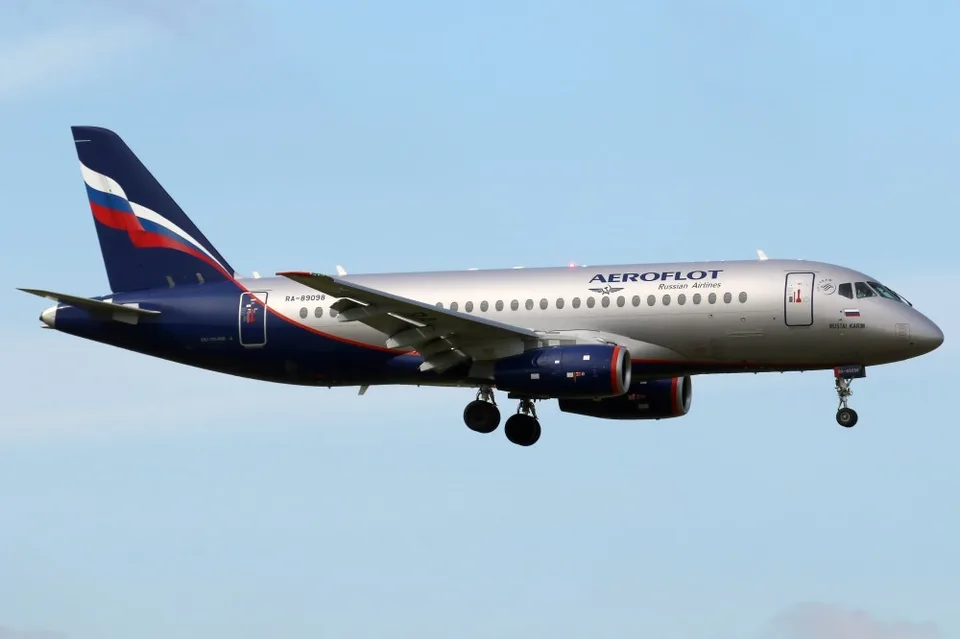
Original photograph used without cropping. Responsive WebP copies resized without cropping.
Geographic context
Sheremetyevo airport reference point
Aircraft stopping position beside runway 24L
The flight departed Sheremetyevo for Murmansk and returned to Sheremetyevo. The markers show the airport reference point and aircraft stopping position. Basemap: Natural Earth, public domain.Read supporting evidence
Lightning was followed by the loss of the autopilot, a radio failure and reversion to Direct Mode. During the return landing, alternating pitch inputs produced three hard touchdowns. Damaged landing gear and wing structure released fuel, and fire spread into the rear cabin.
Read the full incident Follow what happened, from the flight to the investigation findings.
What investigators concluded
MAK attributed the accident to the captain's uncoordinated pitch inputs during the flare and bounces. Training, safety monitoring, operating guidance and approach decisions contributed. The report also identified risks in landing-gear certification and protection against external fire.
1,734 words / about 8 minutes to read. Based on the investigation records cited below.
Departure into thunderstorm activity
Aeroflot flight SU-1492 was scheduled to fly from Moscow Sheremetyevo to Murmansk on 5 May 2019. The RRJ-95B, registered RA-89098, carried 73 passengers, two pilots and three cabin crewmembers. The captain flew from the left seat. The aircraft had arrived from an earlier flight with no reported technical concerns. During preparation, the pilots discussed an immediate return if an emergency arose after takeoff. The airport weather broadcast reported cumulonimbus clouds, and the pilots observed weather returns before departure.
Air traffic control cleared takeoff from runway 24C at 15:02:23 UTC. After liftoff, the crew retracted the landing gear and engaged the autopilot. The aircraft followed the assigned departure, then began a right turn toward thunderstorm activity. MAK's reconstruction found that a change to heading mode started the turn earlier than the departure procedure required. The crew made no request to avoid the storm cells. Controllers had received avoidance requests from other aircraft but did not pass that information to flight 1492. At about 15:08:10, a noise lasting roughly one and a half seconds appeared on the cockpit voice recording as the aircraft encountered atmospheric electricity.
At 15:08:12, the autopilot disconnected and the flight control system announced Direct Mode. Channels A of both engine interface units had rebooted, interrupting the data they supplied to other systems. Direct Mode placed the aircraft under manual control and required manual pitch trim. Its usual automatic pitch and roll stabilization, flight-envelope limiting functions and turn coordination were unavailable. Electrical commands proportional to the sidestick and pedal movements went to the control-surface actuators through the actuator control electronics. The autothrottle initially remained engaged; the captain disconnected it by moving the thrust levers at 15:08:47.
The captain decided to return and instructed the first officer to transmit PAN-PAN. Attempts using the first radio failed. The pilots selected transponder code 7600, and two-way contact was restored through the second radio on 121.5 MHz. They reported the radio difficulty and Direct Mode, then received descent instructions and vectors toward Sheremetyevo. The first officer initially read the autopilot-disconnection checklist and tried to reengage the autopilot. After the captain repeated his request for the Direct Mode procedure, the first officer read that checklist. It required careful maneuvering, manual trim, flaps 3 for landing and manual deployment of the landing spoilers. When the crew said they were unready for approach, the controller provided a circuit and later a longer approach.
The aircraft weighed about 42,600 kg, approximately 1,600 kg above its maximum landing weight. The first officer raised the overweight-landing checklist and the captain agreed to perform it. The cockpit recording contained no discussion of burning off fuel to reduce the weight. The RRJ-95 had no fuel-dumping system. The crew turned off both engine air supplies to obtain the maximum available thrust if a go-around became necessary. They also reviewed the overweight-landing limit of 360 feet per minute for the vertical speed at touchdown.
Maintaining the assigned altitude in Direct Mode proved difficult. During turns, deviations exceeded 200 feet above or below the target and triggered repeated altitude alerts. The first manual stabilizer adjustment after the mode change occurred at 15:22:25, more than 14 minutes after the autopilot disconnected. Further adjustments followed during approach preparation. By 15:23:58, the landing gear was extending and the stabilizer was near its final setting. The crew selected flaps 3 and prepared an ILS approach using the instrument indications. They armed the spoiler handle, although automatic deployment was disabled in Direct Mode. The landing checklist was completed, but the approach checklist and before-landing briefing were omitted. The pilots set code 7700 at 15:26:30 and gave controllers no explanation for the change.
The crew began the glideslope descent at 15:27:20. Airspeed was generally between 155 and 160 knots, and the aircraft flew slightly below the glideslope. The captain held residual aft pressure on the sidestick instead of fully trimming the aircraft for the descent. At 15:28:26, the predictive windshear system sounded its go-around warning. The warning remained active for 11 seconds, with repeated voice messages. The pilots did not discuss it and continued the approach. After decision height, the aircraft moved farther below the glideslope and triggered another warning. The captain acknowledged that alert and continued.
An increase in engine power raised the airspeed. The aircraft crossed the runway threshold at about 165 knots and reached a maximum recorded 172.9 knots near the ground. MAK found that the crew's handling of the windshear warning led to an encounter with a microburst during the early flare. The increased airspeed made the pitch response to sidestick movement more dynamic in Direct Mode. At the thrust-retard callout, the captain reduced the thrust levers and began the flare with a substantial aft input. He then made increasingly large forward and aft movements, reaching both stops and holding the stick there. Pitch alternated from about six degrees nose up to two degrees nose down as the aircraft approached the first touchdown.
The first touchdown occurred at 15:30:00, about 900 m beyond the runway threshold, at 158 knots. The aircraft contacted the runway on all three landing gear with a recorded vertical acceleration of at least 2.55 g, then bounced. The spoilers remained retracted. At touchdown the captain moved from full aft to full forward sidestick and held the forward position for about a second. The aircraft pitched down, and the second touchdown followed 2.2 seconds later at 155 knots, with the nose gear contacting first. A strong nose-up rotation accompanied that impact, which produced at least 5.85 g and another bounce to roughly five metres.
After the first bounce, the captain selected maximum reverse thrust. The reverser doors deployed when the required landing-gear signals became available. Following the second bounce, he pulled the sidestick fully aft and moved the thrust levers to maximum forward thrust. The doors were still open and beginning to stow, so thrust did not increase. At 15:30:06, the third touchdown occurred at 140 knots with at least 5 g. The main landing gear had already suffered attachment damage. Its weakened structure could not absorb the next impact, and wing structure and fuel tanks ruptured. Fuel spilled and ignited. The aircraft slid on its engine nacelles, veered left and stopped off the runway at 15:30:38.
MAK's structural analysis distinguished the impacts. It found no structural destruction from the first. The second sheared attachment fuse pins as designed but left the main gear partly attached, with no fuel leakage identified. At the third, the damaged gear transferred extreme loads into other structure, producing multiple wing-box ruptures.
The cabin attendants had seen the fire during the landing roll. The attendant at the right front door began opening it after the aircraft stopped, and it opened at 15:30:46. The slide inflated in four seconds. The chief attendant opened the left front door at 15:30:55, and its slide inflated in five seconds. MAK found the attendants' decision to start evacuation without waiting for a flight-deck command appropriate to the visible fire and smoke. The rear exits were within the fire area and could not be used for evacuation.
Communication errors complicated the response. The first officer's cabin alert went over the second radio, so the attendants could not hear it. The chief attendant's evacuation announcement was sent to the cockpit instead of the cabin public-address system. Most surviving passengers did not report hearing the command, and the attendants did not use the megaphones. Passengers moved toward the front through smoke. Some retrieved hand luggage and obstructed movement in the aisle. Four more passengers escaped after the front attendants had left, assisted by the pilots and another passenger. The last surviving passenger departed at 15:32:32. In total, 24 passengers used the right front exit and nine used the left. The engines continued running during the initial evacuation and shut down at about 15:31:34.
The accident killed 40 passengers and the rear cabin attendant. Four crewmembers and 33 passengers survived, with nine serious injuries and 28 minor injuries. MAK concluded that exposure to open flame, together with upper respiratory-tract burns from inhaling hot air, caused 40 of the 41 deaths. Fire entered the rear cabin through a group of windows on both sides. The investigation found that cabin-window airworthiness requirements contained no criterion for resisting an external fuel fire. The rear cabin therefore became hazardous before the 90-second interval used in evacuation demonstrations had elapsed.
MAK identified the continued engine operation, fuel in the exhaust streams, unusable rear exits, flashover, congestion and luggage retrieval as probable factors increasing the severity. Its fire simulation found that opening the left rear door had no effect on the outcome. The first firefighting vehicle arrived and began extinguishing at 15:32:07. The response met the applicable arrival standards, measured from the alarm declaration at 15:30:58. The final report also examined the relationship between evacuation demonstrations and firefighting response times, and recommended reassessing the aircraft's protection against fire entering from outside. Those recommendations addressed both the rapid fire spread and the time available to escape.
MAK closed the investigation on 10 March 2025. Its final report attributed the accident to the captain's uncoordinated control inputs during the flare, landing and repeated bounces. It identified ineffective training for Direct Mode and weak monitoring of pilots' landing technique as contributing factors. The approved programs met minimum regulatory requirements, but they did not prepare the crew adequately for the specific abnormal situation. The report also identified unclear landing guidance, thunderstorm-avoidance failures, inadequate trim, excessive approach speed and failure to deploy the spoilers manually. Activation of reverse thrust after the first bounce made the subsequent go-around impossible.
The equipment analysis found that the aircraft's performance matched the type's characteristics in the flight conditions examined. MAK also identified a certification issue: landing-gear strength requirements and demonstrations of safe gear separation lacked a defined relationship. At the second impact, the fuse pins broke but the gear stayed partly attached. The next impact then damaged fuel tanks. Recommendations called for clearer certification methods and consideration of landing-gear changes or equivalent measures to reduce fuel-spillage risk.
For Aeroflot, MAK recommended routine monitoring of each pilot's technique using recorded flight data, more effective hazard identification and additional training for hard landings, bounced landings and emergency evacuation. For RRJ-95 operators, it recommended more simulator practice in Direct Mode throughout the flight, including go-arounds. For the designer, it proposed reviewing warning messages, considering restoration of Normal Mode after equipment recovered and considering automatic spoiler deployment in Direct Mode.
Follow the main stages, then open the evidence beneath each step.
1
A change in control mode
The engine interface units rebooted after lightning. Their data interruption caused Direct Mode and autopilot disconnection, increasing the manual-control tasks for the pilots.
The second impact broke attachment fuse pins while leaving the gear partly attached. The third impact loaded the damaged gear and ruptured wing structure and fuel tanks.
Why did the flight controls change to Direct Mode?
After the lightning encounter, channels A of both engine interface units rebooted and interrupted their processor operation for about 18 seconds. The loss of their data caused the autopilot to disconnect and the flight controls to revert to Direct Mode.
MAK attributed the accident to the captain's uncoordinated pitch inputs during the flare and repeated bounces. He alternated large forward and aft inputs and held the sidestick at its stops. The resulting hard impacts destroyed the landing gear and wing structure, releasing fuel that caught fire.
How long did the surviving passengers take to leave?
The last surviving passenger left at 15:32:32 UTC, 106 seconds after the right front door opened. Twenty-four passengers escaped through that door and nine through the left front door.
MAK could not determine whether the engine interface unit reboots resulted from interruption of power at the channel inputs or a short fault within the channels.
MAK calculated that an advance standby alert could have brought firefighting vehicles to the aircraft earlier. It could not objectively evaluate the effect on the severity of the outcome because fire would still have entered the cabin.
Actions and recommendations are described at the dates of the cited records. A recommendation is not proof of implementation.
Pilot technique and Direct Mode training
MAK recommended monitoring individual piloting technique through recorded flight data and increasing simulator practice in Direct Mode, including go-arounds.
MAK recommended considering landing-gear changes or equivalent measures to reduce fuel spillage. Certification authorities were asked to assess protection against external fire entering the fuselage and the relationship between evacuation and firefighting response times.
The designer was asked to consider automatic spoiler deployment in Direct Mode and restoration of Normal Mode after equipment recovered. Additional evacuation training and clearer criteria for predictive windshear warnings were recommended.
The report records that new Aircraft Operations Emergency Rescue Support regulations were brought into force during the investigation, under Ministry of Transport Order 517 of 26 November 2020.
These labels organise the evidence. They are not a ranking of causes. A shared label means a shared research topic, not an identical mechanism.
CauseBounced landing
MAK found that the captain's disproportionate alternating pitch inputs produced three hard touchdowns. The second and third impacts exceeded the energy absorbed in the certification evaluations and destroyed structural elements and fuel tanks.
Matching dossiers for Bounced landing: No other dossier in this collection.
Contributing factorDirect Mode training
The approved training programs met minimum regulatory requirements but gave crews insufficient knowledge and skills for flight control in Direct Mode. Airline monitoring also failed to identify recurring pitch-control errors during landing.
The crew continued after a predictive windshear warning. MAK found that a microburst affected the early flare and that the operating documents lacked clear criteria for deciding when the warning could be disregarded.
These comparisons connect specific research topics. Shared circumstances do not establish identical causes. Evidence from both investigations is provided below.
Both investigations examined landing decisions, training and aircraft-system behavior close to the runway. At Sheremetyevo, repeated pitch inputs caused three hard impacts after a change to Direct Mode, and prior reverse-thrust activation prevented a later go-around. At Dubai, Emirates 521 attempted a go-around while the engines remained at idle for most of the maneuver. The GCAA found that the crew missed the autothrottle response and omitted thrust verification after touchdown inhibited the go-around switches.
Explore the records below for additional context. They open on the publisher's site and are not all included in our report search. Source reuse terms apply.
Official investigation report. No licence for wholesale commercial reproduction is stated; short cited passages support original safety commentary. Source terms.
Kevin Murphy writes the incident accounts on AirlineIncidents.com, out of a long interest in aviation safety and the lessons each investigation leaves behind.
Prepared by
AirlineIncidents editorial desk
Report citation check
Independent expert review
Not completed
Citation checks compare supporting text with the indexed report pages. They do not constitute independent expert review. How these pages are prepared.
Revision history
: MAK final report, courtesy English translation; investigation completed 10 March 2025.