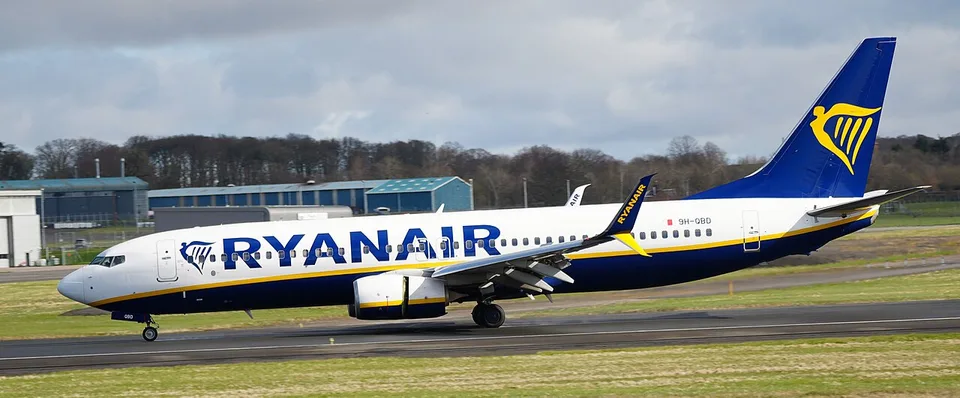
Wikimedia-generated 1280-pixel thumbnail, no editorial crop or content alteration. Responsive WebP copies resized without cropping.
Geographic context
Pisa departure
Prestwick intended arrival
Edinburgh first diversion
Manchester final landing
Approximate schematic markers only. Lines between airports are not a recorded flight track. Basemap: Natural Earth, public domain.Read supporting evidence
A scheduled Pisa-Prestwick flight encountered windshear twice at Prestwick and again after diverting to Edinburgh. Manchester had refused the crew's first diversion request. After the third escape the crew declared a fuel emergency and reached Manchester below final reserve fuel.
Read the full incident Follow what happened, from the flight to the investigation findings.
What investigators concluded
The AAIB found that Manchester's airport and handling-agent policies meant the first diversion request should have been accepted. A communication breakdown led to its refusal. Following the incident Manchester restated that acceptance depended on airport capacity, with the decision belonging to the airport rather than a handling agent.
What happened: three escapes and a shrinking fuel margin
1,955 words / about 9 minutes to read. Based on the investigation records cited below.
A storm planned for, but difficult to escape
By the time 9H-QBD reached Scotland on 3 October 2025, the crew had already prepared for a difficult arrival. Storm Amy was forecast to bring strong winds and rain across Scotland and northern England. The airline had issued a storm pack the previous day and another reminder on the day of the flight. Those messages encouraged conservative fuel planning and additional fuel for disruption. This was a scheduled passenger service from Pisa to Glasgow Prestwick, carrying 171 passengers and six crew.
The pilots had reviewed the briefing separately at home, then compared their planning at Pisa. They preferred Manchester as their alternate because its weather looked more favourable than Glasgow's. The longer runway at Prestwick presented a forecast crosswind problem, so they expected to use Runway 20. That expectation mattered before takeoff: the shorter runway restricted the permissible landing weight, which in turn limited the amount of additional fuel the aircraft could carry.
The original flight plan used Glasgow as the alternate. Changing the pilots' selected alternate did not require the operations centre to issue a revised plan, and the filed alternate therefore remained Glasgow. The AAIB explains that a nominated alternate does not receive a copy of the flight plan and is not guaranteed to accept a diversion. The crew's preferred option was an operational intention that still required coordination.
The plan was not to depart with only the minimum fuel. The commander selected extra discretionary fuel, with a planned total of 11,500 kg. The extra 1,322 kg above the adjustment for Manchester offered roughly an hour and twelve minutes of additional flight time. Recorded fuel before taxi was 11,671 kg. The report presents these as different planning and recorded values, not interchangeable measurements. Departure, delayed from the scheduled time, took place at 15:28 UTC. The flight north was initially uneventful.
The conditions at Prestwick made themselves felt as the Boeing approached Runway 20. The surface wind was reported as 240 degrees at 29 knots, gusting to 45 knots. Both pilots remarked on the turbulence. At about 1,200 ft above aerodrome level they disconnected the autopilot and autothrottle because of the fluctuating airspeed. The commander was flying the aircraft manually.
Nearer the runway, the airspeed began to decrease. The commander increased thrust, but the decrease continued and the windshear warning activated. The flight-history account describes the warning near 264 ft above aerodrome level. The combined recorded-data timeline places it at 18:06:27, 215 ft above ground, about 0.7 nautical miles from the runway threshold. Those height references come from different bases in the report and should not be casually combined.
A windshear escape is more demanding than an ordinary missed approach. As the AAIB describes it, the pilots use maximum thrust and retain the existing flap and landing-gear configuration while controlling pitch for the best climb performance. Once clear of the shear, they can transition into a normal climb configuration. The purpose is to get out of an environment that is reducing the aircraft's performance, rather than continue toward the runway.
The escape worked. The crew returned to a normal go-around and entered the Turnberry hold at 6,000 ft. Recorded fuel at the warning was about 4,608 kg. They reviewed the fuel and waited for another aircraft of the same type to attempt a landing. That aircraft landed, but reported a 25-knot airspeed loss at 500 ft on final approach. The crew now had evidence that a landing was possible, alongside evidence that the approach still contained an important hazard.
The crew's operating policy allowed another approach after a weather-related go-around only when the commander had reason to believe it would succeed. The landing by the other aircraft supplied that reason. At 18:21:58 the crew requested a second approach, making clear that another missed approach would be followed by a diversion to Manchester. They were not intending to keep trying at Prestwick indefinitely.
On the second approach, the conditions felt less turbulent than before. The pilots again disconnected the automatic systems near 1,200 ft above aerodrome level. The reported instantaneous wind was 230 degrees at 34 knots, gusting to 46 knots. Less turbulence did not mean that the danger had passed. At 18:36:25, only 50 ft above ground, another windshear warning occurred. The commander performed a second escape manoeuvre and then a normal go-around.
Recorded fuel was now 3,515 kg. On the climb away, air traffic control told the crew that Manchester could not accept them. They were not given a reason. The aircraft returned toward the hold while the pilots sought weather information for Glasgow and Edinburgh. Glasgow was nearer, but its information broadcast included reports of windshear. Edinburgh reported strong winds and previous go-arounds, but no reported windshear.
The refusal at Manchester was crucial because it removed the crew's preferred alternative at the point they intended to use it. The investigation later found that airport policy and the handling agent's policy should have permitted the diversion. It could not establish the complete decision chain: there was no record of the relevant conversation between Airfield Control and the handling agent. At the time, the pilots could act only on the refusal communicated to them, not on the policy discrepancy investigators would later uncover.
At 18:43:26 the crew requested an immediate diversion to Edinburgh. Approval followed at 18:48:53. In the interval they discussed whether to declare a fuel emergency to get to Manchester, but considered their fuel state did not meet the company manual's criteria at that point. The report records their concern about another windshear warning at Edinburgh. It also notes that they wondered whether the earlier warnings might have been spurious.
The investigation found no warning-system failure. The system manufacturer confirmed that the shear parameter reached the required threshold on each occasion and that the equipment was functioning as designed. The warnings were therefore not something the crew could safely dismiss on the basis that another aircraft had landed or that the second approach felt smoother.
The Boeing climbed to Flight Level 150 en route to Edinburgh. The crew were becoming more concerned about fuel, but the AAIB found no discussion during this transit of a plan for a missed approach there. They did not tell air traffic control their fuel situation, although the report states that there was no requirement to do so. High workload also led them to postpone informing the company until after landing.
Edinburgh's surface wind was reported as 240 degrees at 34 knots, gusting to 46 knots. When the pilots asked whether arriving aircraft had experienced windshear, they were told none had been reported. They began an approach to Runway 24. At 19:09:36, just under five nautical miles from the runway and 745 ft above ground, the third warning sounded. Another escape followed. Recorded fuel was about 2,164 kg. The crew had successfully escaped the immediate weather hazard three times, but each successful escape had used fuel and left the landing problem unresolved.
After the Edinburgh escape, air traffic control initially vectored the aircraft north in anticipation of another approach. The pilots faced two linked questions: where could they land safely, and how much fuel would be left when they reached that runway? Returning for an Edinburgh approach might preserve the final reserve if they landed. Another warning and escape could leave them committed to trying again in the same conditions without a workable alternative.
The crew discussed about 2,100 kg remaining. Their required fuel for Manchester, including final reserve, was about 2,800 kg. Initial estimates suggested an arrival with between 500 and 700 kg. When the approach was entered in the flight-management system, the prediction fell to about 300 kg. All those arrival estimates were below the final reserve of 1,101 kg. The report sometimes rounds that reserve to 1,100 kg.
At 19:12:34 the commander declared Mayday fuel. The crew explained that they feared further windshear at Edinburgh and wanted Manchester immediately. The controller acknowledged the request and redirected them south. This was an emergency declaration, distinct from minimum fuel. The AAIB explains that minimum fuel warns that changes or delays may threaten the planned reserve; it does not itself declare an emergency.
The aircraft subsequently climbed to Flight Level 230. The commander recalled a higher arrival estimate once the route and level were entered, followed by falling predictions during climb and cruise. The report preserves both the crew's recollection and the recorded discussions, rather than treating the displayed estimate as a fixed promise. The central fact remained unchanged: Manchester offered the weather option they preferred, but reaching it would consume the protected reserve.
Manchester, with almost no margin for another attempt
On the journey south the pilots recognised that there would not be enough fuel for another go-around. A low-quantity alert appeared for the left main tank at 19:24:26. The crew acknowledged it but did not run the low-fuel-quantity checklist, the commander explaining later that the reason for the warning was clear. They also noted an imbalance of about 100 kg and carried out the fuel-balancing procedure.
The right main tank's low-quantity alert followed at 19:28:28. Fuel quantity was recorded every 64 seconds, so the recorded amounts should not be used to construct an exact second-by-second account of fuel exhaustion. The aircraft was still powered and controllable; it had not run out of fuel. The risk was the loss of a reasonable margin if the final approach could not be completed.
Manchester cleared the aircraft toward a ten-nautical-mile final for Runway 23R. Touchdown occurred at 19:51:30 with 363 kg total fuel remaining. The rounded flight-history time is 19:52. The aircraft taxied to its stand, with the final recorded quantity before engine shutdown down to 240 kg. Nobody was injured and no aircraft damage was reported.
The flight from the first Prestwick go-around to Manchester landing had taken an hour and forty-five minutes. The AAIB considered it unlikely that sufficient fuel would have remained for another go-around. It also identified an opportunity to review the decision when the first low-quantity alert appeared, since Edinburgh was then closer than Manchester, though behind the aircraft. Newcastle had not been considered during the diversion. These observations describe decisions and margins; they do not prove that a different airport would certainly have produced a safe outcome.
The AAIB's conclusion brought the weather and the diversion process together. Storm Amy caused two windshear escapes at Prestwick. The crew then tried to reach Manchester, an option that should have been accepted under the airport's and handling agent's policies. A communication breakdown led to refusal. Edinburgh supplied another landing opportunity but also another windshear encounter, leaving the crew choosing between uncertain weather nearby and a longer diversion with fuel below final reserve.
Manchester reviewed and restated its procedures. Airfield Control would accept a diversion where parking space was available. Handling agents would be informed, but would not participate in the acceptance decision. The airport also reiterated that operators using Manchester as an alternate needed a handling agent. The distinction is practical: the ability to park a diverting aircraft governs acceptance, while the ground-handling arrangements are coordinated around it.
The report does not treat the safe landing as evidence that the remaining fuel was an acceptable routine margin. Final reserve existed to protect the ability to make a safe landing when the plan could no longer be followed. By the last diversion, that reserve could not be preserved. The crew declared an emergency and selected the option the commander considered safest in the circumstances.
The incident therefore ended without injury, but with an important system lesson. Three effective escape manoeuvres protected the aircraft from immediate windshear danger. They could not by themselves guarantee a safe place to land. Airport coordination, changing weather and fuel decisions had to work together, and the initial diversion refusal helped turn a difficult arrival into a fuel emergency.
A simplified reading of the investigation findings. The sequence does not replace the full report or imply that every contributing factor is shown.
Sequence of events
All chronology times are UTC. Recorded data gives touchdown at 19:51:30; the flight-history section rounds this to 19:52. Height references preserve the report's distinction between aerodrome and ground level. Expand an event to see its evidence.
Did the crew leave Pisa without enough planned fuel?
The crew carried extra discretionary fuel for Storm Amy. Landing-weight limits for the anticipated shorter runway restricted how much extra could be loaded. The later emergency developed during repeated approaches and diversions.
The reason could not be fully reconstructed because relevant internal communications were not recorded. The AAIB concluded that a communication breakdown led to refusal despite airport and handling-agent policies under which the diversion should have been accepted.
No. The aircraft landed with 363 kg total fuel and the last recorded quantity before shutdown was 240 kg. That does not establish a precise remaining flight duration.
Actions and recommendations are described at the dates of the cited records. A recommendation is not proof of implementation.
Diversion policy restated
Manchester restated that diversion acceptance rests with Airfield Control when parking capacity exists. Handling agents are notified but do not decide acceptance.
This account records the actions described when the report was published on 24 September 2026. It does not claim to audit later operational compliance.
Matching dossiers for Diversion coordination: No other dossier in this collection.
Read alongside
These comparisons connect specific research topics. Shared circumstances do not establish identical causes. Evidence from both investigations is provided below.
Both reports examine landing decisions in adverse weather. The 9H-QBD crew abandoned three approaches after windshear warnings and then faced a fuel emergency. The NTSB's AA1420 finding concerned continuing an approach with severe thunderstorms at the airport and failing to ensure spoiler extension after touchdown. The comparison concerns weather decisions, not a shared cause.
Explore the records below for additional context. They open on the publisher's site and are not all included in our report search. Source reuse terms apply.
Authority publication record. Later revisions should be checked here.
Sources and transparency
Checked against the original final report. This account has not had independent expert review.
Source limitations
The operator is not named in the AAIB report. Fuel estimates changed as route and approach details were entered. This account does not convert the final fuel quantity into a precise countdown to engine stoppage.
AAIB final report: 9H-QBD
AAIB Official final report
Official report PDF, hosted by assets.publishing.service.gov.uk
Crown copyright 2026. Original report retained privately for citation verification; report figures and photographs are not licensed here. Source terms / provenance.
Runway Overrun During Landing: American Airlines Flight 1420, McDonnell Douglas MD-82, N215AA, Little Rock, Arkansas, June 1, 1999
National Transportation Safety Board NTSB/AAR-01/02, adopted 23 October 2001
US federal investigation report, attributed to the NTSB. Limited excerpts for commentary; third-party material and illustrations excluded. No NTSB endorsement. Source terms / provenance.
Kevin Murphy writes the incident accounts on AirlineIncidents.com, out of a long interest in aviation safety and the lessons each investigation leaves behind.
Prepared by
AirlineIncidents editorial desk
Report citation check
Independent expert review
Not completed
Citation checks compare supporting text with the indexed report pages. They do not constitute independent expert review. How these pages are prepared.
Revision history
: Original source-based account with checked citations, geographic context, technical sequence, reader questions, report-era follow-up and credited aircraft photograph.
.jpg)