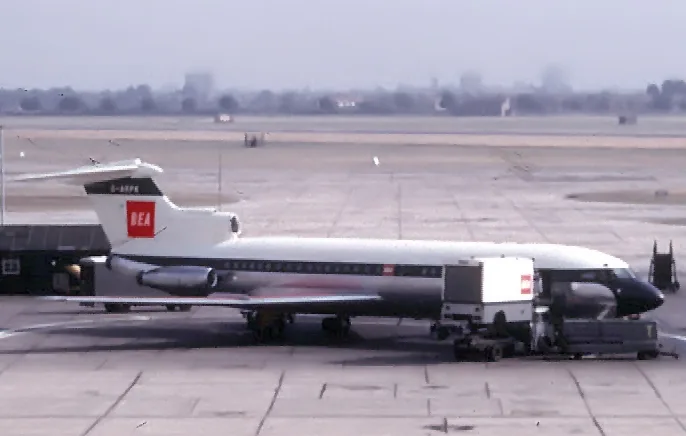
Original downloaded JPEG; no content changes. Responsive WebP copies resized without cropping.
Geographic context
London Heathrow, departure
Accident field near Staines
Brussels, intended destination
Approximate markers locate Heathrow, the field beside the A30 opposite the King George VI Reservoir, and Brussels. The aircraft began a left turn towards the Epsom beacon after takeoff. Basemap: Natural Earth, public domain.Read supporting evidence
The Trident was climbing below its scheduled speed when the leading-edge droops were retracted at 162 knots. Three stick-pusher operations followed. The crew inhibited the stall recovery system, and the aircraft entered a deep stall.
Read the full incident Follow what happened, from the flight to the investigation findings.
What investigators concluded
The public inquiry identified inadequate speed, premature droop retraction, failed monitoring and diagnosis, and inhibition of the stall recovery system as immediate causes. It linked Captain Key's heart condition to impaired concentration and judgment and identified gaps in training and protection against early droop retraction.
BEA 548: the climb and the change of configuration stall
1,557 words / about 8 minutes to read. Based on the investigation records cited below.
A scheduled departure for Brussels
On 18 June 1972, British European Airways Flight BE 548 was preparing to leave London Heathrow for Brussels. The aircraft, Trident I G-ARPI, carried 112 passengers, three flight crew and three cabin crew. Three of the passengers were BEA positioning crew. One of them, Captain Collins, occupied the fourth seat on the flight deck behind the captain.
Captain Key was the handling pilot in the left seat. Second Officer Keighley occupied the right seat, designated P2, and Second Officer Ticehurst sat centrally behind the control pedestal as P3. The crew had been on standby and received the assignment because the originally designated crew had been delayed. All three held valid licences endorsed for the aircraft.
Last-minute load changes delayed pushback until 16:00 GMT. The inquiry found the aircraft slightly above its maximum zero fuel weight and its centre of gravity marginally forward of the airline limit, although within the Flight Manual range. It found these discrepancies had no bearing on the accident. Outside, rain and considerable turbulence accompanied an approaching cold front. The main cloud base was 1,000 feet, with smaller amounts of cloud below. During the critical part of the flight the crew were in cloud and lacked visual reference.
Final takeoff clearance for runway 28R came at 16:08:24. Brake release was estimated at 16:08:30. The aircraft rotated 42 seconds after brake release and left the runway two seconds later at 145 knots indicated airspeed. At 63 seconds the autopilot was engaged, with the aircraft 355 feet above the runway and travelling at 170 knots. Airspeed lock was selected shortly afterwards. At 74 seconds the aircraft began a left turn towards the Epsom beacon.
BEA procedures called for a climb at 177 knots before the noise-abatement segment. At about 90 seconds the flaps were to be raised and engine thrust reduced to the calculated noise-abatement setting. At 3,000 feet the crew were to restore climb power, accelerate, and retract the leading-edge droops at 225 knots. The droops were also to remain extended during a turn.
The accident flight entered noise abatement at 93 seconds. The flaps were selected fully up and power was reduced. Airspeed was then 168 knots, already below the scheduled climb speed. It subsequently fell to 157 knots at 105 seconds before increasing to 162 knots. The inquiry found the autopilot was functioning correctly: its selected datum had been 170 knots, below the required target, and the additional speed loss reflected the thrust reduction and turbulence.
The final radio acknowledgement came at 108 seconds, accepting a climb to Flight Level 60. Ticehurst entered that clearance in his log. Six seconds later, at an altitude of 1,772 feet, the droop lever was selected up while the aircraft remained in the turn.
The droops were raised at a speed about 60 knots below the prescribed retraction speed. Their movement put the aircraft into the stall regime. At 116 seconds the stick-pusher operated, automatically disconnecting the autopilot and pitching the nose down. As the wing incidence decreased, the push stopped. The elevator trim remained in its previous position, leaving the aircraft with a tendency to pitch up in its new configuration.
Incidence rose again. A second stick-push occurred at 124 seconds and a third at 127 seconds. The left bank was removed after the first push, and the inquiry found some small attempt to reduce incidence. At 128 seconds someone on the flight deck pulled the stall recovery override lever. The aircraft then pitched up rapidly, lost speed and height, and entered an aerodynamic stall followed by a deep stall. Recovery from that condition was impossible at the height remaining.
Impact came 150 seconds after brake release, in a field on the Staines side of the A30 Staines By-Pass opposite the King George VI Reservoir. Local people and emergency services reached the wreckage. One occupant arrived at Ashford Hospital alive but deeply unconscious and died soon afterwards. All 118 people aboard suffered fatal injuries. The inquiry found that the rescue services had taken all proper steps to save life.
The Trident used leading-edge devices to permit takeoff and landing at lower speeds. The droop lever operated the droops, their sealing plates and inboard Kruger flaps together. Retracting them reduced the incidence at which the wing would stall. At the low speed of BE 548, moving that lever could bring the wing into the stall regime quickly, even while the aircraft attitude appeared familiar to the crew.
The stall-warning system shook the control columns to prompt a reduction in incidence. If incidence continued to increase, the recovery system used a pneumatic ram to push the columns forward. The shaker could activate from either incidence probe; the pusher required indications from both. The crew could disable the pusher with an override lever on the control pedestal.
Premature droop retraction could produce a shake and push almost together. It also generated a droop-position warning, central warning indications and the warnings associated with autopilot disconnection. The inquiry found that these indications arrived in less than three seconds. Simulator demonstrations showed how attention could become concentrated on airspeed, attitude and the moving control column while the visual warnings went unnoticed.
Recovery remained possible during the sequence. Re-extending the droops, holding the control column forward of its trim position, or allowing the pusher to continue until sufficient speed developed could have restored flight. Increased thrust would have assisted. The crew failed to recognise the changed configuration and failed to fly a recovery.
The evidence from the captain and the monitoring crew
Two flight recorders established the aircraft sequence. The mandatory recorder was supplemented by a quick-access cassette recorder which survived intact despite lacking crash protection. Their data provided speeds, heights, control settings and configuration changes. The aircraft carried no cockpit voice recorder, leaving the inquiry unable to recover the orders and exchanges between the men on the flight deck.
Postmortem examination revealed severe disease in Captain Key's coronary arteries and a fresh tear in the lining of one artery. The inquiry believed he experienced increasing pain and discomfort during takeoff and initial climb, eventually affecting his reasoning. It doubted that the other men noticed this deterioration. Its medical findings linked the condition to his failure to correct the speed and possibly to his retracting the droops, or ordering them retracted, in mistake for the flaps. The identity of the person who operated the lever remained uncertain.
Monitoring duties required Keighley and Ticehurst to detect errors and bring them to the captain's attention. The inquiry concluded that Ticehurst almost certainly missed the speed error and the droop lever movement. The exact distraction was uncertain; it considered Collins's presence beside him a possible influence. Neither co-pilot had been alerted to the dangers of subtle incapacitation. Keighley was properly trained but had little line experience, and the inquiry questioned whether he had enough experience and confidence to intervene as rapidly as the emergency required.
The inquiry found that training had prepared pilots for a progression from stick-shake to stick-push with time to identify the warning. Before the accident there had been no demonstration of premature droop retraction and no exercise demonstrating a stall warning at climbing attitudes. Instruction on pilot incapacity dealt with an obvious collapse. It did not prepare the crew to detect the gradual loss of judgment associated with subtle incapacitation.
Earlier events had exposed the danger. A Trident experienced premature slat retraction after leaving Heathrow in May 1970. Another incident at Orly involved early flap retraction followed by mistaken droop retraction during the noise-abatement sequence. The inquiry examined these events and the handling of their reports. It found missed opportunities to connect the incidents, investigate their operational implications and explain the configuration stall to pilots.
BEA had a cross-index intended to link related incidents, but reports made through its confidential system were excluded from that index. The operational and engineering sides also treated the earlier events differently. After the evidence of these incidents and flight-recorder monitoring became available, the inquiry concluded that BEA should have drawn pilots' attention to the risk and amended training. Reliance on standard drills had proved inadequate when the evidence already showed departures from those drills.
The report identified five immediate causes: failure to maintain adequate speed, premature droop retraction, failure to monitor the speed and lever movement, failure to diagnose the pusher and warnings, and operation of the recovery override. Underlying causes included the captain's heart condition, distraction of the monitoring pilot, the right-seat pilot's limited experience, training gaps and the absence of a speed-dependent restraint on droop retraction after the flaps were raised.
The inquiry recommended a speed-operated baulk to prevent premature droop or slat retraction. It called for instruction on configuration stalls, nearly simultaneous shake and push, and the different design principles of the warning and recovery systems. It also sought more flight-deck experience for young pilots before they served as P2 on passenger flights and attention to subtle incapacitation. It questioned use of the fourth seat by a person without a flight or training function during critical stages.
A further recommendation called for cockpit voice recorders on passenger aircraft above 27,000 kilograms as soon as practicable. The inquiry proposed giving BEA's Air Safety Branch more authority over dangerous incidents and closer cooperation between the regulator's operational and airworthiness branches. It found the existing noise-abatement procedure safe and practicable, while recognising that the thrust reduction had contributed to the speed loss on this flight.
A simplified reading of the investigation findings. The sequence does not replace the full report or imply that every contributing factor is shown.
Sequence of events
All clock times are GMT. Flight events are timed in seconds from brake release, estimated at 16:08:30. Recorder and radio times may differ by up to five seconds. Expand an event to see its evidence.
16:00 GMTPushback requested
Load adjustments delayed the service to Brussels. Taxi clearance followed at 16:03.
The droops increased lift and the wing incidence available before a stall. Selecting them up at 162 knots put the aircraft into the stall regime. The prescribed retraction speed was 225 knots.
Could the captain's heart disease have been detected at his last medical examination?
The inquiry found Captain Key's resting electrocardiogram normal. It concluded that this type of test rarely showed arterial atheroma and found no basis to criticise the doctor who passed him fit. It recommended keeping the reliability of stress testing under review.
Why did the crew inhibit the stall recovery system?
The inquiry found that the crew lacked training in the stall produced by premature droop retraction and in the nearly simultaneous stick-shake and stick-push it could cause. They failed to identify the change in wing configuration and treated the recovery action as a system fault.
The inquiry considered Captain Key or Second Officer Keighley the likely person to have moved the droop lever. Without cockpit speech recordings, it could not settle the identity or the orders exchanged.
The medical evidence established a pre-impact arterial tear. The inquiry inferred increasing discomfort and impaired reasoning during the flight; the precise onset and severity of symptoms were uncertain.
The inquiry found that Ticehurst's attention had wandered. It identified Collins's presence as a possible distraction, while leaving the precise cause uncertain.
Actions and recommendations are described at the dates of the cited records. A recommendation is not proof of implementation.
Preventing early retraction
The inquiry recommended a speed-operated baulk against premature droop or slat retraction and specific training on configuration stalls and the warning systems.
The inquiry called for more operational flight-deck experience before young pilots served as P2 and instruction on subtle incapacitation. BEA had already increased the experience required of a co-pilot paired with a new pilot.
The inquiry proposed greater authority for BEA air safety officers to direct investigations and closer cooperation between the CAA operational and airworthiness branches.
These comparisons connect specific research topics. Shared circumstances do not establish identical causes. Evidence from both investigations is provided below.
Both investigations examined inadequate airspeed monitoring and unsuccessful responses to stall protection. At Staines, premature droop retraction changed the wing configuration and the crew inhibited the pusher. For Colgan Air 3407, the NTSB identified the captain's inappropriate response to the stick shaker as the probable cause of an aerodynamic stall, with airspeed monitoring among the contributing factors.
Explore the records below for additional context. They open on the publisher's site and are not all included in our report search. Source reuse terms apply.
Official publication record for report 4/1973 and its separately issued appendices.
Sources and transparency
The final public inquiry report was signed on 14 April 1973.
Source limitations
The aircraft carried no cockpit voice recorder. The inquiry could not conclusively identify who moved the droop lever or reconstruct the cockpit discussion.
Civil Aircraft Accident Report 4/73: Trident I G-ARPI near Staines
Accidents Investigation Branch, Department of Trade and Industry Final public inquiry report 4/73, signed 14 April 1973; correction to page 12 included
Official report PDF, hosted by assets.publishing.service.gov.uk
Kevin Murphy writes the incident accounts on AirlineIncidents.com, out of a long interest in aviation safety and the lessons each investigation leaves behind.
Prepared by
AirlineIncidents editorial desk
Report citation check
Independent expert review
Not completed
Citation checks compare supporting text with the indexed report pages. They do not constitute independent expert review. How these pages are prepared.
Revision history
: Final public inquiry findings, flight sequence and recommendations.
Quoting this account or linking to it? Please use the page address below, and credit the investigation report it is built from.
Credit line
AirlineIncidents.com. British European Airways Flight 548 accident account. Published 20 October 2026. https://airlineincidents.com/incidents/bea-548-1972/
HTML link
<a href="https://airlineincidents.com/incidents/bea-548-1972/">British European Airways Flight 548 accident account (AirlineIncidents.com)</a>
Select a box to copy it. Spotted something wrong? Send a correction.