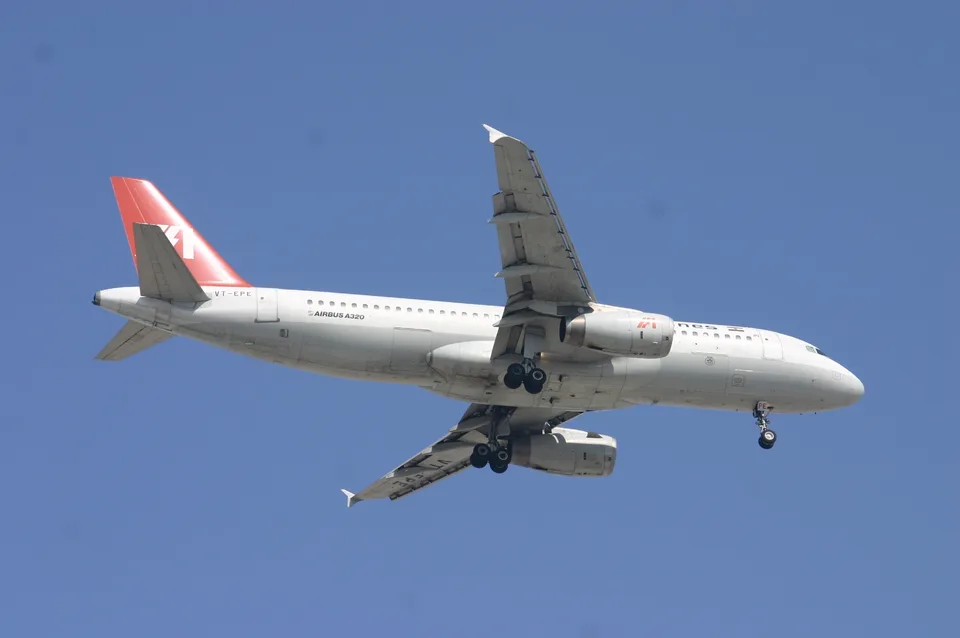
Original photograph retained at full dimensions. Responsive WebP copies resized without cropping.
Geographic context
Accident at Karnataka Golf Club
Bangalore HAL airport
The history of flight places the first ground contact in Karnataka Golf Club about 2,800 feet before runway 09 and 200 feet right of its extended centreline. The golf course marker is approximate; the airport marker uses the reported aerodrome reference point. Basemap: Natural Earth, public domain.Read supporting evidence
On final approach to Bangalore runway 09, Flight 605 entered idle/open descent and slowed below its 132 knot target. The pilots discussed flight guidance modes while airspeed and height fell. Thrust increased too late to prevent ground contact. The aircraft struck an embankment and caught fire.
Read the full incident Follow what happened, from the flight to the investigation findings.
What investigators concluded
The Court attributed the crash to the pilots failing to restore thrust promptly after recognising idle/open descent. The Government accepted the probable cause and emphasised their failure to monitor airspeed during final approach.
The approach to Bangalore and the inquiry findings
1,603 words / about 8 minutes to read. Based on the investigation records cited below.
A command route check to Bangalore
On 14 February 1990, Indian Airlines assigned Airbus A-320-231 VT-EPN to flight IC 605 from Bombay to Bangalore. Earlier that day the aircraft had flown Bombay to Goa and back without incident. It departed Bombay at 11:58 Indian Standard Time, about an hour behind schedule, carrying 139 passengers, including four infants, and seven crew. Captain C.A. Fernandez occupied the left seat and flew the aircraft on his first route check for command endorsement. Captain S.S. Gopujkar, an A320 check pilot, supervised him from the right seat and was commander of the flight.
Both pilots had substantial experience on earlier aircraft types. Gopujkar had 10,340 flying hours and had obtained his A320 command rating in September 1989. Fernandez had 9,307 hours and 68 hours as an A320 co-pilot. VT-EPN itself had arrived in India on 24 December 1989. The flight climbed to flight level 330, reported over Belgaum at 12:23 and contacted Bangalore approach two minutes later. The weather passed to the crew included variable wind at five knots and visibility of ten kilometres. Runway 09 was in use.
The crew requested descent at 12:44 and received clearance to flight level 110. During descent they discussed a VOR/DME approach, including leaving 6,000 feet at eleven miles and 4,500 feet at seven miles, with a minimum descent altitude of 3,280 feet. Speed brakes were used because the aircraft was slightly high. At 12:53 radar identified it 42 nautical miles away and directed a right turn onto heading 140 for vectors to a visual approach. The heading was subsequently changed to 150.
At 12:58 the approach checklist was complete and the approach was activated. A minute later the pilots cross-checked a managed approach speed of 132 knots. They selected flaps and landing gear as they continued towards the cleared altitude of 4,600 feet. At about 13:00, with the runway in sight at seven miles, they disconnected the autopilot and transferred to Bangalore Tower. Tower cleared the aircraft to land at 13:02:17. Landing checks followed, but the go-around altitude had not been set and the flight directors remained on. The inquiry found that the aircraft initially reached a proper approach profile after being slightly high and fast.
The final sequence was reconstructed using cockpit voice and flight recorder evidence. Near DFDR second 292, the flight guidance system entered altitude capture, following an earlier altitude selection near 3,300 feet. At about second 294 Fernandez asked for a descent rate of 700 feet per minute. The requested vertical speed was not established. At second 295 the recorded autothrust speed-select indication changed state. The aircraft subsequently entered idle/open descent, and by second 305 the inquiry considered its presence in that mode certain.
In idle/open descent, thrust stayed at idle as the aircraft lost speed and descended below the approach profile. At second 295 it was about 512 feet above ground. Its airspeed fell from 132 to 106 knots between seconds 297 and 323. The A320 autothrust system used fixed thrust levers: the levers did not move with changes in automatically commanded thrust. Engine thrust indications were available on the cockpit displays. The Government found that the pilots probably diverted their attention to identifying the reason for the mode change while failing to monitor the falling airspeed.
The flight control unit on the glare shield allowed the crew to select guidance modes and parameters such as altitude and vertical speed. These selections could immediately change guidance or aircraft control. The monitoring procedure required the pilot who was not flying to check flight parameters and call airspeed deviations more than ten knots above or five knots below target. By DFDR second 305, speed had fallen to 124.78 knots, approximately seven knots below the selected approach speed.
The crew recognised idle/open descent and discussed switching off the flight directors. The Court found that one pilot probably attempted to turn off the right flight director at about second 313, but it failed to go off and contributed to Gopujkar's confusion. The aircraft continued descending. Radio altitude calls of 400, 300 and 200 feet passed without the pilots responding with the thrust increase needed to arrest the developing situation. The cockpit voice recording contained no calls of speed deviation as the airspeed reached 106 knots.
Fernandez pulled back on the sidestick. High angle of attack protection was entered at second 318, and alpha floor thrust protection triggered at second 323.1. It became active at about second 323.9 or 324.3. The Government clarified that alpha floor activated automatically when its conditions were met. The automatic thrust command and the pilots' eventual thrust lever movement both came too late for sufficient engine power to develop. The Court and Government placed the point beyond recovery at approximately second 321. First contact with the golf course followed at second 329.8.
The history of flight placed the first contact inside Karnataka Golf Club, about 2,800 feet before runway 09 and 200 feet to the right of its extended centreline. The aircraft initially touched on its main wheels and rolled about 80 feet. It became airborne again for roughly 230 feet before contacting the ground near the seventeenth green. On this contact all three landing gears dug into the ground and the right engine grazed a raised area. The aircraft then struck an embankment approximately twelve feet high.
The engines and landing gear struck the embankment directly and separated. The underside of the fuselage and central wing area passed across its top. Momentum carried the damaged aircraft across a drainage channel and a road before it came to rest in ground outside the airport boundary wall. The Court concluded that the engines had operated normally throughout the flight. In its decisions, the Government specified that they had accelerated to high power by the embankment impact. The accident destroyed the aircraft through impact damage and the fire that followed.
An intense fire began in the forward fuselage and spread rearwards. A surviving cabin crew member opened the rear left door, and most surviving passengers escaped through it. Others escaped through overwing exits and openings made by the breakup. A second cabin crew member moved through the cabin directing passengers out. Fire service personnel later opened the rear right door from outside. The Court found that the severe fire greatly increased the loss of life.
The injury table recorded 92 fatalities, comprising 88 passengers and four crew. Two of those passengers died later in hospital. Twenty-two people suffered serious injuries; another 32 were classified as having minor or no injuries, leaving 54 survivors. The inquiry also examined the route taken by airport fire vehicles to reach the wreckage beyond the boundary. It found that they reached the boundary wall promptly but were delayed in opening the gate and reaching the aircraft. The Court recommended better access roads, gate keys carried in fire vehicles and exercises for fires outside the airport perimeter. The Government accepted those recommendations.
The Court's probable cause was the pilots' failure to appreciate the developing danger and move the thrust levers promptly after the radio altitude calls, despite recognising idle/open descent. It could not identify conclusively why that mode had engaged. The flight recorder had captured neither the selected altitude nor the pilots' flight control unit selections. The Government accepted the Court's probable cause and expressed it as a failure to monitor speed during final approach, probably caused by attention being diverted to finding the reason for the unwanted mode.
The Government also identified the most probable trigger: Gopujkar inadvertently selected 700 feet altitude while responding to the request for 700 feet per minute. The altitude and vertical speed knobs were close together. Selecting an altitude below the aircraft could produce idle/open descent. Several opportunities for prevention were identified, including selecting the requested vertical speed, switching both flight directors off, or taking manual thrust control by second 320. The Government added that selecting the required 6,000 foot go-around altitude would also have prevented the mode engagement. It rejected the Court's suggestion that an instrument landing system would probably have prevented the crash, citing the uncertainty over whether the crew would have selected and correctly flown it.
Examination of the aircraft and recorder evidence also found normal operation of its systems. The Government agreed with findings that the electrical, hydraulic, yaw damper, pressurisation and communications systems had not failed. There had been no smoke or fire warning during the flight. The ground proximity warning system sounded its sink rate warning four times from DFDR second 324 onwards. Wreckage examination found the slats extended, flaps fully down and landing gear lowered, consistent with the aircraft having been configured for landing.
The Government received the completed Court report on 3 December 1990 and responded to its findings and recommendations. It reported that changes to route check requirements had already been implemented. For aircraft systems, it recorded an Airbus modification that would return autothrust to speed mode when speed reached the lowest selectable speed. A change requiring an altitude knob pull before leaving speed mode during altitude capture was also being incorporated. The Government accepted a recommendation for pilots to take manual control promptly after unwanted automation behaviour below 1,000 feet and said a circular would be issued. It also accepted the recommendation to record flight control unit selections.
The Court proposed making the vertical speed control operate as a wheel moving up and down to reduce confusion with the altitude knob. The Government referred that recommendation to Airbus. It also accepted referral of a proposal for a single master switch to turn off both flight directors, with individual switches to turn them on. These proposals addressed the controls involved in the approach sequence.
A simplified reading of the investigation findings. The sequence does not replace the full report or imply that every contributing factor is shown.
Sequence of events
Flight times are Indian Standard Time. The final sequence also uses the report's DFDR reference seconds, with first ground contact at 329.8. Expand an event to see its evidence.
11:58 ISTDeparture from Bombay
Flight IC 605 took off for Bangalore. Fernandez was flying his first route check for command endorsement, supervised by check pilot Gopujkar.
Approach control provided vectors for a visual approach. With the runway in sight at seven miles, the crew disconnected the autopilot and changed to the tower frequency.
DFDR 295 secondsDescent below the approach profile
At about 512 feet above ground, the aircraft began descending below the profile and its speed fell below target. The autothrust speed-select recording changed state.
Why did the engines remain at idle during final approach?
The aircraft entered idle/open descent. In that mode, fixed idle thrust allowed airspeed to fall below the approach target. The aircraft remained in that mode as it descended below the approach profile.
Why did alpha floor protection fail to prevent the crash?
Alpha floor automatically commanded increased thrust, but it triggered at DFDR second 323.1 and became active at about 323.9 or 324.3. The Court and Government agreed that this left too little time for sufficient engine power to develop before ground contact.
What did the inquiry recommend for fire service access?
The Court recommended suitable roads to airport exit gates, gate keys in every airport fire service vehicle, and exercises for aircraft fires outside the boundary. The Government accepted these recommendations after the inquiry found a delay at the locked gate.
The flight recorder omitted selected altitude and flight control unit control selections. The Court could not determine the trigger for idle/open descent; the Government considered a mistaken 700 foot altitude selection most probable.
The history of flight gives approximately 2,800 feet from first contact to runway 09. Finding 43 gives approximately 2,300 feet. Both locate the contact in the golf course before the runway.
The inquiry placed alpha floor activation at either DFDR second 323.9 or 324.3. Both timings left too little time for the engines to develop sufficient power before impact.
Actions and recommendations are described at the dates of the cited records. A recommendation is not proof of implementation.
Autothrust modifications
The Government said a change to return autothrust to speed mode at the lowest selectable speed had been introduced. It recorded an altitude selection modification as being incorporated.
The Government reported revised route check requirements and accepted a recommendation for immediate manual control after unwanted automation behaviour below 1,000 feet. It said a circular would be issued.
These comparisons connect specific research topics. Shared circumstances do not establish identical causes. Evidence from both investigations is provided below.
Indian Airlines 605 and Asiana Airlines 214 both involved visual approaches during which airspeed fell and the crews reacted too late. At Bangalore, the aircraft remained in idle/open descent. At San Francisco, the NTSB identified unintended deactivation of automatic airspeed control, inadequate speed monitoring and delayed execution of a go-around among the probable causes.
Explore the records below for additional context. They open on the publisher's site and are not all included in our report search. Source reuse terms apply.
The Court's history of flight, technical analysis, findings and probable cause, together with the Government's responses to findings and recommendations.
Sources and transparency
The Court completed its investigation, and the Government received its report on 3 December 1990. The Government issued decisions on the findings and recommendations.
Source limitations
The Court could not determine why idle/open descent engaged. The Government considered inadvertent selection of 700 feet altitude the most probable explanation. Selected altitude and control selections were absent from the flight recorder data.
Report on the accident to Indian Airlines Airbus A320 VT-EPN at Bangalore on 14 February 1990
Court of Inquiry, Justice K. Shivashankar Bhat; Government of India, Ministry of Civil Aviation Final Court of Inquiry report received 3 December 1990, with Government of India decisions; FAA transcription.
Kevin Murphy writes the incident accounts on AirlineIncidents.com, out of a long interest in aviation safety and the lessons each investigation leaves behind.
Prepared by
AirlineIncidents editorial desk
Report citation check
Independent expert review
Not completed
Citation checks compare supporting text with the indexed report pages. They do not constitute independent expert review. How these pages are prepared.
Revision history
: Court of Inquiry final report and Government of India decisions on the Bangalore accident.
Quoting this account or linking to it? Please use the page address below, and credit the investigation report it is built from.
Credit line
AirlineIncidents.com. Indian Airlines 605 accident account. Published 19 October 2026. https://airlineincidents.com/incidents/indian-airlines-605-1990/