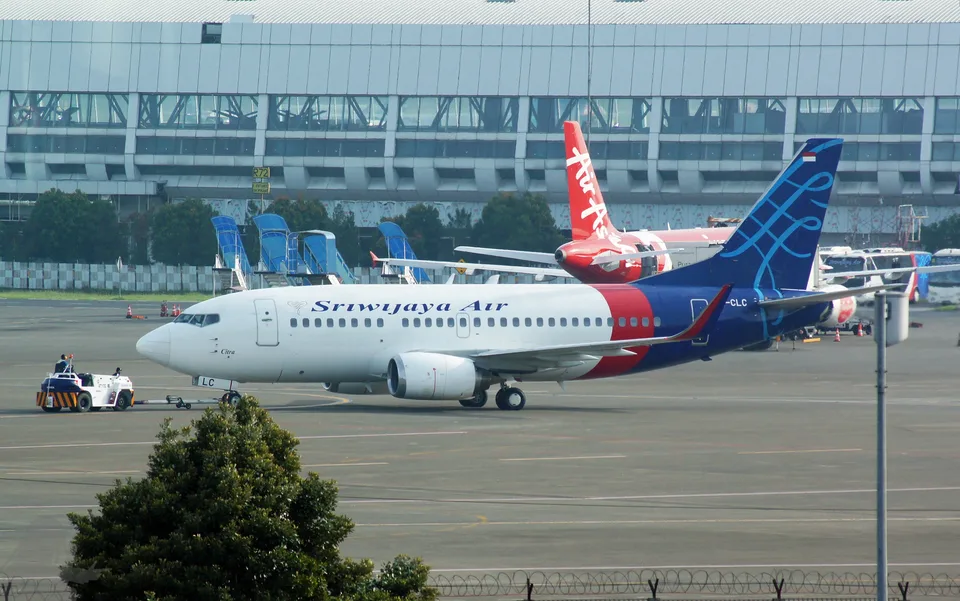
A recurring thrust-control fault produced increasing engine asymmetry during the climb from Jakarta. The Boeing 737 rolled left and descended into the sea, killing all 62 aboard.
Full image used with no additional cropping or colour changes. Responsive WebP copies resized without cropping.
Geographic context
Soekarno-Hatta Airport, Jakarta
Accident vicinity near Kepulauan Seribu
Supadio Airport, Pontianak
The accident marker uses the last flight data recorder coordinates, which KNKT placed near the accident location. The wreckage lay about 80 metres southeast of the last ADS-B position. Airport markers show geographic context. Basemap: Natural Earth, public domain.Read supporting evidence
The right thrust lever stayed at climb power as the autothrottle moved the left lever backward. The growing asymmetry overcame the autopilot correction. The crew missed the developing left turn and applied a recovery input that increased it.
Read the full incident Follow what happened, from the flight to the investigation findings.
What investigators concluded
KNKT identified unresolved mechanical friction or binding, delayed thrust-split protection, inadequate monitoring and deficiencies in upset prevention and recovery training as contributing factors.
1,545 words / about 8 minutes to read. Based on the investigation records cited below.
Departure for Pontianak
Sriwijaya Air flight SJY182 left Jakarta's Soekarno-Hatta International Airport at 14:36 local time on 9 January 2021. The scheduled passenger flight was bound for Supadio International Airport at Pontianak. PK-CLC was a Boeing 737-524, described on the report cover as a 737-500. Two pilots, four flight attendants and 56 passengers were aboard. The captain was flying and the second in command was monitoring. The aircraft departed from Runway 25R in daylight.
The autopilot engaged at 07:36:51 UTC, at about 1,780 feet. Its lateral navigation mode initially followed the programmed departure. At 07:38:00, passing about 5,400 feet, directional control changed to heading select. The vertical mode changed to vertical speed at 07:38:35, while the autothrottle changed to a mode that controlled the speed selected on the mode control panel. These settings required less thrust as the climb developed. The monitoring pilot requested a heading of 075 degrees to avoid weather, and air traffic control approved the request. At 07:39:01, the controller instructed the crew to stop climbing at 11,000 feet to avoid a conflict with another departing aircraft.
At 07:38:40, the left thrust lever began moving backward. Its engine's N1, the rotational speed of the low-pressure spool, fell from about 92 percent. The right lever stayed near its climb position and the right engine remained at about 92 percent N1. As the automation reduced the thrust needed to meet the selected climb rate and speed, the left lever moved farther back to compensate for the right lever's failure to move. The growing difference in engine thrust progressively increased the aircraft's tendency to yaw and roll left.
At 07:39:36, an altitude alert sounded and the monitoring pilot called that the aircraft was approaching 11,000 feet. By then, left-engine N1 had fallen to about 73 percent. Four seconds later the control wheel was deflected about 19 degrees right, while the aircraft was still banked about 15 degrees right. The autopilot was applying controls against the increasing asymmetry. At 07:39:48 the aircraft passed through wings level and began turning left, although heading select remained engaged for the intended right turn. Left-engine N1 had fallen to about 59 percent. The engine indications, separated thrust levers and changing attitude provided cues to the developing problem.
The crew continued handling climb instructions as the bank increased. At 07:39:54 the monitoring pilot called for the standard altimeter setting. The controller then cleared the flight to climb to Flight Level 130, or 13,000 feet. The monitoring pilot acknowledged the clearance. At 07:40:03, as the pilots confirmed the new altitude, the ground proximity warning system sounded a bank-angle warning. The aircraft was at about 10,700 feet and banked about 37 degrees left. Left-engine N1 had fallen to about 35 percent while the right engine remained at its climb setting.
At 07:40:05 the pilot operated the stabilizer trim switch, disconnecting the autopilot. The aircraft reached its highest recorded altitude of about 10,700 feet and started descending with more than 45 degrees of left bank. Disconnecting the autopilot removed its opposing aileron and spoiler inputs. The control wheel then moved left for four seconds, increasing the existing left roll. KNKT found that this input was contrary to recovery. The autothrottle disengaged at 07:40:10, when the aircraft was more than 10 degrees nose down. The flight data recorder stopped at 07:40:28. Subsequent calls from the controller, other aircraft and the emergency frequency received no response.
The aircraft struck the sea near Kepulauan Seribu, about 11 nautical miles northwest of Jakarta. Searchers found the wreckage on 10 January. It lay in water approximately 16 metres deep, spread over an area about 80 by 110 metres. All 62 occupants died. KNKT assessed the accident as unsurvivable. The flight data recorder's last position was near the accident location, while the wreckage lay about 80 metres southeast of the last position transmitted by the aircraft's ADS-B surveillance system.
The flight data recorder memory unit was recovered on 12 January. It contained 370 parameters covering about 27 hours and 18 flights, including the accident flight. The cockpit voice recorder memory unit was recovered on 30 March. Its usable recording included the monitoring pilot's communications, but the captain's voice during flight was captured only when it reached the other pilot's microphone. A tone around 400 Hz obscured the cockpit area microphone channel. KNKT could not determine the reason for that tone. These recording problems restricted analysis of the pilots' coordination. The flight recorder also lacked direct measurements of climb rate and spoiler deflection, which investigators calculated from other data.
Maintenance records showed 65 pilot reports about the autothrottle from 2013 onward, plus 61 reports about differences between engine parameters. Seven earlier thrust-lever asymmetry events appeared in quick access recorder data from 2020 and 2021, with no corresponding pilot reports in the maintenance log. On 15 March 2020 the captain of the accident flight had experienced an asymmetry event that produced a substantial left bank. The crew recovered and continued safely, but the event was not reported to the company or entered in the maintenance log.
Attempts to rectify the recurring problem frequently involved cleaning electrical connectors, which accounted for 48 percent of autothrottle maintenance actions. Engineers often ended troubleshooting after a built-in test returned no faults. The maintenance manual provided additional interactive tests and procedures for investigating engine-control friction, but the maintenance history did not show the relevant mechanical troubleshooting being completed. KNKT concluded that friction or binding in the mechanical thrust-control system, excluding the torque switch mechanism, prevented the autothrottle from moving the right lever.
The problem persisted through recent maintenance. An autothrottle defect was deferred on 20 December 2020 and closed after computer replacement on 30 December. Further reports followed on 3 and 4 January 2021. Cleaning work and satisfactory built-in test results again led to closure, yet flight data from 7 January and the accident flight showed continuing asymmetry. KNKT found that recurring-defect monitoring had failed to bring the unresolved pattern and additional troubleshooting steps effectively to line engineers' attention.
PK-CLC had a Cruise Thrust Split Monitor, a protection added to the autothrottle computer to address excessive thrust differences and uncommanded rolls. It used engine thrust information and flight-control inputs to decide when to disconnect the autothrottle. Its logic required a flight-spoiler position signal of at least 2.5 degrees for at least 1.5 seconds, together with the other activation conditions. Disconnection would stop the autothrottle driving the levers farther apart while leaving manual lever movement available.
Using calculated spoiler positions, investigators found that the conditions for disconnection had been met by about 07:39:40. Actual disconnection occurred about 30 seconds later, after the left roll had developed. Review of the monitor's software found no anomaly, and examination of the previously installed computer found no discrepancy explaining the event. A similar delayed disconnection had occurred during the March 2020 event with a different computer. KNKT considered a right-spoiler position signal that was too low the likely explanation for the delayed activation. It could not determine the cause of the low signal. The calculations assumed normal rigging and neutral aileron trim; investigators could not verify those conditions for the accident aircraft.
KNKT found that the crew had time to identify the thrust asymmetry and flight-path deviation before the upset became severe. The report identified possible automation complacency and confirmation bias: the right-deflected control wheel could have reinforced a belief that the aircraft was following the commanded right turn. The bank warning occurred while the flying pilot was most likely looking toward the mode control panel to change the selected altitude. Investigators considered that inadequate monitoring of the attitude display could have left him with an incorrect understanding of the direction of bank.
The report also identified deficiencies in upset prevention and recovery training. Sriwijaya Air practised upset recovery in recurrent simulator checks, but lacked a detailed training programme and guidance. National requirements had included upset recovery since 2017, while detailed guidance and the prevention element remained incomplete. KNKT linked those gaps to inadequate training implementation. Its contributing factors included the unsuccessful maintenance, the growing thrust asymmetry, delayed protection, reduced monitoring, the inappropriate recovery input and deficiencies in training guidance.
Sriwijaya Air's flight data programme retrieved an average of 28.1 percent of data during 2018 to 2020. Although PK-CLC's quick access recorder had been downloaded, the airline lacked the correct data frame file to analyse it. The March 2020 excessive-bank event therefore escaped detection by that programme. Later asymmetry events fell below its trigger settings. Review of 565 hazard reports from 2020 also found few submissions from pilots or maintenance personnel and none from dispatchers. KNKT found ineffective implementation of the safety management system.
Following the accident, the airline issued maintenance notices, revised defect-management procedures and expanded flight-data event monitoring. Upset prevention and recovery training for all pilots began on 18 November 2021 with a consultant and involvement from the regulator. Garuda Maintenance Facility amended its voice-recorder readout checklist to include waveform quality and audio duration. Boeing revised the maintenance planning document in March 2022 to require repetitive inspections of spoiler and aileron deployment and their position sensors. KNKT issued its final report on 10 November 2022. Its three final recommendations to Sriwijaya Air called for regulator consultation and manufacturer approval before changing flight procedures, increased flight-data retrieval, and stronger hazard reporting by all employees.
A simplified reading of the investigation findings. The sequence does not replace the full report or imply that every contributing factor is shown.
Sequence of events
Flight times are UTC. Local time in Jakarta was UTC plus seven hours. Departure was at 07:36 UTC, or 14:36 local time. Expand an event to see its evidence.
07:36Departure from Jakarta
SJY182 departed Runway 25R for Pontianak with 62 people aboard.
The right thrust lever remained at climb power while left thrust decreased. KNKT identified mechanical friction or binding, delayed protection, reduced monitoring and inadequate upset training in the accident sequence.
The final recommendations to Sriwijaya Air addressed approval of flight procedure changes, greater flight-data retrieval and hazard reporting by all employees.
KNKT considered an undervalued right-spoiler position signal a possible explanation for delayed protection. It could not determine why the signal was too low.
The captain was audible during flight only through the other pilot microphone. A 400 Hz tone obscured the cockpit area microphone, restricting analysis of crew coordination.
Spoiler deflections were calculated from control-wheel data. The calculation assumed normal rigging and neutral aileron trim, which could not be verified for the accident flight.
Actions and recommendations are described at the dates of the cited records. A recommendation is not proof of implementation.
Maintenance and training changes
Sriwijaya Air issued maintenance notices in January and February 2021 and began upset prevention and recovery training for all pilots on 18 November 2021.
Boeing revised the 737-300, 737-400 and 737-500 maintenance planning document on 25 March 2022 to require repetitive inspections of spoiler and aileron deployment and associated sensors.
KNKT recommended consultation with the regulator and manufacturer before procedure changes, greater flight-data retrieval and hazard reporting across the airline.
Matching dossiers for Upset prevention and recovery training: No other dossier in this collection.
Read alongside
These comparisons connect specific research topics. Shared circumstances do not establish identical causes. Evidence from both investigations is provided below.
Both investigations examined unintended autothrottle behaviour and missed monitoring cues. On Turkish Airlines 1951, an erroneous radio-altimeter reading made the autothrottle reduce both engines to approach idle, and the aircraft stalled during approach. On Sriwijaya 182, mechanical friction or binding held the right thrust lever at climb power while the left reduced, producing a growing left roll during climb.
Explore the records below for additional context. They open on the publisher's site and are not all included in our report search. Source reuse terms apply.
The investigation of flight SJY182, including recorder evidence, maintenance history, contributing factors, safety actions and recommendations.
Sources and transparency
KNKT issued final report KNKT.21.01.01.04 on 10 November 2022.
Source limitations
The cockpit area microphone channel was obscured by a 400 Hz tone, limiting analysis of crew coordination. Spoiler deflections were calculated from other recorded parameters.
Aircraft Accident Investigation Report: PT Sriwijaya Air, Boeing 737-500, PK-CLC, 9 January 2021
Komite Nasional Keselamatan Transportasi (KNKT) Final report KNKT.21.01.01.04, issued 10 November 2022
Kevin Murphy writes the incident accounts on AirlineIncidents.com, out of a long interest in aviation safety and the lessons each investigation leaves behind.
Prepared by
AirlineIncidents editorial desk
Report citation check
Independent expert review
Not completed
Citation checks compare supporting text with the indexed report pages. They do not constitute independent expert review. How these pages are prepared.
Revision history
: KNKT final investigation completed on 10 November 2022.