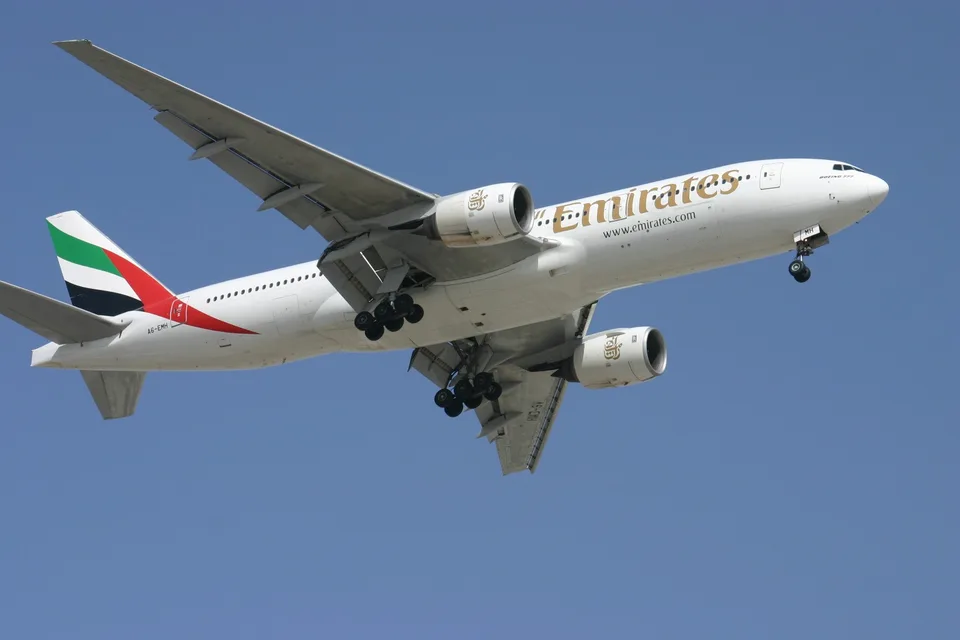
A damaged inner wall separated from the right engine thrust reverser during takeoff from Moscow. GCAA traced the failure to residual heat damage and an ineffective repair.
The crew received a thrust asymmetry warning at about 400 feet after takeoff. Cabin crew reported a bang and sparks. Recorded engine parameters later stabilized, and the commander continued to Dubai, where further pieces separated during landing. The missing component was the left inner wall of the right engine thrust reverser.
Read the full incident Follow what happened, from the flight to the investigation findings.
What investigators concluded
AAIS found that residual thermal damage, incorrectly inspected and repaired after earlier high-temperature exposure, was the primary cause of the inner wall failure.
A thrust reverser inner wall fails during departure
918 words / about 5 minutes to read. The official report for this event is short, so this account is shorter than most and covers only what the report documents.
A warning on departure from Moscow
Emirates passenger flight 132 departed Moscow Domodedovo Airport for Dubai International Airport on 5 March 2011. The aircraft was A6-EMH, described in the flight history as a Boeing 777-200ER. It took off from runway 32L at 2210 local time in darkness. At about 400 feet above the ground, the flight crew received a thrust asymmetry message on the Engine Indication and Crew Alerting System, or EICAS.
The aircraft continued climbing above the minimum sector altitude, and the pilots completed the relevant checklist. Later in the climb, the cabin crew reported a loud bang and sparks from the right side of the aircraft during takeoff. The crew subsequently received further EICAS messages concerning the right engine electronic control normal mode, the turbine overheat sensor, the overheat circuit and the engine fire loop.
The pilots carried out the abnormal checklist required by the operator's procedures. This included selecting the Electronic Engine Control Mode to alternate. The flight recorder showed two short exhaust gas temperature spikes during takeoff, followed by a slightly erratic reading over a four-minute period. About eight minutes after takeoff, all recorded engine parameters stabilized. They remained normal throughout the rest of the flight.
The commander called air traffic control and requested an inspection of the departure runway. The co-pilot later repeated the request in Russian. Air traffic control subsequently told the pilots that no debris had been found. Later inspections by the airport authority did find pieces of the thrust reverser on the runway. The pilots informed Emirates of the EICAS messages. Using the information available to him at the time, the commander decided to continue to Dubai.
On arrival at Dubai, air traffic control reported that small pieces had separated from the aircraft during landing. The flight crew shut down the right engine immediately after leaving the runway and requested another runway inspection. The passengers disembarked normally. The commander learned of the missing thrust reverser part after disembarkation.
The damaged component was the left inner wall of the thrust reverser on the right engine, identified as the No. 2 engine. Its part number was 315W5101-1. Photographs in the summary show the separated aft reverser structure, and a drawing marks the approximate areas of missing material and delamination on the inner wall. The investigation traced the failure to the condition of that composite component and its earlier repair.
The Boeing 777 was powered by two RB 211 Trent 800 engines. Each engine thrust reverser had two fixed inner walls surrounding the aft part of the engine. Movable doors aft of these walls produced reverse thrust by directing fan bypass air forward to help slow the aircraft. The failed inner wall was one of the part numbers supplied on the first sixteen RB 211-powered Boeing 777 aircraft delivered to the operator.
The wall used carbon fiber composite construction, including low-density and high-density core materials. Cytec Metlbond served as the adhesive. A thermal or fire blanket protected the composite from engine heat. Heat passing through the blanket would significantly reduce that protection. Efforts to protect the structure therefore concentrated on limiting the penetration of heated air through the blanket.
The failed inner wall was sent to Boeing for forensic laboratory examination. The work took place under NTSB supervision at the request of the UAE Air Accident Investigation Sector. The examination found that an earlier repair had suffered adhesion failure between its adhesive film and the previously repaired core.
The repair had left residual thermal damage in the panel. Investigators found that the core had been inadequately cleaned before the work and that the repair had not been expanded far enough to remove the heat damage. AAIS determined that the inner wall failed primarily because damage from previous exposure to high temperatures had been incorrectly inspected and repaired.
The forensic examination also identified a possible rigging contribution. The reverser might have been mis-rigged, producing loads above the normal level that could have caused the weakened panel to fail.
Boeing issued flight operations technical bulletins in May and June 2011 about inner wall failures on Rolls-Royce-powered Boeing 777 aircraft. The bulletins associated these failures with thermal degradation of the composite structure following prolonged exposure to elevated temperatures. They described failure typically occurring at or shortly after takeoff rotation.
Boeing also issued service bulletins intended to reduce recurrence. The summary identified excessive heat downstream of the engine eighth-stage bleed valve as a potential starting point for thermal damage to the composite reverser. Safety work concentrated on redesigning that installation. FAA Airworthiness Directive Invalid Date became effective on 3 October 2012 and required replacement of eighth-stage engine bleed valve parts.
Emirates incorporated service bulletins 777-78-0082 and 777-78-0071, which introduced a new thermal protection blanket and inner wall cooling. Service Bulletin 75-G466 modified the engine bleed valve to address the thermal threat during normal operation. Service Bulletin 75-G765 addressed the threat under intermediate-pressure engine bleed valve failure conditions. The listed actions also included compliance with FAA AD Invalid Date.
The operator proactively installed new inner walls on its RB211 Trent 800 engines with the modifications incorporated. The program began in August 2011 and finished in December 2012. Its stated purpose was to remove the risk associated with latent inner wall degradation.
AAIS investigated as the authority of the State of the Operator and Registry after requesting delegation from Russia. The NTSB assigned an accredited representative. The occurrence was initially classified as a serious incident and subsequently reclassified as an incident as more information became available. GCAA issued the completed investigation's Summary Report on 26 November 2015.
A simplified reading of the investigation findings. The sequence does not replace the full report or imply that every contributing factor is shown.
Sequence of events
Takeoff was at 2210 local time in Russia. Later intervals are measured from takeoff; the summary gives no landing time. Expand an event to see its evidence.
5 March 2011, 2210 localDeparture from runway 32L
Flight 132 took off from Moscow Domodedovo for Dubai in darkness.
Cabin crew reported a bang and sparks during takeoff. Further EICAS messages concerned the right engine control and overheat and fire detection systems.
Both pilots requested an inspection. ATC reported no debris; later airport inspections found reverser pieces on the runway. The commander decided to continue using the information available to him.
Dubai ATC reported small pieces separating during landing. The pilots shut down the right engine after vacating the runway and requested an inspection.
The recorder showed two brief exhaust gas temperature spikes on takeoff, then slightly erratic readings for four minutes. All recorded engine parameters stabilized about eight minutes after takeoff and stayed normal for the rest of the flight.
The investigation found inadequate cleaning of the core before repair and a repair area too small to remove all of the thermal damage. The laboratory found adhesion failure between the adhesive film and the previously repaired core.
The operator incorporated thermal protection modifications with a new blanket and inner wall cooling, along with engine bleed valve changes. It also installed new inner walls in a program completed in December 2012.
GCAA published a six-page Final summary report, issued on 26 November 2015. It omits occupant totals, a fatalities and injuries table, detailed recorder plots, the full laboratory examination and a cockpit voice recorder transcript. Its stated scope excludes in-depth analysis of non-contributing factors.
Actions and recommendations are described at the dates of the cited records. A recommendation is not proof of implementation.
Thermal protection and bleed valve modifications
The operator incorporated service bulletins 777-78-0082, 777-78-0071, 75-G466 and 75-G765, covering the blanket, cooling and engine bleed valves. The summary also lists compliance with FAA AD Invalid Date.
The operator installed new inner walls incorporating the modifications on its RB211 Trent 800 engines. The program ran from August 2011 to December 2012.
Heat penetrating the protective blanket reduced protection of the composite inner wall. Safety actions introduced a new blanket, cooling and bleed valve changes.
Matching dossiers for Thermal protection: No other dossier in this collection.
Read alongside
These comparisons connect specific research topics. Shared circumstances do not establish identical causes. Evidence from both investigations is provided below.
Both investigations identified deficiencies in work on components that later separated in flight. A6-EMH had residual thermal damage after an ineffective repair. For Alaska Airlines 1282, NTSB found that Boeing had failed to provide the training, guidance and oversight needed for a parts removal process intended to ensure that bolts and hardware removed for manufacturing rework were reinstalled. The Emirates failure involved a composite reverser inner wall; the Alaska accident involved a fuselage door plug.
Explore the records below for additional context. They open on the publisher's site and are not all included in our report search. Source reuse terms apply.
Kevin Murphy writes the incident accounts on AirlineIncidents.com, out of a long interest in aviation safety and the lessons each investigation leaves behind.
Prepared by
AirlineIncidents editorial desk
Report citation check
Independent expert review
Not completed
Citation checks compare supporting text with the indexed report pages. They do not constitute independent expert review. How these pages are prepared.
Revision history
: GCAA identified residual thermal damage and an ineffective earlier repair as the primary cause of the inner wall failure.