LEVEL 3 Final report

Based on the investigation authority's final report.

Date
Show source
Occurrence
Fatal accident
Location
Pacific Ocean off Lima, 48 nautical miles from Lima VOR on radial 288
Show source
Operator
Aeroperu
Show source
Aircraft
Boeing 757-200
Show source
Registration
N52AW
Show source
Route
Lima, Peru, to Santiago, Chile
Show source
People aboard
70: 61 passengers and 9 crew
Show source
Fatalities
70
Show source
Survivors
0
Show source
Topics
Crew coordination, Static ports left covered, Terrain warning response, Unreliable instrument training

This photograph is cropped for the banner. See the full photograph, credit, licence and what it shows.

Photographs and geographic context

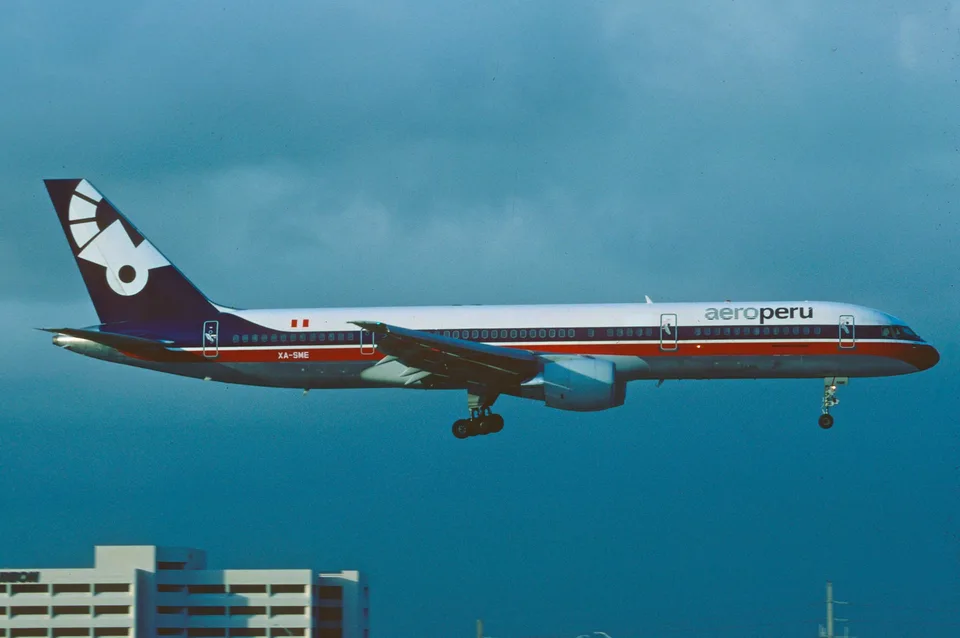
Aeroperu Boeing 757 carrying registration XA-SME with landing gear extended

Aeroperu Boeing 757 photographed in January 1995.

Photo: Aero Icarus, CC BY-SA 2.0

Image info

The aircraft carries registration XA-SME in this January 1995 photograph. It later carried registration N52AW.

Image source

Resized from the original photograph with no cropping or retouching. Responsive WebP copies resized without cropping.

Geographic context

Geographical orientation for Aeroperu Flight 603Jorge Chavez International Airport, Lima; Accident site, section 20 coordinates. The flight departed Lima for Santiago and attempted to return to Jorge Chavez. The accident marker follows the coordinates in section 20; the airport marker is approximate.12NORTH UP / SCHEMATIC / NOT A RECORDED FLIGHT TRACK
  1. Jorge Chavez International Airport, Lima
  2. Accident site, section 20 coordinates
The flight departed Lima for Santiago and attempted to return to Jorge Chavez. The accident marker follows the coordinates in section 20; the airport marker is approximate. Basemap: Natural Earth, public domain.
Read supporting evidence

What happened

Aeroperu Flight 603 departed Lima for Santiago with 70 people aboard. The crew encountered unreliable altitude and airspeed indications, sought radar assistance and received repeated terrain warnings. The aircraft struck the sea while attempting to return. Investigators recovered static ports still covered with masking tape.

Read the full incident Follow what happened, from the flight to the investigation findings.

What investigators concluded

The final report identified tape left over the static ports and missed release and exterior inspections as the principal probable cause. The captain's response to terrain warnings and use of radio altitude, and the first officer's insufficiently assertive warnings, were contributing causes.

Evidence behind this explanation
Accidente de la aeronave Boeing 757-200, Aeroperu, N52AWIII.3.a, Principal probable cause | Printed page 44 | PDF page 49Find this passage in evidence search

From the Lima departure to the impacts at sea

1,570 words / about 8 minutes to read. Based on the investigation records cited below.

Servicing before the departure

Before Aeroperu Flight 603 left Lima, maintenance personnel had worked on its Boeing 757-200, registered N52AW. The work included replacing two blades in the right engine after bird damage and changing a hydraulic pump. Polishing of the lower forward fuselage was also scheduled. During polishing, the static ports were covered with adhesive tape to protect them from polishing material and other foreign matter.

The tape remained over the ports when the aircraft returned to service. The commission traced the release process through maintenance, quality control, the shift supervisor, the line supervisor and the assigned pilot. It found that the successive checks had failed to reveal the obstruction. According to the mechanic responsible for the aircraft that day, Captain Eric Schreiber conducted the flight crew's exterior inspection.

The scheduled passenger flight was bound for Santiago, Chile. There were 61 passengers, two pilots and seven cabin crew aboard. The first officer was David Fernandez Revoredo. The aircraft departed Jorge Chavez International Airport on 2 October 1996. The obstruction remained undetected as the crew began the takeoff and the aircraft left the runway.

Sources for this section
Accidente de la aeronave Boeing 757-200, Aeroperu, N52AWIII.3.a, Principal probable cause | Printed page 44 | PDF page 49Find this passage in evidence search

An emergency after takeoff

Flight 603 took off at 05:42 UTC. The first officer was flying and also handling radio communications. The report describes the first abnormal indications at approximately 200 to 300 feet, as the aircraft reached its initial climb speed. The pilots said that the altimeters had stopped responding, and windshear warnings sounded. The tower controller observed the aircraft level briefly before it continued climbing and entered cloud.

The crew declared an emergency and asked for help returning to Lima. In its flight-sequence summary, the report places the emergency declaration at about 05:45 UTC and the request for radar vectors at 05:46. The tower transferred the flight to the controller providing radar assistance. The airport had an instrument landing system for the return to runway 15, and the controller began providing headings for that approach.

The instrument problem extended across the cockpit. Altitude, indicated airspeed and vertical speed became unreliable. Rudder ratio and Mach speed trim messages added to the warnings. The pilots repeatedly discussed these messages and consulted the associated checklist. The commission found that the accumulating indications and alarms drew attention away from controlling the flight path and prevented the crew from identifying the underlying problem.

Sources for this section
Accidente de la aeronave Boeing 757-200, Aeroperu, N52AWI.13, Flight plan and sequence | Printed page 13 | PDF page 17Find this passage in evidence search
Accidente de la aeronave Boeing 757-200, Aeroperu, N52AWI.17, Meteorology and observed departure | Printed page 19 | PDF page 23Find this passage in evidence search
Accidente de la aeronave Boeing 757-200, Aeroperu, N52AWI.13, Flight plan and sequence | Printed page 13 | PDF page 17Find this passage in evidence search
Accidente de la aeronave Boeing 757-200, Aeroperu, N52AWI.13, Flight plan and sequence | Printed page 14 | PDF page 18Find this passage in evidence search

Radar assistance and a return toward Lima

After leaving Lima, the aircraft continued over the sea while the crew sought headings, altitude information and speed information from the ground. The controller offered successive headings to bring it toward the localizer. By 05:55 UTC the crew was explicitly asking for assistance with both altitude and speed. The report records continuing difficulty interpreting the instruments as the attempted return developed.

At about 05:57 UTC the crew reported that the engines had been reduced and that the aircraft still appeared to be accelerating. At 06:00 they requested another aircraft to help. Three minutes later the controller advised that an aircraft could be ready to depart in fifteen minutes. Meanwhile, the ground proximity warning system was sounding, and the pilots asked whether they were flying over the sea.

The disagreement between indications continued. At 06:05 the crew reported a speed of 370 knots, while the controller gave a groundspeed of 220 knots. Later, the crew reported an altitude of 9,700 feet and received confirmation from the controller. The commission found that the matching altitude information led the pilots to place greater confidence in the erroneous altimeter indication. Its analysis also identified incorrect information reaching the controller from the aircraft instruments.

At 06:08 the crew said they would try to intercept the instrument landing system and asked for speed information. At 06:10, when the controller again reported 9,700 feet and asked about visual reference, the response described the terrain warning. The aircraft was still over the Pacific as the crew attempted to reconcile those indications.

Sources for this section
Accidente de la aeronave Boeing 757-200, Aeroperu, N52AWI.13, Flight plan and sequence | Printed page 13 | PDF page 17Find this passage in evidence search
Accidente de la aeronave Boeing 757-200, Aeroperu, N52AWI.13, Flight plan and sequence | Printed page 14 | PDF page 18Find this passage in evidence search
Accidente de la aeronave Boeing 757-200, Aeroperu, N52AWI.13, Flight plan and sequence | Printed page 15 | PDF page 19Find this passage in evidence search

Warnings and the loss of height

The recorder analysis describes overspeed warnings continuing through the closing part of the flight, together with repeated stall warnings. The first officer recognised the stick shaker as an indication of a stall, while the captain described the stall indication as false. The commission found that the pilots had become confused by the combination of erroneous indications and valid warnings. Their attention narrowed, and coordination between them deteriorated.

The ground proximity warning system repeatedly called attention to the aircraft's height. In one sequence, the report records the terrain warning sounding 22 times over 45 seconds. The crew made only a gentle climb. The commission's analysis describes the aircraft subsequently reaching about 4,000 feet above the sea, remaining there briefly and then entering a continuous descent toward the water.

Independent information was available in the cockpit. The inertial reference systems supplied groundspeed information, and the radio altimeters provided height above the surface at low altitude. The report states that radio altitude appeared on the pilots' instruments below 2,500 feet. The crew failed to use it to establish their actual clearance above the sea. The commission also found that they failed to carry out the required immediate response to the terrain warnings.

Sources for this section

The impacts with the Pacific

The recorder sequence places the first contact with the sea at approximately 01:11:20 local time, equivalent to 06:11:20 UTC. The aircraft struck the water with a slight bank to the left. It rose again after that contact and remained airborne for roughly seventeen seconds. The first officer recognised that they were hitting the water and urged a climb.

The aircraft then rolled steeply left. The report places the final impact at 01:11:38 local time, or 06:11:38 UTC, with a left bank of about 70 degrees. The Boeing broke apart in the sea. All 70 occupants died. The accident site was offshore from Lima, on the 288 radial from the Lima VOR, at a reported distance of 48 nautical miles. Radio communication and the radar return ended with the crash.

Sources for this section
Accidente de la aeronave Boeing 757-200, Aeroperu, N52AWI.13, Flight plan and sequence | Printed page 15 | PDF page 19Find this passage in evidence search

The evidence recovered from the wreckage

The flight data recorder and cockpit voice recorder were recovered from the seabed with assistance from the United States Navy, the National Transportation Safety Board and a remotely operated recovery vehicle. They were taken to Washington for preparation and readout. Their containers were badly damaged by the impact, but the report describes the recording tapes as being in very good condition. Investigators correlated the recordings to reconstruct the flight and the cockpit exchanges.

A recovered section of the left fuselage provided direct evidence of the obstruction. Three static ports remained covered with masking tape. The commission identified this as the principal physical evidence supporting the probable cause. It connected the tape with the protection applied during the polishing work and the failures to detect it before the aircraft was released and accepted for flight.

Investigators also examined a sister aircraft with representatives of the manufacturer, aviation authorities and Aeroperu. They tested navigation equipment, warning functions, the ground proximity warning system and the radio altimeter. The systems tested operated satisfactorily. The investigation's analysis identified the groundspeed and radio altitude information that the accident crew could have used while the air data indications were unreliable. Fuel quantity and centre of gravity were within the report's operating requirements.

Sources for this section
Accidente de la aeronave Boeing 757-200, Aeroperu, N52AWIII.3.a, Principal probable cause | Printed page 44 | PDF page 49Find this passage in evidence search
Accidente de la aeronave Boeing 757-200, Aeroperu, N52AWII.18, Tests and investigations | Printed page 38 | PDF page 43Find this passage in evidence search
Accidente de la aeronave Boeing 757-200, Aeroperu, N52AWII.18, Tests and investigations | Printed page 39 | PDF page 44Find this passage in evidence search

The commission's probable cause findings

The Peruvian commission's final report identified the principal probable cause as the failure to remove the protective tape from the static ports, followed by failures to detect it during release checks and the crew's exterior inspection. Its findings included a possible failure of quality control to supervise the completed work. The report also described a change of supervisor because of illness and an inadequate visual inspection by the line mechanic.

The contributing causes concerned the response in flight. The commission found that the captain failed to follow the procedure for ground proximity warnings and failed to check the radio altimeter. It found that the first officer had been insufficiently insistent and assertive in bringing the terrain warnings to the captain's attention. The report classified the accident as controlled flight into terrain, including water, and described inadequate crew coordination and the effects of the conflicting indications.

The investigation also identified shortcomings in preparation for this particular emergency. The crew lacked specific training for the complex combination of unreliable speed and altitude indications. The commission called for performance information to be available in the quick reference handbook and for training that used that information. It found the weather at Jorge Chavez acceptable and above the applicable minima.

Sources for this section
Accidente de la aeronave Boeing 757-200, Aeroperu, N52AWIII.3.a, Principal probable cause | Printed page 44 | PDF page 49Find this passage in evidence search
Accidente de la aeronave Boeing 757-200, Aeroperu, N52AWIII.2, Earlier safety information | Printed page 43 | PDF page 48Find this passage in evidence search

Recommendations for maintenance, training and warnings

The commission recommended conspicuous protective covers for static ports during maintenance and polishing. It called for better quality control, a more fully documented inspection before flight and explicit attention to the static ports. It also recommended procedures governing flights after polishing, painting and similar work, together with strict documentation of the aircraft's release through to acceptance by the assigned crew.

For flight crews, the report recommended simulator practice with erroneous airspeed indications, procedures for unreliable or absent altitude information, greater use of radio altitude and practice responding to terrain warnings. It asked Boeing to give more attention to flying by attitude and power, to provide a complete procedure for instrument failures in the quick reference handbook and to improve warning design. Recommendations included avoiding conflicting overspeed and stick shaker alerts and providing a caution when speed and altitude were unreliable.

The recommendations extended to air traffic services and rescue coordination. The commission sought controller training in human factors, situational awareness and teamwork. It also found serious delays and poor coordination in the search and rescue response, including aircraft being unavailable for immediate dispatch. It recommended reorganising the rescue system around international search and rescue standards and preparing a manual suited to Peru's geography.

Sources for this section
Accidente de la aeronave Boeing 757-200, Aeroperu, N52AWIV.1, Recommendations to the operator | Printed page 46 | PDF page 51Find this passage in evidence search
Accidente de la aeronave Boeing 757-200, Aeroperu, N52AWIV.2, Recommendations to maintenance | Printed page 47 | PDF page 52Find this passage in evidence search
Accidente de la aeronave Boeing 757-200, Aeroperu, N52AWIV.1, Recommendations to the operator | Printed page 46 | PDF page 51Find this passage in evidence search
Accidente de la aeronave Boeing 757-200, Aeroperu, N52AWIV.6, Recommendations to Boeing | Printed page 49 | PDF page 54Find this passage in evidence search
Accidente de la aeronave Boeing 757-200, Aeroperu, N52AWIV.3, Recommendations to CORPAC | Printed page 48 | PDF page 53Find this passage in evidence search
Accidente de la aeronave Boeing 757-200, Aeroperu, N52AWIV.7, Search and rescue recommendations | Printed page 50 | PDF page 55Find this passage in evidence search

Return to the short summary / Source status and limitations

How the sequence developed

Follow the main stages, then open the evidence beneath each step.

  1. Tape remains after polishing

    Protective adhesive tape remained over static ports after maintenance and escaped the release and exterior inspections.

    Read supporting evidence
    Accidente de la aeronave Boeing 757-200, Aeroperu, N52AWIII.3.a, Principal probable cause | Printed page 44 | PDF page 49Find this passage in evidence search
  2. Flight indications become unreliable

    Altitude, airspeed and vertical speed indications became unreliable after takeoff, accompanied by multiple warnings and messages.

    Read supporting evidence
    Accidente de la aeronave Boeing 757-200, Aeroperu, N52AWI.13, Flight plan and sequence | Printed page 14 | PDF page 18Find this passage in evidence search
  3. Conflicting information draws attention

    The pilots worked through warnings and sought height and speed information from the ground. Matching altitude information reinforced confidence in the erroneous altimeter.

    Read supporting evidence
  4. Terrain warnings receive an inadequate response

    The crew failed to use radio altitude and carry out the required response to the ground proximity warnings.

    Read supporting evidence
  5. The aircraft reaches the sea

    The Boeing struck the water, rose briefly, then hit the sea again in a steep left bank.

    Read supporting evidence

A simplified reading of the investigation findings. The sequence does not replace the full report or imply that every contributing factor is shown.

Sequence of events

Flight-sequence times are UTC. Local time in Lima was UTC minus five hours. The recorder analysis places the final impact at 06:11:38 UTC, or 01:11:38 local time. Expand an event to see its evidence.

  1. Before departureStatic ports remain covered

    Tape applied during polishing remained over the static ports through the aircraft release and exterior inspections.

    Accidente de la aeronave Boeing 757-200, Aeroperu, N52AWIII.3.a, Principal probable cause | Printed page 44 | PDF page 49Find this passage in evidence search
  2. 05:42 UTCDeparture from Lima

    Flight 603 took off for Santiago. Abnormal indications and windshear warnings developed in the initial climb.

    Accidente de la aeronave Boeing 757-200, Aeroperu, N52AWI.13, Flight plan and sequence | Printed page 13 | PDF page 17Find this passage in evidence search
  3. About 05:45 UTCEmergency declared

    The crew declared an emergency and subsequently requested radar vectors for a return.

    Accidente de la aeronave Boeing 757-200, Aeroperu, N52AWI.13, Flight plan and sequence | Printed page 13 | PDF page 17Find this passage in evidence search
    Accidente de la aeronave Boeing 757-200, Aeroperu, N52AWI.13, Flight plan and sequence | Printed page 13 | PDF page 17Find this passage in evidence search
  4. 05:55 UTCHeight and speed assistance requested

    The crew asked the controller to assist with altitude and speed while guiding the flight toward the localizer.

    Accidente de la aeronave Boeing 757-200, Aeroperu, N52AWI.13, Flight plan and sequence | Printed page 14 | PDF page 18Find this passage in evidence search
  5. 06:03 UTCTerrain warnings reported

    The crew reported terrain warnings. The controller advised that another aircraft could be ready to leave in fifteen minutes.

    Accidente de la aeronave Boeing 757-200, Aeroperu, N52AWI.13, Flight plan and sequence | Printed page 14 | PDF page 18Find this passage in evidence search
  6. 06:05 UTCSpeed indications disagree

    The crew reported 370 knots while the controller gave a groundspeed of 220 knots.

    Accidente de la aeronave Boeing 757-200, Aeroperu, N52AWI.13, Flight plan and sequence | Printed page 14 | PDF page 18Find this passage in evidence search
    Accidente de la aeronave Boeing 757-200, Aeroperu, N52AWI.13, Flight plan and sequence | Printed page 14 | PDF page 18Find this passage in evidence search
  7. 06:10 UTCErroneous altitude is repeated

    The controller reported an altitude of 9,700 feet. The crew described the terrain warning.

    Accidente de la aeronave Boeing 757-200, Aeroperu, N52AWI.13, Flight plan and sequence | Printed page 15 | PDF page 19Find this passage in evidence search
    Accidente de la aeronave Boeing 757-200, Aeroperu, N52AWI.13, Flight plan and sequence | Printed page 15 | PDF page 19Find this passage in evidence search
  8. About 06:11:20 UTCFirst water contact

    The aircraft struck the sea, then rose again briefly.

  9. 06:11:38 UTCFinal impact

    The Boeing struck the sea again in a steep left bank. All 70 occupants died.

Search the report evidence

Search extracted report prose, with original page references. Short results link to the full document.

Questions readers ask

What physical evidence identified the blocked static ports?

A recovered section of the left fuselage had three static ports still covered with masking tape. The commission identified this as the principal physical evidence supporting the probable cause.

Why did the altitude information from the ground reinforce the confusion?

The altitude supplied from the ground matched the aircraft altimeter. The commission found that this encouraged the crew to trust the erroneous altitude indication. It also identified incorrect information reaching the controller from the aircraft instruments.

What did the commission recommend for unreliable instrument indications?

It recommended training in flight by attitude and power, a complete instrument failure procedure in the quick reference handbook, a caution for unreliable speed and altitude, and improvements to prevent contradictory warnings.

Accidente de la aeronave Boeing 757-200, Aeroperu, N52AWIV.6, Recommendations to Boeing | Printed page 49 | PDF page 54Find this passage in evidence search

What the evidence can and cannot establish

Impact times differ between sections

The cover gives 06:11:30 UTC. The detailed recorder sequence gives the final impact as 06:11:38 UTC, following an earlier water contact.

Read supporting evidence

Two location summaries

The opening location summary gives coordinates of 11 degrees 44 minutes south and 77 degrees 53 minutes west. Section 20 gives 11 degrees 49 minutes south and 77 degrees 51 minutes west.

Read supporting evidence

Quality control finding

The commission described a possible failure by quality control to supervise completion of the work. It found that the protective tape remained undetected through the aircraft release process.

Read supporting evidence
Accidente de la aeronave Boeing 757-200, Aeroperu, N52AWIII.3.a, Principal probable cause | Printed page 44 | PDF page 49Find this passage in evidence search

Safety follow-up

Actions and recommendations are described at the dates of the cited records. A recommendation is not proof of implementation.

Static port covers and release checks

The commission recommended conspicuous static port covers, improved quality control and a documented inspection before flight that included the static ports.

Read supporting evidence
Accidente de la aeronave Boeing 757-200, Aeroperu, N52AWIV.1, Recommendations to the operator | Printed page 46 | PDF page 51Find this passage in evidence search
Accidente de la aeronave Boeing 757-200, Aeroperu, N52AWIV.2, Recommendations to maintenance | Printed page 47 | PDF page 52Find this passage in evidence search

Training and instrument failure procedures

It recommended simulator practice for unreliable airspeed, procedures for unreliable altitude, greater use of radio altitude and procedures in the quick reference handbook.

Read supporting evidence
Accidente de la aeronave Boeing 757-200, Aeroperu, N52AWIV.1, Recommendations to the operator | Printed page 46 | PDF page 51Find this passage in evidence search
Accidente de la aeronave Boeing 757-200, Aeroperu, N52AWIII.2, Earlier safety information | Printed page 43 | PDF page 48Find this passage in evidence search
Accidente de la aeronave Boeing 757-200, Aeroperu, N52AWIV.6, Recommendations to Boeing | Printed page 49 | PDF page 54Find this passage in evidence search

Cockpit warnings

Boeing was asked to improve flight training by attitude and power, prevent contradictory warnings and provide a caution when altitude and speed were unreliable.

Read supporting evidence
Accidente de la aeronave Boeing 757-200, Aeroperu, N52AWIV.6, Recommendations to Boeing | Printed page 49 | PDF page 54Find this passage in evidence search

Air traffic and rescue coordination

The commission recommended controller training in teamwork and human factors, and reorganisation of the search and rescue system after finding delays and poor coordination.

Read supporting evidence
Accidente de la aeronave Boeing 757-200, Aeroperu, N52AWIV.3, Recommendations to CORPAC | Printed page 48 | PDF page 53Find this passage in evidence search
Accidente de la aeronave Boeing 757-200, Aeroperu, N52AWIV.7, Search and rescue recommendations | Printed page 50 | PDF page 55Find this passage in evidence search

Classifications, with reasons

These labels organise the evidence. They are not a ranking of causes. A shared label means a shared research topic, not an identical mechanism.

Probable causeStatic ports left covered

Protective tape remained over the static ports after polishing. Maintenance release checks and the crew's exterior inspection failed to detect it.

Accidente de la aeronave Boeing 757-200, Aeroperu, N52AWIII.3.a, Principal probable cause | Printed page 44 | PDF page 49Find this passage in evidence search
Contributing causeTerrain warning response

The commission found that the captain failed to carry out the ground proximity warning procedure and failed to check radio altitude.

Contributing causeCrew coordination

The commission found that the first officer was insufficiently insistent and assertive in alerting the captain to the proximity of the sea.

Safety findingUnreliable instrument training

The crew lacked specific preparation for the combination of unreliable altitude and airspeed indications and the resulting warnings.

Accidente de la aeronave Boeing 757-200, Aeroperu, N52AWIV.1, Recommendations to the operator | Printed page 46 | PDF page 51Find this passage in evidence search

Read alongside

These comparisons connect specific research topics. Shared circumstances do not establish identical causes. Evidence from both investigations is provided below.

Air France Flight 447

Both investigations found failures to recognise and manage unreliable flight indications and respond effectively to warnings. Aeroperu 603 began with masking tape left over static ports during maintenance. Air France 447 involved a temporary airspeed inconsistency, likely caused by ice crystals obstructing Pitot probes, followed by loss of flight path control and a sustained stall.

Read supporting evidence
Accidente de la aeronave Boeing 757-200, Aeroperu, N52AWIII.3.a, Principal probable cause | Printed page 44 | PDF page 49Find this passage in evidence search
BEA final reportSynopsis | Printed page 17 | PDF page 19Find this passage in evidence search

Further investigation records

Explore the records below for additional context. They open on the publisher's site and are not all included in our report search. Source reuse terms apply.

Sources and transparency

The Peruvian Comision de Investigacion de Accidentes completed its final report in December 1996.

Source limitations

The report gives several impact times in its different sections. Its detailed recorder sequence places the final impact at 06:11:38 UTC.

Accidente de la aeronave Boeing 757-200, Aeroperu, N52AW

Peru, Comision de Investigacion de Accidentes
Final report (Informe Final), Lima, December 1996, official Spanish edition

Official report PDF, hosted by cdn.www.gob.pe

Open source document

55 PDF pages.

Rights in the official report remain with the issuing authority. Used as investigation evidence.

Read the extraction, classification and review methodology.

Suggest a correction to this dossier

Editorial record

Kevin Murphy writes the incident accounts on AirlineIncidents.com, out of a long interest in aviation safety and the lessons each investigation leaves behind.

Prepared by
AirlineIncidents editorial desk
Report citation check
Independent expert review
Not completed

Citation checks compare supporting text with the indexed report pages. They do not constitute independent expert review. How these pages are prepared.

Revision history

: Final investigation completed; the Peruvian commission dated its final report December 1996.
Source-based corrections are reviewed before changes appear here. Suggest a correction to this dossier.

Cite or link to this page

Quoting this account or linking to it? Please use the page address below, and credit the investigation report it is built from.

Credit line

AirlineIncidents.com. Aeroperu Flight 603 accident account. Published 20 October 2026. https://airlineincidents.com/incidents/aeroperu-603-1996/

HTML link

<a href="https://airlineincidents.com/incidents/aeroperu-603-1996/">Aeroperu Flight 603 accident account (AirlineIncidents.com)</a>

Select a box to copy it. Spotted something wrong? Send a correction.