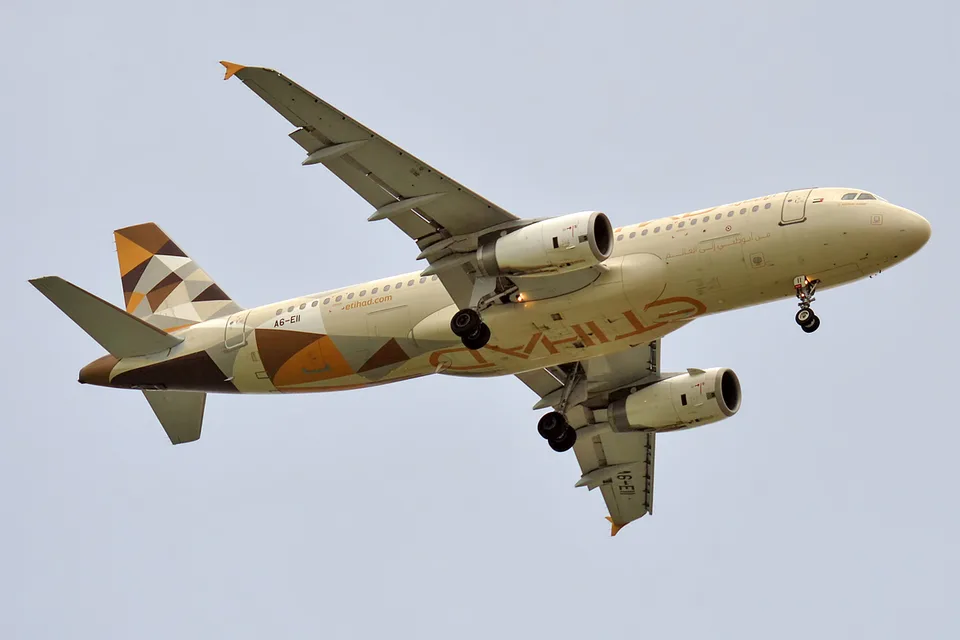
An embolic stroke incapacitated the captain near Abu Dhabi. The co-pilot took control while cabin crew secured the captain, then completed a safe landing.
Original photograph unchanged. Responsive WebP copies resized without cropping.
Geographic context
Approach south of Abu Dhabi airport
Abu Dhabi International Airport
The approach marker is approximate, calculated from the history's 7.1 nautical miles south of the airport and the airport coordinates. The incident brief and analysis give a position 9.5 nautical miles southeast. Basemap: Natural Earth, public domain.Read supporting evidence
During the approach to Abu Dhabi, the captain became unconscious and involuntary rudder inputs caused a sideslip. The co-pilot took control, declared a Mayday and obtained extra time for the approach. Two cabin crew members secured the captain and supplied oxygen. The aircraft landed safely on runway 31L at 20:55:49 UTC and stopped for assistance.
Read the full incident Follow what happened, from the flight to the investigation findings.
What investigators concluded
The AAIS determined that an embolic stroke caused the loss of consciousness. It identified antiphospholipid syndrome, incomplete medical information beyond hypertension, and limitations in the medical assessment requirements as contributing factors. The investigation found that the co-pilot, cabin crew and controller managed the emergency appropriately.
Etihad A6-EII: incapacitation during the approach to Abu Dhabi
1,527 words / about 7 minutes to read. Based on the investigation records cited below.
The captain becomes unresponsive
Etihad Airways flight ETD308 was approaching Abu Dhabi International Airport from Kuwait on 16 November 2012. The Airbus A320-232, registered A6-EII, carried 70 passengers, two pilots and four cabin crew. The captain was flying and the co-pilot was monitoring. Both pilots held the required licences and valid Class 1 medical certificates. Before departure the captain had appeared normal, and he had expressed no concern about his physical condition during the flight before his speech began to change.
At 20:42:14 UTC, the aircraft was maintaining 2,400 feet when the captain spoke in an unusual tone. Between 20:42:52 and 20:43:17, he continued trying to speak, but his words were incoherent. The co-pilot correctly read back an approach instruction at 20:43:32. Over the following seconds he saw the captain slumped to the left, making involuntary movements and gasping for breath. Repeated attempts to rouse him brought no response. At 20:43:50, the co-pilot disconnected the autopilot and took control.
The recorder established the aircraft's condition immediately before the emergency: indicated airspeed was 210 knots, gross weight was 55,266 kilograms, and autopilot 1 was engaged in heading mode. Both flight directors and autothrust were engaged, and the slats and flaps were retracted. The GCAA recovered useful information from both the flight data recorder and the cockpit voice recorder after removing them to its laboratory in Abu Dhabi.
The flight data recorder showed that the captain's sidestick had been touched momentarily at 20:43:37. Four seconds later the left rudder pedal was briefly pressed. The right pedal was then pushed progressively to about 14 degrees over eight seconds and held near that position for another 18 seconds. The aircraft developed a sideslip of approximately 10 degrees. Investigators considered the long rudder input most probably the result of muscle spasms associated with the captain's incapacitation.
The co-pilot initially disengaged autopilot 1 while the aircraft was sideslipping. At 20:43:56 he engaged autopilot 2, then disengaged it seven seconds later while the right rudder input continued. Lateral acceleration reached about 0.26 g. The pedal pressure began decreasing at 20:44:08 and returned to neutral at 20:44:19. During the recovery the co-pilot made continuous manual inputs to restore straight and level flight. He engaged autopilot 1 again at 20:44:23; it disconnected automatically ten seconds later as the bank angle reached about 21 degrees. He re-engaged it at 20:44:47.
At 20:44:04 the co-pilot told the approach controller that the aircraft was maintaining its heading because of pilot incapacitation. He called the cabin manager to the flight deck at 20:44:16 and declared a Mayday at 20:44:28. The controller acknowledged the emergency and asked the airport emergency services to stand by. The cabin manager entered the cockpit at 20:44:40, where the co-pilot explained that a pilot had become incapacitated.
The cabin manager found the captain immobile and unresponsive. She moved him upright, pulled his seat fully aft and removed his hands from the controls. A second cabin crew member came forward to help. Together they restrained his arms, kept his legs away from the controls and checked that his shoulder harness was fitted and locked. The cabin manager fetched an oxygen bottle from business class and fitted a mask over his mouth and nose. Two cabin crew members were needed to restrain him and supply oxygen, as he repeatedly tried to remove the mask. Both remained in the cockpit during landing.
Etihad's operations manual assigned command to the other pilot following a captain's incapacitation. It called for full use of the autopilot to reduce workload, help from cabin crew, notification of air traffic control and a landing as soon as possible. Its instructions also warned against a hasty approach, called for earlier checklist completion and landing configuration, and directed assisting cabin crew to secure the pilot and keep him clear of the controls.
The controller cleared ETD308 for an instrument landing system approach to runway 31L at 20:45:09. The co-pilot replied that he was not ready because the approach might be unstable. The controller offered a holding altitude between 2,000 and 2,500 feet and cleared the aircraft north of the airport. At 20:45:46 the co-pilot reported heading 360 degrees at 2,500 feet and requested a long final. The controller approved the request. The investigation later described the discontinued approach and orbit as giving him time to prepare the cockpit for landing.
At 20:46:55 the controller offered a left turn to intercept the approach at about eight miles. The co-pilot preferred a right turn onto a longer final. He received clearance direct to SENSU and down to 2,000 feet. He then checked that the controller had understood the Mayday and asked for immediate help after landing. The controller confirmed that the emergency services were standing by and that traffic information would continue throughout the approach. Some instructions could not be followed because of the co-pilot's additional workload; investigators found that the controller handled the requests and controlled other traffic safely.
At 20:48:54 the co-pilot reported that the aircraft was about to intercept the final approach. The controller cleared the ILS approach, and the co-pilot confirmed localizer capture. Autopilot 2 was engaged at 20:49:04. Both autopilots were subsequently engaged for the approach and remained in use until the co-pilot disconnected them at 850 feet above ground. At 20:50:33 he asked the cabin crew to find out whether a doctor was on board. An announcement in Arabic and English produced no doctor. He supplied the controller with fuel and occupant information before changing to the tower frequency.
At 20:51:37 the co-pilot contacted Abu Dhabi Tower, declared a Mayday and reported that ETD308 was established on the runway 31L localizer. The tower cleared the aircraft to land and reported a surface wind from 320 degrees at five knots. At 20:53:53 the co-pilot warned that he would have to stop on the active runway and would need emergency assistance. The landing was uneventful at 20:55:49. All 76 occupants survived, the aircraft was undamaged and the report recorded no injuries from the incident.
The co-pilot confirmed that the landing roll was complete and the aircraft had stopped. He contacted ground control, requested assistance and reported the engines shut down at 20:57:26. Etihad policy allowed taxiing only from the left seat, although the aircraft had nosewheel steering tillers on both sides. The co-pilot requested a tow. At 21:01:29 the captain was partly conscious and responsive. The final findings describe his incapacitation as lasting about 18 minutes. Medical personnel reached the cockpit about 30 minutes after landing. The aircraft left the runway under tow at 21:31:45, and the captain disembarked first at the terminal before being taken to hospital.
Hospital examinations included brain imaging, cardiac investigations and blood tests. The medical investigation diagnosed antiphospholipid syndrome and concluded that it had caused an embolic stroke, resulting in loss of consciousness. The captain had previously been diagnosed with hypertension and had declared that condition and its medication in his July 2012 medical renewal application. Investigators found that his other medical history had not been captured before the incident and that the antiphospholipid syndrome became apparent afterwards. They said its symptoms might or might not have been discernible before the event.
The AAIS identified three contributing factors: the syndrome that led to the stroke; the absence of additional medical information beyond hypertension, which meant further preventive treatment had not been prescribed; and medical requirements that had not enabled the specific condition to be discovered. One year after the incident, the report recorded no further episodes of loss of consciousness or seizures and stable monitoring results. Investigators also found that the co-pilot managed the cockpit efficiently, followed the operator's incapacitation procedures and avoided a hurried approach. The cabin crew acted in accordance with their manuals, and the investigation assessed the crew's coordination positively.
The investigation found no aircraft defect or malfunction that contributed to the incident. Weather conditions also had no causal role, and the instrument landing system was functioning. The airport reports around the time of the approach recorded visibility greater than ten kilometres and no cloud. Radio communications with approach, tower and ground control were clear. The aircraft was certified as airworthy when dispatched.
The final report was published on 20 September 2015. It recorded that GCAA medical rules had already been strengthened in February 2015 through additional cardiovascular assessment requirements. These included extended assessment when clinically indicated, annual extended assessment from age 60, and blood lipid assessment at specified certification examinations. The investigation also recommended better collection of medical event data, continuing review of assessment requirements, a warning on licence applications about disclosure of medical history, and an industry culture that encouraged voluntary medical reporting.
Two recommendations went to Etihad. SR 59/2015 called for a risk assessment and review of the prohibition on taxiing from the right seat, particularly in abnormal or emergency situations. The investigation considered that permission to taxi could have enabled the co-pilot to clear the runway promptly. SR 60/2015 called for a safety culture that encouraged licence holders to disclose medical issues voluntarily. The remaining four recommendations, SR 61/2015 to SR 64/2015, were addressed to the GCAA. They extended the investigation's response from the handling of this flight to the collection and assessment of pilot medical information.
Investigators considered the sustained right rudder input most probably a result of muscle spasms during the captain's incapacitation. The co-pilot recovered straight and level flight as the pedal returned to neutral.
He needed time to prepare the cockpit and avoid an unstable approach. He discontinued the initial approach, requested an orbit and a long final, and then landed safely.
Etihad policy prohibited taxiing from the right seat. The co-pilot stopped and requested a tow, although the aircraft had steering tillers on both sides. The AAIS recommended a risk assessment and review of that policy.
The AAIS said symptoms of antiphospholipid syndrome might or might not have been discernible before the incident. The disorder became apparent afterwards.
The history gives 7.1 nautical miles south of the airport at the first unusual speech. The incident brief and analysis give 9.5 nautical miles southeast.
Actions and recommendations are described at the dates of the cited records. A recommendation is not proof of implementation.
Medical outcome recorded after one year
The report recorded no further episodes of loss of consciousness or seizures in the year following the incident, with stable blood clotting monitoring results.
SR 59/2015 sought a risk assessment and review of the right seat taxi prohibition. SR 60/2015 called for a safety culture encouraging voluntary medical disclosure.
SR 61/2015 through SR 64/2015 addressed medical event data, continued assessment review, licence application warnings and a just culture supporting medical disclosure.
Matching dossiers for Taxi policy: No other dossier in this collection.
Read alongside
These comparisons connect specific research topics. Shared circumstances do not establish identical causes. Evidence from both investigations is provided below.
Both investigations describe cabin crew assisting a captain while the co-pilot brought the aircraft to a safe landing. On British Airways 5390, a windscreen failure pulled the captain partly outside the aircraft. On A6-EII, an embolic stroke caused unconsciousness and involuntary control inputs.
Explore the records below for additional context. They open on the publisher's site and are not all included in our report search. Source reuse terms apply.
The official investigation of British Airways 5390, including the co-pilot and cabin crew response to the loss of the captain from flight duties.
Sources and transparency
Final investigation completed. GCAA AAIS published AIFN/0022/2012 on 20 September 2015.
Source limitations
The history places the first unusual speech 7.1 nautical miles south of the airport; the incident brief and analysis give 9.5 nautical miles southeast. The AAIS said symptoms of the syndrome might or might not have been discernible before the incident.
Pilot Incapacitation: Etihad Airways Airbus A320-232 A6-EII
UAE GCAA AAIS Final report AIFN/0022/2012, published 20 September 2015
Kevin Murphy writes the incident accounts on AirlineIncidents.com, out of a long interest in aviation safety and the lessons each investigation leaves behind.
Prepared by
AirlineIncidents editorial desk
Report citation check
Independent expert review
Not completed
Citation checks compare supporting text with the indexed report pages. They do not constitute independent expert review. How these pages are prepared.
Revision history
: Published sourced incident account, timeline, photographs and investigation findings.